








How Does the Food Chain Work in NEET Biology?
The overview of food chain is a vital part of the NEET Biology syllabus, helping students understand how energy flows and nutrients cycle in ecosystems. Food chains illustrate the direct connections between living organisms based on who eats whom, forming the foundation for questions on ecology, environmental biology, and related topics. Recognizing the principles of food chains not only improves conceptual clarity but also equips NEET aspirants to answer application-oriented questions efficiently. Building a strong grasp of this concept supports success in the biology section of the NEET examination.
What is a Food Chain? - Concept Explained
A food chain is a linear sequence showing how organisms are connected through feeding relationships, starting from producers and moving up to different levels of consumers. In simple terms, it traces the path by which energy and nutrients pass from one organism to another within an ecosystem. At the base, plants capture energy from the sun; herbivores (primary consumers) eat the plants, and carnivores or omnivores (secondary and tertiary consumers) feed on these herbivores. Food chains help us understand the structure and function of biological communities, emphasizing the delicate balance of nature.
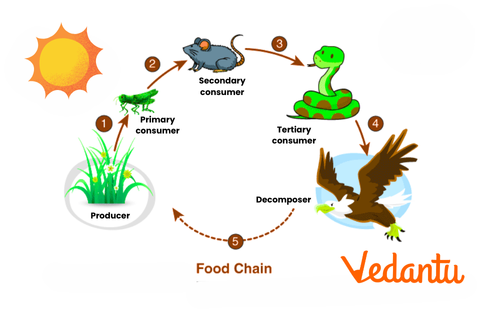
Core Ideas and Fundamentals of Food Chain
Trophic Levels
Every food chain consists of various trophic levels. Each trophic level refers to a specific step in the energy flow, starting from producers up to top-level consumers. The common trophic levels are:
- Producers (First Trophic Level): Mostly green plants or autotrophs that produce their own food via photosynthesis.
- Primary Consumers (Second Trophic Level): Herbivores that feed directly on plants.
- Secondary Consumers (Third Trophic Level): Carnivores or omnivores that eat herbivores.
- Tertiary Consumers (Fourth Trophic Level and higher): Predators feeding on secondary consumers.
Energy Flow in Food Chains
Energy in a food chain flows only in one direction - from the sun to producers, and then through the various consumer levels. At each trophic level, a significant part of the energy (usually about 90%) is lost as heat during metabolic processes, with only about 10% being transferred to the next level. This principle is known as the "10 Percent Law". As a result, food chains rarely exceed 4-5 trophic levels due to energy limitation.
Types of Food Chains
- Grazing Food Chain: Begins with green plants and moves up to herbivores and carnivores.
- Detritus Food Chain: Starts with dead organic matter, decomposers, and detritivores (like earthworms), then passed on to predators.
Important Sub-Concepts Related to Food Chain
Food Webs
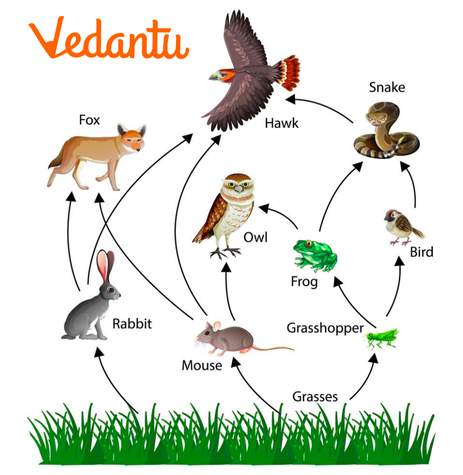
In real ecosystems, food chains are rarely isolated. Several food chains are interconnected to form a food web. A food web provides a more realistic representation of energy flow and feeding relationships in a natural environment, showing how organisms may occupy multiple trophic levels and feed on more than one type of food source.
Ecological Pyramids
Ecological pyramids graphically represent the quantity of organisms, biomass, or energy at each trophic level in a food chain. They help visualize the loss of energy and organisms as we move up the trophic levels.
Role of Decomposers
Decomposers such as bacteria and fungi break down dead organisms at all trophic levels, recycling nutrients back into the ecosystem. Although not often shown in simple food chains, decomposers are fundamental to ecosystem stability.
Key Rules, Principles, and Relationships
The 10 Percent Law
This rule states that only about 10% of the energy is transferred from one trophic level to the next. It explains why food chains are limited in length and why apex predators are far fewer in number compared to primary producers.
Biomagnification
A concept often linked to food chains is biomagnification - the increase in concentration of toxic substances (like DDT, mercury) at each successive trophic level. Understanding food chains helps explain why these substances pose greater dangers to top predators and humans.
Features and Limitations of Food Chain Concept
- Simple and easy to understand representation of energy flow.
- Shows direct feeding relationships clearly.
- Does not accurately depict the complexity of natural ecosystems, where food webs are more common.
- Overlooks the roles of decomposers and omnivores in most cases.
Why is the Food Chain Concept Important for NEET?
The food chain forms a foundational concept in ecology, a frequently tested area in NEET Biology. Questions may directly ask about types of consumers, energy transfer, ecological pyramids, or the difference between food chains and food webs. Understanding this mechanism supports problem-solving in broader topics like environmental biology, pollution, biodiversity, and ecosystem dynamics. Strong command over food chains clarifies several interconnected ideas, such as energy flow, population control, bioaccumulation, and human impact on ecosystems.
How to Study Food Chain Efficiently for NEET
- Start by understanding the definition and structure of food chains with actual ecosystem examples (like grassland, pond).
- Visualize energy flow using diagrams or flowcharts for both grazing and detritus food chains.
- Study the food web images to see how real-life food chains intersect and overlap.
- Revise the 10 Percent Law and relate it to the structure of ecological pyramids.
- Practice NEET-level MCQs on food chain and related concepts like food web, biomagnification, and trophic levels.
- Group-study or quiz with classmates to check conceptual clarity.
- Make use of summary tables and revision cards for fast recall during last-minute preparation.
Common Mistakes Made by Students
- Mixing up primary and secondary consumers in given examples.
- Confusing food chains with food webs or failing to see the interconnectedness.
- Overlooking the role of decomposers.
- Ignoring the application of the 10 Percent Law in energy pyramid questions.
- Not reading questions properly when terms like "biomagnification" or "trophic levels" are used.
Quick Revision Points: Overview Of Food Chain
- A food chain is a straight sequence of who eats whom in an ecosystem.
- Energy flows from producers to top-level consumers with only about 10% passed to each next level.
- Food webs are made of many interconnected food chains.
- Producers (plants), primary consumers (herbivores), secondary/tertiary consumers (carnivores/omnivores) are the main trophic levels.
- Decomposers recycle nutrients - essential for ecosystem health.
- Biomagnification causes harm to organisms higher up in the food chain.
- Food chains are a building block to understanding ecosystem stability and human impact.


FAQs on Overview Of Food Chain in NEET Biology
1. What is a food chain in biology?
A food chain in biology is a sequence that shows how energy and nutrients are transferred from one organism to another in an ecosystem. It is essential for NEET as it explains ecological relationships and energy flow.
Key points:
- Producers (like plants) start the chain by making their own food.
- Primary consumers (herbivores) eat producers.
- Secondary and tertiary consumers (carnivores and omnivores) eat other animals.
- Decomposers (bacteria, fungi) recycle nutrients.
2. What are the main types of food chains?
The main types of food chains are grazing food chain and detritus food chain.
Types include:
- Grazing food chain: Starts with green plants (producers) followed by herbivores and then carnivores.
- Detritus food chain: Begins with dead organic matter which is consumed by decomposers and detritivores.
3. What is the importance of food chain in an ecosystem?
The food chain is important because it demonstrates how energy and nutrients flow within an ecosystem.
Importance:
- Shows nutrient cycling and energy flow
- Maintains ecological balance
- Connects producers, consumers, and decomposers
- Helps in understanding ecosystem dynamics, a key NEET topic
4. What is an example of a simple food chain?
A simple food chain example is: Grass → Grasshopper → Frog → Snake → Hawk.
This chain shows:
- Producer: Grass
- Primary Consumer: Grasshopper (herbivore)
- Secondary Consumer: Frog (carnivore)
- Tertiary Consumer: Snake
- Quaternary Consumer: Hawk (top predator)
5. How is a food chain different from a food web?
A food chain is a straight sequence, while a food web shows interconnections among multiple food chains.
Differences:
- Food chain: Linear, single pathway of energy flow
- Food web: Complex network of interconnected food chains
- Food web better represents real ecosystem interactions (NEET note)
6. What is a trophic level in a food chain?
A trophic level refers to the position an organism occupies in a food chain, such as producer, consumer, or decomposer.
Main trophic levels in NEET syllabus:
- First trophic level: Producers (e.g., plants)
- Second trophic level: Primary consumers (herbivores)
- Third and subsequent levels: Secondary and tertiary consumers (carnivores/omnivores)
7. What are producers and consumers in a food chain?
Producers are organisms (mainly green plants and algae) that make food through photosynthesis, while consumers are organisms that eat other living things for energy.
Details crucial for NEET:
- Producers: Use sunlight to make food
- Primary consumers: Eat producers (herbivores)
- Secondary consumers: Eat primary consumers
- Tertiary consumers: Eat secondary consumers
8. Why are decomposers vital in food chains?
Decomposers are vital because they break down dead organisms, recycling nutrients back into the ecosystem.
Role of decomposers (important for NEET):
- Convert organic matter into simpler substances
- Maintain nutrient cycle and soil fertility
- Examples: Bacteria, fungi
9. What happens if one link in a food chain is removed?
If one link is removed from a food chain, it disrupts the flow of energy and affects all other organisms in the chain.
Possible impacts on NEET-based ecosystems:
- Population imbalance
- Overgrowth or decline of certain species
- Disturbed ecosystem stability
10. What is the flow of energy in a food chain?
Energy flows in a food chain from producers to consumers, decreasing at each trophic level.
How energy moves (NEET focus):
- Sunlight is captured by producers
- Energy moves to primary, secondary, and tertiary consumers
- Only about 10% of energy passes to the next level (10% law)
11. What do you mean by food chain according to the NEET syllabus?
According to the NEET syllabus, a food chain is a linear sequence showing who eats whom in an ecosystem, detailing energy and nutrient transfer.
Key NEET points:
- Explains producer-consumer-decomposer relationships
- Essential for understanding ecological balance
- Often diagram-based questions in NEET exams
12. How does the food chain maintain ecological balance?
The food chain maintains ecological balance by regulating the number of organisms at each trophic level.
NEET exam relevance:
- Prevents over-population or extinction of species
- Keeps energy flow and nutrient cycling stable
- Supports sustainability in ecosystems
