









Why is the Counter-current Mechanism Important? Understand the Main Components and How They Work
The counter-current mechanism is a kidney process in which the loop of Henle and vasa recta maintain an osmotic gradient in the medulla. This gradient helps reabsorb water from the collecting duct, allowing the formation of concentrated urine.
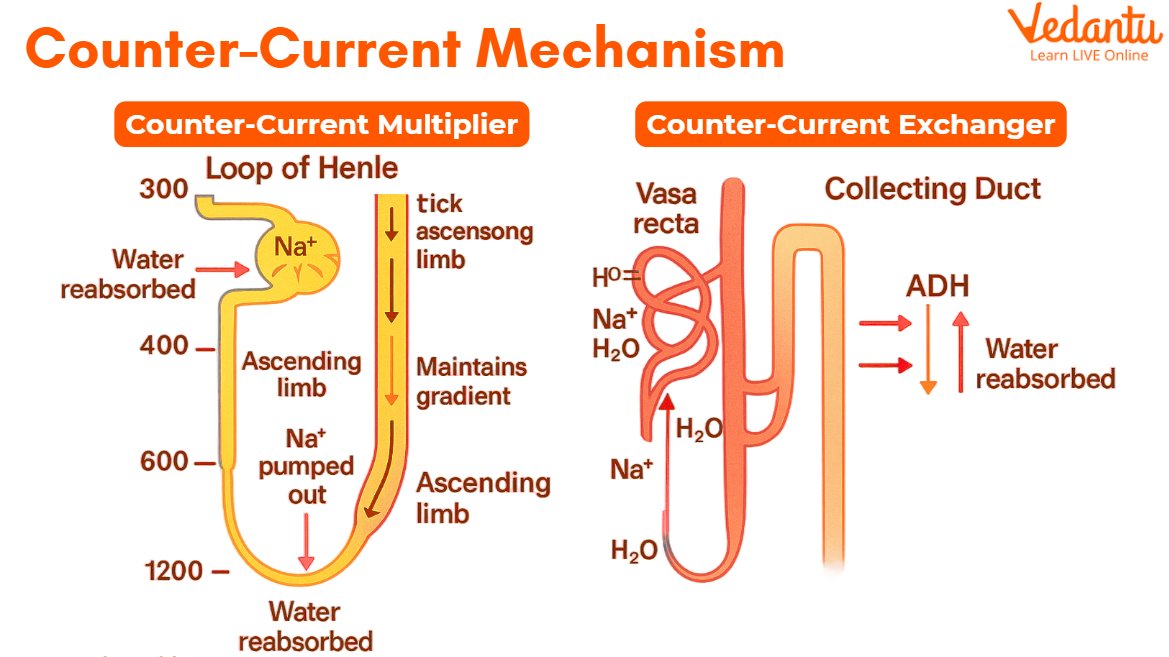
“In simple terms, the counter-current mechanism in the kidney allows the nephron to make urine more concentrated than the original filtrate. This mechanism is essential for maintaining water balance, electrolyte balance, and overall body homeostasis.”
Counter-current Mechanism in the Kidney
The counter-current mechanism in the kidney mainly involves two structures:
Loop of Henle
Vasa recta
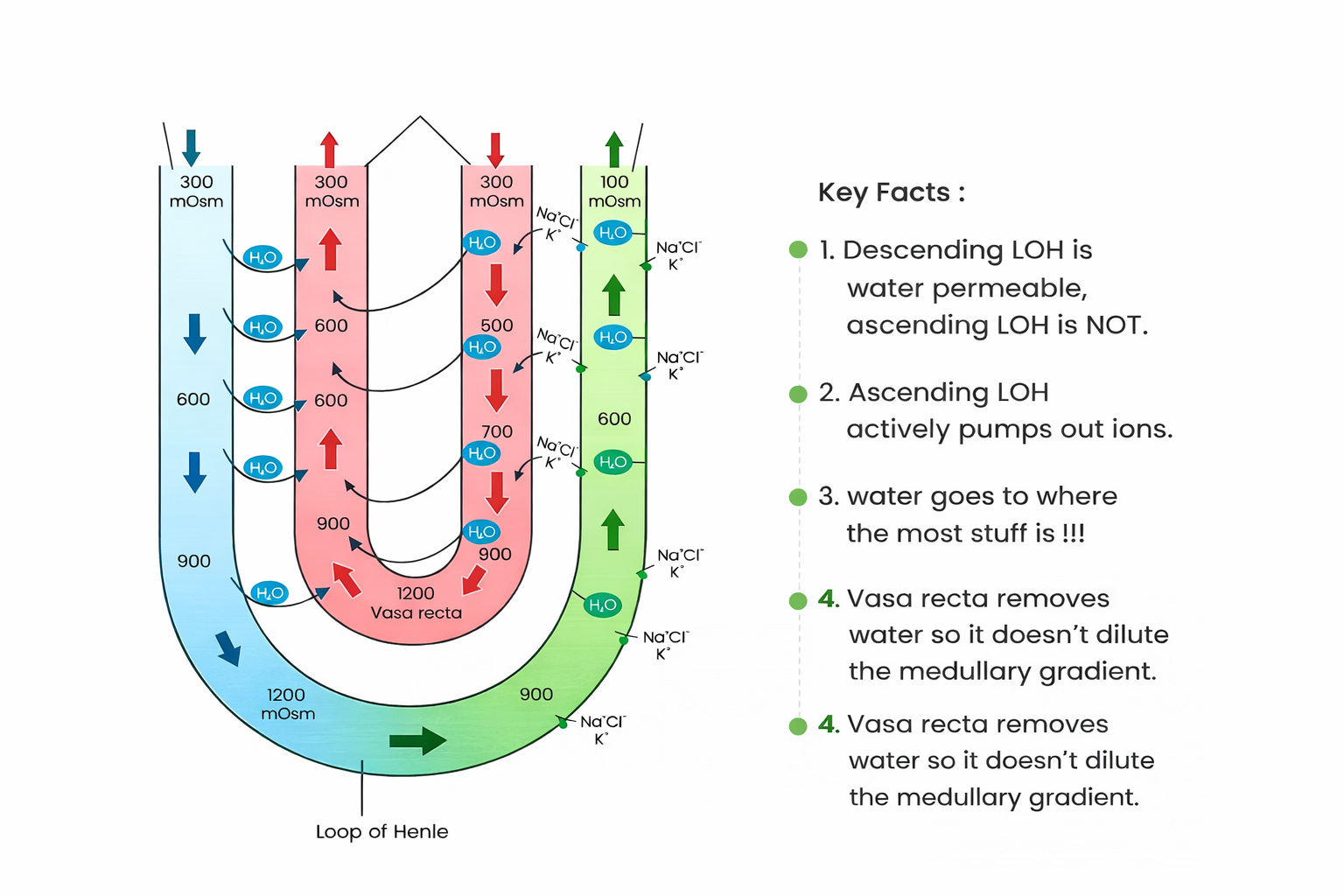
The filtrate in the descending and ascending limbs of the loop of Henle moves in opposite directions. Similarly, blood in the descending and ascending limbs of the vasa recta also flows in opposite directions. This arrangement is called a counter-current system.
Because these structures lie very close to each other, they help establish and maintain an increasing osmolarity in the medullary interstitium. This osmotic gradient rises from about 300 mOsmol L⁻¹ in the cortex to nearly 1200 mOsmol L⁻¹ in the inner medulla.
This gradient makes it easier for water to move out of the collecting duct by osmosis, which ultimately results in concentrated urine.
Why is the Counter-current Mechanism Important?
The kidney cannot produce concentrated urine without this system. The counter-current arrangement helps in:
conserving water
maintaining salt balance
concentrating urine
preventing excess water loss
supporting normal body fluid balance
That is why the counter-current mechanism of urine formation is considered a major adaptation in mammals.
Main Components of the Counter-current Mechanism
1. Loop of Henle
The loop of Henle plays the central role in creating the osmotic gradient.
The descending limb is more permeable to water.
The ascending limb is less permeable to water but actively transports salts like NaCl.
As the filtrate moves down the descending limb, water moves out into the surrounding interstitium, so the filtrate becomes more concentrated.
As the filtrate moves up the ascending limb, NaCl is transported out, but water does not follow. As a result, the filtrate becomes more dilute.
This repeated process helps create the medullary osmotic gradient.
2. Vasa Recta
The vasa recta help preserve the gradient established by the loop of Henle.
Blood flow in the vasa recta is also counter-current.
It exchanges water and salts with the interstitium without washing away the gradient.
It allows the kidney to maintain a highly concentrated inner medulla.
So, while the loop of Henle primarily establishes the gradient, the vasa recta primarily maintains it.
How the Counter-current Mechanism Works?
The mechanism's operation can be understood step by step.
Step 1: Opposite flow in the loop of Henle
The filtrate moves in opposite directions in the descending and ascending limbs of Henle’s loop.
Step 2: Salt movement from the ascending limb
The ascending limb transports NaCl into the medullary interstitium. This increases the osmolarity of the surrounding tissue.
Step 3: Water movement from the descending limb
Because the interstitium becomes more concentrated, water moves out of the descending limb by osmosis. This makes the filtrate inside more concentrated.
Step 4: Counter-current flow in vasa recta
Blood in the vasa recta also moves in opposite directions. This arrangement helps exchange water and salts while preserving the gradient.
Step 5: Urea contribution
A small amount of urea also enters parts of Henle’s loop and contributes to the high osmolarity of the medulla.
Step 6: Concentration of filtrate in the DCT and the collecting duct
When the filtrate reaches the distal convoluted tubule and collecting duct, the already established medullary gradient helps water move out by osmosis. This makes the urine highly concentrated.
Osmotic Gradient in the Medulla
One of the most important outcomes of the counter-current mechanism is the formation of an osmotic gradient in the kidney medulla.
This increase in osmolarity from cortex to medulla is essential for water reabsorption. Because the inner medulla is highly concentrated, water leaves the collecting duct more easily, and urine becomes hypertonic.
Role of NaCl and Urea
NaCl and urea mainly form the medullary gradient.
Role of NaCl
NaCl is transported out of the ascending limb of Henle’s loop.
It enters the interstitium, increasing osmolarity.
It is exchanged with the descending limb of the vasa recta and later returned to the interstitium by the ascending part of the vasa recta.
Role of Urea
Small amounts of urea move into the thin ascending segment of Henle’s loop.
Urea later returns to the interstitium from the collecting tubule.
This recycling further strengthens the medullary osmotic gradient.
Counter-current Mechanism of Urine Formation
Initially, the filtrate entering the nephron has an osmolarity of about 300 mOsmol L⁻¹. Due to the medullary gradient and water reabsorption in the collecting duct, the urine concentration can rise to about 1200 mOsmol L⁻¹.
This means the kidney can produce urine that is nearly four times as concentrated as the initial filtrate. This is an excellent mechanism for conserving water, especially in terrestrial mammals.
Flow of Filtrate in the Loop of Henle
1. Descending limb
Water moves out
Filtrate becomes concentrated
2. Ascending limb
NaCl moves out
Water does not move out significantly
Filtrate becomes dilute
This difference in permeability between the two limbs is a core feature of the counter-current mechanism.
Role of Distal Convoluted Tubule and Collecting Duct
The DCT and collecting duct do not create the osmotic gradient, but they use it.
As the filtrate passes downward through the collecting duct:
More and more water moves out into the medulla by osmosis
The filtrate becomes increasingly concentrated
The final urine becomes hypertonic compared to the blood
Thus, the collecting duct is the final place where the kidney takes advantage of the gradient generated by the counter-current system.
Counter-current Mechanism Flowchart
Opposite flow in the loop of Henle
→ NaCl is transported from the ascending limb to the medullary interstitium
→ Medullary osmolarity increases
→ Water moves out of the descending limb by osmosis
→ Filtrate becomes concentrated in the descending limb
→ Vasa recta preserves the osmotic gradient
→ Urea recycling strengthens medullary concentration
→ Water moves out of the collecting duct
→ Urine becomes highly concentrated
Counter-current Mechanism at a Glance
Difference Between Descending and Ascending Limb
This difference explains why the loop of Henle acts as a multiplier system.
Why Can Mammals Produce Concentrated Urine?
Mammals can produce concentrated urine because:
They possess a loop of Henle
The vasa recta runs alongside it
Both have counter-current flow
A medullary osmotic gradient is formed and maintained
collecting ducts reabsorb water efficiently
This adaptation is particularly important for land animals that must conserve water.
Importance of Water Conservation
The counter-current mechanism in the kidney is one of the body’s best water-saving systems. Allowing maximum water reabsorption before urine is excreted helps prevent dehydration and supports normal physiological function.
This is why the mechanism is often described as an excellent method for conserving water.
Important Points to Remember for NEET Preparation
A counter-current mechanism occurs in the kidney.
It mainly involves the loop of Henle and vasa recta.
Fluids flow in opposite directions, forming a counter-current system.
Osmolarity rises from 300 mOsmol L⁻¹ in the cortex to 1200 mOsmol L⁻¹ in the inner medulla.
NaCl and urea are the main contributors to the medullary gradient.
The descending limb concentrates the filtrate; the ascending limb dilutes it.
The collecting duct uses this gradient to reabsorb water.
Human kidneys can produce urine about four times more concentrated than the initial filtrate.
Final Note from the Expert
The counter-current mechanism is one of the most important renal processes for maintaining water and salt balance. By using the opposite flow of filtrate in the loop of Henle and blood in the vasa recta, the kidney builds a steep osmotic gradient in the medulla.
This gradient allows water to leave the collecting duct easily, which results in concentrated urine.
Read Related Topics To Revise for NEET


FAQs on Counter-current Mechanism in the Kidney and Urine Formation Explained
1. What is the counter-current mechanism?
The countercurrent mechanism is the process in the kidney by which the loop of Henle and vasa recta create and maintain a medullary osmotic gradient, helping to concentrate urine.
2. Where does the counter-current mechanism occur?
It occurs mainly in the loop of Henle and the vasa recta of the nephron.
3. What is the role of the loop of Henle in the counter-current mechanism?
The loop of Henle helps establish the osmotic gradient by allowing water to leave the descending limb and salts to leave the ascending limb.
4. What is the role of vasa recta?
The vasa recta maintains the medullary gradient by counter-current exchange without washing away the salts.
5. Why is the counter-current mechanism important?
It helps conserve water and produce concentrated urine.
6. What is the osmolarity of the renal medulla?
It increases from about 300 mOsmol L⁻¹ in the cortex to about 1200 mOsmol L⁻¹ in the inner medulla.
7. Which substances mainly create the medullary gradient?
The gradient is mainly due to NaCl and urea.
8. How does the collecting duct use the gradient?
Water moves out of the collecting duct by osmosis because the medullary interstitium is highly concentrated.
9. What is the counter-current mechanism of urine formation?
It is the process by which the kidney uses the loop of Henle, vasa recta, and collecting duct to convert dilute filtrate into concentrated urine.
10. Why is it called counter-current?
It is called counter-current because fluid or blood flows in opposite directions in adjacent limbs.
11. What is the concentration of filtrate in the kidneys?
The filtrate formed in the glomerulus has an osmolarity of about 300 mOsmol L⁻¹, which is similar to blood plasma. As the filtrate moves through the nephron, especially the loop of Henle and the collecting duct, its concentration changes in response to water reabsorption and solute movement.
12. What role does the loop of Henle play in concentrating the filtrate?
The loop of Henle creates the osmotic gradient in the medulla. The descending limb allows water to move out, concentrating the filtrate, while the ascending limb transports NaCl into the interstitium without water movement, diluting the filtrate. This counter-current flow helps establish conditions for urine concentration.
13. How does the counter-current mechanism contribute to filtrate concentration?
The counter-current mechanism establishes increasing osmolarity from the cortex to the inner medulla. This gradient allows water to move out of the collecting duct by osmosis. As more water leaves the filtrate, it becomes highly concentrated, resulting in concentrated urine.
14. What is the role of antidiuretic hormone (ADH) in the concentration of filtrate?
Antidiuretic hormone (ADH) increases the permeability of the distal convoluted tubule and collecting duct to water. In the presence of ADH, more water is reabsorbed from the filtrate into the medullary interstitium, which increases urine concentration and reduces urine volume.
15. What is the osmotic gradient, and how does it affect the concentration of the filtrate?
The osmotic gradient refers to the increasing osmolarity from the cortex (about 300 mOsmol L⁻¹) to the inner medulla (about 1200 mOsmol L⁻¹). This gradient draws water out of the collecting duct by osmosis, thereby concentrating the filtrate and forming hypertonic urine.
16. How does the vasa recta maintain the concentration gradient in the kidneys?
The vasa recta acts as a counter-current exchanger. Blood flows in opposite directions in its limbs, allowing slow exchange of water and solutes. This prevents the washing away of NaCl and urea from the medulla and helps maintain the osmotic gradient required for urine concentration.
17. What factors can affect the concentration of urine?
Several factors influence urine concentration, including:
Antidiuretic hormone (ADH) levels
Hydration status of the body
Osmotic gradient in medulla
Function of the loop of Henle
Function of vasa recta
Salt and urea concentration
Blood pressure and filtration rate
Changes in any of these factors can alter urine concentration.
18. What is the maximum concentration of human urine?
The human kidney can produce urine with a maximum osmolarity of about 1200 mOsmol L⁻¹, which is nearly four times more concentrated than the initial filtrate formed in the nephron.
19. How is dilute urine produced?
Dilute urine is produced when ADH levels are low—in this condition, the distal convoluted tubule and collecting duct become less permeable to water. As a result, less water is reabsorbed, and the filtrate remains dilute, leading to large volumes of dilute urine.
20. What happens if the filtrate cannot be concentrated properly?
If the filtrate cannot be concentrated properly, the body loses excess water through urine. This can lead to dehydration, electrolyte imbalance, and increased urine output. Conditions such as diabetes insipidus are associated with impaired urine concentration.
