









All About Rhizopus Life Cycle with Diagram and Characteristics
Rhizopus is a genus of saprophytic fungi commonly found growing on moist organic substances such as bread, fruits, vegetables, and decaying food materials. It is widely known as black bread mould because it frequently appears as black cottony growth on stale bread. Rhizopus plays an important role in decomposition and nutrient recycling in nature. It is also economically significant because some species are used in fermentation and industrial production of chemicals.
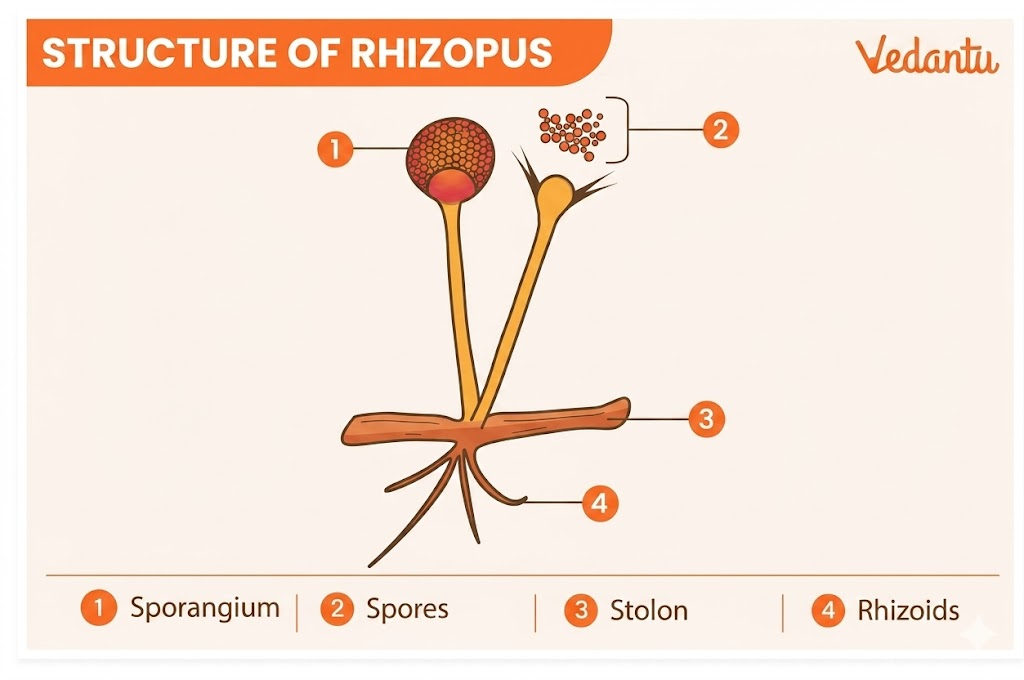
Rhizopus consists of a network of branched hyphae forming a mycelium. These hyphae are coenocytic, meaning they lack septa and contain multiple nuclei in the same cytoplasm. The fungus reproduces by vegetative, asexual, and sexual methods, making its life cycle important for NEET biology.
Rhizopus Diagram
A labelled Rhizopus diagram usually includes:
stolon
rhizoids
sporangiophore
sporangium
sporangiospores
columella
mycelium
This diagram is very important for morphology-based questions.
Rhizopus Classification
The classification of Rhizopus places it under fungi that reproduce by zygospore formation.
Rhizopus is an example of zygomycete fungi.
Rhizopus Characteristics
Rhizopus shows several important features:
Fast growing fungus
Cottony mycelium
Coenocytic hyphae
Saprophytic nutrition
Grows on bread and fruits
Asexual reproduction by spores
Sexual reproduction by zygospores
Multinucleated cytoplasm
Chitin cell wall
Mycelium differentiated into hyphae types
These features help identify Rhizopus under microscope.
Rhizopus on Bread
Rhizopus commonly grows on moist bread. Initially white mycelium appears. Later black sporangia form at tips of sporangiophores, giving bread a black dotted appearance.
Conditions required:
moisture
warm temperature
organic substrate
oxygen
This is why bread kept in humid conditions develops mold.
Rhizopus Structure
The structure of Rhizopus consists of branched mycelium made of hyphae. The hyphae are coenocytic and multinucleated.
Three types of hyphae are present:
1. Stolon
Stolons are horizontal hyphae that grow along the surface of substrate. They connect different groups of hyphae and help spread the fungus.
2. Rhizoids
Rhizoids arise from nodes where stolons touch the substratum. They penetrate the substrate and absorb nutrients. They also anchor the fungus.
3. Sporangiophores
Sporangiophores are aerial hyphae that grow vertically upward. They bear sporangia at their tips. These structures are responsible for spore formation.
The cell wall is made of chitin, and the cytoplasm contains nuclei, mitochondria, vacuoles, and other organelles.
Life Cycle of Rhizopus
The life cycle of Rhizopus includes three types of reproduction:
vegetative reproduction
asexual reproduction
sexual reproduction
This makes Rhizopus an ideal example to study fungal reproduction.
Vegetative Reproduction in Rhizopus
Vegetative reproduction occurs by fragmentation. When a part of stolon breaks, it develops into a new mycelium. Each fragment grows independently and forms a new fungal colony.
This method helps rapid spread.
Asexual Reproduction in Rhizopus
Asexual reproduction occurs by formation of sporangiospores and chlamydospores.
Spore Formation in Rhizopus (Sporangiospores)
Spore formation occurs in the sporangium present at the tip of sporangiophore.
Steps involved:
Sporangiophore develops from aerial hyphae
Tip swells forming sporangium
Cytoplasm and nuclei move upward
Sporangium differentiates into columella and spores
Sporangiospores formed
Sporangium wall ruptures
Spores released as powdery mass
Spores germinate into new mycelium
These spores are non-motile and multinucleated.
Chlamydospore Formation
Chlamydospores form during unfavorable conditions. They are thick-walled spores formed from hyphae. They remain dormant and germinate when conditions become favorable.
Sexual Reproduction in Rhizopus
Sexual reproduction occurs by fusion of compatible hyphae. Many species are heterothallic, meaning + and – strains are required.
Steps of sexual reproduction:
Compatible hyphae approach
Progametangia formed
Septa form gametangia
Gametangia fuse
Plasmogamy occurs
Karyogamy follows
Diploid zygospore formed
Zygospore thickens
Meiosis occurs during germination
Haploid spores formed
New mycelium develops
This process produces zygospore, characteristic of zygomycetes.
Rhizopus Under Microscope
Under microscope Rhizopus appears as:
branching hyphae
coenocytic mycelium
sporangiophores
spherical sporangia
spores inside sporangium
rhizoids at base
This appearance helps identify Rhizopus.
Difference Between Mucor and Rhizopus
This difference is commonly asked in exams.
Types of Rhizopus
Some common species include:
Rhizopus stolonifer
Rhizopus oryzae
Rhizopus microsporus
These species differ in applications and growth.
Economic Importance of Rhizopus
Rhizopus has both beneficial and harmful roles.
Useful Roles
fermentation of food
production of organic acids
alcohol production
soybean fermentation
enzyme production
Harmful Roles
spoilage of food
plant diseases
human fungal infections
Expert Tips
Rhizopus is a saprophytic fungus commonly called bread mould. It has coenocytic mycelium with stolon, rhizoids, and sporangiophores. It reproduces by vegetative, asexual, and sexual methods. Asexual reproduction occurs by sporangiospores. Sexual reproduction forms zygospore. It grows on moist bread and decaying organic matter.
Also Explore -
FAQs on Rhizopus: Structure, Life Cycle, Spore Formation, Classification and Labelled Diagram
1. What is Rhizopus commonly known as?
Rhizopus is commonly known as bread mould or black bread mould. It is a fast-growing fungus that usually appears on moist bread, fruits, and vegetables. A common example is Rhizopus stolonifer, which is why rhizopus on bread is often used to explain its growth.
2. Does Rhizopus cause disease?
Yes, some species of Rhizopus can cause disease. Although it usually lives as a saprophyte on dead organic matter, it can sometimes infect plants and, in certain cases, humans, especially when immunity is weak.
3. Is Rhizopus harmful to humans?
Rhizopus is not usually harmful to healthy people, but it can be dangerous in individuals with low immunity. In such cases, it may cause serious fungal infections such as mucormycosis. So, Rhizopus can be harmful under specific conditions.
4. Is Rhizopus a yeast or mold?
Rhizopus is a mould, not a yeast. It is a filamentous fungus made of branched hyphae and forms a cottony mycelium. Under Rhizopus under microscope, it appears as thread-like hyphae with sporangia at the tips.
5. What is the second name for Rhizopus?
Another common name for Rhizopus is bread mould or black bread mould. This name is used because the fungus commonly grows on stale bread and forms black spore-bearing structures.
6. What are the 4 classifications of fungi?
The four major classifications of fungi are generally given as:
Zygomycota – includes Rhizopus and other bread moulds
Ascomycota – includes yeast and sac fungi
Basidiomycota – includes mushrooms and club fungi
Deuteromycota or other simplified teaching groups in some school-level classifications
7. What is the deadliest fungal infection?
Some of the most dangerous fungal infections are severe invasive fungal diseases that affect people with weak immunity. These include infections caused by fungi such as Rhizopus, Candida, Aspergillus, and Cryptococcus. Among Rhizopus-related diseases, mucormycosis is one of the most serious.
8. What is the Rhizopus classification?
The Rhizopus classification is:
Domain – Eukaryota
Kingdom – Fungi
Phylum – Zygomycota
Class – Zygomycetes
Order – Mucorales
Family – Mucoraceae
Genus – Rhizopus
9. What is spore formation in Rhizopus?
Spore formation in Rhizopus mainly occurs through sporangiospores. These spores are formed inside sporangia present at the tips of sporangiophores. When the sporangium bursts, the spores are released and germinate under suitable conditions.
