









What is Krebs Cycle and Where it Occurs? Steps, ATP Yield and TCA Cycle Diagram
The Krebs cycle is one of the most important stages of cellular respiration. It is a cyclic metabolic pathway in which acetyl-CoA is oxidized to release energy stored in the form of NADH, FADH₂, and ATP. These energy-rich molecules later enter the electron transport chain to produce large amounts of ATP. Because of its central role in metabolism, the Krebs cycle is considered the heart of cellular respiration.
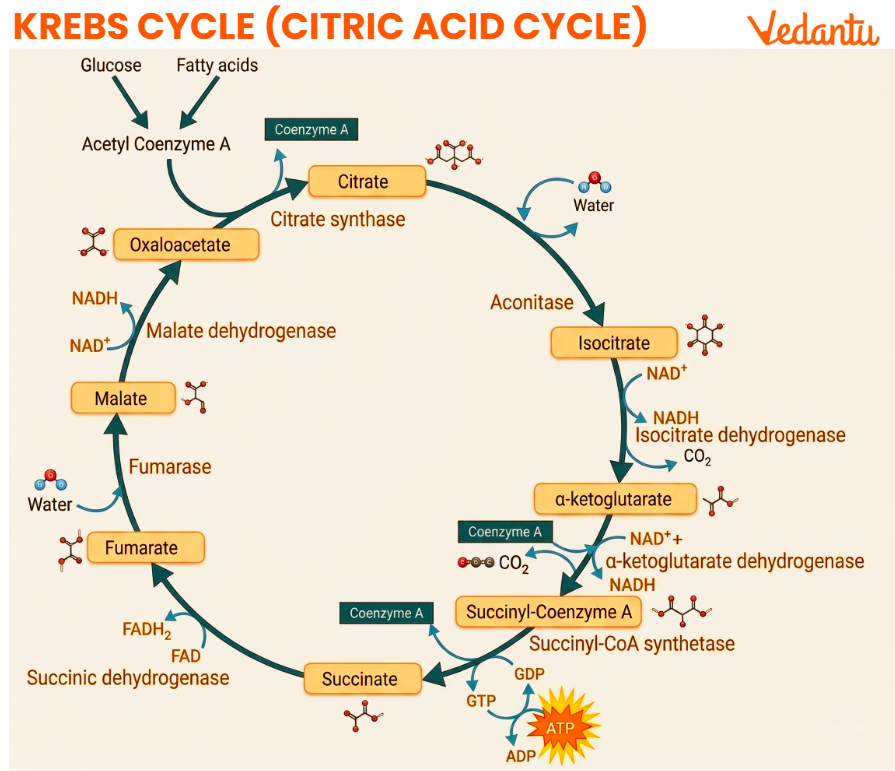
The Krebs cycle begins when acetyl-CoA combines with oxaloacetate to form citrate. Through a sequence of enzyme-controlled reactions, carbon dioxide is released, electron carriers are reduced, and oxaloacetate is regenerated. This regeneration makes the pathway cyclic and allows it to continue repeatedly.
Krebs Cycle is Also Known As:
Citric acid cycle
Tricarboxylic acid cycle (TCA cycle)
The name citric acid cycle comes from the formation of citrate as the first product. The name TCA cycle refers to the presence of three carboxyl groups in early intermediates. The term Krebs cycle is used in honor of Sir Hans Krebs, who discovered the pathway.
Main functions of Krebs cycle:
Oxidation of acetyl-CoA
Production of NADH and FADH₂
Formation of ATP (or GTP)
Release of CO₂
Regeneration of oxaloacetate
The cycle operates continuously as long as acetyl-CoA is available.
Krebs Cycle Takes Place In:
The location of Krebs cycle depends on organism type:
In eukaryotic cells, pyruvate enters mitochondria and is converted into acetyl-CoA, which then enters the Krebs cycle.
Krebs Cycle Pathway Overview
The Krebs cycle pathway begins with a 2-carbon acetyl-CoA molecule combining with 4-carbon oxaloacetate to form a 6-carbon citrate. Through a series of reactions, citrate is oxidized and rearranged until oxaloacetate is regenerated.
Important features of pathway:
cyclic pathway
eight major reactions
enzyme controlled steps
release of CO₂
generation of NADH and FADH₂
regeneration of oxaloacetate
This cyclic nature allows continuous operation.
Krebs Cycle Steps
The Krebs cycle consists of eight major steps. Each step is catalyzed by a specific enzyme.
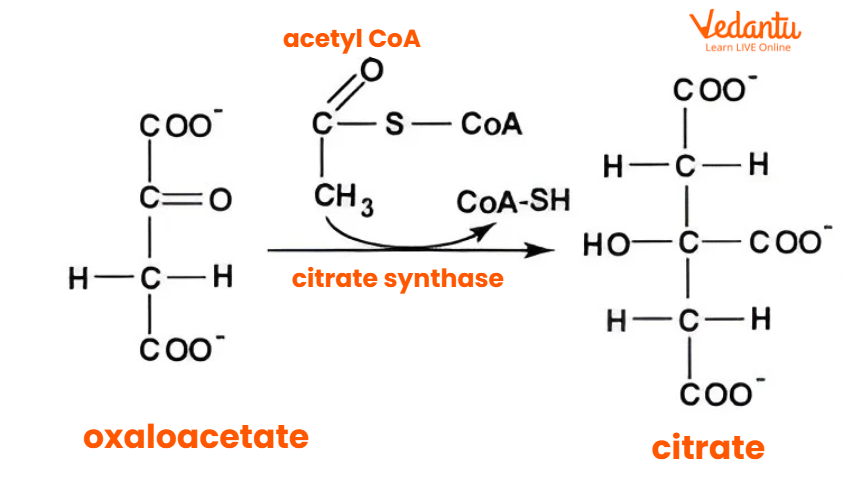
Step 1: Formation of Citrate
Acetyl-CoA combines with oxaloacetate to form citrate. This reaction is catalyzed by citrate synthase.
Reaction:
Acetyl-CoA + Oxaloacetate + H₂O → Citrate + CoA-SH + H+
This step initiates the cycle.
Step 2: Citrate to Isocitrate
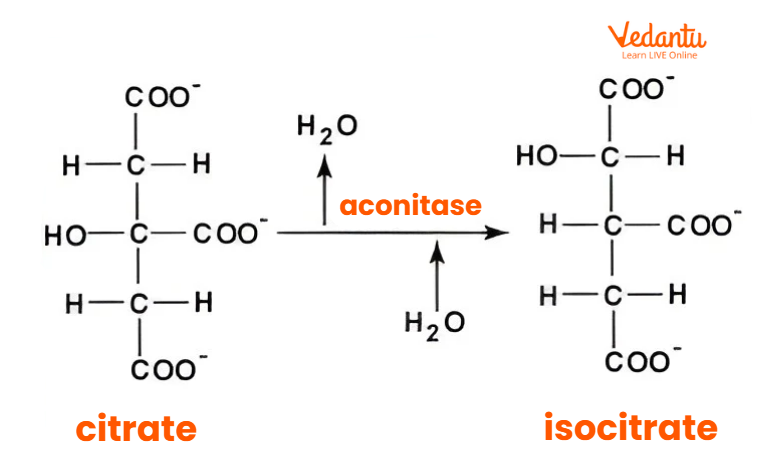
Citrate is rearranged into isocitrate through an intermediate. This reaction is catalyzed by aconitase.
This step prepares the molecule for oxidation.
Step 3: Isocitrate to Alpha Ketoglutarate
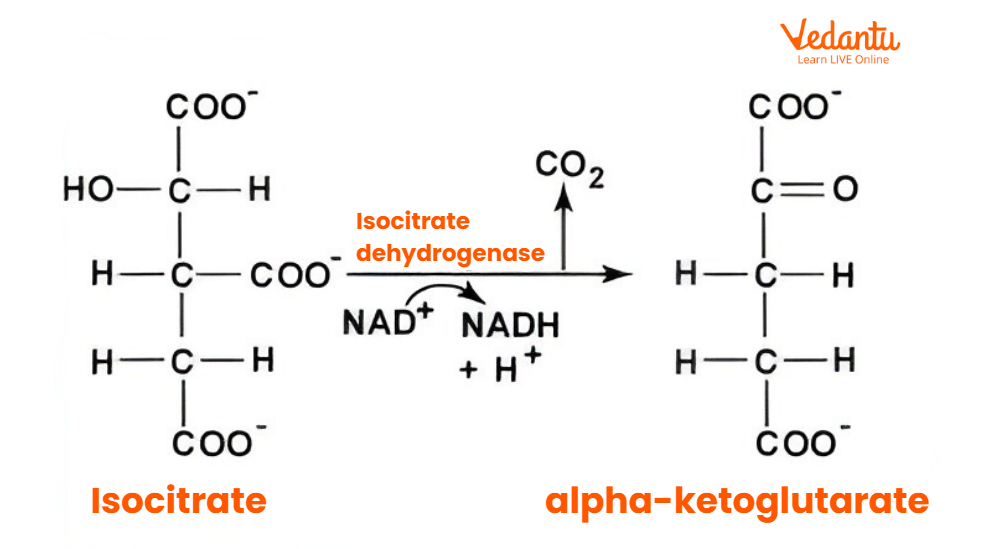
Isocitrate undergoes oxidation and decarboxylation.
Products:
NADH formed
CO₂ released
α-ketoglutarate formed
This is the first oxidative decarboxylation.
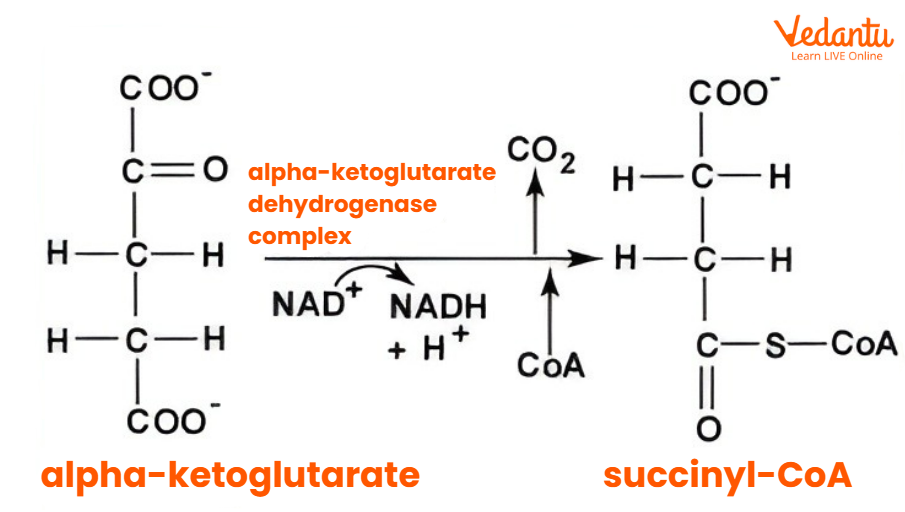
Step 4: Alpha Ketoglutarate to Succinyl CoA
Alpha ketoglutarate is oxidized.
Products:
NADH produced
CO₂ released
Succinyl CoA formed
This is the second oxidative decarboxylation.
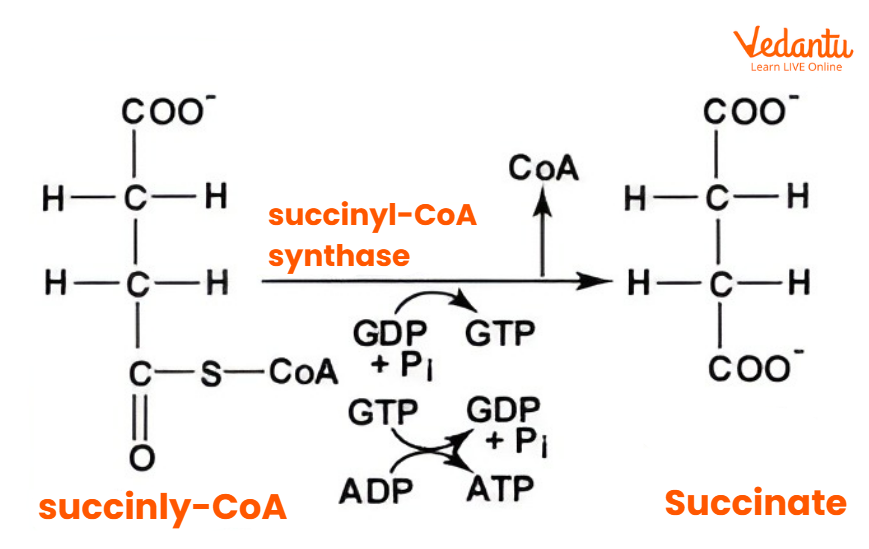
Step 5: Succinyl CoA to Succinate
Succinyl CoA is converted to succinate.
Products:
ATP or GTP formed
CoA released
This is the substrate-level phosphorylation step.
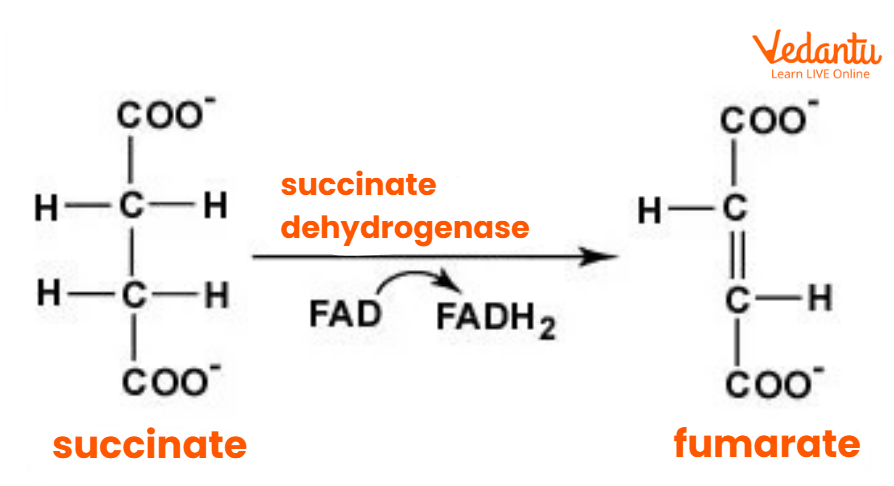
Step 6: Succinate to Fumarate
Succinate is oxidized to fumarate.
Product:
FADH₂ formed
This step occurs in the mitochondrial membrane.
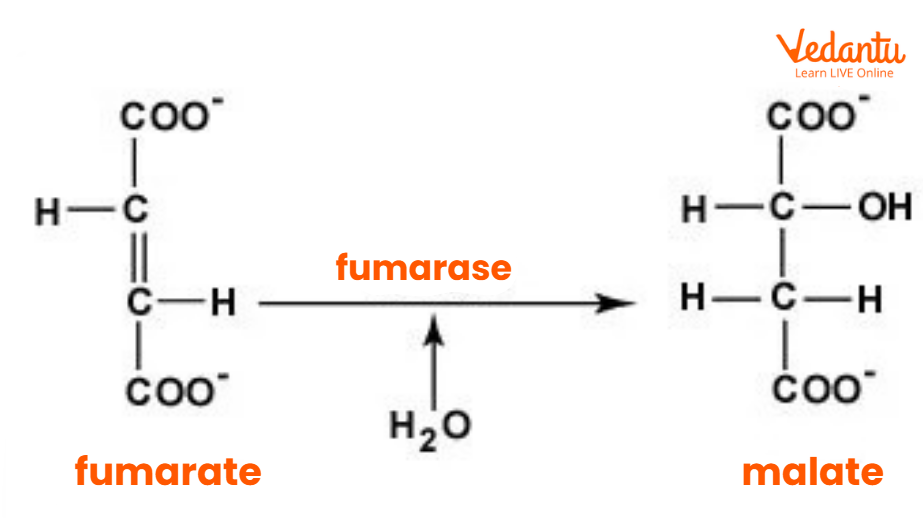
Step 7: Fumarate to Malate
Water is added to fumarate to form malate.
This is a hydration reaction.
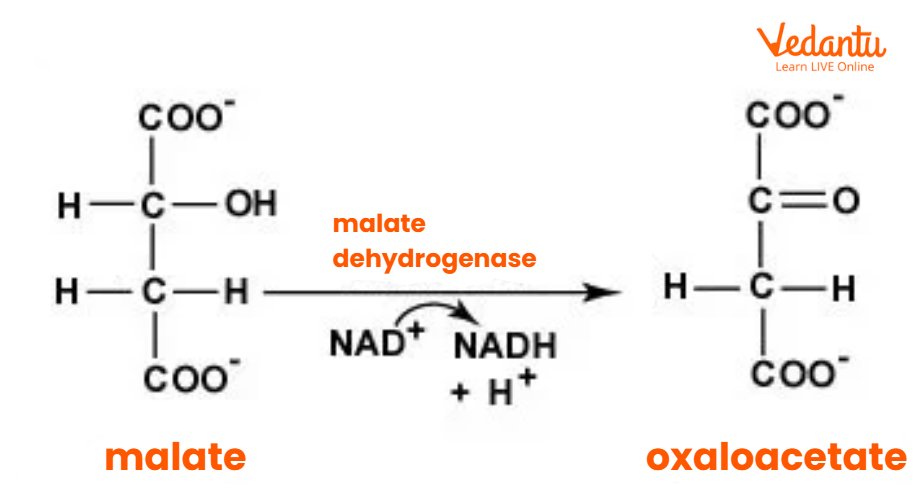
Step 8: Malate to Oxaloacetate
Malate is oxidized to oxaloacetate.
Product:
NADH produced
Oxaloacetate regenerated and the cycle continues.
Simplified Krebs Cycle
A simplified Krebs cycle can be summarized as:
Acetyl-CoA + Oxaloacetate → Citrate → Isocitrate → α-Ketoglutarate → Succinyl CoA → Succinate → Fumarate → Malate → Oxaloacetate
This simplified pathway helps in quick revision.
Krebs Cycle Reaction Summary
Overall reaction per turn:
Acetyl-CoA + 3 NAD⁺ + FAD + ADP + Pi → 2 CO₂ + 3 NADH + FADH₂ + ATP + CoA
This represents complete oxidation of acetyl-CoA.
End Product of Krebs Cycle
The end product of Krebs cycle per turn includes:
2 CO₂
3 NADH
1 FADH₂
1 ATP (or GTP)
Oxaloacetate regenerated
These products are used in the electron transport chain.
How Many ATP Are Produced in Krebs Cycle?
ATP produced directly:
1 ATP per cycle
2 ATP per glucose
Indirect ATP production:
3 NADH → 9 ATP
1 FADH₂ → 2 ATP
Total ATP per cycle = 12 ATP
Total ATP per glucose = 24 ATP
Most ATP comes indirectly through the electron transport chain.
Krebs Cycle with Carbon Count
Carbon count helps understand decarboxylation.
Importance of Krebs Cycle
The Krebs cycle is important because:
central metabolic pathway
generates NADH and FADH₂
produces ATP
releases CO₂
provides intermediates for biosynthesis
connects carbohydrate fat protein metabolism
It acts as a metabolic hub.
FAQs on Krebs Cycle: Steps, Diagram, ATP Yield, Pathway and Reactions Explained
1. What is the kreb cycle in simple terms?
The Krebs cycle is a major step of aerobic respiration in which acetyl-CoA is broken down to release energy. This energy is captured mainly in the form of NADH, FADH2, and a small amount of ATP. In simple words, it is the stage where the cell extracts more energy from food after glycolysis.
2. How many steps are there in a Krebs cycle?
The Krebs cycle steps are usually described as eight main steps. In these reactions, acetyl-CoA combines with oxaloacetate, passes through a series of intermediate compounds, and finally regenerates oxaloacetate so the cycle can begin again.
3. Does the Krebs cycle produce ATP?
Yes, the Krebs cycle produces ATP, but only a small amount directly. One ATP or GTP is formed in each turn of the cycle. Since one glucose molecule gives two turns of the cycle, 2 ATP are produced directly per glucose. Most of the energy is stored in NADH and FADH2.
4. What are the 4 stages of respiration?
The four main stages of aerobic respiration are:
Glycolysis
Pyruvate oxidation or link reaction
Krebs cycle
Electron transport chain or oxidative phosphorylation
These stages work together to break down glucose completely and release energy in the form of ATP.
5. How to memorize Krebs' cycle?
A simple way to remember the simplified Krebs cycle is to memorize the sequence of compounds in order:
Citrate → Isocitrate → Alpha-ketoglutarate → Succinyl-CoA → Succinate → Fumarate → Malate → Oxaloacetate
You can also remember that:
CO2 is released twice
NADH is formed three times
FADH2 is formed once
ATP or GTP is formed once
6. What is another name for the Krebs cycle?
The Krebs cycle is also known as:
Citric acid cycle
Tricarboxylic acid cycle
All these names refer to the same metabolic pathway.
7. What is NADH and FADH2?
NADH and FADH2 are high-energy electron carriers formed during cellular respiration. In the Krebs cycle, they collect hydrogen and electrons released during oxidation reactions and carry them to the electron transport chain, where they help in making ATP.
8. Krebs cycle takes place in?
The Krebs cycle takes place in the mitochondrial matrix in eukaryotic cells. In prokaryotes, it occurs in the cytoplasm.
