









Structure of Volvox Colony and Complete Life Cycle Explained
Volvox is a genus of green algae that includes about 20 species of freshwater algae. Each colony is made up of thousands of individual cells, with colony sizes ranging from 500 to 60,000 cells. The first observation of Volvox was made by Leeuwenhoek in 1700. These algae are commonly studied to explore the process of morphogenesis. Found in freshwater environments like ponds and ditches, the rapid growth of Volvox often gives the water a greenish tint.
Systematic Position of Volvox
The classification of Volvox places it among green algae belonging to the division Chlorophyta. It is grouped under the class Chlorophyceae, which includes many freshwater green algae. Volvox falls within the order Chlamydomonadales, known for colonial and motile algae. The family Volvocaceae contains organisms closely related to Volvox, and the genus Volvox represents spherical colonial green algae with coordinated cellular organization.
Classification of Volvox
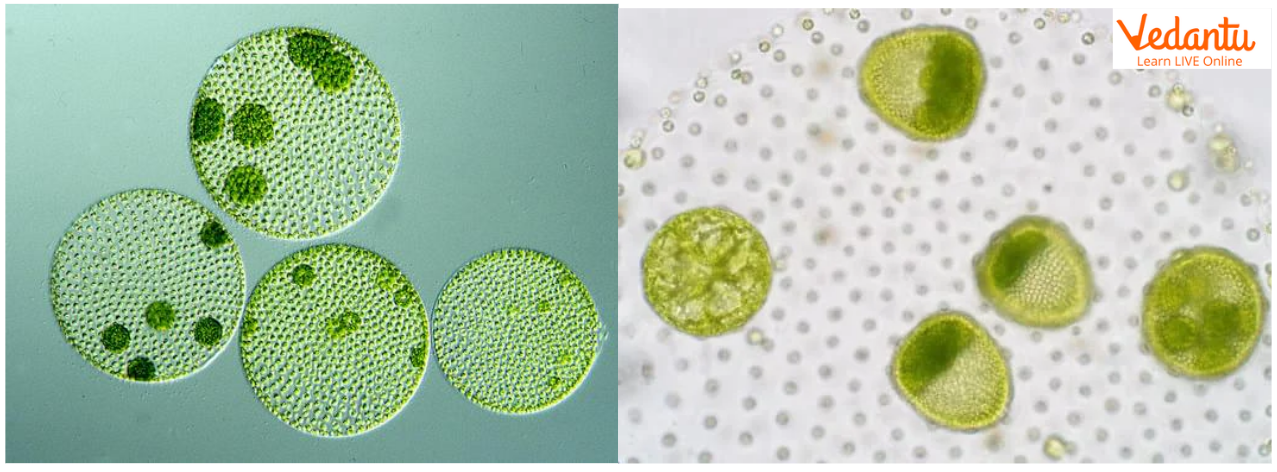
Some common species of Volvox include Volvox aureus, Volvox globator, V. carteri, and V. barberi.
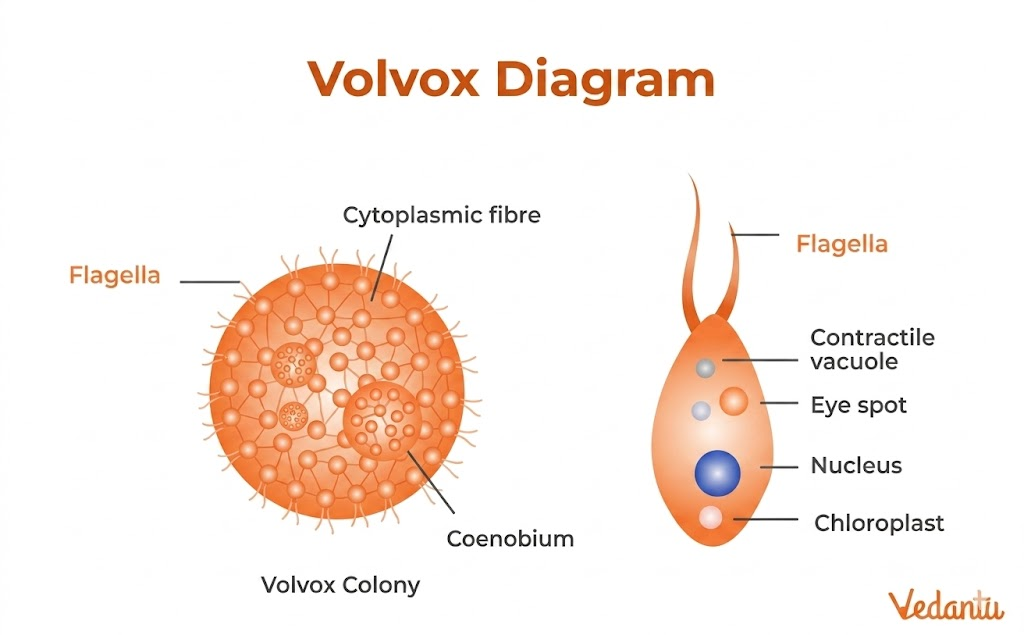
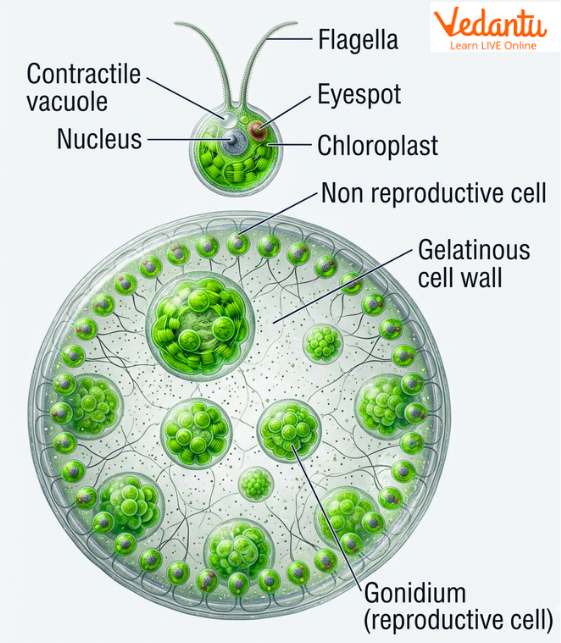
Volvox Diagram
Volvox Characteristics
A single Volvox colony appears as a ball approximately 0.5 mm in diameter.
The body is a hollow sphere called a coenobium, with thousands of cells arranged on its outer surface.
The cells in the coenobium are of two types-
Germ cells
Flagellated somatic cells
The extracellular matrix of the coenobium is composed of glycoproteins.
Individual cells are spherical and contain a cup-shaped chloroplast with pyrenoids.
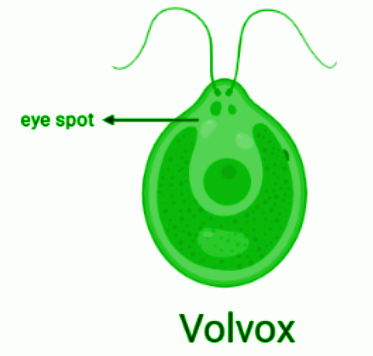
Each cell also has a nucleus, vacuoles, and an eyespot.
Two flagella of equal size are present in the anterior part of each cell, allowing the colony to move through the water.
Each cell performs independent metabolic functions like respiration, photosynthesis, and excretion.
Cytoplasmic strands form during cell division, connecting adjacent cells.
There is polarity in the coenobium-
Anterior cells have larger eyespots than posterior cells.
Eyespots help with light reception and contribute to phototaxis.
Volvox contributes significantly to oxygen production and serves as a food source for various aquatic organisms.
Volvox aureus can multiply rapidly, leading to harmful algal blooms (HABs) in warm waters with high nitrogen content.
Also Check: Photosynthesis in Higher Plants
Life Cycle of Volvox
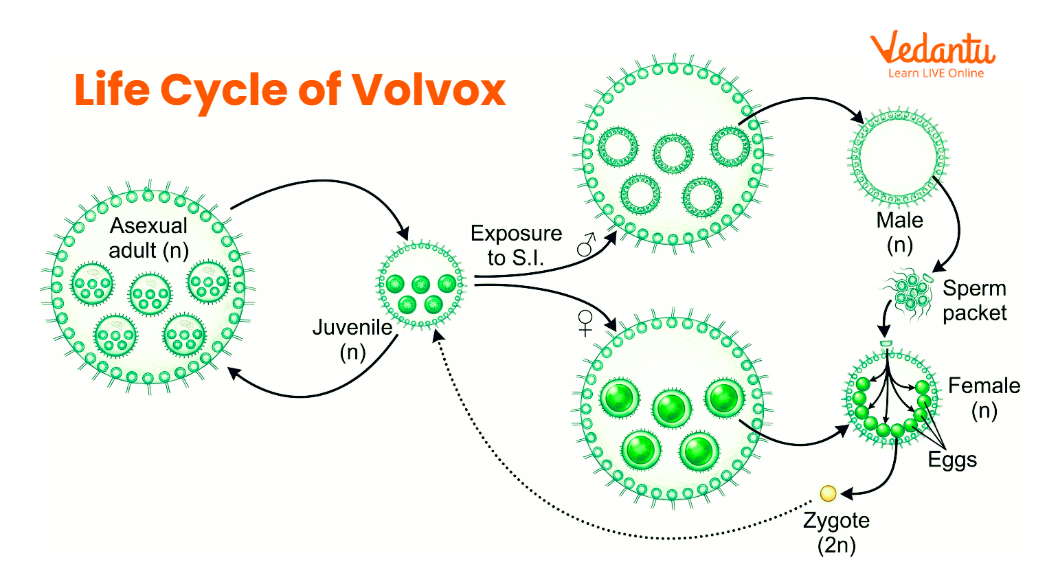
The life cycle of Volvox is haplontic, meaning the dominant stage is the free-living haploid (n) gametophyte, and the diploid zygote (2n) is the only sporophyte.
Cell differentiation occurs, creating reproductive and somatic cells.
Volvox reproduces by both-
Asexual reproduction under favorable conditions.
Sexual reproduction under unfavorable conditions.
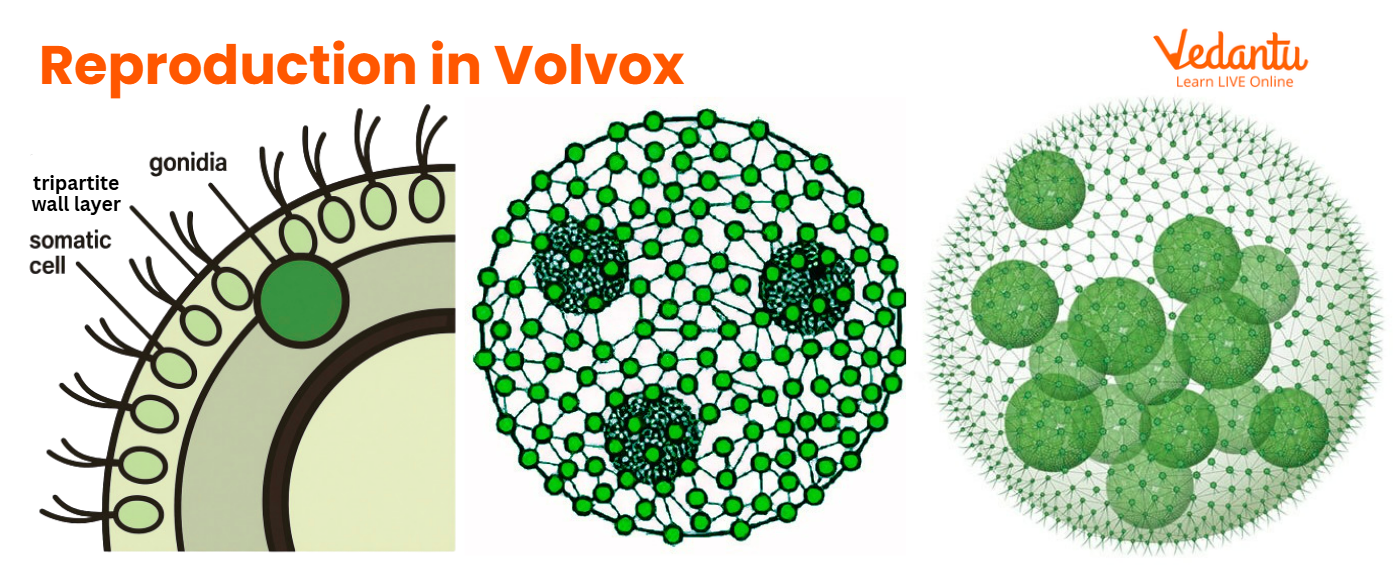
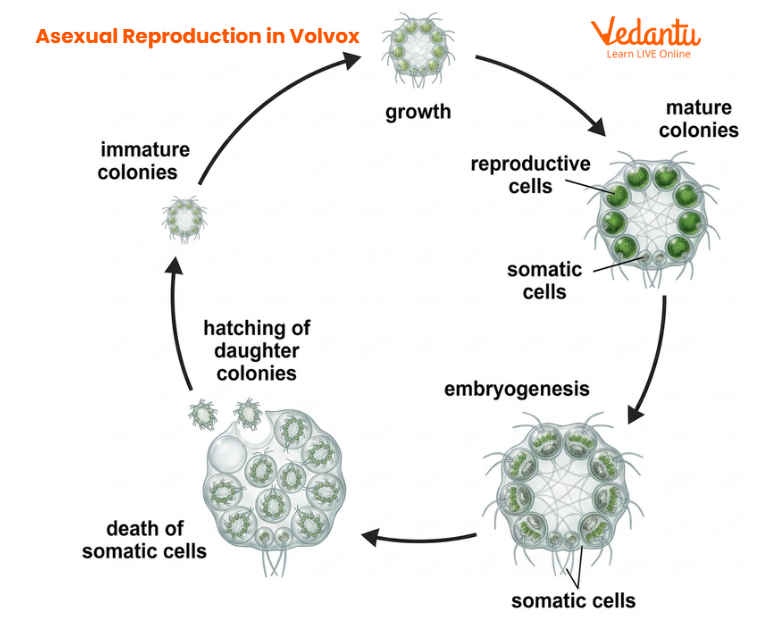
Asexual Reproduction-
Gonidia (reproductive cells) form daughter colonies, which mature and are released from the parent.
The gonidium undergoes multiple divisions to form a colony of around 3,200 cells.
Sexual Reproduction-
Volvox exhibits oogamous sexual reproduction, with male and female reproductive cells-
Spermatozoa (male) and ova (female).
Ova-
Produced inside the oogonium.
Large, non-motile, green (due to chloroplasts), and contain pyrenoids for food storage.
Spermatozoa-
Produced inside the antheridium.
Spindle-shaped, with apical cilia.
Released in groups or individually.
Chemotactic movement attracts spermatozoa to the oogonium.
Fertilisation occurs when one spermatozoid fertilizes the egg, forming a diploid zygote.
The zygote forms a cyst and becomes red due to the accumulation of hematochrome.
The zygote detaches from the parent and remains dormant for a longer duration.
Upon germination, the zygote undergoes meiosis to form four haploid cells.
The haploid cells undergo multiple mitotic divisions to form a new colony, continuing the cycle.
Also Check: Sexual Reproduction in Flowering Plants
Also Read:
Essential Study Materials for NEET UG Success
FAQs on Volvox Classification, Characteristics, Structure, Reproduction, Life Cycle
1. What is Volvox?
Volvox is a genus of green algae consisting of around 20 species, known for forming spherical colonies made up of thousands of cells. It is commonly found in freshwater habitats like ponds and ditches.
2. What is the structure of a Volvox colony?
A Volvox colony looks like a ball, about 0.5 mm in diameter, made up of thousands of cells arranged in a hollow sphere called the coenobium. The colony has two types of cells- germ cells and flagellated somatic cells.
3. What is the function of the eyespot in Volvox?
The eyespot in Volvox cells helps detect light, aiding in phototaxis, which is the movement of the colony towards light. Cells with larger eyespots are located in the anterior part of the coenobium.
4. How does Volvox move?
Each Volvox cell has two flagella located anteriorly. The coordinated movement of these flagella allows the colony to move through the water.
5. How does Volvox reproduce?
Volvox can reproduce through both asexual and sexual reproduction-
Asexual reproduction occurs when gonidia produce daughter colonies, which are released from the parent.
Sexual reproduction is oogamous, involving the fusion of male spermatozoa and female ova to form a diploid zygote.
6. What are gonidia in Volvox?
Gonidia are reproductive cells that divide and form new daughter colonies during asexual reproduction. Each gonidium undergoes multiple divisions to create a colony of about 3,200 cells.
7. What is the life cycle of Volvox?
Volvox has a haplontic life cycle, where the dominant stage is the free-living haploid gametophyte (n), and the diploid zygote (2n) is the only sporophyte stage. The zygote undergoes meiosis and forms new haploid cells to continue the cycle.
8. What is a cyst in the Volvox life cycle?
The zygote forms a cyst and becomes red due to the accumulation of hematochrome. The cyst remains dormant until favorable conditions return.
9. How does Volvox contribute to oxygen production?
Volvox plays a significant role in oxygen production through photosynthesis, helping to maintain oxygen levels in freshwater environments.
10. What are harmful algal blooms (HABs) in Volvox?
Rapid multiplication of Volvox aureus can lead to harmful algal blooms (HABs), which are more common in warm waters with high nitrogen content. HABs can negatively affect water quality and aquatic life.
11. How does sexual reproduction occur in Volvox?
Sexual reproduction in Volvox is oogamous, with the male spermatozoa and female ova fusing to form a diploid zygote. The zygote undergoes fertilization, forms a cyst, and remains dormant until conditions are suitable for germination.
12. What is Volvox known for?
Volvox is known as a freshwater colonial green alga commonly found in ponds, puddles, and still water bodies. It performs photosynthesis, releases oxygen, and serves as food for many small aquatic organisms such as rotifers, making it important in aquatic ecosystems.
13. What are 5 characteristics of Volvox?
Five important characteristics of Volvox are:
A Volvox colony appears as a small spherical ball visible to the naked eye.
The plant body is a hollow sphere called coenobium.
Thousands of cells are arranged on the outer surface of the sphere.
Cells are of two types: somatic cells and reproductive (germ) cells.
Each cell has flagella that help the colony move in water.
14. Is a Volvox male or female?
Volvox can be male, female, or bisexual depending on the species. Some colonies produce only male or only female reproductive structures, while others may contain both.
15. Is a Volvox useful or harmful?
Volvox is generally useful because it forms part of the aquatic food chain and produces oxygen through photosynthesis. However, excessive growth of Volvox in nutrient-rich water may sometimes contribute to algal blooms.
