









How Does a Neuron Work? NEET Biology Explained
The neuron is the fundamental unit of the nervous system and is crucial for understanding human biology, especially for NEET aspirants. Neurons are specialized cells responsible for transmitting information throughout the body. A clear grasp of the structure and function of neurons helps students tackle foundational concepts in neurobiology and related NEET questions. Mastering this topic strengthens both conceptual understanding and exam performance in biology.
What is a Neuron?
A neuron is a specialized cell designed to receive, process, and transmit electrical and chemical signals in the body. It is often called a nerve cell and forms the basic building block of the nervous system. Neurons play a central role in communication within the brain, spinal cord, and peripheral nerves, making them essential for sensation, movement, and cognition. For NEET biology, understanding what a neuron is and how it works forms the foundation for various topics in human physiology.
Core Structure and Function of Neurons
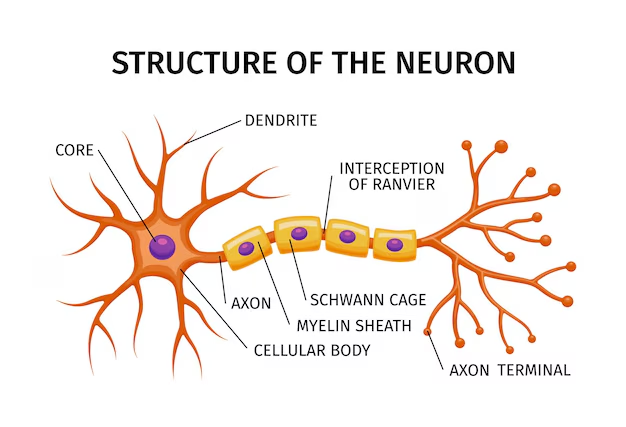
Neurons have a unique structure that enables them to carry out rapid and efficient signaling throughout the body. Their core structure can be broken down into three main parts which together coordinate the transmission of information.
1. Cell Body (Soma)
The cell body, or soma, contains the nucleus and most of the cell’s cytoplasm. It is responsible for the general metabolic functions of the neuron and integrates incoming signals received from the dendrites.
2. Dendrites
Dendrites are short, branched extensions from the cell body. They receive incoming signals from other neurons or sensory cells and transmit these signals to the cell body. The more dendrites a neuron has, the more information it can receive.
3. Axon
The axon is a long, slender projection that carries electrical impulses away from the cell body toward other neurons, muscles, or glands. Many axons are covered with a myelin sheath, which helps increase the speed of impulse transmission.
How Neurons Communicate: Synapse and Transmission
Neurons communicate through synapses - specialized junctions where the axon terminal of one neuron connects with another neuron or target cell. At the synapse, electrical signals are converted into chemical signals using neurotransmitters, allowing information to pass across the gap.
Key Sub-Concepts Related to Neurons
Several important sub-concepts help students build a complete understanding of neurons and their role in biology.
Types of Neurons
Neurons are classified based on structure and function:
- Sensory (Afferent) Neurons: Carry signals from sensory organs to the central nervous system.
- Motor (Efferent) Neurons: Transmit signals from the central nervous system to muscles or glands.
- Interneurons: Connect sensory and motor neurons within the central nervous system.
Myelination and Its Role
Some axons are covered by a fatty layer called the myelin sheath, which is produced by Schwann cells (in the peripheral nervous system) or oligodendrocytes (in the CNS). Myelin increases the speed of signal transmission through saltatory conduction, where impulses jump between nodes of Ranvier.
Neurotransmitters
Neurotransmitters are chemicals that transmit signals across the synapse. Examples include acetylcholine, dopamine, and serotonin. Each plays specific roles in mood, movement, and various bodily functions.
Principles and Relationships Related to Neurons
Understanding the functional principles helps in grasping how neurons work to generate and transmit signals.
The Resting Membrane Potential
At rest, a neuron maintains a specific voltage across its membrane, typically around -70 mV (millivolts), due to the difference in ion concentration inside and outside the cell. This resting potential is mainly maintained by the sodium-potassium pump and selective ion channels.
Action Potential
When stimulated, the neuron undergoes rapid depolarization and repolarization, creating an action potential that travels along the axon. This rapid change in membrane potential allows communication over long distances.
Saltatory Conduction
In myelinated neurons, action potentials jump from one node of Ranvier to the next, dramatically increasing the speed of nerve signal transmission.
Structural and Functional Features of Neurons
- Highly specialized shape for signaling
- Ability to generate and conduct electrical impulses
- Integration of multiple inputs through dendrites
- Synaptic communication with other neurons or effector cells
Importance of Neurons in NEET Exam
Neuron-related questions frequently appear in NEET due to their relevance in human physiology chapters and the overall nervous system. Understanding neurons supports the interpretation of diagrams, MCQ problem-solving on signal transmission, and concepts connected to reflex actions, muscular movement, and sensory reception. A clear grasp of this topic aids in understanding broader concepts such as neurotransmitters, brain functioning, and coordination - all integral parts of the NEET biology syllabus.
How to Study Neurons Effectively for NEET
- Start by sketching and labeling the structure of the neuron. Visual learning enhances memory.
- Understand how each part of the neuron contributes to its function, not just their definitions.
- Review diagrams repeatedly, especially those highlighting myelination and the flow of impulses.
- Practice NEET-style MCQs on neural signaling, types of neurons, and synaptic transmission.
- Use flowcharts to summarize the steps in impulse conduction and synaptic transmission.
- Regularly revise neurotransmitter examples and their roles.
- Self-test using previous year NEET question papers covering this topic.
Common Mistakes Students Make in Neuron Concept
- Mixing up dendrites and axons, both in structure and function.
- Forgetting which direction the impulse travels (dendrite to axon terminal).
- Confusing types of neurons and their pathways (sensory vs motor vs interneuron).
- Omitting the importance of the myelin sheath in impulse speed.
- Misunderstanding the difference between electrical and chemical transmission at synapses.
- Overlooking details of action potential and its graph.
Quick Revision Points: Neuron
- Neuron = functional unit of nervous system. Main parts: cell body, dendrite, axon.
- Dendrites receive signals, axon transmits signals away.
- Myelinated axons - faster impulse (saltatory conduction).
- Signals change from electrical (within cell) to chemical (at synapse) using neurotransmitters.
- Resting membrane potential is negative inside neuron (-70 mV).
- Three neuron types: sensory, motor, interneuron.
- Impulses always travel in one direction: dendrite - cell body - axon - axon terminal.
- Key for questions on reflex arc, synapses, neurotransmitters, and impulse propagation.
FAQs on Biology Neuron for NEET: Structure, Functions, and Diagram
1. What is a neuron in biology?
Neuron is the basic functional and structural unit of the nervous system in biology.
Key features of neurons (especially relevant for NEET):
- They transmit nerve impulses rapidly across long distances.
- A neuron consists of three main parts: cell body (soma), dendrites, and axon.
- Neurons help coordinate and control all body functions by processing information.
2. What are the different types of neurons?
Neurons are mainly classified based on structure and function.
Types of neurons for NEET:
- Sensory neurons (Afferent neurons): Carry information from sense organs to the central nervous system.
- Motor neurons (Efferent neurons): Send signals from the CNS to effectors like muscles and glands.
- Interneurons (Association neurons): Connect sensory and motor neurons within the CNS.
3. What is the structure of a neuron?
A neuron consists of three main structural parts.
NEET-relevant neuron parts:
- Cell body (Soma): Contains the nucleus and cytoplasm; responsible for metabolic activities.
- Dendrites: Short, branched extensions; receive signals from other neurons.
- Axon: Long, single extension; transmits impulses away from the cell body.
4. How does a neuron transmit nerve impulses?
A neuron transmits nerve impulses through electrochemical processes.
Steps of impulse transmission for NEET:
- Generation of action potential: Stimulus causes depolarization in neuron membrane.
- Propagation: The action potential travels along the axon.
- Synaptic transmission: At axon terminals, neurotransmitters are released, passing the impulse to the next neuron or effector cell.
5. What is the function of myelin sheath in neurons?
The myelin sheath increases the speed of nerve impulse transmission in neurons.
Functions of myelin sheath for NEET syllabus:
- Acts as an insulating layer around the axon.
- Facilitates saltatory conduction, allowing impulses to jump between nodes of Ranvier.
- Protects the axon and maintains signal strength.
6. What is a synapse in a neuron?
A synapse is the junction where one neuron communicates with another neuron or effector cell.
Key NEET points about synapse:
- Consists of a presynaptic neuron, synaptic cleft, and postsynaptic neuron.
- Neurotransmitters (like acetylcholine) are released by vesicles into the cleft.
- Enables transfer of nerve impulses (chemical or electrical).
7. Define nerve impulse. How is it related to a neuron's function?
A nerve impulse is an electrochemical signal generated and conducted by neurons.
Connection to NEET syllabus:
- Involves movement of ions across neuron membranes, particularly sodium and potassium.
- Allows neurons to rapidly transmit messages throughout the body.
- Essential for reflexes, sensory perception, and motor responses.
8. What is the difference between a neuron and a nerve?
A neuron is an individual nerve cell, while a nerve is a bundle of axons from multiple neurons.
NEET key points:
- Neuron: Single cell; processes and transmits impulses.
- Nerve: Collection of many axons wrapped together, often outside the CNS.
- Nerves can be sensory, motor, or mixed, and facilitate communication throughout the body.
9. Which neurotransmitter is vital for brain function and NEET exams?
Acetylcholine is a major neurotransmitter essential for brain and neuron function, frequently cited in NEET exams.
Other important neurotransmitters for NEET:
- Dopamine – controls movement and emotional responses.
- Serotonin – regulates mood and sleep cycles.
- Noradrenaline – involved in alertness and arousal.
10. How are neurons important in NEET biology and medical entrance exams?
Neurons are foundational in NEET biology due to their critical role in understanding human physiology.
Exam relevance of neurons:
- Frequently featured in NEET syllabus under Nervous System and Human Physiology sections.
- Key for understanding reflex actions, sensory input, and muscle control.
- Questions on neuron structure, function, impulse conduction, and related diseases appear regularly.
11. What is the function of dendrites in a neuron?
Dendrites are branch-like structures in a neuron responsible for receiving signals.
Key points for NEET:
- Dendrites collect information from surrounding neurons or sensory receptors.
- Transmit incoming signals to the cell body (soma) for processing.
- Crucial for effective communication within the nervous system.
