



 Watch Video







Evolution Mechanisms Explained for NEET Biology Students
Evolution is a fundamental concept in Biology that explains how living organisms have changed over time through natural processes. For NEET aspirants, understanding evolution is crucial because it forms the basis for many biological principles and helps connect various topics in the syllabus. A strong grasp of evolution not only aids in scoring well in the exam but also builds a clear understanding of life sciences as a whole.
What is Evolution?
Evolution is the gradual process by which different kinds of living organisms have developed and diversified from earlier forms during the history of the earth. It describes how species adapt to their environment and how new species arise over generations due to genetic changes. In simple terms, evolution explains the origin, adaptation, and diversity of life on Earth.
Core Ideas and Fundamentals of Evolution
Descent with Modification
This principle means that all living organisms are related through common ancestry and have changed over time through accumulation of small genetic differences. These modifications can result in new traits and sometimes new species.
Natural Selection
Natural selection is a key mechanism of evolution. It suggests that individuals with traits better suited to their environment are more likely to survive, reproduce, and pass those traits to the next generation. Over time, these beneficial traits become more common in the population.
Variation and Heredity
Genetic variations arise from mutations and recombination, creating differences among individuals in a population. Through heredity, these traits are passed down from parents to offspring, forming the foundation for evolutionary changes.
Speciation
Speciation is the formation of new species from existing ones due to genetic isolation, environmental changes, or other evolutionary processes. It is a crucial result of long-term evolution.
Important Sub-Concepts Related to Evolution
The Origin of Life
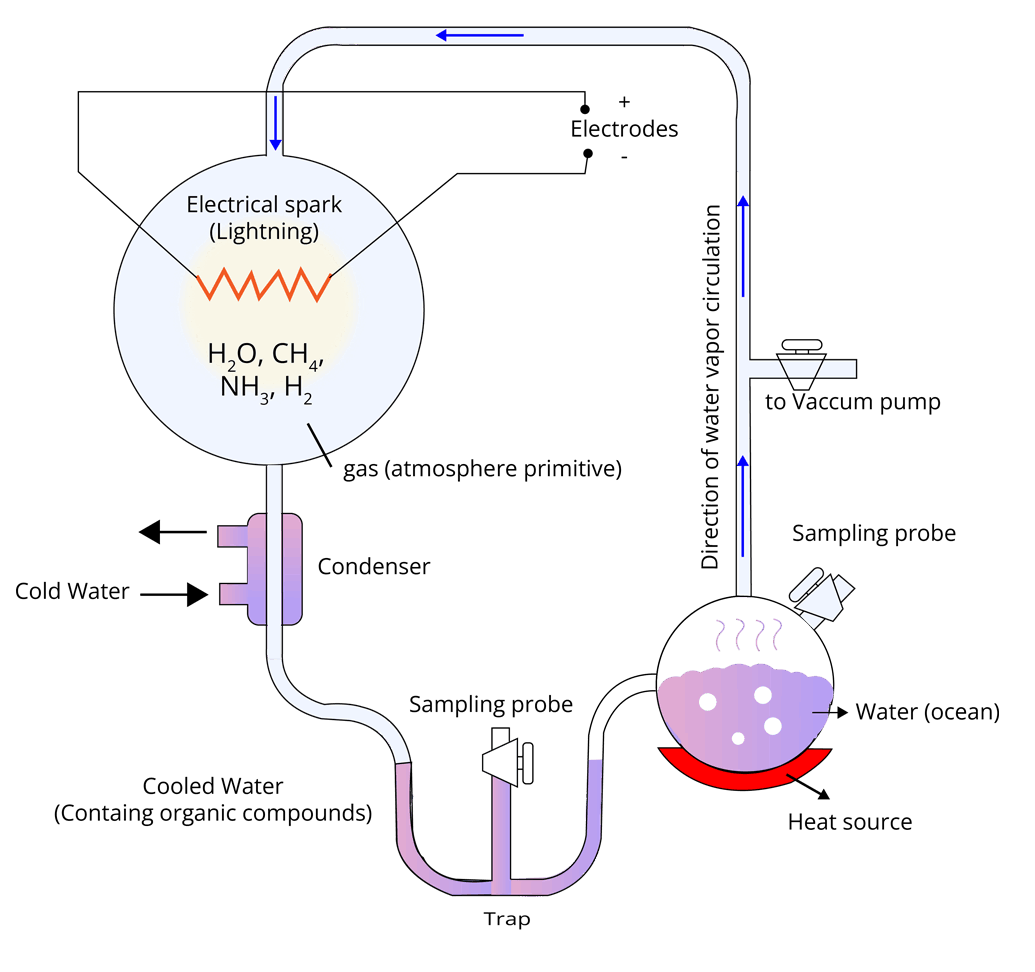
One of the first questions in evolutionary biology is how life began on Earth. Scientists believe that simple molecules gradually formed complex organic molecules, eventually leading to the first simple life forms. The Miller-Urey Experiment is famous for simulating early Earth conditions and demonstrating how amino acids, the building blocks of life, could have formed spontaneously.
Lamarckism and Darwinism
Lamarckism proposed that acquired traits are inherited, while Darwinism emphasized natural selection as the main force driving evolution. NEET often tests the ability to differentiate between these theories and understand why Darwinism is more widely accepted today.
Evidence of Evolution
Key types of evidence for evolution include:
- Fossil records showing changes in organisms over time
- Comparative anatomy of homologous and analogous organs
- Molecular evidence such as similarities in DNA sequences
- Embryological similarities among different species
Adaptive Radiation
Adaptive radiation explains how a single ancestral species diversifies into multiple new forms that adapt to different environmental niches. The classic example includes Darwin's finches on the Galápagos Islands, each with different beak shapes adapted to specific diets.
Key Principles and Relationships in Evolution
While evolution does not typically involve strict formulas, certain principles and relationships are essential for conceptual and MCQ-based questions in NEET:
- Hardy-Weinberg Principle: Describes genetic equilibrium in a population. According to this principle, allele and genotype frequencies in a population remain constant from generation to generation unless specific disturbing influences are introduced.
- Lamarck’s Law of Use and Disuse: States that body structures develop with use and diminish with lack of use, although this concept has been largely discredited.
- Survival of the Fittest: Refers to the enhanced reproductive success of organisms best adapted to their environment.
- Genetic Drift: Random changes in allele frequencies, especially in small populations, contributing to evolution.
Features and Importance of Evolution in Biology
- Explains the unity and diversity of life forms
- Helps understand adaptation, speciation, and extinction
- Connects genetics, ecology, and taxonomy
- Forms the foundation for understanding biological classification and phylogeny
Why is Evolution Important for NEET?
Evolution frequently appears in NEET questions due to its critical role in biology. Students must understand evolution to answer both direct questions and those connecting to genetics, ecology, and diversity in the living world. Mastery of evolutionary concepts strengthens overall subject clarity, aids in tackling MCQs, and links ideas across multiple chapters, enhancing overall problem-solving skills in NEET Biology.
How to Study Evolution Effectively for NEET
- Start by understanding the basic definitions - such as evolution, natural selection, and speciation - before moving to complex mechanisms.
- Use diagrams, like the Miller-Urey experiment setup, to visualize key experiments and evidence.
- Learn the difference between homologous and analogous organs with examples.
- Revise major evolutionary theories (Lamarckism, Darwinism, Modern Synthetic Theory) and their main points.
- Practice MCQs focused on distinguishing between different types of evidence and understanding concepts like Hardy-Weinberg equilibrium and genetic drift.
- Summarize notes for adaptive radiation, migration, mutation, and natural selection mechanisms.
- Review previous years’ NEET questions on evolution for pattern familiarity and confidence building.
Common Mistakes Students Make in Evolution
- Confusing analogous and homologous organs
- Misunderstanding the Hardy-Weinberg principle and its application
- Mixing up Lamarckism and Darwinism or their significance
- Ignoring diagram-based questions, such as those related to key experiments or fossil records
- Focusing only on memorization rather than understanding concepts and principles
Quick Revision Points for Evolution
- Evolution explains the origin and diversity of life forms over time.
- Natural selection is a major driving force - survival and reproduction of the fittest.
- Lamarckism (use and disuse) is largely discredited; Darwinism (natural selection) is widely accepted.
- The Miller-Urey Experiment provides experimental support for the chemical origin of life.
- Hardy-Weinberg equilibrium describes allele stability in populations, disrupted by mutation, migration, or selection.
- Homologous organs indicate common ancestry; analogous organs indicate similar function, not ancestry.
- Adaptive radiation leads to species diversity from a common ancestor.
- Revise evidence types: fossil, anatomical, molecular, and embryological.
Biology Evolution NEET: Complete Guide for Students

 Share
ShareFAQs on Biology Evolution NEET: Complete Guide for Students
1. What is evolution in biology for NEET?
Evolution in biology refers to the gradual process by which different kinds of living organisms have developed and diversified from earlier forms throughout Earth’s history.
- It involves changes in the hereditary characteristics over generations.
- Natural selection, mutation, genetic drift, and gene flow are main mechanisms.
- This concept is essential for NEET aspirants to understand diversity and adaptation in biology.
2. What are the key evidence of evolution required for NEET?
Key evidence of evolution includes multiple scientific observations.
- Fossil records: Show chronological changes in organisms.
- Comparative anatomy: Study of homologous and analogous organs.
- Embryological evidence: Similar embryonic stages across species.
- Molecular evidence: DNA and protein analysis showing relationships.
- These evidences are frequently asked in NEET biology exams.
3. What is natural selection and how does it relate to NEET Evolution syllabus?
Natural selection is a key mechanism of evolution where organisms better adapted to their environment survive and reproduce more successfully.
- Proposed by Charles Darwin.
- Acts on variation within a population.
- Leads to adaptation and speciation.
- This concept is critical for NEET genetics and evolution chapters.
4. List the main theories of evolution studied for NEET exams.
Major theories of evolution important for NEET include:
- Lamarckism (inheritance of acquired characteristics)
- Darwinism (natural selection)
- Mutation theory (proposed by Hugo de Vries)
- Modern synthetic theory (neo-Darwinism)
5. What is the difference between homologous and analogous organs? (NEET-focused)
Homologous organs have the same structure but different functions, while analogous organs have different structures but similar functions.
- Homologous: Structure similar, evolved from a common ancestor. Example: forelimbs of humans and whales.
- Analogous: Function similar, different evolutionary origins. Example: wings of bats and insects.
- Comparing these helps understand adaptive evolution for NEET syllabus.
6. How does mutation lead to evolution in NEET syllabus?
Mutations are sudden, heritable changes in the DNA sequence that provide raw material for evolution.
- Cause genetic variation within a population.
- Useful mutations can enhance survival (positive selection).
- Mutation theory is part of NEET Evolution curriculum.
7. What is genetic drift and why is it important for NEET evolution?
Genetic drift is a random change in allele frequencies in a population over time.
- Not due to natural selection but chance.
- Significant in small populations.
- Leads to evolution and is included under NEET Evolution topics.
8. What was Charles Darwin’s contribution to evolution as per NEET syllabus?
Charles Darwin proposed the theory of natural selection, providing scientific explanation for evolution.
- Published ‘On the Origin of Species’ in 1859.
- Introduced concepts like survival of the fittest.
- His work underpins modern biology and NEET exam questions on Evolution.
9. State the Hardy-Weinberg principle with reference to NEET evolution topics.
The Hardy-Weinberg principle states that allele and genotype frequencies in a population remain constant from generation to generation in the absence of evolutionary forces.
- It provides a mathematical model for population genetics.
- Applicable when no mutation, selection, gene flow or genetic drift occurs.
- This principle is a key point for NEET Evolution-based MCQs and numericals.
10. Why is the study of evolution important for NEET and biology students?
Studying evolution helps understand the origin, adaptation, and diversity of life on Earth.
- Provides the basis for modern biological classification.
- Essential for understanding heredity, variation, and selection.
- Frequently tested in NEET Biology examination for conceptual clarity.
