








Amphibia Important Features and NEET Exam Relevance
Amphibia are a fascinating class of vertebrates that hold a special place in biology and NEET preparation. They serve as a key link between aquatic and terrestrial life, showcasing important evolutionary and physiological features. For NEET aspirants, understanding Amphibia builds strong foundational knowledge and is essential for mastering both animal classification and adaptation topics. This page gives you a clear, comprehensive, and student-friendly guide on Amphibia so you can master the concept easily for your exam.
What are Amphibia? - Simple Meaning and Overview
Amphibia is a class of cold-blooded vertebrates that live both in water and on land at different stages of their life. The word "amphibian" literally means "double life," referring to their ability to survive in two environments. Amphibians include animals like frogs, toads, salamanders, and caecilians. These unique animals usually start life as larvae in water, breathing with gills, and then undergo metamorphosis to become adults that breathe using lungs and skin. In NEET, questions about Amphibia often check your understanding of their distinct features, adaptations, and their importance as evolutionary links.
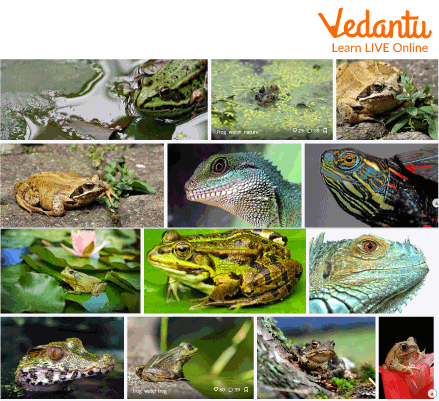
Core Ideas and Fundamental Characteristics of Amphibia
To understand Amphibia fully, it is necessary to focus on their main characteristics, body structure, and adaptations, which make them different from other vertebrate groups.
Key Features of Amphibians
- Amphibians are ectothermic (cold-blooded), meaning their body temperature depends on the environment.
- They have moist, smooth, or sometimes rough skin without scales, which helps in respiration.
- Animals in this class usually lay eggs in water. Their eggs lack a hard shell and are covered by a gelatinous substance.
- Young amphibians (larvae) typically breathe with gills, while adults use lungs, skin, and in some species, the lining of the mouth for respiration.
- Most have a three-chambered heart (two atria and one ventricle).
- Show metamorphosis - a dramatic transformation from larva to adult.
Examples of Amphibians
- Frogs (e.g., Rana tigrina)
- Toads (e.g., Bufo bufo)
- Salamanders (e.g., Ambystoma)
- Caecilians (e.g., Ichthyophis)
Important Sub-Concepts Related to Amphibia
Several sub-concepts add depth to the topic of Amphibia and are frequently tested in NEET. Understanding these well will help you answer both direct and application-based questions.
Metamorphosis in Amphibians
One of the most important features of amphibians is metamorphosis. Amphibian larvae (like tadpoles in frogs) undergo a transformation where they develop legs, lose their tails, and shift from gills to lungs and skin for breathing, eventually becoming adults. Recognizing this process helps students understand evolutionary adaptation and life cycles.
Respiratory Adaptations
Amphibians use different organs to breathe at different life stages: gills as larvae, lungs and moist skin as adults. Cutaneous respiration (through the skin) is significant and unique to this group. NEET questions often focus on these adaptations and their significance.
Amphibian Circulatory System
Amphibians have a three-chambered heart, which results in mixing of oxygenated and deoxygenated blood. Understanding this circulatory arrangement highlights their adaptation level compared to fishes and reptiles.
Classification of Amphibia
The class Amphibia is divided into three main orders:
- Anura (frogs and toads)
- Caudata/Urodela (salamanders)
- Apoda/Gymnophiona (caecilians)
Key Principles, Unique Features, and Adaptations of Amphibia
Amphibians display several unique principles and adaptations that highlight their evolutionary position between fishes and reptiles.
Principles and Adaptations
- Metamorphosis: The larval stage is aquatic and breathes through gills, while the adult is generally semi-terrestrial and uses lungs and skin for respiration.
- Parental care: Some amphibians show unique methods of caring for their eggs and young, such as carrying tadpoles on their backs or in their mouths.
- Protective coloration: Many amphibians can camouflage themselves in their surroundings, helping them survive predators.
- Hibernation and aestivation: Amphibians survive harsh winters and dry summers by entering states of dormancy.
Comparison of Amphibia with Other Vertebrate Classes
| Feature | Amphibia | Reptilia |
|---|---|---|
| Skin | Moist, glandular, without scales | Dry, scaly |
| Respiration | Skin, lungs, gills (larva) | Lungs only |
| Heart Chambers | 3 (2 atria, 1 ventricle) | 3 or 4 (crocodiles: 4) |
| Egg Type | Without shells, in water | Leathery shells, laid on land |
This comparison helps students remember how Amphibia stand between fishes and reptiles in the evolutionary tree and why their adaptations are important.
Importance of Amphibia for NEET
Amphibia is a NEET-important topic because it covers major ideas like animal classification, adaptations, and evolutionary biology. Concepts from Amphibia are often linked with questions about animal physiology, developmental biology (like metamorphosis), and vertebrate comparison. A solid understanding can help you solve direct MCQs, assertion-reason questions, and even complex, passage-based questions. It connects well with related NEET topics such as animal kingdom, evolution, and environmental adaptation, forming a foundational block for biological understanding.
How to Study Amphibia Effectively for NEET
- Start by reading the textbook for basic definitions, examples, and the life cycle of amphibians.
- Learn the unique features that distinguish Amphibia from other vertebrates - use tables or charts for visual memory.
- Make flowcharts for processes like metamorphosis and respiration.
- Use diagrams and labelled images (like the one above) to understand structure and classification.
- Practice MCQs from past NEET papers on Amphibia. Focus on exceptions and factual differences.
- Revise using concise notes focused on differences between Amphibia and other classes.
- Test your recall and understanding of both direct features and related sub-concepts (e.g., metamorphosis, respiration).
Common Mistakes Students Make in Amphibia
- Confusing amphibians with reptiles, especially regarding skin type and respiration.
- Forgetting the distinction between larval and adult respiratory systems.
- Missing the importance of moist skin for respiration.
- Overlooking exceptions or examples provided in textbook illustrations.
- Not remembering the orders of Amphibia and their representative animals.
Quick Revision Points on Amphibia (For NEET)
- Amphibians are cold-blooded vertebrates living on land and water (dual life).
- Skin is moist and without scales - functions in respiration.
- Show metamorphosis - aquatic larvae (with gills) to terrestrial adults (with lungs and cutaneous respiration).
- Heart has three chambers - allows mixing of blood.
- Eggs are laid in water, are covered in jelly, not a hard shell.
- Include frogs, toads, salamanders, and caecilians.
- Form a middle group in evolution between fishes and reptiles.
- Frequently asked in NEET - focus on life cycle, respiration, and adaptation.
FAQs on Biology Amphibia NEET Complete Overview
1. What are the main characteristics of Amphibia for NEET exam?
Amphibia are vertebrates that can live both in water and on land, which is key for NEET. Main characteristics include:
- Moist, glandular skin without scales
- Three-chambered heart for circulation
- Lungs and skin for respiration (cutaneous, buccal, and pulmonary)
- Cold-blooded (ectothermic) nature
- Metamorphosis from larval stage to adult
- Presence of limbs (usually four, except in some caecilians)
2. How are amphibians different from reptiles? [NEET]
Amphibians and reptiles differ in several key NEET syllabus points. Main differences:
- Skin: Amphibians have moist, glandular skin; reptiles have dry, scaly skin.
- Egg laying: Amphibians lay eggs in water; reptile eggs have leathery shells and are laid on land.
- Respiration: Amphibians respire through lungs, skin, and buccal cavity; reptiles use lungs only.
- Metamorphosis: Amphibians show larval stages; reptiles do not.
3. Which organisms are included in class Amphibia? [NEET syllabus]
Class Amphibia includes organisms that demonstrate a dual mode of life. Examples important for NEET include:
- Frogs (e.g., Rana tigrina)
- Toads (e.g., Bufo melanostictus)
- Salamanders (e.g., Salamandra)
- Newts
- Caecilians (Gymnophiona, e.g., Ichthyophis)
4. What is metamorphosis in amphibians for NEET?
Metamorphosis in Amphibia is the biological process by which a larva transforms into an adult. For NEET, key points are:
- Egg → Tadpole (larva) → Adult stages
- Changes include development of limbs, loss of gills, and lung formation
- Essential for adaptation to terrestrial environment
5. What are the adaptations of amphibians for terrestrial life? [NEET 2024 Expected Question]
Amphibians possess several adaptations for terrestrial survival:
- Development of lungs for air breathing
- Presence of eyelids for eye protection
- Well-developed limbs for locomotion
- Moist skin for cutaneous respiration
- Tympanum (ear drum) for hearing airborne sounds
These adaptations are vital for success in NEET Biology questions regarding amphibian evolution.
6. What is the circulatory system of Amphibia? [NEET relevant]
Amphibians have a closed circulatory system with a three-chambered heart. Key facts for NEET include:
- Two atria and one ventricle
- Double circulation but some mixing of oxygenated and deoxygenated blood
- Helps in efficient distribution of oxygen into blood and body tissues
7. How do amphibians breathe? [NEET Previous Year Question]
Amphibians use multiple modes of respiration, a frequent NEET question:
- Gills (larval stage/tadpoles)
- Lungs (adults)
- Skin (cutaneous respiration, all stages)
- Buccopharyngeal membrane
8. Name three examples of amphibians. [Scraped NEET FAQ]
Common examples of amphibians for NEET exams include:
- Frog (Rana tigrina)
- Toad (Bufo melanostictus)
- Salamander (Salamandra)
9. What is the habitat of amphibians? [Scraped NEET FAQ]
Most amphibians inhabit moist environments suitable for their lifecycle. Typical habitats include:
- Ponds, freshwater bodies, and marshes for breeding and larval development
- Moist terrestrial regions, under logs and leaves for adults
10. Why are amphibians called cold-blooded animals? [Scraped NEET FAQ]
Amphibians are termed cold-blooded (ectothermic) because they cannot regulate their body temperature internally.
- Their body temperature changes with environmental temperature
- They rely on external sources for warmth
11. What is the significance of amphibians in evolution? [Scraped NEET FAQ]
Amphibians mark a significant evolutionary transition from aquatic to terrestrial life. Main evolutionary points:
- First vertebrates to adapt to land
- Developed lungs and limbs
- Showed metamorphosis for life cycle adaptation
12. State the importance of moist skin in amphibians. [Scraped NEET FAQ]
Moist skin in amphibians is vital for gas exchange (cutaneous respiration), crucial for NEET Biology:
- Allows continuous absorption of oxygen and release of carbon dioxide
- Compensates for underdeveloped lungs in some species
