








How Does DNA Replication Occur in NEET Biology? Steps, Enzymes, and Functions
DNA replication is a crucial biological process where cells make exact copies of their genetic material before division. For NEET aspirants, clear understanding of DNA replication is essential because it forms the foundation for genetics, cell biology, and molecular biology. Questions based on this topic often test conceptual clarity and the ability to connect it with DNA structure, enzymes, and genetic inheritance. Mastering DNA replication not only boosts exam preparation but also strengthens basic biology knowledge needed for medical studies.
What is DNA Replication?
DNA replication is the process by which a cell duplicates its DNA, ensuring that each daughter cell receives an identical set of genetic instructions during cell division. It occurs in the nucleus of eukaryotic cells during the S-phase of the cell cycle. The mechanism follows a semi-conservative mode, where each original strand serves as a template for the new strand. This concept is fundamental for understanding how life passes genetic information across generations and is frequently tested in NEET Biology.
Core Ideas and Fundamentals of DNA Replication
1. Structure of DNA
DNA is a double-stranded helix, where each strand consists of a backbone of deoxyribose sugar and phosphate groups, linked by nitrogenous bases (adenine, thymine, cytosine, guanine). The double helix unwinds during replication, making each strand accessible as a template.
2. Semi-Conservative Replication
DNA replication is semi-conservative: after replication, each new DNA molecule contains one parental (old) strand and one newly-synthesized strand. This model was proved by Meselson and Stahl’s experiment, a renowned study for NEET exams.
3. The Replication Fork
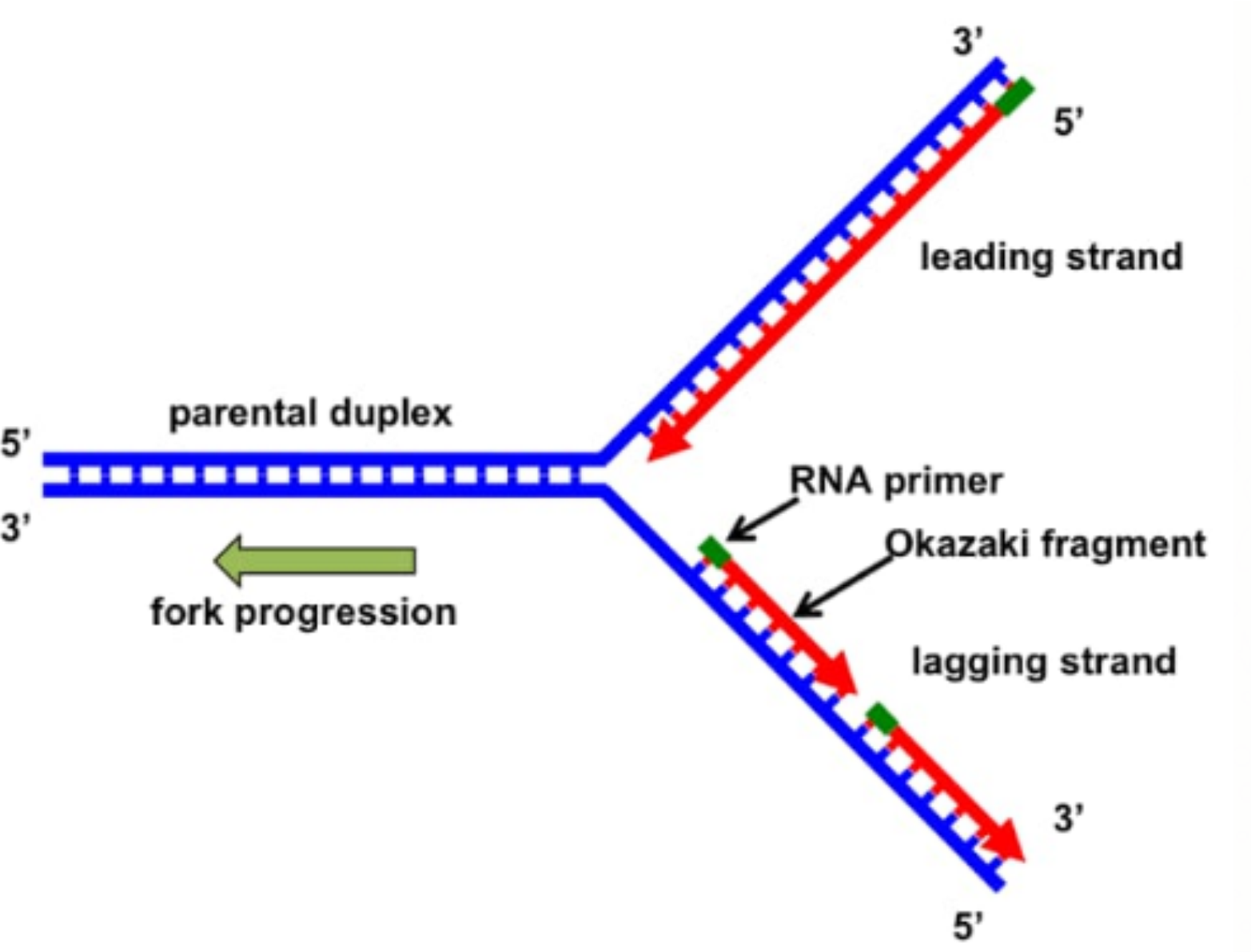
A replication fork forms where the double-stranded DNA is unwound. Helicase enzyme opens the helix, creating a 'Y'-shaped structure. Both leading and lagging strands synthesize new DNA at this fork, but in different ways.
4. Enzymes Involved
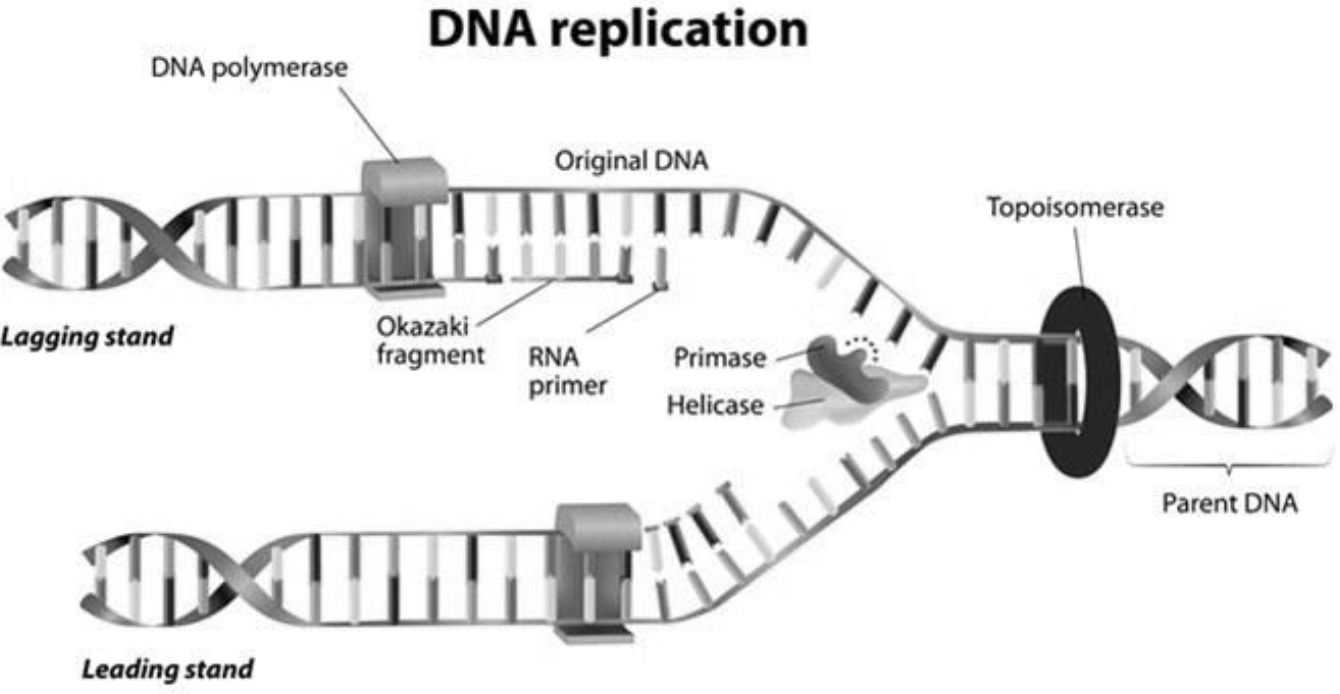
- Helicase - Unwinds the double helix
- Single-stranded binding proteins (SSBPs) - Stabilize unwound strands
- Primase - Synthesizes RNA primers
- DNA polymerase - Adds nucleotides to growing strand
- Ligase - Joins Okazaki fragments on the lagging strand
- Topoisomerase - Relieves tension ahead of replication fork
Key Sub-Concepts in DNA Replication
Leading and Lagging Strand Synthesis
Replication on both strands occurs in the 5' to 3' direction, but because the two strands are antiparallel, their synthesis mechanisms differ. The leading strand is synthesized continuously, while the lagging strand is synthesized discontinuously in short fragments known as Okazaki fragments.
Okazaki Fragments and DNA Ligase
On the lagging strand, DNA polymerase synthesizes short DNA fragments using RNA primers. DNA ligase then joins these Okazaki fragments to form a continuous strand. This aspect is commonly tested in NEET with diagram-based or statement-based questions.
Role of Primase and Primers
Primase synthesizes short RNA primers that provide a starting point for DNA polymerase, as the enzyme cannot start synthesis from scratch. Once the primers are in place, DNA polymerase extends from these points.
Enzyme Specificity
Each enzyme involved in DNA replication has a specific role and directionality. Being familiar with their functions helps in solving NEET MCQs that ask about their precise actions or order.
Principles and Major Relationships in DNA Replication
Base Pairing Rules
DNA replication strictly follows the base pairing rules: Adenine pairs with Thymine (A-T), and Cytosine pairs with Guanine (C-G). This ensures accuracy in copying genetic information. Any mismatch can lead to mutations.
Directionality: 5' to 3'
DNA polymerases can only add nucleotides to the 3’ end, leading to replication occurring in the 5’ to 3’ direction. This fundamental property helps explain the continuous and discontinuous synthesis on the two strands.
Semi-Conservative Nature of Replication
Each new DNA molecule consists of one original and one new complementary strand, preserving half of the original molecule. This property ensures genetic fidelity and is an essential principle for MCQs in NEET.
Main Steps of DNA Replication
- Initiation - The replication origin is identified, and the DNA helix is unwound.
- Primer Synthesis - Primase creates short RNA primers for DNA polymerase to start synthesis.
- Elongation - DNA polymerase adds nucleotides along both leading and lagging strands.
- Primer Removal and Replacement - RNA primers are removed and replaced with DNA nucleotides.
- Ligation - DNA ligase seals gaps between Okazaki fragments to complete the strand.
- Termination - Replication stops when the full DNA molecule is copied.
Why is DNA Replication Important for NEET?
DNA replication is directly tied to fundamental genetics, inheritance, biotechnology, and cell division topics frequently asked in NEET. Many questions test whether students properly understand how genetic information is duplicated and passed on. Mastering this concept improves the ability to answer questions related to mutations, enzyme function, DNA repair, and the application of molecular biology methods. It also connects directly to higher-level concepts like gene expression and biotechnology techniques.
How to Study DNA Replication Effectively for NEET
- Visualize the process with diagrams and attempt to redraw the DNA replication fork and enzymes involved.
- Memorize the sequence of steps and the role of each enzyme in the replication process.
- Use NEET-focused question banks to solve MCQs that test both direct and application-based understanding.
- Revise base pairing rules, directionality, and difference between leading and lagging strands regularly.
- Explain the process in your own words or teach a peer - it helps clarify gaps in understanding.
- Focus on commonly confused enzymes and their functions to avoid silly mistakes in exam.
- Review and attempt previous years’ NEET questions on DNA replication for practice.
Common Mistakes Students Make in DNA Replication
- Confusing the leading and lagging strand synthesis mechanisms.
- Misunderstanding the directionality (5’ - 3’) of DNA synthesis.
- Forgetting the specific roles of enzymes like primase, ligase, or topoisomerase.
- Neglecting the importance of the semi-conservative nature of DNA replication.
- Mistaking RNA primers for DNA fragments in the formation of Okazaki fragments.
- Ignoring error correction and proofreading steps done by DNA polymerases.
Quick Revision Points for DNA Replication
- DNA replication occurs during the S-phase of the cell cycle.
- Semi-conservative: each new molecule has one old and one new strand.
- Key enzymes: Helicase, Primase, DNA polymerase, Ligase, Topoisomerase, SSBPs.
- Replication fork: site where DNA is actively unwound and copied.
- Leading strand synthesized continuously, lagging strand discontinuously (Okazaki fragments).
- Base pairs: A-T and C-G, essential for accuracy in copying genetic code.
- RNA primers are necessary for DNA polymerase to start synthesis.
- DNA ligase seals gaps between Okazaki fragments on lagging strand.
- Clamp proteins help hold polymerase in place during DNA synthesis.
FAQs on DNA Replication in NEET Biology: Complete Explanation and Process
1. What is DNA replication and why is it important for NEET Biology?
DNA replication is the process by which a cell makes an exact copy of its DNA before cell division, and it is a crucial topic in NEET Biology as it ensures genetic information is transmitted accurately from parent to daughter cells.
Key points:
- DNA replication occurs during the S-phase of the cell cycle.
- It guarantees genetic continuity during cell division.
- Essential for growth, repair, and reproduction in living organisms.
2. What is the semi-conservative model of DNA replication?
The semi-conservative model of DNA replication means that each new DNA molecule consists of one original (parental) strand and one newly synthesised strand.
Features of the model:
- Each strand of the parental DNA acts as a template.
- Meselson and Stahl's experiment proved this model in 1958.
- This mechanism ensures genetic stability across generations.
3. Which enzymes are involved in DNA replication?
Several specific enzymes participate in DNA replication, playing key roles in the accurate duplication of genetic material required for NEET Biology.
Major enzymes involved:
- DNA helicase: Unwinds the double helix.
- DNA polymerase: Synthesizes new DNA strands.
- Single-strand binding proteins (SSBs): Stabilize unwound strands.
- Primase: Lays down RNA primers.
- DNA ligase: Joins Okazaki fragments on the lagging strand.
4. How does DNA replication occur step by step?
DNA replication occurs in a series of coordinated steps, ensuring the accurate copying of genetic information for cell division and NEET Biology.
Steps involved:
- Initiation: Origin recognition and unwinding of DNA by helicase.
- Primer synthesis: Primase creates short RNA primers.
- Elongation: DNA polymerase adds nucleotides using the template strand.
- Leading and lagging strand synthesis: Continuous and discontinuous synthesis, respectively.
- Joining: DNA ligase seals gaps between Okazaki fragments.
5. Why is DNA replication called semi-discontinuous?
DNA replication is termed semi-discontinuous because one strand (leading) is synthesized continuously, while the other (lagging) is synthesized in short segments.
Key points:
- Leading strand is made in a single piece moving towards replication fork.
- Lagging strand forms as Okazaki fragments moving away from fork.
- Fragments are later joined by DNA ligase.
6. What is the role of DNA polymerase in DNA replication?
DNA polymerase is the primary enzyme responsible for synthesizing new DNA strands by adding complementary nucleotides during replication, a common NEET exam concept.
Main roles:
- Reads the template and adds correct nucleotides.
- Ensures fidelity and proofreading for error correction.
- Different types (e.g., DNA polymerase I, III in prokaryotes) have specialized functions.
7. How is DNA replication different in prokaryotes and eukaryotes?
DNA replication shows key differences between prokaryotes and eukaryotes, often asked in NEET.
Major distinctions:
- Prokaryotes: Single origin of replication, faster rate, circular DNA.
- Eukaryotes: Multiple origins, slower rate, linear chromosomes.
- Eukaryotes have more complex regulatory mechanisms and additional enzymes.
8. What is an Okazaki fragment?
Okazaki fragments are short, newly synthesized DNA segments formed on the lagging strand during DNA replication.
Key facts for NEET:
- DNA ligase joins these fragments together.
- They arise due to discontinuous synthesis away from the replication fork.
- Essential for completion of lagging strand synthesis.
9. What is the significance of the origin of replication?
The origin of replication is a specific DNA sequence where replication begins, ensuring timely and accurate DNA copying which is frequently tested in NEET.
Significance:
- Initiates DNA unwinding by enzymes like helicase.
- In prokaryotes, there is a single origin; eukaryotes have multiple origins.
- Regulates the timing of replication process.
10. What is the function of RNA primer in DNA replication?
The RNA primer is a short segment required to initiate the synthesis of new DNA strands during replication.
Main roles:
- Laid down by the enzyme primase.
- Provides a free 3'-OH group for DNA polymerase to start adding nucleotides.
- Later removed and replaced with DNA.
11. Which experiment proved the semi-conservative nature of DNA replication?
The semi-conservative nature of DNA replication was proven by the Meselson and Stahl experiment in 1958.
Key points:
- Used Escherichia coli bacteria and nitrogen isotopes (N15 and N14).
- Demonstrated that each daughter DNA molecule contains one parental and one new strand.
- This experiment is a high-yield topic for NEET Biology exams.
12. What are the key steps involved in the DNA replication process in NEET syllabus?
The key steps of DNA replication in NEET syllabus are initiation, elongation, and termination—each vital for genetic fidelity.
Steps include:
- Initiation: Opening of DNA at replication origin.
- Elongation: Building new strands via DNA polymerase.
- Termination: Completion and disassembly of the replication machinery.
