




Stepwise Answer Guide: Class 7 English Chapter 9 Questions and Answers
North South East West Question Answer – Let Us Do These Activities Before We Read. (Page 118)
I. Work in pairs. Discuss the place that you have enjoyed travelling to. Talk about who you went with, how you travelled, and what you learnt from the experience.
Answer: I once took a trip to Nainital with my family. We travelled by car, and the drive through the hills was stunning. I enjoyed seeing the lake and going boating with my parents. We also visited the zoo and saw many animals. This trip taught me how calm and soothing nature can be and how important it is to care for the environment. I also realised that travelling with family makes every moment more fun and memorable.
II. Which State or Union Territory of India do you live in? Write the following details about it.
1. Part of the country—North, East, Northeast, West, South or Centre
2. Its capital
3. Language
4. River(s)
5. Tourist attraction
6. Food
Answer:
1. West Bengal.
1. East
2. Kolkata
3. Bengali
4. Hooghly, Ganga, Teesta
5. Sundarbans, Darjeeling, Victoria Memorial, Howrah Bridge
6. Shukto, Alur Dom with Luchi, Beguni, Sandesh, Roshogolla, Pithe.
III. Work in pairs. Recall the names of the states of our country which have ‘Pradesh’ in their names. Mention if it is in the North, East, Northeast, West, South or Centre of our country. Recall any special feature about each ‘Pradesh’. Share your answers with your classmates and the teacher.
Answer:
North South East West Class 7 Question Answer – Let us discuss (Page 125)
Complete the table given below based on Shaana’s postcards. An example has been done for you. Share your answers with your classmates and the teacher.
Answer:
Class 7 English North South East West Question Answer – Let us think and reflect (Pages 126-127)
I. Read the extracts given below and answer the questions that follow.
Question 1. Amma tells me that places like the Sundarbans are called wetlands. I never knew such a place existed, and that it was possible for trees called mangroves to grow in seawater! But Amma is sad about how much this place floods today.
We also saw crocodiles and a lonely snake while boating. I hope they don’t follow us home.
How is everyone? Are you missing me yet?
(i) What feeling does Shaana most likely experience when she says, “I never knew such a place existed…”?
A. pride
B. hope
C. relief
D. wonder
Answer: D. Wonder
(ii) Complete the following sentence with a suitable reason.
Amma is sad about the frequent flooding in Sundarbans because ____________.
Answer: the place is now flooding.
(iii) Select the evidence from the text that reflects a feeling of the speaker’s slight nervousness.
Answer: The line “I hope they don’t follow us home,” said after seeing crocodiles and a lone snake while boating, reveals that the speaker feels a little nervous or uneasy about the wild animals.
(iv) Select the option that applies to both the Assertion and the Reason.
Assertion: The speaker is missing her friends.
Reason: The speaker wishes to know the well-being of her friends.
A. Both the assertion and the reason are true, and the reason correctly explains the assertion.
B. Both the assertion and the reason are true, but the reason does not correctly explain the assertion.
C. The assertion is true, but the reason is false.
D. Both the assertion and the reason are false.
Answer: A. Both the Assertion and Reason are true and the reason correctly explain the assertion.
Explanation:
In the text, Shaana writes to her classmates and ends her letter with, “How is everyone? Are you missing me yet?” This shows she is thinking about her friends and wondering if they miss her, which means she is missing them too. So, both the assertion and the reason are correct, and the reason properly explains the assertion.
Question 2. Amma and Appa are fast asleep, and I should be sleeping too, but I just love looking out of the window. I think we’re in the southwest part of the country, in Goa, and you won’t believe how nice the plateaus look. There are so many hills here, and beaches too.
There are also a lot of tunnels that the train goes through. I used to be afraid of tunnels, but I’m not any more. Someday, I wish we could all go on a tour of the plateaus.
(i) Complete the sentence with a suitable reason.
The speaker chooses to stay awake because ____________.
Answer: she wants to experience the beautiful plateaus, hills and beaches.
(ii) What does the speaker mean by saying, you won’t believe how nice the plateaus look’?
Answer: The speaker means that the plateaus are so stunning that her friends might not believe it unless they see them in person.
(iii) What has been the change in the speaker’s attitude towards tunnels?
A. from fear to comfort
B. from courage to confidence
C. from doubt to clarity
D. from fascination to delight
Answer: A. from fear to comfort.
(iv) Fill in the blanks with the correct option from those given in the brackets.
The speaker’s wish to share the experience of touring the plateaus with others indicates her ____________ (ability to communicate/sense of connection) as well as the value she places on ____________ (shared experiences/updating information) with her peers.
Answer: sense of connection; shared experience.
II. Answer the following questions.
Question 1. Shaana mentions that she used to be afraid of tunnels. What could have been the most likely reason for her to be scared of tunnels?
Answer: Shaana says she used to be scared of tunnels, which is common among young children. At that age, children are often afraid of the dark.
Question 2. Do you think Shaana’s Appa and Amma enjoyed themselves, just like children do? Support your answer with evidence from the text.
Answer: Shaana’s appa and amma had fun playing like children, tossing snowballs and splashing water at each other. They were also excited about going scuba diving.
Question 3. Shaana mentions less snow in the glaciers and more flooding in the SundarbAnswer:Explain what these observations indicate.
Answer: Shaana’s remarks about reduced snow on the glaciers and increased flooding in the Sundarbans point to the impacts of climate change and global warming.
Question 4. Shaana’s visits to different parts of the country highlight the diversity of India’s geography. Support this statement with evidence from the text.
Answer: Shaana’s travels across different parts of the country highlight the diversity of India’s geography. She talks about the snow-covered glaciers of Kashmir and Himachal Pradesh, the thick forests of Arunachal Pradesh, the wetlands of the Sundarbans, the desert landscapes of Gujarat, and finally the coastal regions and beaches.
Question 5. How did Shaana use language to convey her excitement, curiosity, and sometimes her fears about the places she visits?
Answer: Shaana uses vivid language to show her excitement, asks questions to express curiosity, and uses short, tense sentences to convey fear. She describes what she sees, hears, and feels to make each place come alive. Her words are energetic when she’s excited, thoughtful when she’s curious, and dark or tense when she is afraid.
Question 6. What might Shaana have learnt from her travels across India? How would it impact her understanding of the country?
Answer: Shaana may have learned about India’s varied landscapes, cultures, and environmental challenges. This would help her appreciate the country’s diversity and understand why it is important to care for both its people and its natural surroundings.
Question 7. What could be the author’s purpose of presenting the text in the form of postcards?
Answer: The author uses postcards to make the text feel more personal and interesting. Through them, Shaana shares her thoughts and experiences briefly yet vividly, helping readers feel as if they are travelling with her. The story becomes relatable because of the way she recounts moments from her trip.
North South East West Class 7 Questions and Answers – Let us learn (Pages 128-131)
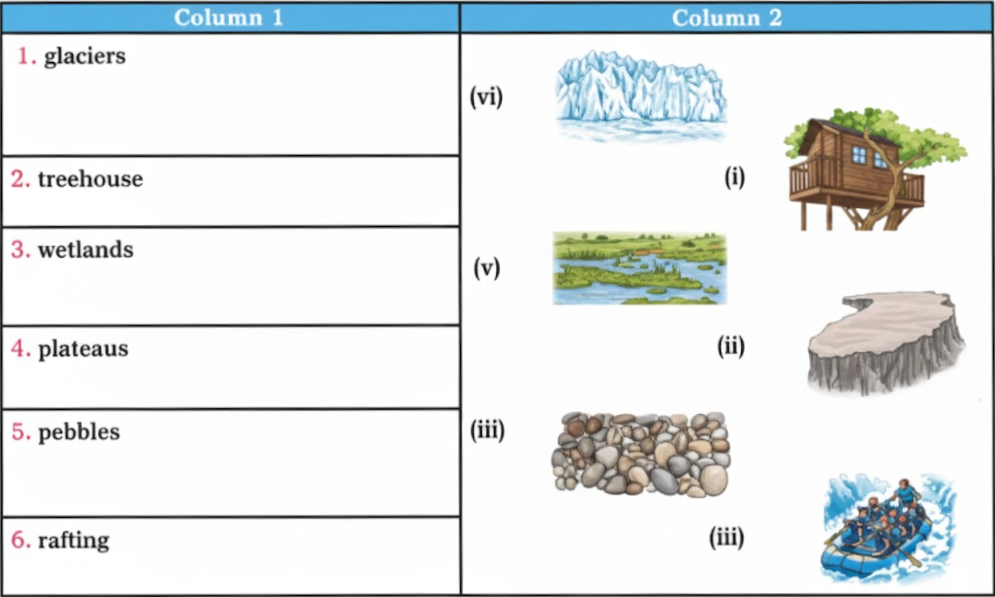
I. Read the words from the text given in Column 1 and match them with suitable pictures in Column 2.
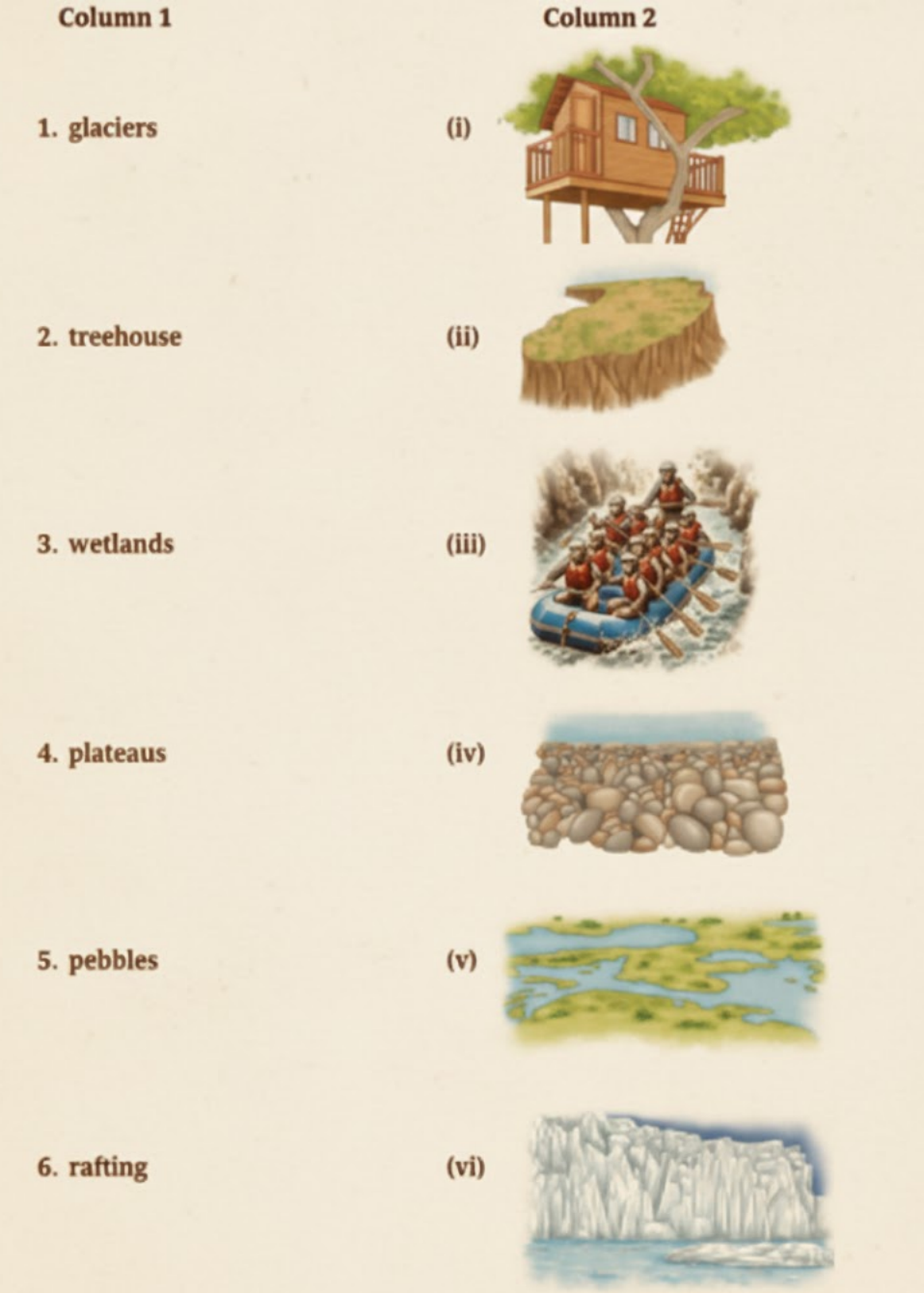
Answer:
II. Read the situations given in Column 1. Choose the associated words from the text given in the box below and write them in Column 2. An example has been done for you.
Answer:
III. The following word grid has six words related to ‘travel’ used in the lesson. Circle the words in the grid. You can search horizontally and vertically. The last letter of each word has been highlighted.
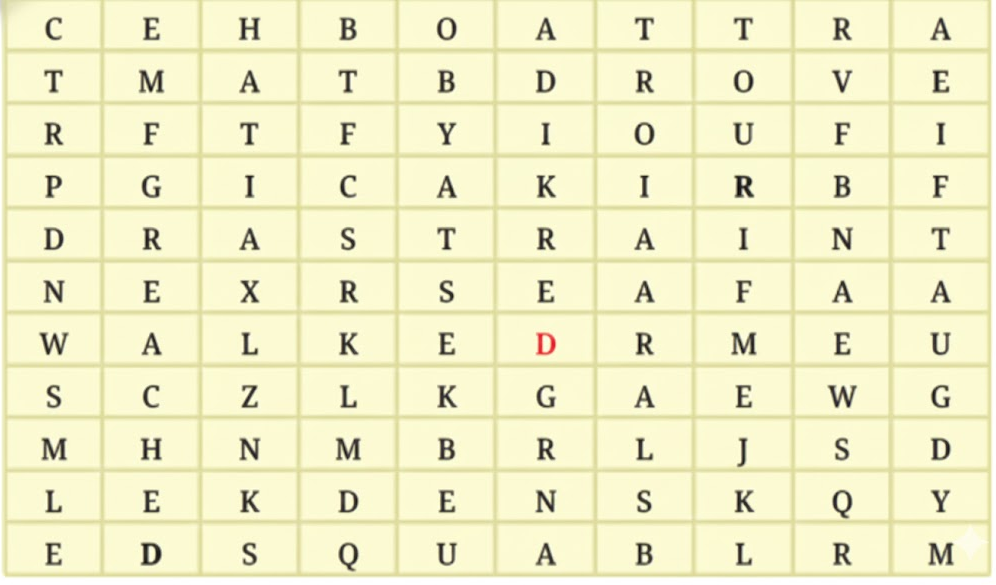
Answer:
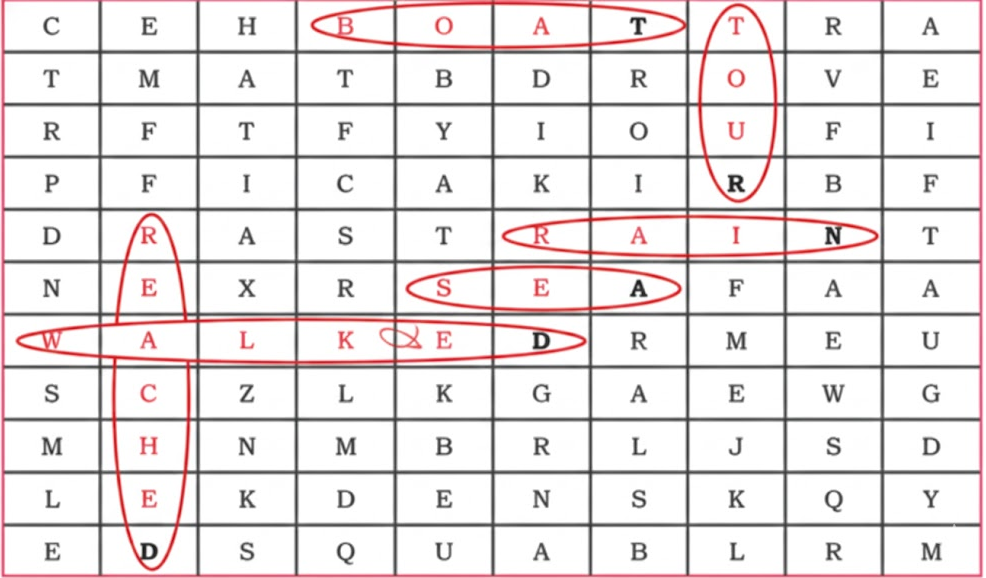
IV. Read the following sentences from the text and underline the subject and the verb.
Question 1. Amma and Appa are fast asleep.
Answer: Subject: Amma and Appa Verb: are
GOLDEN GRAMMAR TIPS
When the subject is plural, meaning it refers to more than one person or thing, a plural verb is used.
Question 2. It’s hot, dry, and there is sand everywhere.
Answer:
Subject: (First Clause): It Verb: is
Subject: (Second Clause): There Verb: is
GOLDEN GRAMMAR TIPS
When the subject is ‘it’, we use a singular verb. ‘It’ is treated as a singular subject, even when referring to things, time, weather, or situations.
Question 3. There are so many hills here, and beaches too.
Answer: Subject: so many hills and beaches Verb: are
GOLDEN GRAMMAR TIPS
In sentences starting with “there’ the verb comes before the subject.
GOLDEN GRAMMAR TIPS
Subject-verb agreement means that the verb must match the subject in number and person.
A singular subject takes a singular verb.
A plural subject takes a plural verb.
Students to Read the Text from NCERT Textbook on Page 130.
V. Choose the correct option from the words given in the brackets.
1. A pair of sunglasses _________ (is/are) essential when travelling to sunny destinations.
2. Either the tour guide or the tourists _________ (has/have) to arrive first at the meeting point.
3. The information on travel expenses _________ (is/are) useful for firsttime travellers.
4. Neither the flght crew nor the pilot _________ (was/were) aware of the delay.
5. The news about the heavy rains _________ (makes/make) many people reconsider their vacation plans.
6. A pair of binoculars _________ (is/are) useful for spotting wildlife on a safari.
7. The hill stations in India _________ (remains/remain) a popular travel destination during winter.
8. Keeping accounts _________ (is/are) important for spending money wisely during travel.
9. Either the ticket or the bus passes _________ (need/needs) to be used for travelling in the tourist bus.
10. Neither the passengers nor the taxi driver _________ (was/were) aware of the best route to the hotel.
Answer:
1. A pair of sunglasses is (is/are) essential when travelling to sunny destinations.
2. Either the tour guide or the tourists have (has/have) to arrive first at the meeting point.
3. The information on travel expenses is (is/are) useful for first time travellers.
4. Neither the flight crew nor the pilot was (was /were) aware of the delay.
5. The news about the heavy rains makes (makes/make} many people reconsider their vacation plans.
6. A pair of binoculars is (is/are) useful for spotting wildlife on a safari.
7. The hill stations in India remain (remains/remain) a popular travel destination during winter.
8. Keeping accounts is (is/are) important for spending money wisely during travel.
9. Either the ticket or the bus passes need (need/needs) to be used for travelling in thejtourist bus.
10. Neither the passengers nor the taxi driver was (was/were) aware of the best route to the hotel.
North South East West Question Answer Class 7 – Let us listen (Pages 131-132)
1. You will listen to a girl speak about the story of how Agartala got its name and the importance of agar. As you listen, choose the correct option for the questions given below. (Transcript for the teacher on page 138 from NCERT Textbook)
Question 1. What does the word ‘Agartala’ mean?
(i) under the agar tree
(ii) beside the agar tree
(iii) around the agar tree
Answer (i) under the agar tree
Question 2. Which of these is another name for agarwood trees?
(i) gharuwood
(ii) sandalwood
(iii) rosewood
Answer: (i) gharuwood
Question 3. What kind of smell does agarwood have?
(i) woody and citrusy
(ii) woody and flowery
(iii) fresh and citrusy
Answer: (ii) woody and flowery
Question 4. How is agarwood formed?
(i) when the tree dries
(ii) when the tree dies
(iii) when the tree gets infected
Answer: (iii) when the tree gets infected
Question 5. What is agarwood used to make?
(i) incense and edible oil
(ii) perfumes and wood carvings
(iii) gum and candies
Answer: (ii) perfumes and wood carvings
Class 7 English Chapter 9 Question Answer – Let us speak (Pages 132-133)
Read the questions listed below.
Which of the two given options do you prefer?
Question 1. How do you like to travel?
Bus
Train
Answer: Bus
Question 2. What kind of a trip do you like?
Family trip
School trip
Answer: School trip
Question 3. Where would you like to go?
Beaches
Mountains
Answer: Mountains
Question 4. What do you like to do on a trip?
Adventure activities
Sightseeing
Answer: Sightseeing
Question 5. When do you like to travel?
Winter
Summer
Answer: Winter
Question 6. What kind of places would you like to visit?
Historic monuments
Wildlife sanctuaries
Answer: Historic monuments
Question 7. How long of a trip would you like?
Short
Long
Answer: Long
(These answers are suggestive.)
Now, work in pairs and tell each other about your preferences with respect to the questions. You may use the phrases given below to speak about your choices
(i) I prefer… to… because…
(ii) I would rather… than… because…
(iii) I like… better than… as…
(iv) … is or are better than… because…
(v) … appeal or appeals to me more than… as…
(vi) I am alright with both, but I prefer… because…
(vii) Given a choice, I would go for… over… as…
Question 1. How do you like to travel?
Answer: I like travelling by bus because it is cheaper and allows me to enjoy the scenery through the window.
Question 2. What kind of a trip do you like?
Answer: I would choose a school trip over a family trip because I really enjoy travelling with my friends.
Question 3.Where would you like to go?
Answer: I prefer mountains to beaches because I enjoy the fresh air and the calm surroundings.
Question 4. What do you like to do on a trip?
Answer: I enjoy sightseeing more than adventure activities because I love discovering new places and cultures.
Question 5. When do you like to travel?
Answer: I’m fine with both, but I like winter more because the cooler weather makes travelling more comfortable.
Question 6. What kind of places would you like to visit?
Answer: If given a choice, I would love to visit historical monuments because I find history very fascinating.
Question 7. How long of a trip would you like?
Answer: I prefer long trips over short ones because they give me more time to explore and unwind.
NCERT Class 7 English Poorvi Chapter 9 Question Answer – Let us write (Page 133)
Imagine that you have to travel to your hometown to attend a family event. Write an application to the Principal of your school, requesting leave of absence. Remember to include the duration of the leave, the reason for the leave and mention how you will complete your school work. Use the format of the application and the verbal cues given below.
__________ (House no. and street)
__________ (City)
__________ (State or Union territory)
__________ (Date)
The Principal
__________ (Name of your school)
__________ (City)
__________ (State or Union territory)
Subject: Request for leave for ___ days
Dear __________ (Madam or Sir),
I am writing to request ______ days leave with effect from ______ to ______ in order to attend ______.
I would like to assure you that I would ______.
I would be grateful if you could grant me the leave.
Yours sincerely,
__________ (Name)
__________ (Class, Section, Roll Number)
Answer:
D-150, Sector-15
Noida (U.P.)
1st September, 2025
The Principal
Rosebud Public School
Karol Bagh, New Delhi
Subject: Request for Leave for 5 Days
Dear Madam,
I am writing to request five days of leave from 7.9.25 to 12.9.25 as I need to attend a family wedding in my hometown.
I assure you that I will complete all my schoolwork by taking notes from my classmates and keeping up with the lessons.
I would be grateful if you kindly grant me the leave.
Yours sincerely,
Sunny
Class 7A
Roll No. 34
Class 7th English Chapter 9 North South East West Question Answer – Let us explore (Pages 134—135)
I. Solve the crossword puzzle by identifying the States and Union Territories of India using the clues given.
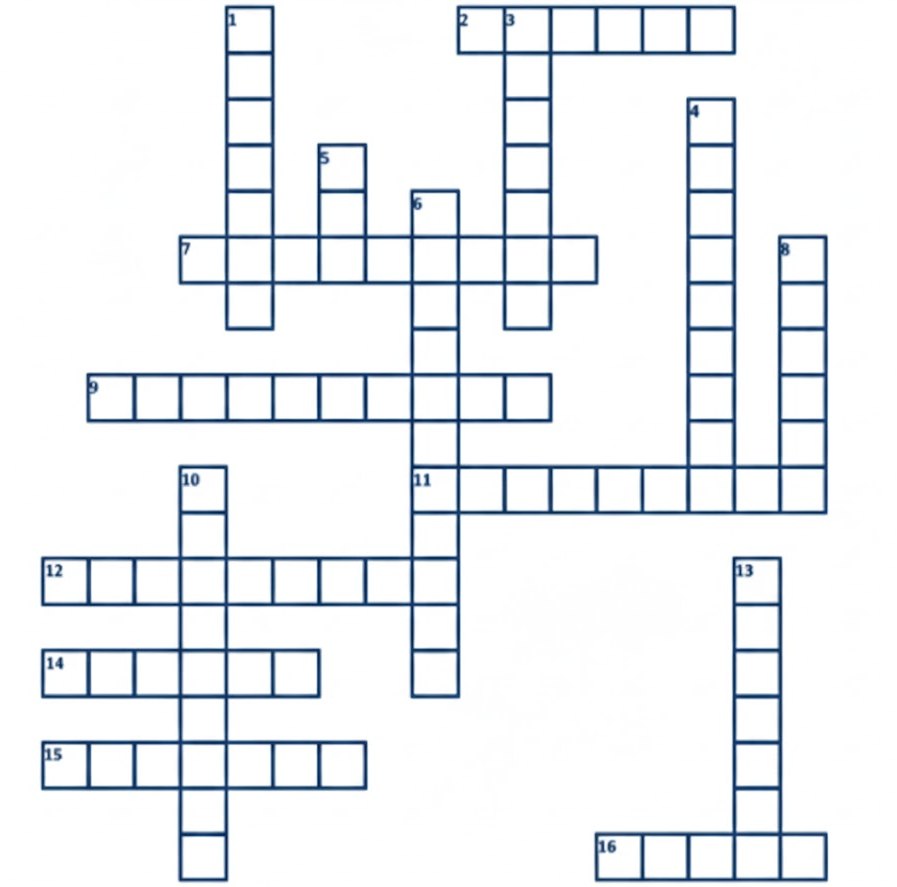
Across
2. Pangong Lake
7. Thar Desert
9. Serenity Beach
11. Hampi
12. Nagarjuna Sagar Dam
14. Thangka Paintings
15. Rann of Kutch
16. Nalanda University
Down
1. Dampa Tiger Reserve
3. Cellular Jail
4. Double Decker Living
Root Bridge
5. Dudhsagar Falls
6. Gangotri Glacier
8. Chilika Lake
10. Chota Nagpur Plateau
13. Kurukshetra
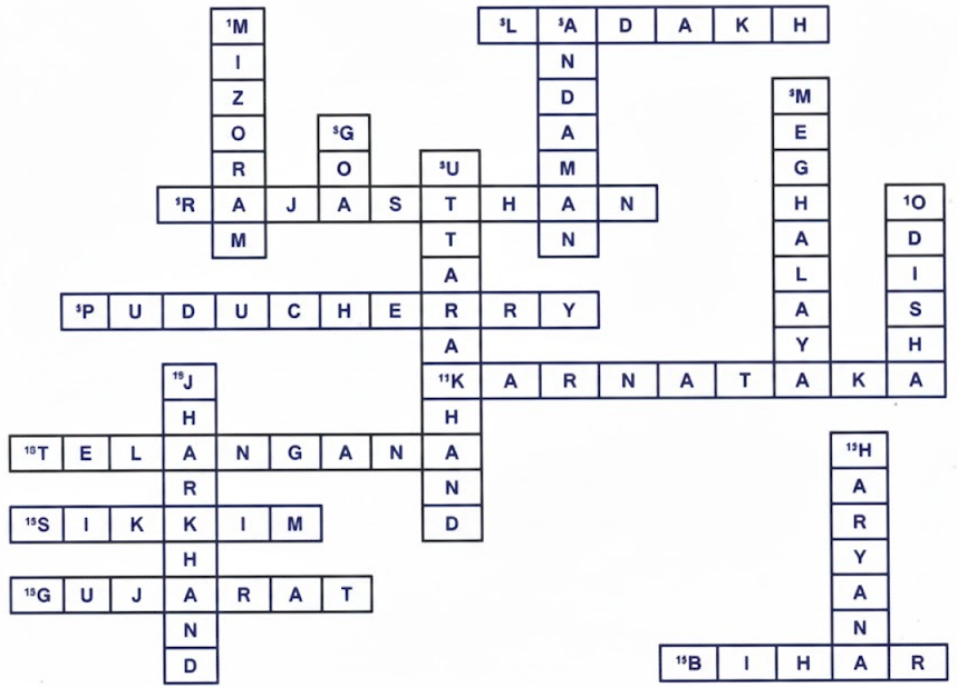
Answer:
II. There are many ancient places to visit in India. For example, Kailasa, the majestic cave temples of Ellora. They are offially listed on the World Heritage list by UNESCO. These caves were carved out of the vertical basalt cliffs of the Sahyadri hills. You may visit this site to know more about these caves https://indianculture.gov.in/stories/ kailasa-majestic-temple-ellora
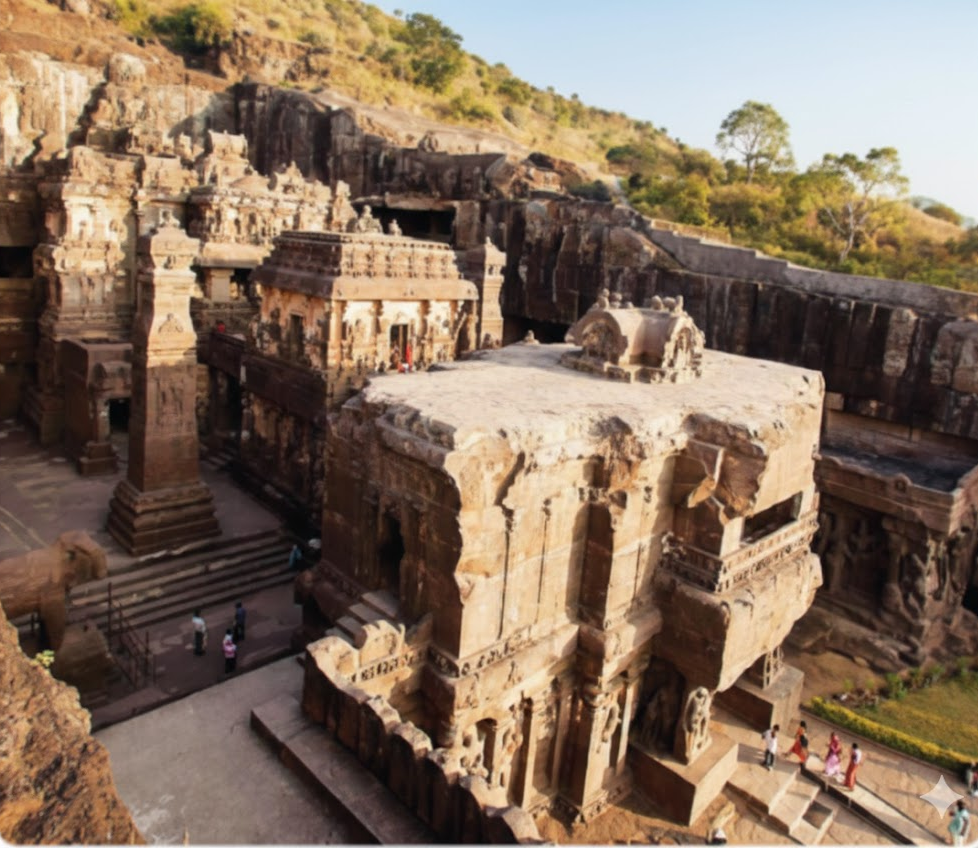
The Kailasa Temple Source: UNESCO
1. Rani-ki-Vav (the Queen’s Stepwell) is located at Patan, Gujarat and is also on the World Heritage list by UNESCO. Stepwells are a distinctive form of water resource and storage systems on the Indian subcontinent, and were constructed during ancient times. They evolved over time from what was basically a pit in sandy soil towards elaborate multi-storey works of art and architecture.
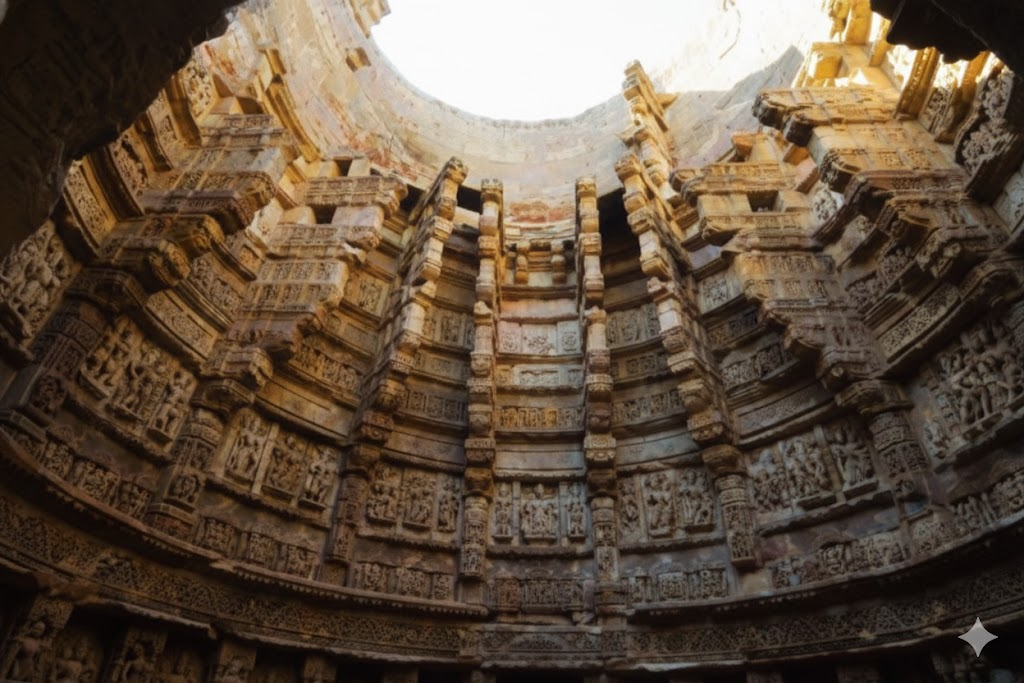
Rani-ki-Vav
Source: UNESCO
Now, find out about the unique places in your village, region or state and share the details with your classmates and the teacher.
Answer: Students should do it by themselves.
III. The Hornbill festival is a unique festival that is held annually in the Kisama village near Kohima, the capital of Nagaland. In groups of four, fid out about this festival—when it is held, who participates in it, what its purpose is, what events are held, etc. Share your fidings with your classmates and the teacher.

Answer: Students should do it by themselves.
NCERT Solutions Class 7 English Chapter 9 North, South, East, West – Key Concepts
Explore the diverse landscapes and cultures of India through NCERT Solutions Class 7 English Chapter 9 North, South, East, West. This chapter encourages students to appreciate the beauty and uniqueness of each region, building a strong foundation in geographical awareness.
By reading about Shaana’s travels from Kashmir to Puducherry, learners develop skills in observation and description. Practicing questions from NCERT Solutions 2026-27 sharpens their understanding and helps in scoring better marks in exams.
Make sure to revise the key places and main experiences for each destination. Regular revision with exercise-based solutions will boost your confidence and help you answer comprehension and vocabulary questions more effectively.
FAQs on NCERT Solutions For Class 7 English Chapter 9 North, South, East, West - 2026-27 Free PDF Download (Sign-in Required)
1. What are NCERT Solutions for Class 7 English Chapter 9: North, South, East, West?
NCERT Solutions for Class 7 English Chapter 9: North, South, East, West provide detailed, stepwise answers to all textbook questions to help students understand the story and score high marks.
- Includes summary, question answers, key definitions, and exam strategies
- Structured as per the latest CBSE syllabus (2026–27)
- Helps with revision and preparation through clear explanations
2. How can I write stepwise NCERT answers to score full marks in Class 7 English Chapter 9?
To score full marks, present each answer in a clear, stepwise format using key points from the chapter.
- Begin with a direct answer or definition
- Add examples or supporting details from the story
- Highlight keywords and important phrases
- Structure long answers with a brief introduction, main points, and a conclusion
3. Which questions are most important in "North, South, East, West" for the school exam?
The most important questions from "North, South, East, West" often include theme-based, character analysis, and summary-type questions.
- Character traits of Poorvi and main events
- Summary of the story
- Life lessons or moral from the story
- Meanings of new words and key definitions
4. Where can I download the NCERT Solutions PDF for Class 7 English Chapter 9?
You can download the free PDF of NCERT Solutions for Class 7 English Chapter 9 from trusted educational platforms.
- Look for a single-click PDF download link on the solution page
- Download for offline study and revision
5. How should I structure long answers in Class 7 English Chapter 9 for better marks?
For long answers, use a clear structure that matches CBSE marking schemes to maximise marks.
- Start with a brief introduction mentioning chapter/theme
- Present main points in ordered paragraphs or bullets
- Support answers with details from the chapter or story events
- End with a concise conclusion or personal reflection
6. Are diagrams or definitions mandatory in the answers for "North, South, East, West" Class 7?
Including key definitions is important, but diagrams or maps are only required if specifically asked in the question.
- Always define new words or characters if asked
- Label diagrams or maps neatly if required
7. What are the key definitions and summary from NCERT Solutions Class 7 English Chapter 9?
The key definitions from Chapter 9 focus on important terms and the main summary points of the story.
- Define characters: Poorvi, Mother, Father, story settings
- Summarise the central theme: self-discovery and understanding one’s roots
- List any new vocabulary or phrases given in the text
8. How do CBSE marking schemes affect how I should answer questions in Class 7 English Chapter 9?
CBSE marking schemes reward stepwise, well-structured answers that cover all parts of the question.
- Use keywords from the chapter
- Answer in points or logical order
- Avoid skipping steps or details, especially in long answers
- Follow the required word limit for each question
9. Do examiners award partial marks for correct steps even if the final answer is wrong?
Yes, CBSE examiners often give partial marks for correct steps or accurate reasoning, even if the final answer is incomplete or slightly incorrect.
- Always show your work or thought process in stepwise answers
- This helps maximise your marks even in tough questions
10. How can I revise "North, South, East, West" quickly for exams?
To revise quickly for exams, focus on summaries, key points, and format-based answers from Chapter 9.
- Read the summary and main events
- Practise all NCERT textbook questions and extra questions
- Memorise important definitions and new vocabulary
- Attempt sample papers and use revision notes for English Class 7
11. Are NCERT Solutions enough for Class 7 English exams?
NCERT Solutions provide comprehensive coverage for exam preparation, but supplementing with practice questions and revision notes can further strengthen your performance.
- Ensure you understand all solutions and summaries
- Practise extra questions and sample papers for thorough revision
12. What are some common mistakes students make with Class 7 English Chapter 9 answers?
The most common mistakes include skipping key details, writing vague summaries, or not following the answer structure recommended by CBSE.
- Always include important keywords and facts
- Present answers in a stepwise, logical sequence
- Read the question carefully to address all required parts
