




How to Write Full Marks Answers for The Day the River Spoke?
NCERT Solutions Class 7 English Chapter 1 The Day the River Spoke (2026-27)
Let Us Do These Activities Before We Read. (Page 1)
I. Close your eyes and quietly listen to the sounds around you for a minute.
Question 1. Are they trying to tell you something?
Answer: Yes, the sounds are trying to convey a message. For example, birds chirping may indicate a cheerful morning, while rustling leaves might suggest a windy day.
Question 2. Do you think the things around you also listen to you all day long?
Share your answers with your classmates and the teacher.
Answer: Yes, I feel that trees, rivers, and birds might hear us when we speak or laugh—like quiet, gentle friends who are always listening.
“I heard the birds singing, and it made me happy. I believe nature listens to us, too!”
II. Jahnavi was a bright young girl who lived with her parents and three brothers in a coastal village in India. Her parents worked on a farm. She had a dream.
Question 1. What could that dream be?
Answer: Jahnavi’s dream might be to attend school and learn to read and write, because she is clever and eager to learn more.
The Day the River Spoke Class 7 Question Answer – Let us discuss (Page 6)
Complete the table given below with Jahnavi’s questions in Column 1 and the River’s answers in Column 2. Check your answers with the teacher.
Answer:
Class 7 English The Day the River Spoke Question Answer – Let us think and reflect (Pages 7-8)
I. Read the extracts given below and answer the questions that follow.
Question 1. “You shouldn’t cry, you know,” the voice went on. “And you really shouldn’t be scared, when you have been coming here to see me every day, well, almost everyday She was puzzled. It was such a voice, like the river. It couldn’t be the river! “Well, tell me all about it,” said the River, for it was the River. “I’ve got to hurry to reach the sea, you know. ”
(i) Complete the sentence with the correct option from those given in the brackets.
The tone of the River in the given extract is (assuring/ sympathising)
Answer:
assuring.
(ii) Select a phrase from the extract which shows that Jahnavi was a frequent visitor to the spot.
Answer: The phrase that shows Jahnavi was a frequent visitor is:
“when you have been coming here to see me every day, well, almost every day.”
(iii) Choose the correct option to complete the sentence.
The use of an exclamation mark at the end of the line, ‘It couldn’t be the river!’, expresses
A. excitement
B. hesitation
C. irritation
D. disbelief
Answer:
D. Disbelief!
(iv) Choose three qualities of the River highlighted in the extract from the words in the box given below.
affectionate, forgiving, thoughtful, impatient, kind-hearted
Answer:
affectionate, thoughtful, kind-hearted.
Question 2. “Can I do something?” asked Jahnavi. “Well, it’s up to you,” said the River. “Seems to me little girls can do as much as little boys—they swim as fast as little boys. You just slip along one morning and sit there in the school and listen to what’s going on, and maybe the teacher will let you stay.”
“I couldn’t,” gasped Jahnavi. “I couldn’t! They’d scare me! They’d chase me out.”
(i) Complete the sentence with an appropriate reason.
According to the River, there was no difference between girls and boys because __________.
Answer:
they can do the same things, like swim as fast.
(ii) Identify whether the following statement is true or false.
The River encourages Jahnavi to have faith in herself and fulfill her desire to go to school.
Answer:
True.
Reason: It tells her to try school and trust herself.
(iii) Choose the correct option to complete the sentence.
When the River suggests that Jahnavi should ‘slip along’, it means that she should move
A. quickly
B. casually
C. quietly
D. confidently
Answer:
C. Quietly.
(iv) What does the repetition of the phrase I couldn’t, tell us?
Answer:
scared and unsure.
II. Answer the following questions.
Question 1. Why does the writer describe different aspects of nature in great detail at the beginning of the story? Why do you think the writer does this?
Answer: The writer describes the kingfisher’s blue wings, the green lizard, and the flowing river to create a beautiful picture of nature and to show Jahnavi’s deep love for it. These details make the story more enjoyable and also hint that the river is special. The writer uses this imagery to capture our interest and to connect Jahnavi closely with her surroundings.
Question 2. How did the River know so much about Jahnavi?
Answer: The River knew a lot because Jahnavi visited it almost every day, sharing her thoughts and feelings. It observed her closely and noticed that she was not afraid of lizards or any other creatures.
Question 3. Jahnavi says, “And I’m so old now, they’ll never let me go.” What can you infer about Jahnavi and the school from this line?
Answer: Jahnavi thinks she is too old (almost ten) to start school, and she worries that her family or the school might not allow older children to join. She feels as if she has already missed her chance.
Question 4. Why did the River laugh when’ Jahnavi said she would be scared at school?
Answer: The River laughed because Jahnavi is brave enough to handle lizards and spiders, yet she is scared of going to school. It finds this amusing since she is usually so fearless.
Question 5. Why should Jahnavi follow the River’s advice?
Answer: She should follow it because the River knows her well and gave her a smart idea for entering the school. She tried it, and it worked—the teacher agreed to let her join.
Question 6. How does the conversation between Jahnavi and the River make the story more appealing?
Answer: The talking river makes the story exciting and magical. It helps reveal Jahnavi’s hopes and fears, keeping readers curious about what will happen next.
Question 7. What is the main message that the writer intends to convey?
Answer: The writer teaches us to be brave and follow our dreams, like Jahnavi wanting to go to school. The story also shows that girls can achieve anything boys can if they are determined and given the chance.
The Day the River Spoke Class 7 Questions and Answers – Let Us Learn (Pages 8-12)
I. You have learnt that naming words are called nouns and only proper nouns begin with a capital letter. Why has the author used a capital letter for the ‘River’ even when it is a common noun? (Clue: Has the River been given qualities of a human being?)
Answer:
In real life, rivers do not speak, but in this story the author personifies the River to make it act like a human being. The River guides Jahnavi and highlights the importance of education. The author uses a capital “R” because the River is treated as a character—it talks, listens, and helps Jahnavi. It is not just water but a figure with its own voice, feelings, and wisdom. This makes the River feel more powerful and meaningful in the story, helping readers connect with it as a living companion.
II. There are a few words related to sound in the text. Pick the words from the text and write them next to the correct definition.
Answer: made a high-pitched piercing sound — shrieked
to cause liquid to strike or fall on something — splashed
a low continuous background noise — murmuring
cry with loud uncontrollable gasps — sob
to make a soft dry sound, like paper or leaves moving — rustled
took a short quick breath through the mouth due to surprise, pain, or shock — gasped
shaking rapidly to make continuous short, sharp sounds — rattling
making a lot of noise — noisy
made a long, high cry, usually because of pain or sadness — wailed
Now, fill in the blanks with suitable sound words from exercise (II).
The classroom grew (i) _______ as the students noticed the teacher carrying the answer papers. As the teacher turned the pages with a (ii) _______, the children (iii) _______, wondering what comments awaited. Someone (iv) _______ in frustration, and the (v) _______of the students steadily increased. Finally, when the teacher praised the students for their excellent performance, the students (vi) _______ with excitement.
Answer: The classroom grew (i) noisy as the students noticed the teacher carrying the answer papers. As the teacher turned the pages with a (ii) rustle, the children (iii) gasped, wondering what comments awaited. Someone (iv) wailed in frustration, and the (v) murmuring of the students steadily increased. Finally, when the teacher praised the students for their excellent performance, the students (vi) shrieked with excitement.
III. The word ‘catamaran’ is used in the text. The word originates from Tamil language ‘kattu maram’ meaning ‘tied wood’.
Find out the meanings of these words. From which Indian language these words were borrowed. An example has been given.
1. karma (Sanskrit)
2. sahib
3. chutney
4. guru
5. verandah
6. jungle
7. areca
8. palanquin
Answer: Word Meanings and Their Languages of Origin
Karma — results of your actions (Sanskrit)
Sahib — respectful word for “sir” (Urdu/Hindi)
Chutney — spicy sauce (Hindi)
Guru — teacher or guide (Sanskrit)
Verandah — roofed porch (Hindi)
Jungle — wild forest (Hindi/Sanskrit)
Areca — a nut tree (Malayalam/Tamil)
Palanquin (Palki) — a covered seat carried on poles for one passenger (Sanskrit/Hindi)
IV. Chandu, the fisherman, has a catamaran that the River preferred to a ship. Given below are some boats that are used in different parts of our country.
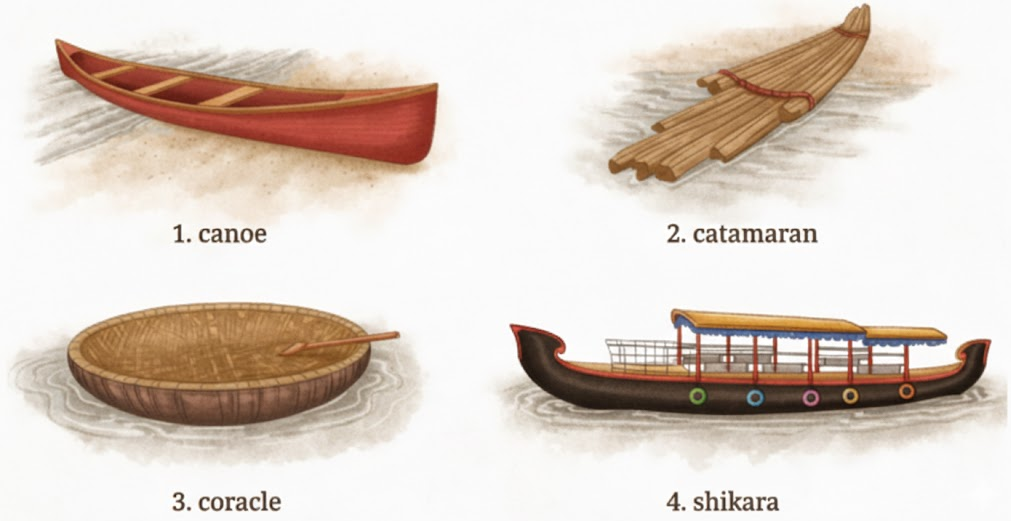
(i) Which one would you like to travel in?
(ii) Make a colourful drawing of a boat that you would like to travel in.
Answer: (i) I would travel in a Shikara because it feels peaceful and beautiful to glide across the lake.
(ii) Students should do it by themselves.
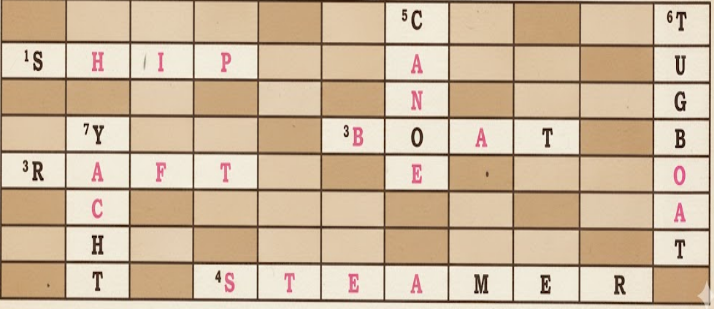
V. Solve the crossword puzzle based on words related to water transport.
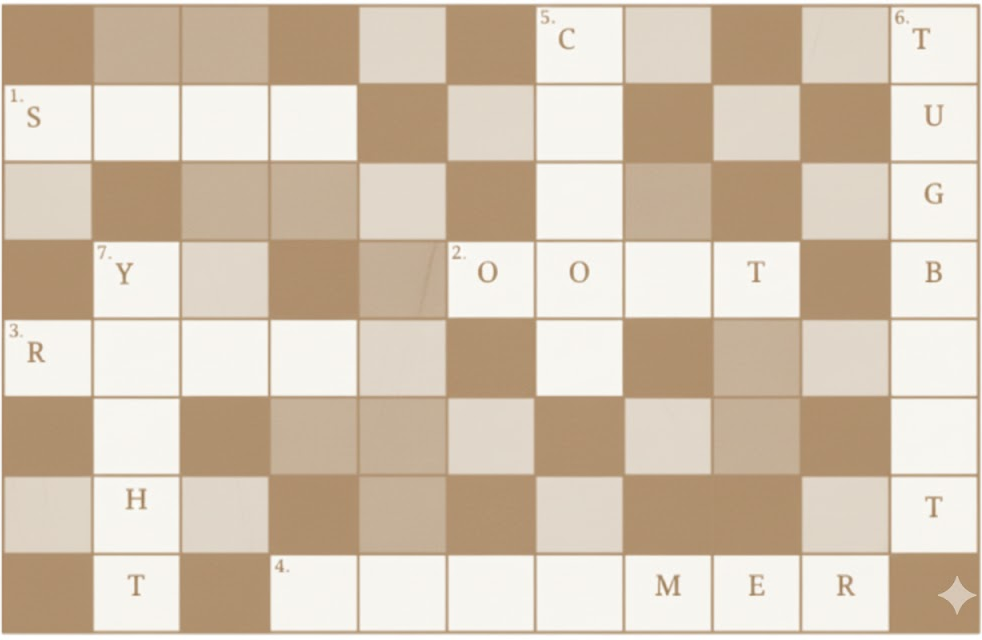
Across
1. a Targe vessel used for transporting goods or passengers by sea
2. a srqall vessel for travelling on water, typically propelled by oars, sails, or an engine
3. a flat floating structure for travelling across water
4. a boat or ship driven by steam
Down
5. a small, light, narrow boat, pointed at both ends and moved using a paddle
6. a boat with a powerful engine which can change direction easily and is used to pull large ships into and out of port
7. a boat with sails and sometimes an engine, used for either racing or travelling for pleasure, rhymes with ‘cot’
Answer:
VI. Read the highlighted words in the following lines from the text.
“She goes down towards the sea. I’ve seen her; she always takes the same way—over the mountains and down to the sea, like me!”
“She goes down towards the sea. I’ve seen her; she always takes the same way—over the mountains and down to the sea, like me!”
Prepositions are words that indicate the relationship between nouns or pronouns and other elements in a sentence. They show direction, location, time or logical relationships between ideas.
Now, fill in the blanks with suitable prepositions given within the brackets.
Jahnavi takes the River’s advice and goes to school. On her fist day
1. _________ (at/in/on) school, Jahnavi stood nervously 2. _________ (in/ outside/above) the gate, clutching her bag close to her. The bell rang and she hurried 3. _________ (outside/through/inside) the bustling classroom. She found a seat 4. _________ (among/between/from) two friendly classmates. The teacher greeted them warmly and started the lesson 5. _________ (about/in/for) numbers. Jahnavi listened attentively, feeling excited 6. _________ (at/about/for) the new adventure ahead.
Answer:
Jahnavi takes the River’s advice and goes to school. On her first day 1. at (at/ in/on) school, Jhhnavi stood nervously 2. outside (in/ outside/above) the gate, clutching her bag close to her. The bell rang and she hurried 3. inside (outside/ through/inside) the bustling classroom. She found a seat 4. between (among/between/ from) two friendly classmates. The teacher greeted them warmly and started the lesson 5. about (about/in/for) numbers. Jahnavi listened attentively, feeling excited 6. about (at/about/for) the new adventure ahead.
VII. Read the highlighted words in the following sentence from the text.
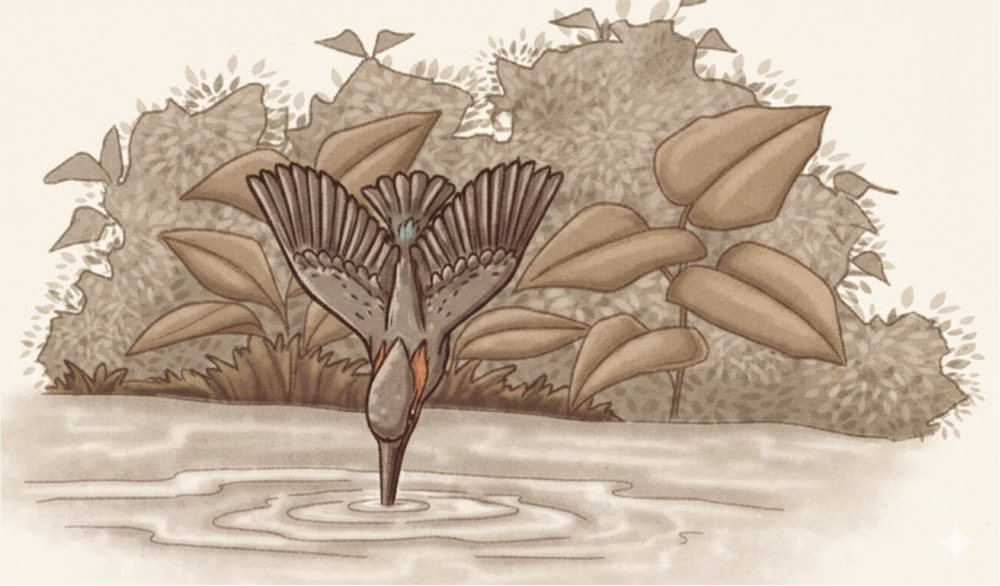
A kingfisher swept down, its wings an arrow of blue in the sunlight.
Words like on, off, up, down can function both as preposition and as adverb.
For example:
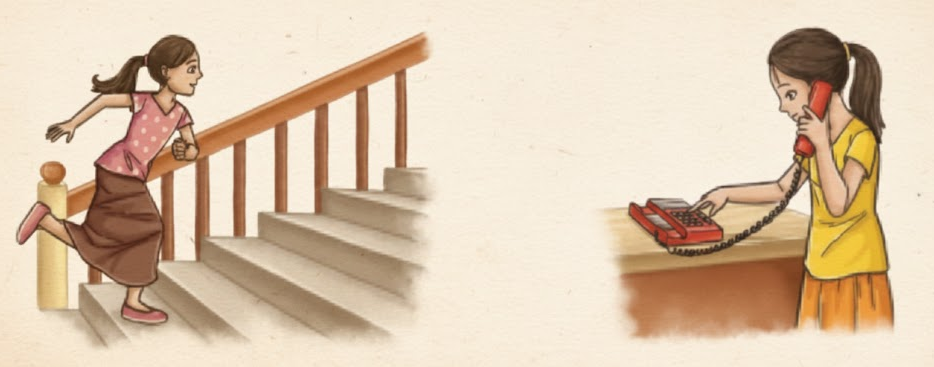
Remember, a preposition will always be followed by an object (noun) whereas an adverb will tell you more about the action (verb).
Fill in the blanks with prepositions or adverbs.
1. The cat jumped ___________ the table. (preposition)
2. The children played ___________ until dark. (adverb)
3. She quickly ran ___________ the park. (preposition)
4. The helicopter was hovering ___________. (adverb)
5. We were just walking ___________, chatting. (adverb)
6. After thoroughly wiping his shoes, he stepped ___________. (adverb)
7. She drove slowly ___________ the sharp curve. (preposition)
8. He placed the keys ___________ the mat before leaving. (preposition)
Answer:
1. The cat jumped on the table, (preposition)
2. The children played outside until dark, (adverb)
3. She quickly ran to the park, (preposition)
4. The helicopter was hovering above, (adverb)
5. We were just walking along chatting, (adverb)
6. After thoroughly wiping his shoes, he stepped inside, (adverb)
7. She drove slowly around the sharp curve, (preposition)
8. He placed the keys on the mat before leaving, (preposition)
The Day the River Spoke Question Answer Class 7 – Let us listen (Page 12)
I Read the words given in the box below. You will listen to fie people speak about school life. As you listen, circle the words that are used by the speakers. There are two words you do not need. (Transcript for the teacher on pg. 39 )
Answer:

II. You will once again listen to the five speakers. As you listen, match each statement 1-7 to each speaker (i)-(v). There are two statements that you do not need
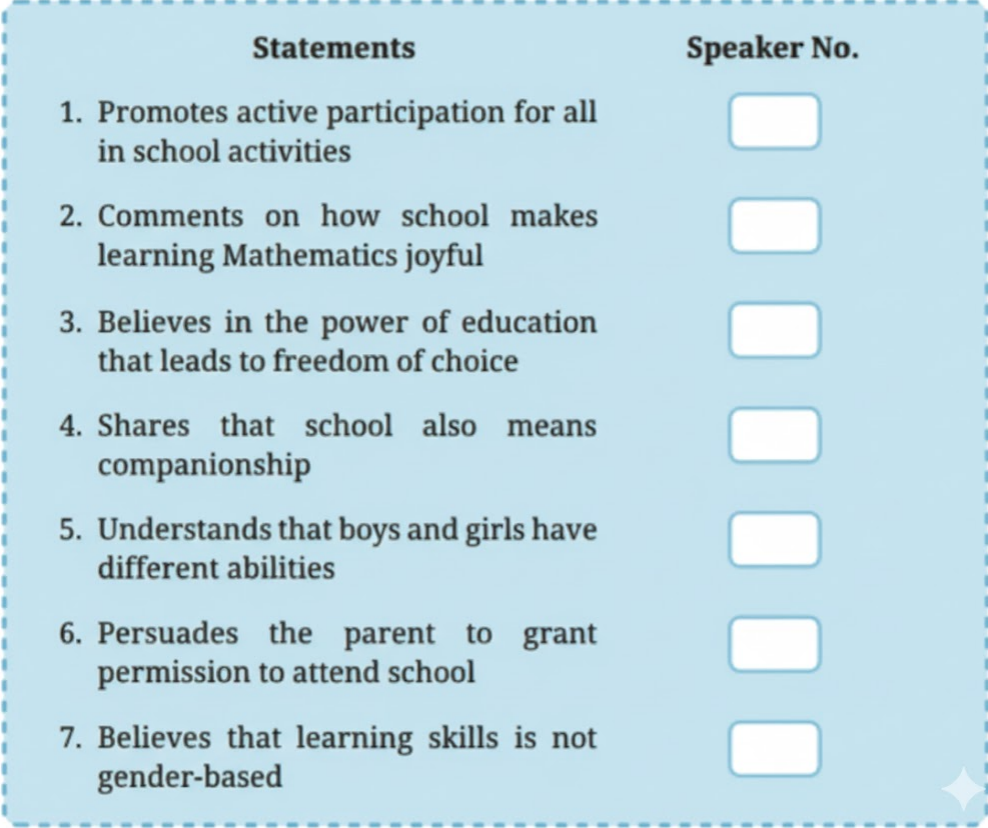
Answer:
Statements 2 and 5 do not match with any speaker
Class 7 English Chapter 1 Question Answer – Let us speak (Page 13)
I. Read the sentence given below.
“Dear, dear! What’s the matter? … You shouldn’t cry, you know. And you really shouldn’t be scared, when you have been coming here to see me every day, well, almost every day. ”
The River spoke to Jahnavi in a ‘sleepy’ voice. Work in pairs and take turns to speak the same sentence in ‘other’ voices. Some hints are given below.
Answer: Students should do it by themselves.
II. Janhavi asks the River for advice and the River gives advice. Read the given situations and work in pairs to ask for and give advice. Take turns to change your roles. Use the prompts given below.
1. Situation (i) : You wish to play football at school but it has an all-boys’ team only.
2. Situation (ii): You have been unable to score well in Mathematics due to nervousness during exams.
3. Situation (iii): You really enjoy music classes but do not get enough time to practise for it.
4. Situation (iv): You cannot see the blackboard clearly from the last bench.
Answer:
1. Situation (i): You wish to play football at school, but the team is all boys.
Student A (asking for advice): I really want to play football at school, but it has an all-boys’ team only. What do you think I should do?
Student B (giving advice): I think you should speak to your teacher or the principal and request them to allow girls to join or start a mixed team. If I were you, I would also gather other interested girls to support your request.
2. Situation (ii): You are unable to score well in Mathematics due to exam nervousness.
Student A (asking for advice): I’ve been unable to score well in Mathematics because I get really nervous during exams. I’d appreciate your advice on this issue.
Student B (giving advice): Why don’t you try practicing mock tests at home under exam-like conditions? If I were you, I’d also talk to a teacher or counselor about your anxiety. The best thing to do is to stay calm and revise regularly.
3. Situation (iii): You enjoy music classes but don’t get enough time to practise.
Student A (asking for advice):
I really enjoy music classes, but I don’t get enough time to practise. What would you do in my position?
Student B (giving advice):
I think you should create a daily schedule and set aside at least 15–20 minutes just for music. If I were you, I’d also reduce screen time or other less important activities so you have time to practise.
4. Situation (iv): You cannot see the blackboard clearly from the last bench.
Student A (asking for advice):
I can’t see the blackboard clearly from the last bench. Do you think I should change my seat?
Student B (giving advice):
Yes, the best thing to do is to politely ask your teacher if you can sit closer to the board. If I were you, I’d also get my eyesight checked just to make sure everything is fine.
NCERT Class 7 English Poorvi Chapter 1 Question Answer – Let us write (Page 14)
Observing Nature
(Students to read the paragraph from page 14 of the NCERT textbook)
Now, write a descriptive paragraph based on what you’ve observed. Highlight the colours, shapes textures, and unique details that made an impression on you.

Give a title to your paragraph.
Answer:
The Silent Beauty Around Us**
Every day, I see nature whispering its beauty through the tiniest things. While walking in the garden, I noticed the soft rustling of leaves as the wind passed through them like a gentle song. The morning sun filtered through the branches, creating golden patches on the ground.
I find it fascinating that no two leaves are alike—each has its own shape, shade, and texture. Some are glossy and smooth, while others are rough and wrinkled.
I enjoy watching butterflies dance from flower to flower because they bring colour even to the dullest corners. The vibrant yellow wings of one butterfly glowed in the sunlight like tiny lanterns. I felt calm and happy, as if nature had pressed pause on the noisy world for a moment.
The sky, with its shifting clouds and birds flying in formation, looked like a painting that changes every minute.
I want to say that there is magic in the ordinary if you pause and look closely. My advice to everyone is: take a moment to observe nature—
it teaches us patience, peace, and the art of finding beauty in stillness.
Class 7th English Chapter 1 Day the River Spoke Question Answer – Let us explore (Pages 14-15)
I. Discuss why rivers in India are considered to be sacred and most of them are referred to as female. Some rivers are referred to as male, for example, the Brahmaputra and the Sone.
Answer:
In India, rivers are considered sacred because they are viewed as life-givers. They provide water for drinking, farming, and many essential activities. Rivers also play an important role in religious rituals and cultural traditions. Many people believe that bathing in holy rivers washes away sins and brings spiritual purity.
Most rivers in India are referred to as female because they are associated with nurturing, fertility, and motherhood—qualities traditionally linked with femininity. They are often worshipped as goddesses; for example, the Ganga is worshipped as Goddess Ganga.
However, a few rivers, such as the Brahmaputra and the Sone, are referred to as male. This may be because of the meaning of their names or because their strong and forceful flow is traditionally seen as a masculine characteristic.
II. Whole Class Activity
1. India is a multilingual country, and many of us can speak two to three languages easily. Make a list of the languages that everyone in the class can speak and display it on a chart paper in the classroom.
Answer:
Languages Spoken by Students in the Class
(Example response – can be modified as needed.)
Hindi
English
Tamil
Bengali
Telugu
Punjabi
Urdu
Marathi
Many students in the class can speak two or more languages.
This list can be creatively presented on chart paper and decorated with the scripts or alphabets of each language to make it visually appealing.
Question 2. In which language do you enjoy reading and learning the most?
Answer: I enjoy reading and learning the most in English because the books and stories are interesting, and the language helps me connect with the world. English is also used in many subjects, and it helps me understand science and technology better.
I also enjoy learning in my mother tongue because I feel comfortable expressing my thoughts, and I understand the lessons more clearly when they are taught in a familiar language.
III. Read the poster given on page 15 of the textbook and answer the questions that follow.

Question 1. What are the things you can observe in the poster?
Answer: In the poster, I can see three to four girls sitting together and smiling while studying. They are dressed in comfortable home clothes and appear to be enjoying their learning time. The atmosphere looks cheerful and peaceful, suggesting that they feel safe, relaxed, and supported as they study together.
Question 2. Why do you think the girls look happy?
Answer: The girls look happy because they are getting the opportunity to study in a safe and encouraging environment. They are likely treated with love and respect, which gives them a sense of freedom and joy. Being with friends and having access to education makes them feel confident, cared for, and valued.
Question 3. Dignity means ‘self-respect’. What is the relation between ‘dignity’ and ‘happiness’ ?
Answer: Dignity and happiness are closely connected. When girls are treated with respect and given the right to education and equality, they develop a strong sense of self-worth. This builds their confidence and helps them feel valued and important. As a result, they experience true and lasting happiness.
Question 4. How does a Nation prosper when its daughters are happy?
Answer: A nation prospers when its daughters are happy because happy girls grow into confident, educated women who contribute to society in many meaningful ways. They help build stronger families, better communities, and more productive workplaces. When girls are empowered and given equal opportunities, the entire nation becomes healthier, more educated, and more progressive.
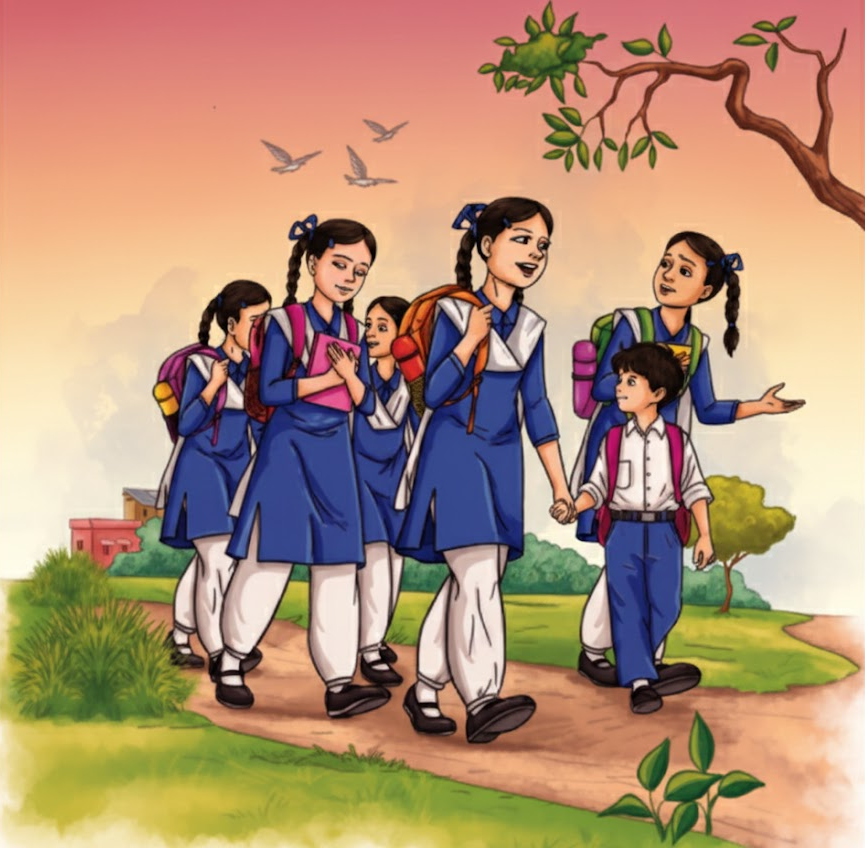
IV. The Government has launched many schemes for the education of the girl child. Some of them are ‘Beti Bachao Beti Padhao’, ‘Balika Samridhi Yojana’, ‘Samagra Shiksha Scheme-Kasturba Gandhi Balika Vidyalayas’, etc.
Find out more such schemes from the internet or from your teacher and spread awareness in your neighbourhood.
Answer:
I found several government schemes that support girls’ education in India. These include:
1. Sukanya Samriddhi Yojana (SSY)
A savings scheme launched under the Beti Bachao Beti Padhao campaign. It encourages parents to save money for their daughters’ higher education and future needs.
2. CBSE Udaan Scheme
This scheme provides free resources, study materials, and mentoring to girl students from economically weaker sections who are preparing for engineering entrance exams like JEE.
3. National Scheme of Incentive to Girls for Secondary Education (NSIGSE)
This scheme gives financial assistance to girls who pass Class 8 and enroll in Class 9, especially those from SC/ST communities. It helps reduce dropout rates.
4. Pragati Scholarship Scheme
Offered by AICTE, this scholarship supports meritorious girl students pursuing technical and professional courses in AICTE-approved colleges.
5. National Scholarship Portal (NSP) – Digital India Initiative
A central online platform where girls from minority and economically weaker backgrounds can apply for different scholarships provided by various ministries and state governments.
Spreading Awareness in the Neighbourhood
To spread awareness about these schemes, I can:
Prepare posters or charts and display them in public places such as schools, libraries, or community centres.
Talk to neighbours and parents about the importance of girls’ education and the government schemes available for them.
Organise a small awareness session in school with the help of teachers.
Share information through WhatsApp groups, social media, and local community pages so that more people can learn about these opportunities.
Mastering NCERT Solutions Class 7 English Chapter 1: The Day the River Spoke
Grasping the main ideas of "The Day the River Spoke" is crucial for success in Class 7 English. Using NCERT Solutions Class 7 English Chapter 1 helps you understand the values of courage, curiosity, and determination in a fun, relatable way.
With step-wise explanations and highlighted vocabulary, these solutions ensure you’re exam-ready. Carefully reviewing important story moments can boost your marks and spark a love for reading and learning new words.
Stay consistent with your revision of Class 7 English NCERT Solutions 2026-27. Focusing on each question not only strengthens your concepts but also improves confidence—making scoring high in your exams more achievable than ever!
FAQs on NCERT Solutions For Class 7 English Chapter 1 The Day The River Spoke - 2026-27 Free PDF Download (Login Required)
1. What are NCERT Solutions for Class 7 English Chapter 1 The Day the River Spoke?
NCERT Solutions for Class 7 English Chapter 1 The Day the River Spoke provide exam-focused, stepwise answers to all textbook exercises.
• They cover every question from the chapter as per the CBSE 2026–27 syllabus.
• Each answer uses easy language and key points recommended by teachers.
• Includes summaries, important definitions, and sample long answers for exam preparation.
• Perfect for revision and scoring full marks in English exams.
2. How can I download the day the river spoke question answers class 7 PDF for free?
You can get the The Day the River Spoke question answers Class 7 PDF for free from trusted educational websites.
• Look for a 'Download PDF' button or link on resource pages.
• The PDF contains all NCERT solutions, extra question answers, and summary notes.
• Useful for quick offline study and exam revision.
• Always check that the solution matches the CBSE 2026–27 syllabus.
3. How to write stepwise NCERT answers in Class 7 English to score full marks?
To score full marks with NCERT Solutions for Class 7 English Chapter 1, follow these presentation tips:
• Start answers with a direct sentence from the chapter.
• Write stepwise, using short paragraphs or bullet points for multi-part questions.
• Include all key details, definitions, and examples as asked.
• Highlight any important words or phrases from the question prompt.
• Keep your answers clear, neat, and within the suggested word count.
4. What is the summary of Class 7 English Chapter 1 The Day the River Spoke?
The Day the River Spoke tells the story of a child’s deep connection with a river, learning its secrets and wisdom.
• The chapter highlights themes of nature, curiosity, and listening to the environment.
• Key moments include the protagonist's experience by the riverside and the imaginary conversation with the river.
• It encourages students to reflect on the importance of observing and respecting nature.
• Summary notes help with quick revision and long answer preparation.
5. Are diagrams, definitions, or examples mandatory in Class 7 English answers?
While not always mandatory, adding definitions and examples in your NCERT Solutions for Class 7 English Chapter 1 can help you score extra marks.
• Include definitions for key terms if the question asks for it.
• Examples or quotations from the chapter can strengthen your answer.
• Diagrams are rarely needed in English literature, but neatness and well-structured writing are essential.
• Follow CBSE guidelines and your teacher’s advice for best results.
6. Where can I find extra questions and answers for The Day the River Spoke Class 7?
You can find extra questions and answers for Class 7 English Chapter 1 The Day the River Spoke on educational websites and in study guides.
• Look for sections labeled 'extra questions' or 'important questions'.
• These are aligned with expected exam questions and help in in-depth understanding.
• Practice with both short and long answer types for full coverage.
• Downloadable PDFs are also often available for offline practice.
7. What are the likely exam questions from Class 7 English Chapter 1?
Exam questions from Class 7 English Chapter 1 usually cover:
• Short answers on main events or characters.
• Meaning/explanation of lines from the chapter.
• Long answers about the lesson’s message or the protagonist's learning.
• True/false or fill-in-the-blanks from the summary.
• Definitions or use of specific words from the text.
Practice previous year’s questions and NCERT exercises for best results.
8. How do NCERT Solutions help in revision for CBSE English exams?
NCERT Solutions for Class 7 English Chapter 1 make exam revision faster and more effective.
• All answers are organised exercise-wise, making practice easy.
• Cover important definitions, key lines, and summary points.
• Include tips on answer structuring, word limits, and marking schemes.
• PDF format allows for quick last-minute revision, even offline.
• Ensures confidence and accuracy during CBSE 2026–27 board exams.
9. How should I structure long answers for Class 7 English to get better marks?
Structure long answers in Class 7 English by:
• Starting with a concise introduction stating your main point.
• Breaking down the answer into 2–3 logical paragraphs.
• Adding supporting details with examples from the chapter.
• Ending with a brief conclusion or the lesson learnt.
• Using clear sentences and important keywords such as The Day the River Spoke, protagonist, lesson, and nature.
10. Are NCERT Solutions enough for Class 7 English exam preparation?
NCERT Solutions for Class 7 English Chapter 1 are usually enough for scoring well in exams, especially if you:
• Study all back exercise and in-text questions thoroughly.
• Practice long and short answers, and work on extra questions for confidence.
• Revise summaries, definitions, and key points.
• Refer to teacher-reviewed solutions that match the current CBSE syllabus.
• Attempt sample papers and revision notes for complete preparation.
