




Stepwise Answers and Marking Scheme for Rani Abbakka Class 7 English
NCERT Solutions Class 7 English Chapter 15 Rani Abbakka (2026-27)
Rani Abbakka Question Answer – Let us do these activities before we read. (Page 206)
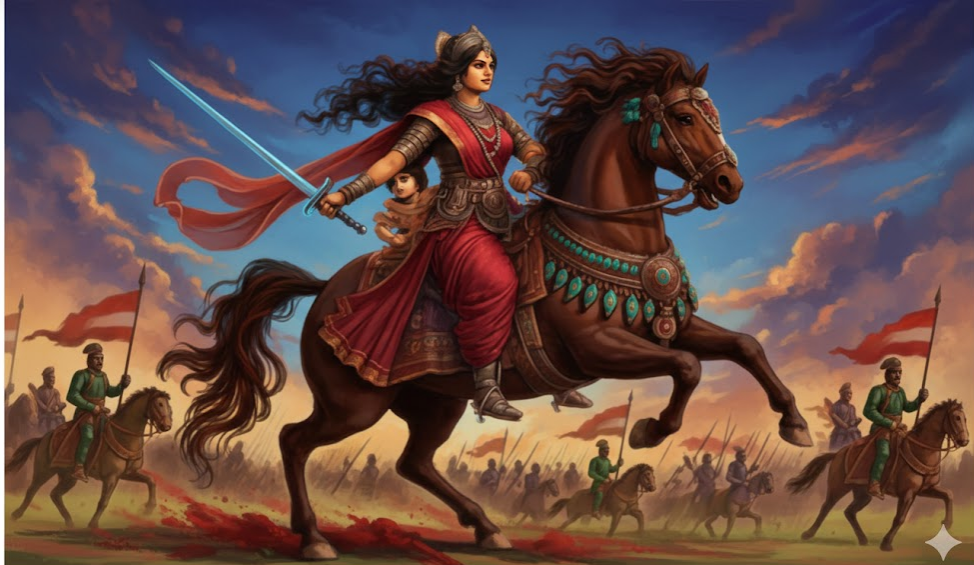
I. Solve the riddle given below and share your answer with your classmates and the teacher.
She was a queen who led the fight,
She fought for her country and her right.
With a shining sword in her hand,
Her son on her back in a cloth band Remembered as a warrior grand,
She died defending her beloved Motherland.
Who is she?
Answer: The riddle refers to Rani Lakshmibai, the Queen of Jhansi. She was a courageous warrior leader who valiantly fought the British during the Revolt of 1857.
II. Think of any other women warriors who made a significant contribution to India’s struggle for Independence. Share your answers with your classmates and the teacher.
Answer: Some other women who played important roles in India’s freedom struggle include:
Begum Hazrat Mahal: She resisted British forces during the 1857 uprising in Awadh and became a symbol of courage.
Sucheta Kriplani: An active participant in the Quit India Movement and an influential leader of the Indian National Congress.
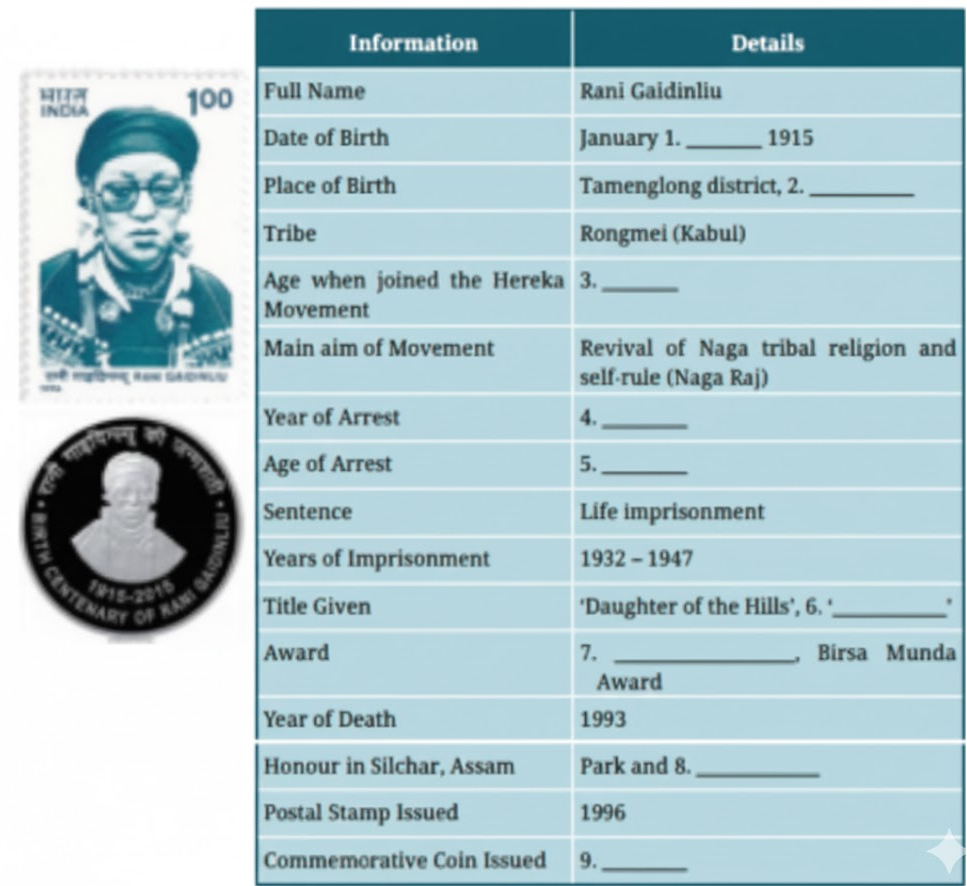
Rani Gaidinliu: She led a tribal rebellion against British rule in Manipur and was imprisoned for her brave resistance.
Rani Abbakka Class 7 Question Answer – Let us discuss (Pages 213-214)
I. Match the words in Column 1 with their meanings in Column 2. Share your answers with your classmates and the teacher.
Answer:
II. Complete the table given below based on your understanding of the story. An example has been done for you. Share your answers with your classmates and the teacher.
Answer:
Class 7 English Rani Abbakka Question Answer – Let us think and reflect (Pages 214-215)
I. Read the extract given below and answer the questions that follow.
Portuguese envoy: Our Governor has sent me to remind you that the annual tribute from Ullal is long overdue and…
Rani Abbakka: We are a sovereign country. We don’t pay tribute to Portugal. And we don’t take orders from the Portuguese!
Portuguese envoy: Your Majesty, you will regret your stand.
Abbakka ordered merchant ships to be built and in alliance with the Zamorin of Kozhikode, she defied the Portuguese and established a hugely profitable trading relation with Arabia.
Question 1. What does the word ‘tribute’ mean in this context?
Answer: In this context, ‘tribute’ means a payment that the Portuguese forced Ullal to give as a symbol of accepting their colonial authority.
Question 2. Complete the sentence with a suitable reason.
Rani Abbakka says, “We are a sovereign country” because _____________.
Answer: She wanted to prove that Ullal was independent and did not have to follow or pay tribute to the Portuguese rulers.
Question 3. Identify whether the following statement is true or false.
The Portuguese envoy threatened Rani Abbakka.
Answer: True
Question 4. Choose a word given in brackets to replace the underlined word.
“… she defied the Portuguese and established a hugely profitable trading relation with Arabia.” (defeated/disobeyed)
Answer: disobeyed.
Question 5. Choose the option that lists the qualities of Rani Abbakka, based on this extract.
(i) bold
(ii) thoughtful
(iii) capable
(iv) generous
(v) determined
A. (i), (ii), and (v)
B. (ii), (iii), and (iv)
C. (i), (iii), and (v)
D. (ii), (iv), and (v)
Answer: Option C (i), (iii), and (v)- bold, capable and determined.
II. Answer the following questions.
Question 1. Rani Abbakka spoke to her mother on her deathbed. How might these words have made her mother feel?
Answer: Rani Abbakka’s words to her mother in her final moments would have filled her mother with pride, reassurance, and hope, knowing that her daughter was determined to defend their kingdom with courage.
Question 2. What does the support of the people of Ullal and the soldiers for Rani Abbakka suggest about their mindset?
Answer: The citizens of Ullal, along with its soldiers, displayed immense courage, loyalty, and pride in their land. They were prepared to safeguard Ullal’s independence no matter the sacrifice. Their unity reflected their deep faith in Rani Abbakka and their firm determination to oppose Portuguese domination.
Question 3. How might the people of Ullal have felt when the mighty Portuguese were defeated?
Answer: The people of Ullal would have been filled with happiness and pride after overcoming the powerful Portuguese forces. They likely rejoiced in their regained freedom and deeply appreciated the courage shown by Rani Abbakka.
Question 4. Why do you think Rani Abbakka’s victory against the Portuguese would have inspired other rulers to go against a foreign power?
Answer: Rani Abbakka’s triumph proved that a strong and dominant foreign power could be overcome through bravery and collective strength. Her success would have motivated other rulers to rise against outside domination and defend their independence.
Rani Abbakka Class 7 Questions and Answers – Let us learn (Pages 215-220)
I. Study the following words taken from the text.
seize, sovereign, their, soldiers
The spelling of the given words have ‘ei’ and ‘ie’ in them.
Spelling tip: ‘i’ before ‘e’ except after ‘c’
For example: receive, deceive
Now, fill in the blanks with ‘ie’ or ‘ei’ for the following words.
1. c___ling
2. bel___ve
3. th___f
4. ach___ve
5. perc___ve
6. prot___n
7. soc___ty
8. sh___ld
9. w___ght
10. fr___nd
Answer:
1. ceiling.
2. believe
3. thief
4. achieve
5. perceive
6. protein
7. society
8. shield
9. weight
10. friend
II. Study the highlighted word in the following sentence from the text.
…; and Bangadi too may have to face their wrath.
Was the initial letter ‘w’ pronounced? There are many words in the English language where certain letters are not pronounced but are spelt. They are called ‘silent letters’.
For example: campaign, knowledge, pneumonia, honour, calm.
Golden Grammar Tips
Silent letters are letters in a word that are written but not pronounced when you say the word
Examples:
k in knight (we say “nite”) b in thumb (we say “thum”) w in write (we say “rite”)
Now, find more words with silent letters.
Answer:
Knife has a silent “k”,
wrist has a silent “w”, and
honest has a silent “h”.
Similarly, listen has a silent “t”,
doubt has a silent “b”,
and castle has a silent “t”.
Other examples include receipt with a silent “p”,
comb with a silent “b”,
gnome with a silent “g”,
and subtle with a silent “b”.
III. Read the following expressions from the text.
laughing stock, last laugh Use the dictionary page given below to find the meanings of the following.
burst out laughing, don’t make me laugh, laugh until you cry, have a good laugh. ,
Now, use these expressions in sentences of your own.
Answer:
Burst out laughing – to begin laughing all of a sudden.
Sentence: The joke was so hilarious that I suddenly burst out laughing during class.
Don’t make me laugh – used when someone says something unbelievable or foolish.
Sentence: When he claimed he could lift 200 pounds, I replied, “Don’t make me laugh!”
Laugh until you cry – to laugh so intensely that tears start rolling down your face.
Sentence: The movie was so funny that I ended up laughing until tears came out.
Have a good laugh – to enjoy something because it is funny.
Sentence: We had a wonderful laugh thinking about our mischievous childhood moments.
GOLDEN GRAMMAR TIPS
Direct speech shows the exact words spoken by a person. It is usually enclosed in quotation marks (“ ”).
Example-.
She said, “I am going to the market.”
Indirect speech reports what someone said without using their exact words. Quotation marks are not used, and pronouns, tenses, and time expressions often change.
Example:
She said that she was going to the market.
IV. Rewrite the following sentences in direct speech to indirect speech. Remember to make the necessary changes.
1. The teacher said, “Women of valour have made significant contributions throughout history.”
2. “I enjoy reading historical novels,” said Smitha.
3. The captain said to the coach, “Our team won the championship last year.”
4. The class teacher said, “Please turn off the lights when you leave.”
5. “Finish the work before dinner,” said mother to Ravi.
6. The vet said to the pet owner, “Take the dog for a walk.”
Answer:
1. The teacher remarked that women of valour had made significant contributions throughout history.
2. Smitha shared that she enjoyed reading historical novels.
3. The captain told the coach that their team had won the championship the previous year.
4. The class teacher requested to turn off the lights when we left.
5. Mother advised Ravi to finish the work before dinner.
6. The vet instructed the pet owner to take the dog for a walk.
V. Read the conversation between the Captain and the team.
Captain: We need to focus on our strategy for the final match.
Player: I have some ideas on how we can improve our strategy.
Captain: Make sure to share those ideas with the team during practice.
Complete the following paragraph by transforming the dialogue in the indirect form of speech.
The Captain remarked that 1. _____________.
To which one of the players replied that 2. _____________.
The Captain advised the player to 3. _____________.
Answer:
1. they needed to focus on their strategy for the final match.
2. he had some ideas on how they could improve their strategy.
3. make sure to share those ideas with the team during practice.
Rani Abbakka Question Answer Class 7 – Let us listen (Pages 220 -221)
You will listen to the teacher speak about a braveheart. As you listen, complete the bio-table given below. (Transcript for the teacher on pg. 224 of the textbook)
Answer:
Class 7 English Chapter 15 Question Answer – Let us speak (Page 221)
Some of the words from the story ‘Rani Abbakka’ are given in the table below. Work in pairs and pronounce these words by referring to the notes given below. Emphasise the highlighted syllable.
Remember, single syllable (monosyllabic) words do not have any stress.
Answer: Students should do it by themselves.
NCERT Class 7 English Poorvi Chapter 15 Question Answer – Let us write (Page 221)
1. India’s past was heroic, and at present, the pace of her development is inspiring. Women play a significant role in it. These women are around us, inspiring tts all the time.
With these thoughts, write a conversation between two students, Pratap and Tarana, discussing the role played by women in forming India’s identity as a strong nation.
You may begin like this:
Pratap: Tarana, I have a lot of respect for women like…
Tarana: I believe in the capabilities of women. Did you …?
Complete the conversation in about six to eight sentences for each of them and share your answers with your classmates and the teacher.
Answer:
Pratap: Tarana, I truly admire remarkable women like Rani Lakshmibai, Sarojini Naidu, and Kalpana Chawla. Each of them made outstanding contributions in their own fields.
Tarana: I have great faith in women’s abilities. You know, women played an important part in India’s freedom movement and continue to help shape the nation even today.
Pratap: Absolutely! Besides the freedom fighters, leaders like Indira Gandhi and Kiran Bedi have been influential figures in politics and administration.
Tarana: Right! Today, women are achieving excellence in science, sports, entrepreneurship, and even space missions. Take Mary Kom, for example—she has brought immense pride to India through boxing.
Pratap: And we must also acknowledge women like Dr. Tessy Thomas, known as the “Missile Woman of India,” who has made significant contributions to the country’s defence research.
Tarana: Exactly! Women are demonstrating that they are capable of matching men in every field. Their determination and bravery are helping India progress every day.
Pratap: It is our responsibility to support them so they can continue breaking obstacles and inspiring future generations.
Tarana: Absolutely! A country becomes truly strong only when both men and women move forward together with equal respect and opportunity.
Class 7th English Chapter 15 Rani Abbakka Question Answer – Let us explore (Page 222)
Question 1. In groups of five, find facts about any one brave woman who we remember because of her achievements and present in class. For example, Rani Chennamma of Kittur, Rani Durgavati, Ahilyabai Holkar, Jhalkari Bai, Captain Lakshmi Sahgal, Kanaklata Barua, Kalpana Chawla, or anyone else.
Include the following in your presentation:
1. Childhood
2. Training / Education
3. Achievements
4. Contributions
5. What you have learnt from her
Answer:
Brave Woman: Kalpana Chawla — Rephrased Version
Childhood: Kalpana Chawla was born on March 17, 1962, in Karnal, Haryana. As a child, she was deeply fascinated by airplanes and outer space. She would often gaze at the sky, imagining herself soaring among the stars.
Education and Training: Kalpana pursued her passion by studying aeronautical engineering at Punjab Engineering College. She later moved to the United States for higher studies, where she completed her master’s degree and eventually a Ph.D. in aerospace engineering.
Achievements: She created history by becoming the first woman of Indian origin to journey into space. Her first spaceflight was in 1997 on the Space Shuttle Columbia. She returned to space in 2003, but tragically, the shuttle disintegrated during re-entry, leading to the loss of Kalpana and her fellow astronauts.
Contributions: Kalpana Chawla showed the world that determination and dedication can turn dreams into reality. Her achievements motivated countless young girls to follow paths in science, engineering, and space research.
What I Learned from Her: Kalpana’s story teaches us to aim high, persevere, and stay committed to our goals. She proved that no aspiration is unreachable when we work with passion and persistence. Her bravery and love for space continue to inspire people everywhere.
A Homage to Our Brave Soldiers – Class 7 English Solutions
Exploring NCERT Solutions Class 7 English Chapter 15 Rani Abbakka (2026-27) helps students understand the incomparable bravery of Indian heroes. These answers capture the spirit of valour, inspiring you to honour the nation’s sacrifices.
Learning about India’s highest gallantry awards and the stories of war heroes fosters a sense of gratitude and national pride. By reviewing solutions, you develop deeper respect and clarity on important exam concepts.
Practice exercise-based answers regularly for high-scoring results in your finals. Focus on key facts and emotional lessons about patriotism to make your preparation strong and meaningful.
FAQs on NCERT Solutions For Class 7 English Chapter 15 Rani Abbakka - 2026-27
1. What is the best way to write NCERT Solutions for Class 7 English Chapter 15 Rani Abbakka to score full marks?
The best way to score full marks in Class 7 English Chapter 15 Rani Abbakka is by following stepwise NCERT Solutions aligned to the CBSE marking scheme.
To maximise marks, you should:
- Write answers using clear, structured steps as shown in NCERT Solutions.
- Include important keywords and phrases from the chapter.
- Use bullet points or numbered lists for long answers where required.
- Underline names like Rani Abbakka, key events, and definitions.
- If a diagram or map is required, label it neatly and refer to it in your answer.
2. Which questions from Rani Abbakka chapter are most likely to be asked in school exams?
Most exams include a mix of short and long questions from Class 7 English Chapter 15 Rani Abbakka.
Commonly asked questions include:
- Important events in Rani Abbakka’s life and her resistance to foreign invasion.
- Short notes on leadership qualities of Rani Abbakka.
- Significance of her actions for Indian history.
- Definitions of key terms or explanations of major events.
- Extract-based questions and value-based questions on bravery or patriotism.
3. Are diagrams or maps mandatory in answers for Class 7 English Chapter 15 Rani Abbakka?
Diagrams or maps are generally not compulsory in English answers for this chapter, but including them can help score better if the question asks for a location or event illustration.
To get full marks:
- Draw neat, labelled maps if asked about regions ruled by Rani Abbakka or major battles.
- Keep diagrams simple; focus on important places/events.
4. How should I structure long answers for Rani Abbakka to get higher marks as per CBSE?
To structure long answers in Class 7 English Chapter 15 Rani Abbakka, follow the official CBSE format:
- Start with a strong introduction stating the main idea.
- Develop 2-3 well-organised paragraphs with headings or bullets for each point.
- Support answers with examples, keywords, and facts from the text.
- Conclude by summing up the key message, like Rani Abbakka's leadership or bravery.
5. Where can I download the NCERT Solutions PDF for Class 7 English Chapter 15 Rani Abbakka?
You can download the free NCERT Solutions PDF for Class 7 English Chapter 15 Rani Abbakka from educational websites offering official chapterwise solutions.
Steps:
- Visit trusted websites (such as Vedantu or NCERT-related portals).
- Locate Class 7 English > Chapter 15 Rani Abbakka.
- Click on the PDF download button for offline study.
6. Are NCERT Solutions enough for Class 7 English exams?
For CBSE exams, NCERT Solutions are usually sufficient as they cover all textbook exercises, chapter summaries, and important questions.
For thorough preparation:
- Follow stepwise NCERT answers and understand concepts.
- Practice additional worksheets or past year questions if time allows.
- Use revision notes for last-minute review.
7. How to present long answers to match CBSE marking for Rani Abbakka?
To match the CBSE marking scheme, long answers should be:
- Well-structured in paragraphs or points.
- Started with an introduction, followed by supporting details, and a strong conclusion.
- Include keywords like Rani Abbakka, leadership, resistance, and important dates.
- Neat handwriting and underlining important phrases enhance presentation.
8. How can I learn and label maps or diagrams from this chapter for the exam?
Learning to label maps or diagrams in Class 7 English Chapter 15 Rani Abbakka helps you score step marks.
Best practices:
- Practice with simple maps showing Rani Abbakka’s kingdom and key battle sites.
- Use a ruler and proper labels for neatness.
- Revise with sample diagrams from your NCERT Solutions PDF.
9. What are the most important topics to revise from NCERT Class 7 English Chapter 15 Rani Abbakka?
The most important topics from Class 7 English Chapter 15 Rani Abbakka include:
- Main events and achievements of Rani Abbakka.
- Leadership qualities and instances of her bravery.
- The impact of her resistance against foreign invaders.
- Key definitions and terms related to the chapter.
- Short summary points and back exercise questions.
10. How do stepwise NCERT Solutions help with CBSE exam preparation?
Stepwise NCERT Solutions help students:
- Understand the exact answer structure graded by CBSE evaluators.
- Identify keywords and important points for each question.
- Avoid common mistakes and cover all required steps for partial marking.
- Become familiar with the style and pattern of expected answers in the exams.
11. Do examiners award partial marks for correct steps even if the final answer is wrong?
Yes, in CBSE exams, partial marks are awarded for correct steps shown in the answer, even if the final step is incorrect.
To maximise marks:
- Always write each required step separately in your answer.
- Do not skip workings or explanations, especially in multi-step questions.
12. Are references to textbook page numbers useful during revision?
Referencing textbook page numbers while revising NCERT Solutions for Class 7 English Chapter 15 Rani Abbakka is very useful.
Benefits:
- Helps you quickly locate important definitions, diagrams, or solved exercises.
- Makes last-minute revision focused and efficient.
- Assures you are following the correct CBSE syllabus content.
