




Stepwise Solutions & Extra Questions for Say the Right Thing – Class 7 English
NCERT Solutions Class 7 English Chapter 6 Say the Right Thing (2026-27)
Say the Right Thing Question Answer – Let Us Do These Activities Before We Read. (Page 70)
I. Work in pairs and discuss.

Question 1. What does “Athithi Devo Bhava” mean?
Answer: This Sanskrit phrase means “A guest is like God.” It highlights the Indian tradition of welcoming guests with great respect, care, and hospitality.
Question 2. Why is it important to be polite to guests?
Answer: Treating guests politely creates a warm and inviting environment, helping them feel respected and at ease. It also reflects well on the host and supports good relationships and social harmony.
II. Choose the statements that display polite behaviour when you have guests at home.
1. Offer the guests a glass of water.
2. Enquire about the well-being of the guests.
3. Ask the guests when they would leave.
4. Comment critically about the habits of guests.
5. Accompany the guests to the door when they leave.
Answer: The actions that show polite behaviour towards guests at home are:
Offering them a glass of water.
Asking how they are doing.
Walking with them to the door when they leave.
These statements reflect courtesy towards guests:
Serving the guests a glass of water.
Checking on their well-being.
Seeing them off at the door.
Polite behaviour towards guests includes:
Giving them water to drink.
Inquiring about their health and comfort.
Escorting them to the door as they depart.
III. Sometimes you find that a few friends in class are rude while disagreeing with each other on certain issues. Work in groups. How would you deal with such a situation? Share at least three ways in which you can do this.
Answer:
1. Stay calm and neutral:
Keep your cool during disagreements and listen to both sides without taking anyone’s part. Your calm presence can help ease the tension.
2. Promote respectful communication:
Gently remind your friends to share their opinions politely. You might say, “Let’s talk this out without getting personal,” to encourage a more respectful exchange.
3. Look for common ground or suggest a short break:
Try to point out areas where they agree, or recommend pausing the conversation if things get too heated. A brief break can help everyone relax and think more clearly.
Say the Right Thing Class 7 Question Answer – Let us discuss (Page 74)
I. Complete the table given below based on Scene I of the play. An example has been done for you. Share your answers with your classmates and the teacher.
Answer:
II. Do you think Mary will be able to follow her mother’s advice successfully when Mrs. Harding and Mrs. Lee visit? Why or why not?
Answer: Mary makes an effort to follow her mother’s advice, but she may not be able to do it successfully. Though she is confident and willing, she hasn’t yet learned how to speak politely or think before she talks, which could cause problems when the guests come.
Class 7 English Say the Right Thing Question Answer – Let us discuss (Page 77)
I. Rectify the false statements given below from Scene II of the play. An example has been done for you. Share your answers with your classmates and the teacher.
Question 1. Mrs. Harding states that they do not like London as it is not the same as Lanfield.
Answer: Mrs. Harding mentions that they are very fond of Lanfield, even though it is different from London.
Question 2. Mrs. Harding was pleased to know that Mary was familiar with her children.
Answer: Mrs. Harding was displeased because she made it clear that she did not have any children.
Question 3. Mrs. Shaw shared that she liked Mrs. Best as she read a lot of newspapers.
Answer: Mrs. Shaw said she liked Mrs. Best for who she was, not because she read newspapers.
Question 4. Mrs. Harding and Mrs. Shaw agree that wearing a blue dress with a red coat is unfashionable.
Answer: Mrs. Shaw promptly said she liked blue dresses and red coats so that she wouldn’t offend Mrs. Harding, who had just mentioned wearing that combination often.
Question 5. Mary shares that she finds the dog outside the window cute.
Answer: Mary says she thinks the dog outside is dirty and admits she doesn’t like it or find it cute. Later, she learns that the dog actually belongs to Mrs. Harding.
Say the Right Thing Class 7 Questions and Answers – Let us think and reflect (Pages 78-79)
I. Read the extracts given below and answer the questions that follow.
1. MARY: What are you going to talk about?
Mrs. Shaw: I don’t know. All kinds of things. One day you’ll have to go to some of these houses yourself and talk to the people there.
MARY: I can talk now. I’ve been able to talk for a long time.
Mrs. Shaw: Yes, that’s true. You always talk too much. But does anyone want to hear the things that you say?
MARY: I can talk very well when I like. I’ll stay with you today and talk to them when they come.
Mrs. Shaw: Oh, I don’t think so. You can go out for a walk. It will be better if you do that.
(i) What does Mrs. Shaw imply when she says, “One day you’ll have to go to some of these houses yourself and talk to the people there”?
A. She believes Maiy should start learning about hosting guests then.
B. She thinks Maiy is ready to visit these houses independently.
C. She wants Maiy to develop social skills for the future.
D. She hopes Maiy will avoid these social interactions entirely.
Answer: C. She wants Mary to develop social skills for the future.
(ii) Complete the following sentence with the correct option from the brackets.
Mrs. Shaw and Mary are discussing how to _____________
(have a polite conversation/ get to know people better)
Answer: have a polite conversation
(iii) Why did Mary insist on staying with her mother when the guests arrived?
Answer: Mary wanted to show that she could hold a conversation and speak properly when needed.
(iv) Match the following character traits to the characters in the extract:
A. eager
B. inexperienced
C. cautious
Mary
Mrs. Shaw
Answer:
Mary: A. eager
Mrs. Shaw: C. cautious
2. MARY: I saw Mrs. Cotter this afternoon. I met her in the street.
No one sees her in the morning because she always stays in bed then.
And she’s always asking the doctor to go to see her.
I can’t understand women who stay in bed in the morning.
And why must she always ask for the doctor?
I’ve never been to a doctor in my life.
Ms. HARDING: I stay in bed in the morning myself.
(i) Complete the following sentence suitably.
Mary could spot Mrs. Cotter in the street because _____________.
Answer: she often goes out during the day.
(ii) What does Mary’s comment about Mrs. Cotter staying in bed and calling the doctor suggest about her understanding?
A. She is worried about why Mrs. Cotter stays in bed all morning.
B. She is unable to understand why people need medical help.
C. She thinks Mrs. Cotter is scared and lonely for staying in bed.
D. She believes Mrs. Cotter is right to rest and take care of herself.
Answer: B. She is unable to understand why people need medical help.
(iii) How can we say that Mary enjoyed good health?
Answer: We can conclude that Mary was in good health because she says she has never had to see a doctor, which indicates she is quite healthy.
(iv) Identify whether the following statement is true or false.
Mary might have unintentionally offended Mrs. Harding.
Answer: True
II. Answer the following questions.
Question 1. What does Mary’s comment about Mr. Best’s routine and profession reveal about her viewpoint on bankers and their way of life?
Answer: Mary’s remark reveals that she thinks bankers live boring, monotonous lives. She mocks their daily train rides and their habit of reading only newspapers, suggesting they lack imagination and are too absorbed in work.
Question 2. What can we infer about Mary’s understanding of polite conversation based on her interactions with the guests?
Answer: Mary’s behaviour reveals that she lacks an understanding of polite conversation. She frequently makes unsuitable comments that embarrass the guests, even though her mother has advised her to speak kindly and pleasantly.
Question 3. What do you think the repeated – stage direction ‘no one speaks’ indicates • about the atmosphere in the room when Mary speaks?
Answer: The stage direction “no one speaks” shows that an uncomfortable silence has fallen in the room. It implies that Mary’s remarks have made the guests feel uneasy and unsure of what to say.
Question 4. How does Mary’s attitude towards the guests change throughout the play?
Answer: At the beginning, Mary is keen to speak and impress the guests, but as the play continues, her mistakes leave her feeling embarrassed and unsure of herself, particularly when her comments upset the guests.
Question 5. What do Mrs. Harding’s and Mrs. Lee’s responses to Mary’s blunders during their visit reveal about their characters?
Answer: Mrs. Harding and Mrs. Lee reply to Mary calmly and politely, even when she says inappropriate things. This shows their patience and their ability to stay composed in an awkward situation.
Question 6. In what way does the play show the importance of knowing how to engage in polite conversation?
Answer: The play shows that polite conversation is essential for making a good impression and forming relationships. Mary’s errors demonstrate how careless words can cause awkwardness and push people apart.
Say the Right Thing Question Answer Class 7 – Let us learn (Padres 80-83)
I. Study the following words taken from the text:
humorous hilariously coming beautiful
The given words are made by adding word endings like -ous, -ly, -ing, and -ful to the root words humour, hilarious, come, and beauty. Such word endings are called suffixes.
Humour + -ous
Hilarious + -ly
Come + -ing
beauty + -ful
Now, divide the following words from the text as root words and suffixes. Check your answer with the teacher.
Answer:
Gladly : Glad + -ly
Banker : Bank + -er
Guidance : Guide + -ance
Quietly : Quiet + -ly
Walking : Walk + -ing
Question 1. Study the words in Column 1. Match the suffixes in Column 2 with their meanings or purpose in Column 3. Write a few examples for each in Columq 4. Share your answers with the teacher.
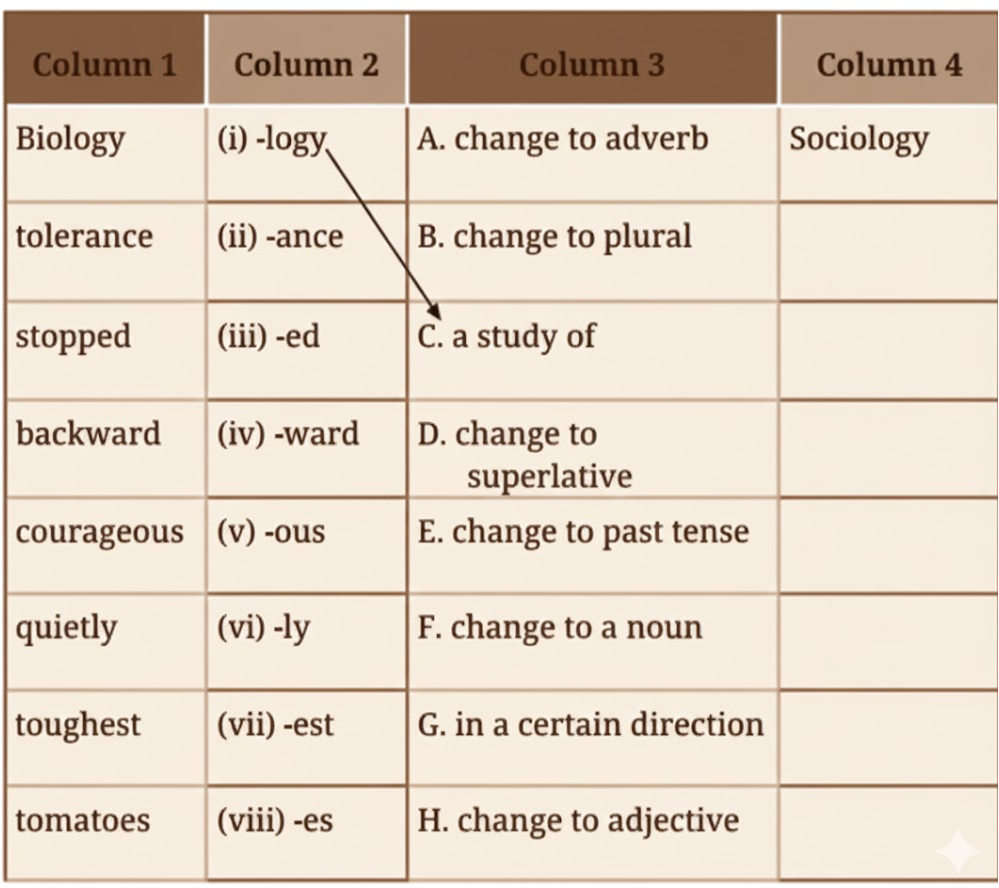
Answer:
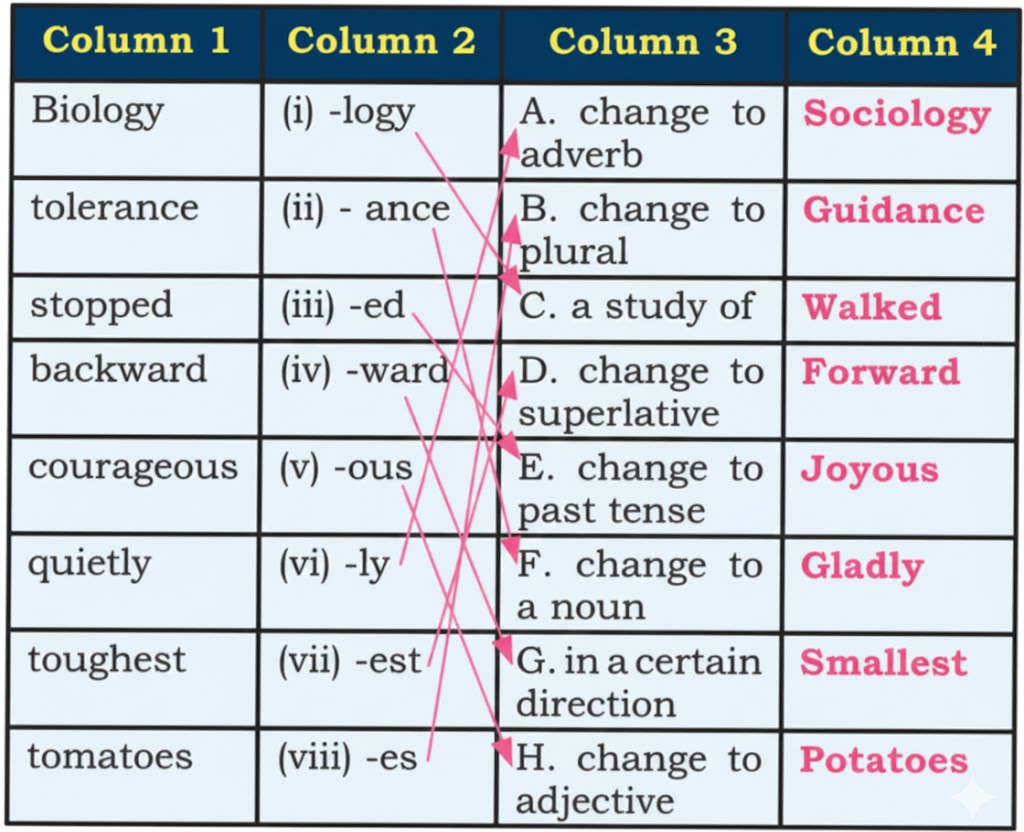
Question 2. Fill in the blanks using words given in the brackets by adding suitable suffixes.
To communicate (i) _____________ (effective), choose your words and topics (ii) _____________ (wise). Avoid (iii) _____________ (discuss) things you don’t know much about or that could upset someone. Remember to be (iv) _____________ (respect) towards others, including yourself, and express your (v)
_____________ (appreciate). Finally, always fee (vi) _____________ (response) by replying promptly to communicate.
Answer:
(i) effectively
(ii) wisely
(iii) discussing
(iv) respectful
(v) appreciation
(vi) responsive
II. Read the highlighted words in the following sentences from the text.
But does anyone want to hear the things that you say?
I can’t tell you everything.
Select the correct answer.
Is there a difference in the meanings of ‘say’ and ‘tell’? (Yes/No)
‘say’ focuses on the message and does not always require a listener.
‘Tell’ focuses on who receives the message and always needs a listener.
Answer: Yes, say emphasises the words spoken and doesn’t always need a specific listener.
Yes, tell highlights the person being spoken to and therefore always requires a listener.
Question 1. Fill in the blanks with suitable words from the sets of words given in the box below. Make changes in the verb forms (tense), if necessary.
(i) I _________ at the photo, but I didn’t _________ anyone familiar.
(ii) I’d better go and _________ my mother from the station, and then _________ her home.
(iii) I need to _________ for my mathematics exam this weekend, so I hope to _________ new concepts along the way.
(iv) I can _________ the music from my neighbour’s house, but I need to _________ to it carefully to understand the lyrics.
(v) “Could I _________ to Mrs. Kalpana, who is going to _________ to us about gardening,” said Ritu.
(vi) I _________ in a small town, but I often _________ with my relatives in the city
Answer:
1. looked, see
2. fetch, bring
3. study, learn
4. hear, listen
5. speak, talk
6. live, stay
III. Read the following sentences from the text and underline the verbs.
They lived in London before.
I met her in a shop and asked her to come
The verbs underlined are in simple past tense (actions that happened in the past or distant past)
Read the following sentence from the text and underline the verb.
Answer: She has been staying with them for some time.
The underlined verb is in the present perfect continuous tense.
We use the present perfect continuous (has/have + been + verb + -ing) to show:
1. An action that began in the past and is still happening now.
Mrs. Shaw has been preparing the room since morning for Mrs. Harding and Mrs. Lee’s visit.
2. An action that was happening recently, with clear effects in the present.
The emphasis is on the activity itself, not on whether it is finished.
Mrs. Shaw has been cleaning the room since the morning.
(Now the room is spotless.)
The students have been practising a play based on the story.
(Now they are well-rehearsed and ready.)
Question 1. Fill in the blanks using the verbs given in brackets in present continuous or present perfect continuous tense.
The students (i) _________ (organise) a play and setting up the stage. They (ii) _________ (prepare) for weeks to make everything perfect. The performers (iii) _________ (rehearse) every day, and their excitement (iv) _________ (grow). The sound in-charge (v) _________ (test) the microphones to check the sound quality. Everyone (vi) _________ (work) hard, and now the place (vii) _________ (buzz) with energy and excitement.
Answer:
(i) are organising
(ii) have been preparing
(iii) have been rehearsing
(iv) is growing
(v) is testing
(vi) is working
(vii) is buzzing
IV. Read the explanation about the kinds of sentences given in the table below.
1. Identify the kinds of sentences and punctuate them appropriately.
(i) the meeting starts at 10.00 a.m. in the conference room
(ii) what an exciting adventure it was
(iii) how did you solve the problem so quickly
(iv) what is the weather forecast today
(v) how beautiful is the rainbow
(vi) clean up your room before dinner
(vii) the children are planning a surprise party for their mom
(viii) turn off the music
Answer:
(i) The meeting starts at 10.00 am in the conference room. (Declarative)
(ii) What an exciting adventure it was! (Exclamatory)
(iii) How did you solve the problem so quickly? (Interrogative)
(iv) What is the weather forecast today? (Interrogative)
(u) How beautiful is the rainbow! (Exclamatory)
(vi) Clean up your room before dinner. (Imperative)
(vii) The children are planning a surprise party for their mom. (Declarative)
(viii) Turn off the music. (Imperative)
Class 7 English Chapter 6 Question Answer – Let us listen (Page 84)
I. Mrs. Shaw wanted Mary to learn to say the right thing. You will listen to a conversation between a mother and her son about basic manners. As you listen, fill in the blanks given below by selecting the correct option.
(Transcript for the teacher on page 89 of NCERT textbook)
Question 1. How did the son behave in the grocery queue?
(i) Strangely
(ii) Impatiently
(iii) Politely
Answer: (ii) Impatiently
Question 2. The mother finally refers to her son as a
(i) Polite young man
(ii) Responsible son
(iii) Grateful person
Answer: (i) Polite young man
II. You will once again listen to the conversation. As you listen, select four true statements from 1-7 given below.
1. The mother uses the grocery store incident as an opportunity to teach her son about patience and fairness.
2. The son recognises the value of apologising and understands that it shows he notices others.
3. The son is gradually learning the importance of polite words and actions from his mother’s guidance.
4. The mother discourages her son from speaking softly in public, suggesting that people should adjust to his voice level.
5. The son feels that covering his mouth when coughing is only important when he’s at home.
6. The son receives all advice readily while understanding its importance.
7. The mother uses praise to support the polite behaviours she wants her son to continue practising.
Answer:
1. The mother uses the grocery store incident as an opportunity to teach her son about patience and fairness. (True)
2. The son recognises the value of apologising and understands that it shows he notices others. (True)
3. The son is gradually learning the importance of polite words and actions from his mother’s guidance. (True)
4. The mother discourages her son from speaking softly in public, suggesting that people should adjust to his voice level. (False)
5. The son feels that covering his mouth when coughing is only important when he’s at home. (False)
6. The sun receives all advice readily while understanding its importance. (False)
7. The mother uses praise to support the polite behaviours she wants her son to continue practising. (True)
NCERT Class 7 English Poorvi Chapter 6 Question Answer – Let us write (Page 86)
Rewrite the play ‘Say The Right Thing’ as a short story, focusing on Mary’s interactions with her mother and the guests.
Ensure the story captures the main events, characters , emotions, and humorous moments effectively.
Use paragraph to organise your story and include descriptive language to bring the characters and events to
life.
You may refer to the following hints:
Begin with an introduction: describe Mary and Mrs. Shaw, their relation¬ship and the setting of the story.
Explain Mrs. Shaw’s instructions to Maiy before the guests arrive and Mary’s confidence in handling the situation.
Narrate the events when Mrs. Harding and Mrs. Lee visit, highlighting Mary’s remarks and the guests’ reactions.
Include key moments of humour and awkwardness to maintain the tone of the play.
Conclude by commenting on how the visit ended and Mary’s impact on the situation.
Answer: Mrs. Shaw eagerly prepared for the visit of the respected guests, Mrs. Harding and Mrs. Lee, and carefully coached her daughter Mary on proper manners. But Mary’s enthusiasm and blunt honesty soon created several uncomfortable situations. She complimented Mrs. Harding on children she didn’t have, upset Mrs. Lee with her comments about bankers, and criticised Mrs. Best’s clothing—only to learn that Mrs. Harding dressed the same way.
The most embarrassing moment came when Mary spoke negatively about dirty dogs, unknowingly describing Mrs. Harding’s own pet, Towzer. Although Mrs. Shaw tried to rescue the conversation, Mary’s final remark, “Oh, must you stay? Can’t you go?” brought the disastrous visit to an end. The guests left with stiff farewells, while Mrs. Shaw was mortified. Mary, unaware of the trouble she had caused, smiled proudly, believing she had socialised perfectly.
Class 7th English Chapter 6 Say the Right Thing Question Answer – Let us explore (Pages 86-87)
I. Work in groups. Enact your favourite part of the play.
Points to remember:
Allot a specific role to each member in the group.
For example: director, narrator, and characters.
Include the actions and expressions as indicated in brackets in the play.
Answer: Students will do it on their own.
II. Find out how people greet guests who visit their homes in different languages. Share it with your classmates and the teacher.
Answer: People around the world welcome guests in different ways.
In English, it is common to say, “Hello, welcome to our home!” or “Come on in!”
In Hindi, guests are greeted with “Namaste!” or “Aapka swagat hai!”
In Odia, people say, “Namaskara, ama gharaku swagat.”
In Bengali, the greeting is, “Nomoskar, amader barite shagot.”
In Tamil, guests are welcomed with “Vanakkam, engal veetirkku varuga.”
In Telugu, people say, “Namaskaram, maa intiki swagatam.”
In Malayalam, the greeting is “Namaskaram, njangalude veettilekku swagatham.”
In Marathi, guests are welcomed with “Namaskar, amchya ghari swagat aahe.”
Importance of Honesty in "Say the Right Thing"
Learning from NCERT Solutions Class 7 English Chapter 6 Say the Right Thing helps students understand the value of honesty and responsibility. The chapter shows how accepting mistakes strengthens trust within families and builds stronger character.
By practicing the exercises in this chapter, students can improve their comprehension and learn how to handle real-life situations with courage and sincerity. Regular study ensures better performance and aids in developing meaningful values.
Reviewing answers and revising key ideas will boost your confidence for exams. Focus on the main message—always say the right thing and stand by your actions for a successful academic journey in the 2026-27 session.
FAQs on NCERT Solutions For Class 7 English Chapter 6 Say The Right Thing - 2026-27 Free PDF Download (Login Required)
1. What are NCERT Solutions for Class 7 English Chapter 6 Say the Right Thing?
NCERT Solutions for Class 7 English Chapter 6 Say the Right Thing provide stepwise, exam-ready answers for all textbook exercises.
- Each answer is crafted as per the CBSE marking scheme.
- Detailed explanations help clarify key themes and important phrases from the chapter.
- Includes intext questions and back exercise solutions, making your exam preparation complete.
2. How do these solutions help in scoring full marks in Class 7 English Chapter 6 exams?
The solutions follow a stepwise approach, matching CBSE's marking criteria for high scores.
- Answers are structured with introductions, points, and conclusions as per examiner expectations.
- Important keywords and phrases are included to align with the syllabus.
- Tips to avoid common mistakes and model long answers with supporting details.
3. Where can I download the NCERT Solutions Class 7 English Chapter 6 Say the Right Thing PDF?
You can download the free PDF of Class 7 English Chapter 6 Solutions for offline study from the solutions page.
- Click the Download PDF button provided on the page.
- The PDF covers all stepwise question-answers, summaries, and key definitions for revision.
4. Are diagrams or definitions compulsory in Class 7 English Chapter 6 exam answers?
For Chapter 6 Say the Right Thing, diagrams are generally not required, but precise definitions can help in short and long answers.
- Always add well-written definitions where a term or phrase requires explanation.
- Neat answer structuring and key points improve marks, especially in comprehension and subjective questions.
5. How should long answers be structured in CBSE Class 7 English exams?
Long answers should begin with a brief introduction, followed by 3-4 key points and a conclusion.
- Use paragraphs or bullets for clarity.
- Highlight important aspects from the chapter, like moral lessons or character actions.
- Use examples from Say the Right Thing to support your response.
6. What are the most important topics in Say the Right Thing Class 7 NCERT Chapter 6?
Focus on these key topics for exams from Chapter 6:
- Main theme and moral lesson of the story.
- Character analysis and their choices in important situations.
- Meanings of new words and phrases used in the chapter.
7. Are NCERT Solutions sufficient for Class 7 English exam preparation?
NCERT Solutions are the primary resource for preparing for CBSE Class 7 English exams.
- They ensure you cover all types of exam questions – intext, exercise, and summary-based.
- Practising these stepwise answers builds confidence and improves your answer writing skills.
8. Which types of questions can come from Class 7 English Chapter 6 in exams?
Common questions from Say the Right Thing include:
- Short answer type – meanings, direct interpretation, character reactions.
- Long answer/Value-based – lesson from the story, opinion-based, justification of title.
- Vocabulary – meanings or using new words in sentences.
9. What are common mistakes students make in Class 7 English Chapter 6 answers?
Students often lose marks in Chapter 6 by:
- Missing keywords and lesson-specific vocabulary.
- Writing answers that are too short or off-topic.
- Ignoring the importance of structuring with points or conclusions.
10. Do examiners award partial marks for correct steps even if the final answer is wrong?
Yes, CBSE examiners may award partial marks for correct steps or relevant points even if the final answer is not completely correct.
- Write all the steps and logical reasoning as shown in stepwise NCERT Solutions.
- This maximises your marks even in case of minor errors in interpretation.
11. How can I quickly revise Class 7 English Chapter 6 before an exam?
Aim for a structured revision using the following steps:
- Go through summary notes and definitions provided in the NCERT Solutions PDF.
- Practice important question-answers and sample papers.
- Review key themes, values, and character actions from Say the Right Thing.
12. Where can I find extra questions and answers for Say the Right Thing Class 7?
Extra questions and answers for Chapter 6 are often included in practice sets, important questions, and NCERT Exemplar solutions online.
- Check the chapter solutions and linked resources for extra practice aligned with the CBSE syllabus.
