



Stepwise Answers for Class 7 English Chapter 5: Important Questions Explained
NCERT Solutions Class 7 English Chapter 5 A Funny Man (2026-27)
A Funny Man Question Answer – Let us do these activities before we read. (Page 59)
Look around you for things or people that make you laugh. Write them in the bubbles given below. Share the reasons for your answers with your classmates and the teacher.
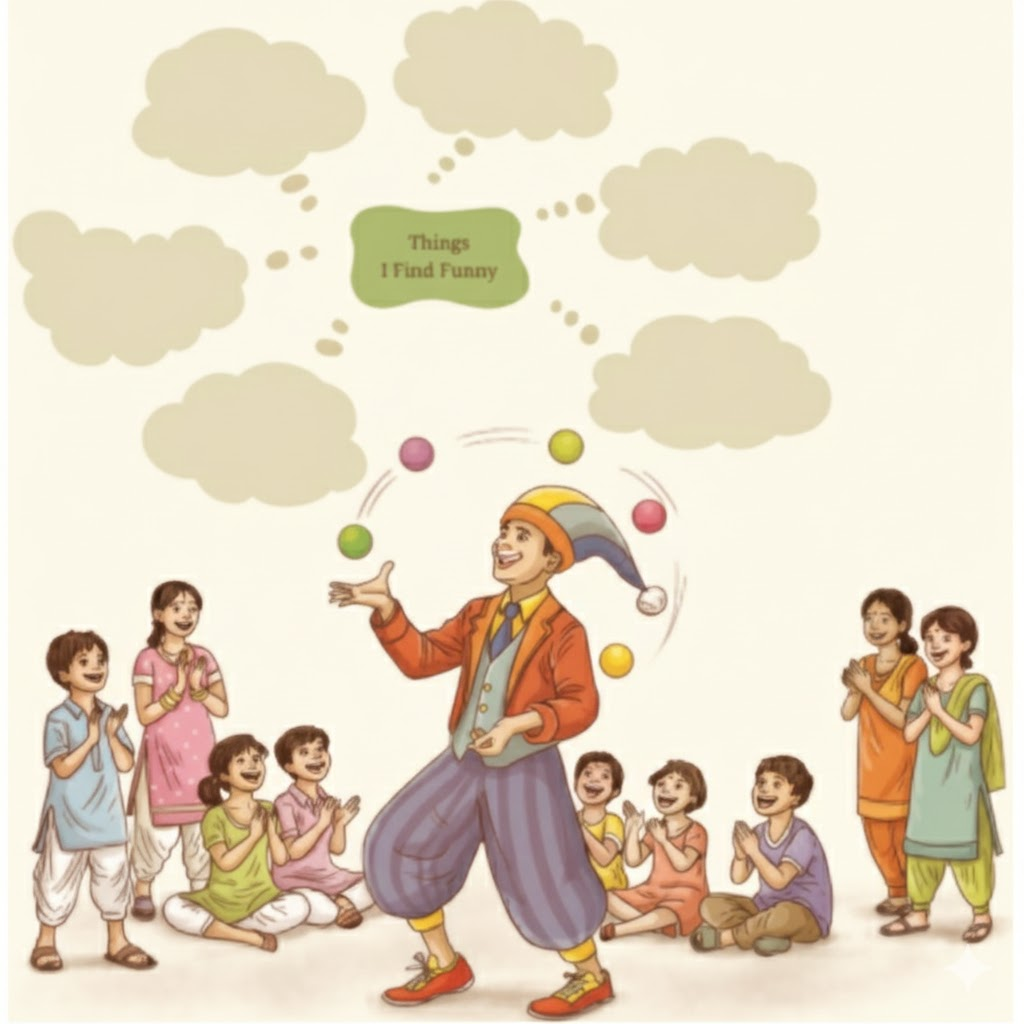
Answer:
Things that make us laugh:
(Students’ responses will vary.)
Clowns: Their funny faces and silly actions always make me laugh.
Funny animal videos: Pets doing unexpected things are entertaining and amusing.
Cartoons: The silly jokes and exaggerated expressions make them very humorous.
A Funny Man Class 7 Question Answer – Let us discuss (Pages 61-62)
I. Work in pairs. Identify the true statements. Check your answers with the teacher.
1. The poet says that she had never heard such an amusing song.
Answer: True – As stated in stanza 5: “You never heard in all your life such a funny feeling sound.”
2. The funny man was quite ill-mannered.
Answer: False – As mentioned in stanza 2: “His manners were polite.”
3. The funny man wore two hats on his feet.
Answer: True – As shown in stanza 6: “Why do you wear two hats upon your feet?”
4. The funny man hopped on his head to reach home.
Answer: True – As stated in stanza 6: “Hopped home on his head.”
5. The funny man gave a rose to the poet.
Answer: False – According to stanza 3, “He offered a currant bun, not a rose.”
6. The funny man smiled at the poet.
Answer: True – As mentioned in stanza 2: “He raised the shoe and smiled at me.”
II. Identify the words from the poem based on the meanings given. Share your answers with your classmates and the teacher,
1. a small seedless raisin – C_R _ _ _T
2. moved unsteadily – S _ _ GG _ _ _ D
Answer:
1. currant
2. staggered
III. Complete the following sentences with a reason.
1. The tone of the poem is ___________ because ___________.
2. The rhyme scheme of the poem is ___________; and it gives a ___________ quality to the poem.
3. The poet has frequently repeated the word ‘funny’ in order to ___________
Answer:
The tone of the poem is light-hearted and humorous because the man’s strange and absurd actions make the situation comical.
The rhyme scheme of the poem is AABB, which gives it a musical and playful rhythm.
The poet repeats the word “funny” several times to highlight the man’s silly and ridiculous behaviour.
IV. Choose the correct answer from the options given in the brackets.
1. The poem uses vivid imagery to create a _______________________ (humorous and nonsensical/ confusing but thought-provoking) scene.
2. The structure of the poem is in ___________ (monologue/ dialogue) form.
3. The phrases ‘sounding sight’ and ‘hopped home’ are examples of ___________. (alliteration/simile)
Answer: The poem uses vivid imagery to present a humorous and nonsensical scene that is amusing yet thought-provoking. The poem is structured in a dialogue form.
The phrases “sounding sight” and “hopped home” are examples of alliteration.
V. Rewrite the following line from the poem in the correct order.
Question 1. But never had I seen before Such a funny sounding sight.
Answer: But I had never seen a sight that sounded so funny before.
Question 2. Why has the poet used phrases like ‘funny sounding sight’ and ‘funny feeling sound’ with reference to the funny man?
Answer: The poet uses these phrases to emphasise the man’s absurd behaviour. “Funny sounding sight” suggests that his appearance is so strange it almost seems to make a sound, while “funny feeling sound” indicates that his singing causes a physical sense of amusement. This blending of senses adds to the comic effect.
VI. Can you think of any real-world situations where people do similar things for fun, entertainment, or performance? Share with your classmates and the teacher.
Answer: Many real-world examples resemble the funny man’s playful behaviour:
Circus clowns, who wear oversized costumes and perform silly acts.
Street performers who juggle strange objects or do unusual balancing tricks.
Comedians who use absurd props and illogical actions in their shows.
Children’s entertainers who wear clothes backwards or put shoes on their hands to make kids laugh.
Performance artists who create surreal, nonsensical acts to surprise their audience.
Mime artists who pretend invisible objects are real in amusing ways.
All these examples involve breaking normal rules in a humorous, unexpected way to entertain people—just like the funny man in the poem.
Class 7 English A Funny Man Question Answer – Let us think and reflect (Pages 62-63)
I. Read the extracts given below and answer the questions that follow:
Question 1.He said, “Allow me to present Your Highness with a rose. ” And taking out a currant bun He held it to my nose. I staggered back against the wall And then I answered, “Well!”
(i) Why does the funny man address the poet as ‘Your Highness’?
Answer: He calls her “Your Highness” to playfully imitate formal politeness in a humorous way.
(ii) Choose a phrase from the extract which indicates a polite request.
Answer: “Allow me to present” expresses a courteous request.
(iii) Choose the option which shows a ‘currant bun’.

Answer: Image 2 shows a currant bun.
(Image 1 is bread, Image 3 is a donut, and Image 4 is a loaf.)
(iv) Complete the sentence with an appropriate reason.
When the poet says, ‘Well!’, it expresses surprise. This was so because _________________.
Answer: The man gave her a currant bun instead of a rose, which was quite unexpected.
Question 2. You never heard in all your life Such a funny feeling sound.
“My friend, why do you wear two hats Upon your feet?” I said.
He turned the other way about,
And hopped home on his head.
(i) Choose the line from the extract which tells us that the sound was unique.
Answer: You had never heard a sound so strangely amusing in your entire life.
(ii) Complete the sentence with an appropriate reason.
The poet calls the funny man ‘my friend’ because ___________.
Answer: The poet refers to him as “my friend” because she sees him as harmless and amusing.
(iii) What does the reaction of the funny man to the poet’s question tell us about him?
Answer: His response shows he likes acting silly and doesn’t treat things seriously.
(iv) Choose the correct option to complete the sentence.
The last line of the extract makes the readers feel ___________.
A. dreamy
B. impatient
C. worried
D. cheerful
Answer: D. cheerful
II. Answer the following questions:
Question 1. Which character trait of the funny man was most appealing to you? Why?
Answer: His playful nature is charming because it brings joy even without any logic.
Question 2. The funny man does unusual things in the poem. How does it affect the overall mood of the poem?
Answer: The funny man behaves in strange ways in the poem, and his actions add a cheerful, humorous tone throughout.
Question 3. What alternative title would you suggest for the poem? Give reason(s) for your choice.
Answer: I would title it “The Topsy-Turvy Man” because it perfectly reflects his upside-down behaviour.
Question 4. Why do you think the poet has included dialogues in the poem?
Answer: The poet uses dialogue in the poem because it makes the scene vivid and allows readers to feel the interaction directly.
Question 5. What does the poet wish to convey by highlighting the unusual behaviour of the funny man?
Answer: The poet emphasises the funny man’s absurd actions to show that breaking rules can bring joy and surprise. His nonsensical behaviour celebrates imagination and the freedom to be delightfully unconventional.
A Funny Man Class 7 Questions and Answers – Let us learn (Pages 63-65)
Read the following phrases from the poem.
walking down
taking out
sat down
These are phrasal verbs.
Phrasal verbs are combinations of a verb with a preposition or adverb that together function as a single unit. They often have meanings that are different from the individual words used alone. The same verb followed by different prepositions or adverbs conveys different meanings.
I. Match the phrasal verbs in Column 1 with their correct meaning in Column 2.
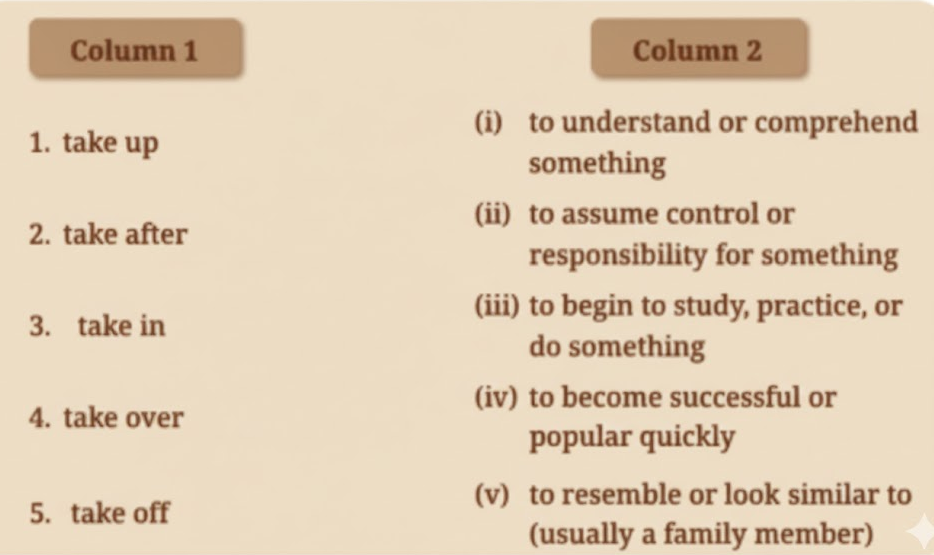
Answer:
1. take up – (iii),
2. take after – (ii),
3. take in – (i),
4. take over – (ii),
5. take off – (iv)
Now, fill in the blanks with suitable phrasal verbs from the table given in
I. You may change the tense of the verb, if required.
1. The new technology is set to _________________ traditional methods of communication.
2. I tried hard to _________________ what the writer wanted to say but was unsuccessful.
3. Arjun decided to _________________ painting as a hobby.
4. The smartphone quickly _________________ the sales in the market.
5. Sheela _________________ her father; they have the same smile
Answer:
1. The new technology is set to take over traditional methods of communication.
2. I tried hard to take in what the writer wanted to say but was unsuccessful.
3. Arjun decided to take up painting as a hobby.
4. The smartphone quickly take off the sales in the market.
5. Sheela take after her father; they have the same smile.
II. Match the verbs in Column 1 with any suitable adverbs or prepositions in Column 2. Write their meanings in Column 3. An example has been done for you.
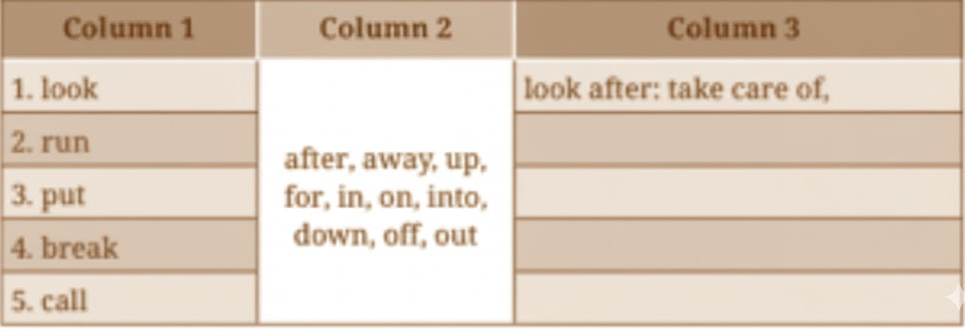
Now, frame sentences of your own using any five phrasal verbs.
Answer:
look + for = to search
I need to look for my lost keys before I leave.
run + away = to escape
The puppy tried to run away when it heard the loud fireworks.
put + off = to postpone
They put off the meeting until Tuesday.
break + down = to stop working
The car broke down on the highway.
call + off = to cancel
We called off the picnic because of the rain.
III. Read the following words from the poem.
walking, staggered, hopped The given words denote the different ways of walking. Arrange the words given in the box in increasing order of pace.

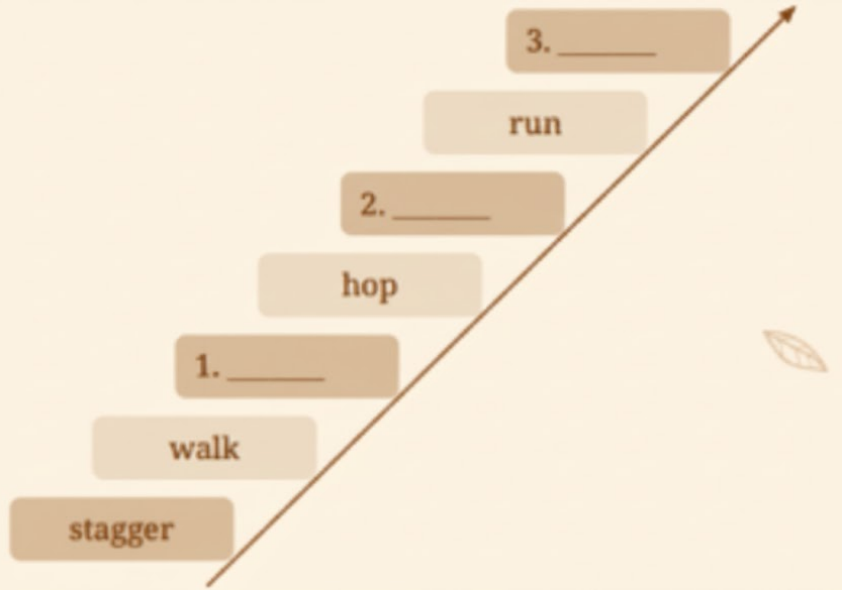
Answer:
1. jog-walk
2. trot-hop
3. sprint-run
A Funny Man Question Answer Class 7 – Let us listen (Pages 65-65)
I. You will listen to a girl narrate a personal incident. As you listen, select the picture related to the narration. (Transcript for the teacher on pg. 88)
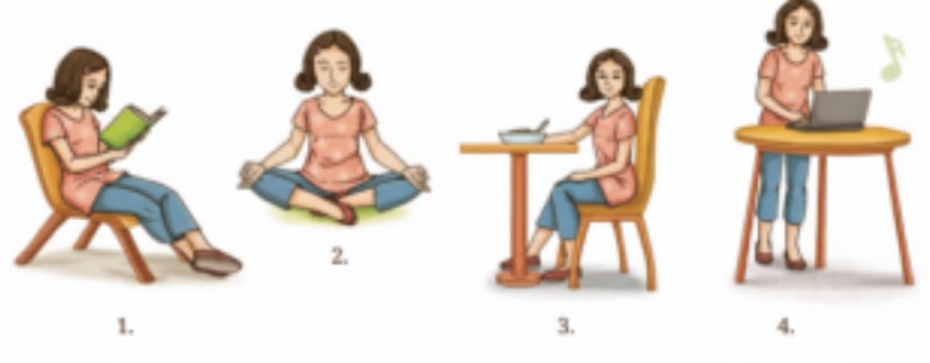
Answer: Picture 3
II. You will once again listen to the girl narrate a personal incident. As you listen, arrange the events in order of occurrence.
1. Ate lunch
2. Took off shoes
3. Put shoes in the room
4. Laughed at the mistake
5. Placed the plate in the room
6. Prepared for the presentation
7. Put the plate in the kitchen
Answer: Events in order of occurrence are as follows.
6-2- 1-5-4-3-7
6. Prepared for the presentation
2. Took off shoes
1. Ate lunch
5. Placed the plate in the room
4. Laughed at the tile mistake
3. Put shoes in the room
7. Put the plate in the kitchen
Class 7 English Chapter 5 Question Answer – Let us speak (Page 66)
Read the joke given below.
A man is talking to God.
The man says, “God, how long is a million years?”
God replies, “For me, it’s about a minute.”
The man asks, “How much is a million rupees?”
God smiles and replies, “It’s less than a rupee for me.”
The man quickly requests, “God, may I have a rupee?”
God promptly says, “Wait a minute.”
Work in pairs and take turns to tell the joke.
Remember:
Narrator’s voice- your own voice (speak matter-of-factly)
Man’s voice- change to a louder voice (speak with respect)
God’s voice- deep voice (speak in a pleasant tone)
Now, work in pairs to create a joke and tell it in front of the class.
Answer:
1. For the given joke, students should practice:
Narration in a neutral tone
Man’s lines in a louder, respectful voice
God’s lines in a deep, calm voice
2. For the created joke (student responses will vary; no fixed answer).
Sample: A man buys a parrot that talks like hum
Answer:
One night, a thief breaks into the house.
The parrot calls out, “Who’s there?” The thief freezes and whispers, “It’s just the wind!”
The parrot replies, “Then why are you taking the TV?”
NCERT Class 7 English Poorvi Chapter 5 Question Answer – Let us write (Pages 66-67)
I. A limerick is a nonsensical and funny verse consisting of five lines. Study the limerick given below and identify the rhyme scheme.
1. There was an Old Man with a beard,
Who said, “It is just as I feared!
Two Owls and a Hen,
Four Larks and a Wren,
Have all built their nests in my beard!”
Edward Lear Now, read another limerick
2. There were two friends in Bengaluru’s lanes,
One loved books, the other flew planes.
They’d laugh and they’d play,
In their own unique way,
Creating stories and flying in dreams’ trains.
Remember all limericks have the same rhyme scheme AABBA.
Answer:
Rhyme scheme: AABBA (hand/feared, Hen/Wren, beard)
→ The poem follows an AABBA rhyme pattern, with words like hand–feared, Hen–Wren, and beard forming the rhymes.
Rhyme scheme: AABBA (lands/planes, play/way, trains)
→ This stanza also uses an AABBA rhyme scheme, shown through pairs such as lands–planes, play–way, and trains.
II. Follow the structure given below and write a limerick on your own.
Line 1: Introduction of a person or place
There was a child from ___________
Lines 2-4: A silly story
Who ___________
She/He ___________
Line 5: An unexpected ending __
Answer:
There was a child from Pune,
Who ate soup with a spoon,
Then danced in the rain,
And forgot all her pain,
Now she howls at the full moon!
Class 7th English Chapter 5 A Funny Man Question Answer – Let us explore (Pages 67-69)
I. In ancient Indian literature and mythology, there are several humorous or funny characters who play important roles in the stories. These characters often represent wit, humour and mischief while conveying deeper moral lessons. Here are a few well-known funny characters:
Take any story to read and share it with your classmates and the teacher.
Answer: Once, Tenali Rama fooled a greedy merchant by making him believe that an ordinary stone had magical powers. The merchant bought it and later realised it was useless, learning that greed only brings loss.
II. We can identify the acts of the funny man with certain modern-day activities that have playfulness or unconventional behaviour.
For example:
Street Performers or Clowns: Performance Art or Abstract Theatre, Children’s Entertainment and Comedy Shows (See Pages 67-68)
In these examples, the common theme is humour, imagination, and defying logic or expectation, which is exactly what the funny man in the poem represents.”
Answer:
Street performers: They may wear shoes on their heads to make people laugh.
Clown acts: They often use silly props, just like offering a bun instead of a real rose.
Comedy shows: They include nonsensical or playful dialogues similar to those in the poem.
Children’s entertainers: They do funny tricks like headstands or hopping around, much like the funny man.
III. Sukumar Ray, an Indian poet and illustrator, wrote poems in a similar style in his book Abol Tabol.
You may also share a similar poem from your native language with your classmates and the teacher.
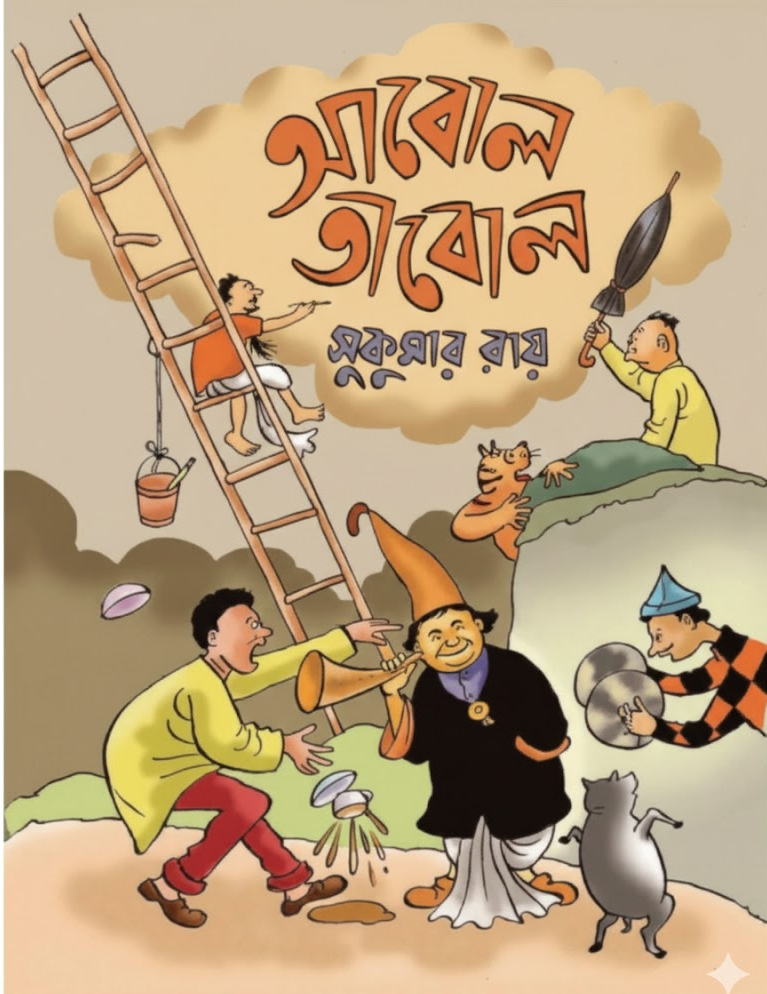
Answer:
“Bandar mama pehen pajama,
Neeli dhoti, laal rumal,
Jab bhi aate ghar hamare,
Karte hain bahut tamasha!”
Understanding the Humour in "A Funny Man"
The poem A Funny Man from NCERT Class 7 English combines wit and humour to engage students in a delightful way. Focusing on unusual actions and funny descriptions, it encourages learners to enjoy literature while understanding poetic devices.
Practicing NCERT solutions for Chapter 5 A Funny Man helps students quickly grasp the poem’s central ideas, learn important vocabulary, and answer exam questions efficiently. Make sure to review the compound words and palindrome activities for added learning.
Stay consistent by solving each exercise and revising the key terms. This will not only reinforce concept clarity but also boost your mock test performance for English in the upcoming NCERT 2026-27 exams.
FAQs on NCERT Solutions For Class 7 English Chapter 5 A Funny Man - 2026-27 Free PDF Download (Sign-in Required)
1. What are NCERT Solutions for Class 7 English Chapter 5 A Funny Man?
NCERT Solutions for Class 7 English Chapter 5 A Funny Man provide detailed, step-by-step answers to all exercises in the chapter, designed as per the CBSE 2026–27 syllabus.
- Include intext and back exercise solutions
- Follow the latest marking scheme for full marks
- Help clarify concepts and boost exam confidence
2. How can NCERT Solutions Class 7 English Chapter 5 A Funny Man help in scoring high marks?
These solutions help students score better by offering structured answers matched to CBSE evaluation:
- Stepwise explanation for precise marking
- Answers with important keywords highlighted
- Model answers for both short and long questions
- Tips and common mistakes to avoid negative marking
3. How do I write stepwise NCERT answers to score full marks in Class 7 English Chapter 5?
To score full marks, present your answers in a clear, step-by-step manner:
- Start with a summary statement
- Explain each point logically in order
- Use headings or bullet lists where needed
- Include definitions, examples, or quotes from the chapter
- Follow the marking scheme for each question type
4. Which questions are most important from Class 7 English Chapter 5 A Funny Man for exams?
Key questions likely to appear in exams from this chapter include:
- Summary of A Funny Man and main character traits
- Short and long answer questions based on back exercises
- Definitions and explanations of key terms from the chapter
- Extra questions or HOTS (Higher Order Thinking Skills) based on the lesson
5. Are diagrams or definitions compulsory in Class 7 English Chapter 5 answers?
While definitions of key terms are often required for full marks, diagrams are generally not mandatory unless the question specifically asks for one. Always include:
- Accurate definitions in your answers when asked
- Neat diagrams only if instructed in exercises
- Label diagrams clearly if included
6. How do I structure long answers for Class 7 English Chapter 5 to score better?
For long answers, use a clear format to impress examiners:
- Begin with an introduction sentence
- Write body paragraphs, each covering one point
- Use supporting examples or quotes from the chapter
- Conclude with a summary or your opinion
- Underline key words and stick to the word limit
7. Where can I download the Class 7 English Chapter 5 A Funny Man Solutions PDF?
You can download the free PDF of NCERT Solutions Class 7 English Chapter 5 A Funny Man from trusted educational websites as per CBSE 2026–27 standards:
- Look for a clear download button on the solutions page
- Ensure the PDF covers all intext and back exercises
- Prefer sites that offer teacher-reviewed and updated PDFs
8. What is the summary of Class 7 English Chapter 5 A Funny Man?
The summary of 'A Funny Man' in Class 7 English covers the main story and its key message:
- Highlights the traits of the main character known for his humor
- Explains how his actions affect those around him
- Focuses on moral lessons and important events in the chapter
9. Are NCERT Solutions enough for Class 7 English exams?
NCERT Solutions are sufficient for most exam questions in CBSE Class 7 English.
- Cover all syllabus exercises and important topics
- Provide model answers as per exam patterns
- For extra practice, refer to exemplar or additional questions
10. How can I revise Class 7 English Chapter 5 quickly for school exams?
Revise the chapter quickly using these steps:
- Read the summary and key points of 'A Funny Man'
- Revise stepwise NCERT solutions for all exercises
- Go through definitions and important terms
- Test yourself with extra questions and sample papers
- Use flash notes or revision planners for last-minute prep
11. How to present long answers to match CBSE marking?
To match CBSE marking scheme, present long answers by:
- Organising content into introduction, main body, and conclusion
- Using clear bullet points or paragraphs for each idea
- Adding examples/quotes and maintaining logical flow
- Using proper grammar, spelling, and word limits
12. Do examiners award partial marks for correct steps even if the final answer is wrong?
Yes, as per the CBSE step-marking system, partial marks are given for every correct step, even if the final answer is wrong due to calculation or minor errors.
- Write all steps clearly
- Use proper method and logic
- Highlight main points or keywords
