




Stepwise NCERT Exercise Answers & PDF for Santoor The Wise Parrot
Let us Think (Page 45)
A. Answer the following questions.
Question 1. Why did the merchant keep the parrot in a cage of gold?
Answer: The merchant placed the parrot in a golden cage because he cared deeply for it and wished to keep it protected and near him.
Question 2. What made the parrot a favourite pet of the merchant?
Answer: The parrot was the merchant’s most cherished pet as it was lively, spoke a lot, and delighted him with its tales and songs.
Question 3. What message did the parrot ask the merchant to convey to its friends?
Answer: The parrot requested the merchant to convey its regards to its friends in the forest, saying that it still thought of them while living in its cage.
Question 4. What happened after the merchant gave the message to the parrots?
Answer: When the merchant delivered the message to the parrots in the forest, one of them suddenly fell from a tree to the ground, appearing lifeless.
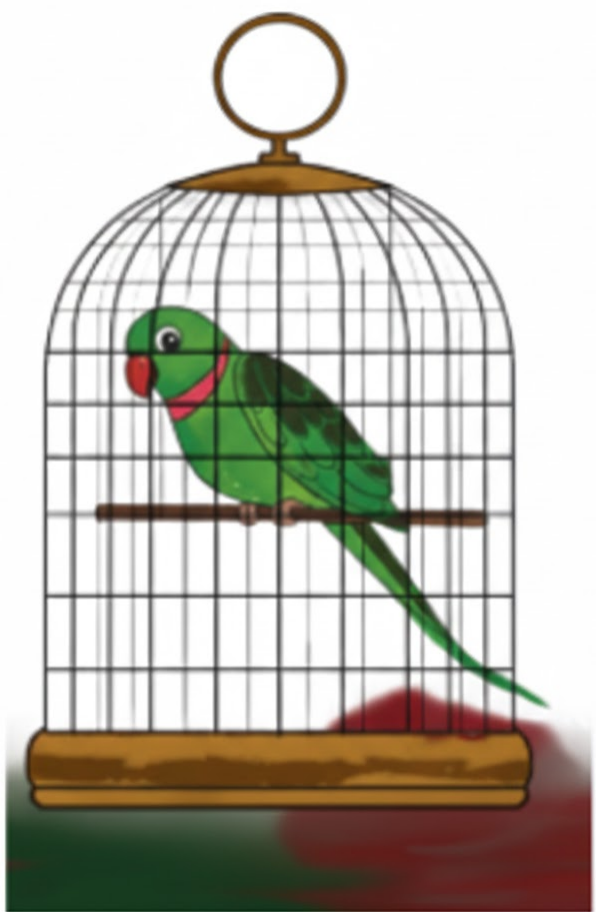
Question 5. How did the parrot escape from the cage?
Answer: The parrot freed itself by acting as though it were dead, copying the behaviour of the parrot in the forest. When the merchant set it on the windowsill, it came back to life and flew away into the open air.
B. Think and discuss
Question 1. If you were the merchant, how would you respond to the parrot’s request for freedom?
Answer: If I were in the merchant’s place, I would think about what the parrot truly wanted and let it go, realising that real joy comes from being free, not from living in a fancy cage or being given delicious food.
Question 2. Can you think of a real-life situation where intelligence is more useful than strength?
Answer: Yes, in many situations—like tackling a tough problem or getting out of danger—smart thinking and creative ideas can be far more useful than physical strength.
Question 3. Which parrot from the chapter was actually ‘wise’ according to you? Give reasons for your answer.
Answer: The parrot inside the cage showed the most wisdom because it observed what the forest parrot did and used its mind, not strength, to find its freedom.
Let us Learn (Page 46-48)
A. Fill in the blanks with suitable phrases given in the box to make a meaningful paragraph.
stand upright, all over, look after, stepped out, went away, came across, about to
One winter morning, as I …….. of my home, I saw that the snow was ……… the place. While walking uphill towards my shop, I ……… a small puppy. Its leg was injured and it was collapse. Being in pain it was unable to ……… . So, I decided to take it home and ……… it. With good care, all its pain …….. .
Answer: One winter morning, as I stepped out of my home, I saw that the snow was all over the place. While walking uphill towards my shop, I came across a small puppy. Its leg was injured and it was about to collapse. Being in pain it was unable to stand upright. So, I decided to take it home and look after it. With good care, all its pain went away.
Note for the Teacher
Provide learners with the meanings of each phrase.
Use examples from various texts to help them understand how a phrase differs from a complete sentence.
B. Complete the sentences. The first one has been done for you.
pack, bouquet, army, flock, bunch, flight, swarm,
Question 1. A flight of parrots came to the forest.
Answer: flight
Question 2. I saw a ……….. of sheep in the fields.
Answer: flock
Question 3. A ……….. of wolves was howling loudly.
Answer: pack
Question 4. We gave a ………. of flowers to the chief guest.
Answer: bouquet
Question 5. A ………. of bees hovered around the flowers.
Answer: swarm
Question 6. An ……… of ants is moving towards the anthill.
Answer: army
Question 7. I helped my mother find a ……….. of keys.
Answer: bunch
Note for the Teacher
Motivate learners to include the collective nouns from the earlier question in their spoken activities.
Introduce additional examples of collective nouns to widen their understanding.
Reinforce these words whenever possible by referring to them during casual classroom discussions.
C. Read the following.
1. I have come from Jalandhar.
The underlined part tells us that the action of ‘coming from Jalandhar’ took place sometime in the recent past.
Answer:
2. Rita has read all the poems written by Sarojini Naidu.
The underlined part tells us about an ‘experience of reading’, that took place in the past but is still relevant in the present.
The above sentences have used present perfect tense.
We use present perfect tense to talk about:
Actions that were completed in the recent past.
Actions or experiences that happened in the past but affect the present.
Rule
Subject + has/have + Verb + Object
Now complete the following sentences using present perfect tense.
a. I …….. (visit) Delhi many times. It is a city with many historical sites.
Answer: has visited
b. My friend Onshangla is an artist. She ……… (draw) pictures of ten monuments.
Answer: has drawn
c. Mr. Joon …….. (buy) a new car.
Answer: has bought
d. I ………. (complete) my homework and my brother ……….. (revise) for his test.
Answer: have completed, has revised
e. They ………. (write) letters to their friends.
Answer: have written
Let us Listen (Page 48)
Your teacher will read the paragraph given below, listen to the paragraph carefully. Your teacher will ask you some questions, which you can try to answer.
Birds are beautiful creatures with feathers and wings. Due to various reasons, many species of birds have become endangered. To protect these birds and their species, bird sanctuaries have been built. There are more than 70 bird sanctuaries in India. The Vedanthangal Bird Sanctuary, located in Tamil Nadu, is the oldest bird sanctuary in India. The Bharatpur Bird sanctuary, located in Rajasthan, is the largest bird sanctuary in our country.
Answer: Classroom task.
Note to the Teacher
Ask factual questions based on the above paragraph.
Let us Speak (Page 49)
A. Listen and repeat
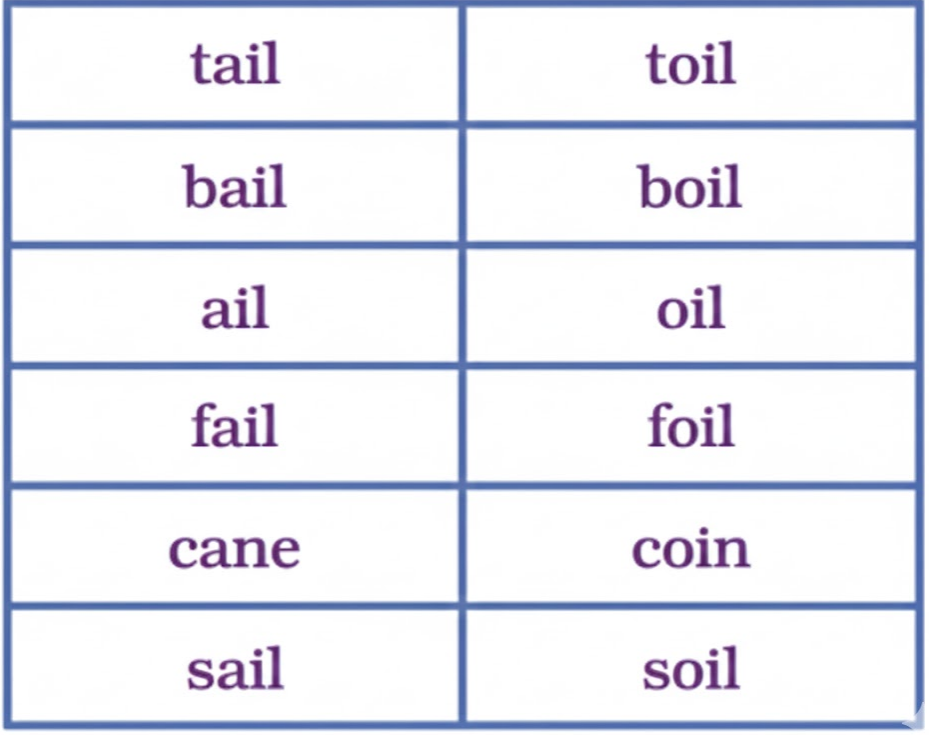
Answer: Students should do it by themselves.
B. Look at the pictures below. There are two birds. Which bird would you want to be and why? Share your views with the class.
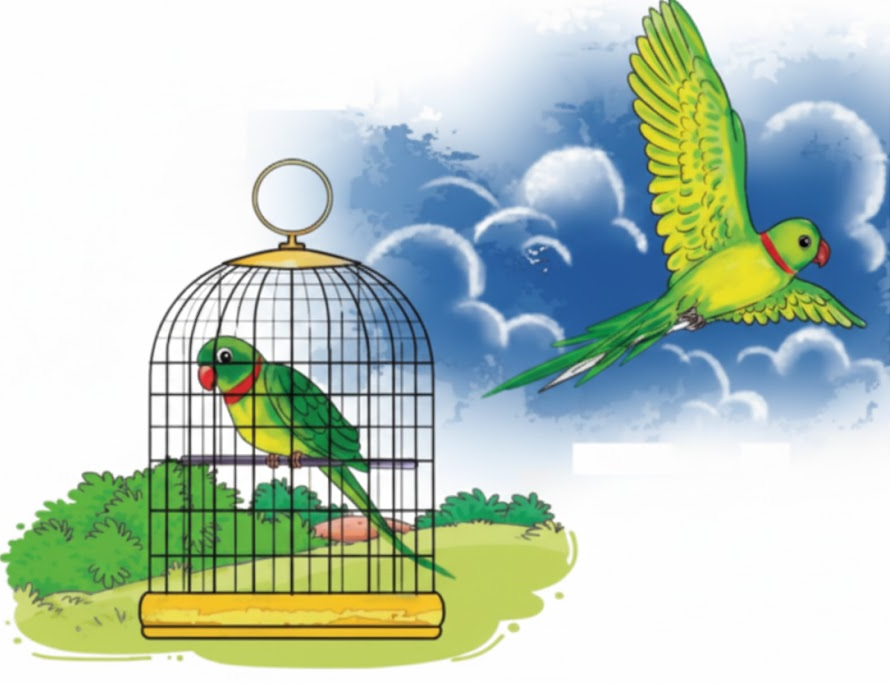
Answer: I would choose to be the bird soaring in the sky because it enjoys freedom. To me, being free matters more than staying in an expensive cage and eating tasty food.
Note for the Teacher
Invite learners to express their opinions openly in class.
Make sure they articulate the words clearly, especially differentiating between the ‘ai’ and ‘o’ sounds.
Let us Write (Page 50)
In the story, you read how the parrot tricked the merchant into releasing it but the story does not end here. Use your imagination to complete the parrot’s story.
After escaping from the golden cage, the parrot decided to fly away …
Answer: After breaking free from the golden cage, the parrot chose to return to the forest. There, it reunited with its old companions and told them how it cleverly escaped from the merchant. At last, the parrot felt truly joyful, soaring through the trees and singing happily in its newfound freedom.
Let us Do (Page 50)
A bird feeder is an object used to keep food for birds. You might have seen bird feeders placed outdoors in balconies, gardens, or parks to attract and feed birds. They are filled with seeds, grains, or nuts and placed in safe locations to help birds find food easily.
Question 1. Look at the pictures of bird feeders given below and try to identify the material used to make them.
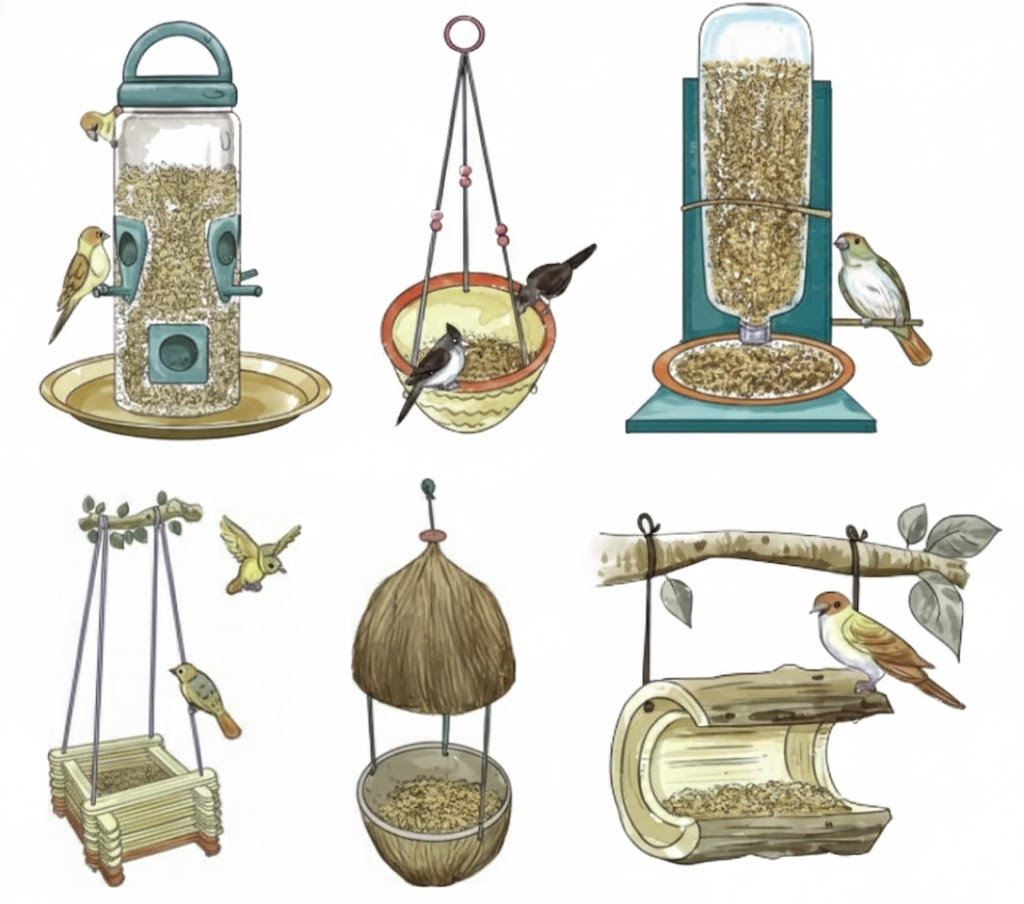
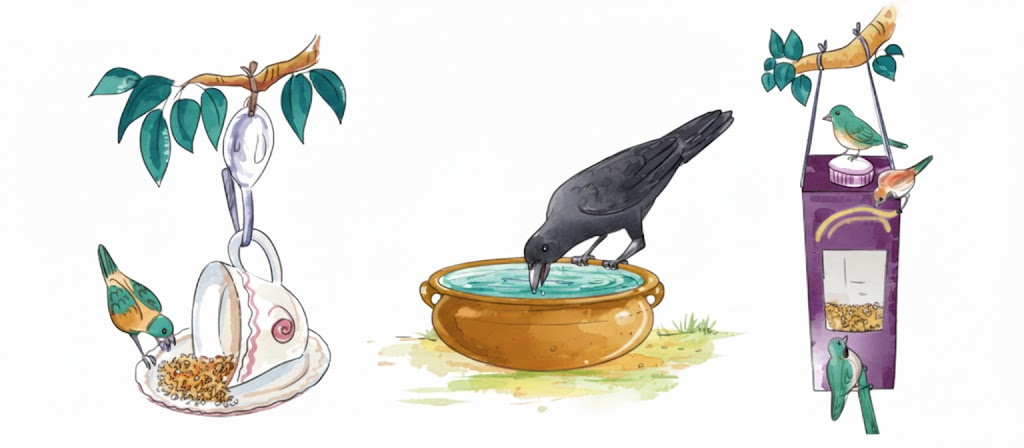
These materials are easily available in our homes.
Answer: Students should do it by themselves.
Question 2. Make a bird feeder with the material of your choice. Fill it up with water, seeds, and grains like millets. With the help of your parents, place it at an appropriate location outside your house.
Happy feeding!
Answer: Students should do it by themselves.
Let us Explore (Page 52)
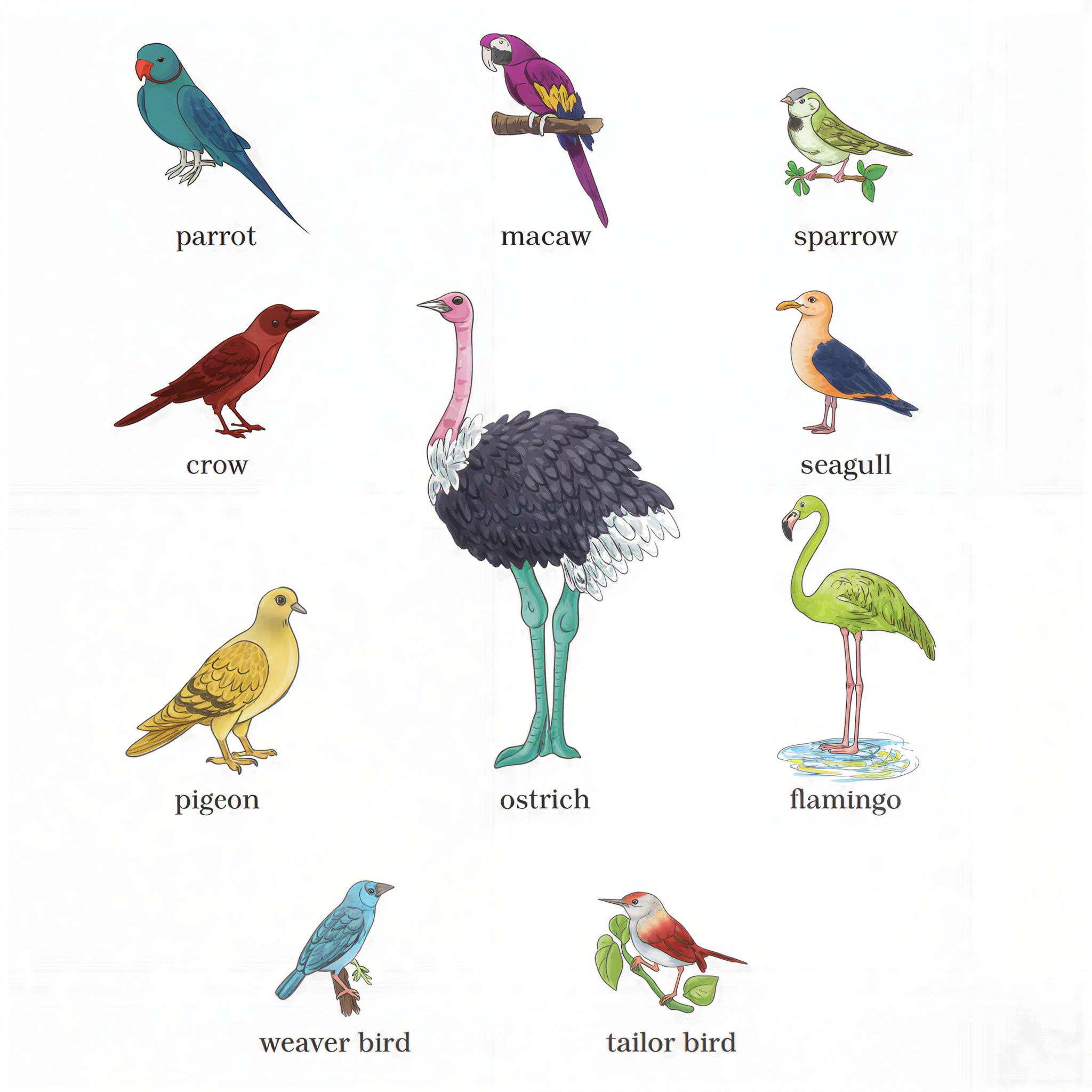
Choose any two of the above and find out a few interesting facts about them.
Answer:
Parrot
Parrots are famous for copying human voices. They are smart, friendly birds that enjoy being around others.
Ostrich
Ostriches are the biggest birds on Earth. Though they cannot fly, they can sprint incredibly fast—reaching speeds of nearly 70 km/h.
Macaw
Every macaw has a one-of-a-kind pattern, much like a human fingerprint. These birds usually stay with the same partner throughout their lives.
Sparrow
A sparrow is a tiny brown bird, hardly bigger than a tennis ball, with dark lines on its back. Males and females look different in colour, not in size.
Crow
Crows are known for being extremely smart and adaptable. Their loud “caw” is recognisable, and scientists continue to discover new things about their remarkable abilities.
Seagull
Seagulls, or gulls, are intelligent birds that can learn difficult tasks and pass them on to their young. They live in groups and communicate with many sounds and gestures.
Pigeon
Pigeons are surprisingly intelligent and skilled at finding their way over long distances. They can even produce a special type of milk for their young and have a long history with humans.
Flamingo
Flamingos are easily recognised by their bright pink colour, tall legs, and unusual feeding method. They live in large groups and get their pink shade from the food they eat.
Weaver Bird
Weaver birds, such as the Baya Weaver, are known for creating beautifully woven nests out of grass and leaves. These small birds often live and feed in groups and are remarkably intelligent.
Tailorbird
Tailorbirds earn their name from the way they “sew” leaves together using fibres or spider silk to make their nests. These lively birds are found in South and Southeast Asia and are known for their sharp calls.
NCERT Solutions Class 5 English Chapter 4 Santoor The Wise Parrot 2026-27: Chapter Insights
The story of The Wise Parrot teaches the value of intelligence, freedom, and cleverness. Practising NCERT Solutions Class 5 English Chapter 4 Santoor The Wise Parrot helps you understand these themes for better exam performance.
With chapter-wise easy solutions, students can build solid concepts in English and boost their writing skills. Reviewing factual questions daily will enhance both understanding and confidence for school tests.
Stay consistent with regular practice of exercise-based answers for Class 5 English Chapter 4 in the 2026-27 NCERT curriculum. Short and effective revisions can improve marks and make learning enjoyable.
FAQs on NCERT Solutions For Class 5 English Chapter 4 The Wise Parrot - 2026-27 Free PDF Download (Sign-in Required)
1. What is included in the NCERT Solutions for Class 5 English Chapter 4 Santoor The Wise Parrot?
The NCERT Solutions for Class 5 English Chapter 4 Santoor The Wise Parrot include stepwise, exercise-wise answers as per the CBSE syllabus for 2026–27. These solutions provide:
- Intext and back exercise solved questions
- Explanations for long and short answers
- Definitions, key concepts, and diagrams (if any)
- Exam-oriented tips and important keywords
- A free PDF download for offline study
2. How can these solutions help me score better in the CBSE Class 5 English exam?
These NCERT Solutions boost your exam performance by:
- Providing step-by-step answers following CBSE marking schemes
- Highlighting key points, definitions, and answer structures
- Offering tips to avoid common mistakes
- Building confidence with practice questions and sample answers
3. How should I structure long answers in Class 5 English Chapter 4 to get full marks?
To get full marks for long answers, structure them as follows:
- Start with a clear introduction stating the main point
- Break your answer into short paragraphs or bullet points
- Use main keywords and refer to events or characters from the chapter
- Conclude with a summary sentence
- Keep handwriting neat and follow the CBSE step marking criteria
4. Where can I download the free PDF of NCERT Solutions Class 5 English Chapter 4 Santoor The Wise Parrot?
You can download the free PDF for this chapter's NCERT Solutions directly from trusted educational platforms. Look for a single-click download button on solution pages labeled:
- "Class 5 English Chapter 4 PDF download"
- "NCERT Solutions for Santoor The Wise Parrot PDF"
5. Are diagrams or definitions mandatory in answers for this chapter?
Definitions are often mandatory for scoring marks, especially if the question asks for them. Diagrams are usually required only if the question specifically mentions or the exercise suggests drawing/labeling something. Always check your textbook and marking scheme guidance to decide.
6. What are the most important topics and questions from Santoor The Wise Parrot for CBSE exams?
The most important topics and questions from Santoor The Wise Parrot include:
- The main theme and moral of the story
- Character traits of Santoor (the parrot)
- Key incidents that show Santoor’s wisdom
- Meanings of difficult words and key definitions
- Short question-answers and long answer-type questions covering story details
7. How can I quickly revise NCERT Solutions for Class 5 English Chapter 4 before exams?
For quick revision before exams:
- Go through stepwise solutions for all exercises
- Highlight important definitions and story points
- Use quick notes or flashcards for key events and character sketches
- Practice mock questions and sample papers related to the chapter
8. Do I need to memorize the whole story or just focus on the solutions?
You should understand the main story and focus on the NCERT Solutions, especially:
- Key events, characters, and their actions
- Solved question-answers as per the CBSE marking scheme
- Moral or lesson of the story
9. Are NCERT Solutions enough for Class 5 English exams?
NCERT Solutions provide comprehensive coverage for Class 5 English exams. They help you:
- Understand the chapter’s concepts
- Practice possible exam questions
- Structure your answers as per CBSE guidelines
10. How to present long answers to match CBSE marking?
Present long answers by:
- Starting with the main idea or introduction
- Arranging information in logical order using paragraphs or bullet points
- Highlighting important terms, keywords, or events
- Completing with a short summary
- Ensuring proper length as per marks allotted
