




Stepwise Answers and Exam Tips for Santoor The Decision of the Panchayat
Let us Think (Page 95)
A. Answer the following questions.
Question 1. Why did the farmer buy the well?
Answer: The farmer purchased a new piece of land and needed water for it, so he decided to buy a well as well.
Question 2. Why did the farmer become upset?
Answer: The farmer purchased a well from his neighbour, but the clever neighbour denied him access to the water inside it, which made the farmer very upset.
Question 3. How did the Panchayat solve the problem?
Answer: The Panchayat decided that the neighbour had sold only the well and not the water inside it. Therefore, he was told to take out all the water at once. This clever decision settled the matter.
Question 4. What was the final judgment given by the Panchayat?
Answer: The clever neighbour was ordered to use or empty the water from the well right away and then give the well to the farmer. This was the final decision.
B. Think and discuss
Question 1. Do you think the decision of the Panchayat was correct?
Answer: Yes, the Panchayat’s decision was fair and justified.
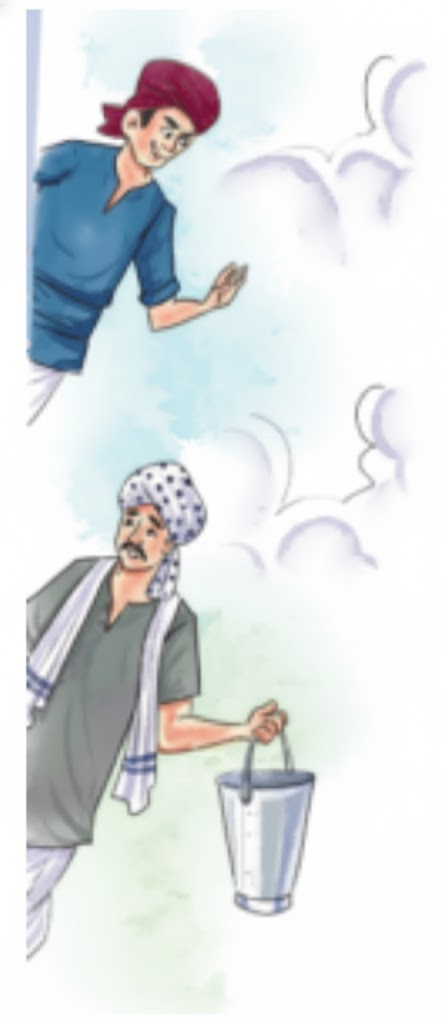
Question 2. You have an extra painting box which you wish to share with your friends in the class to complete an activity. Two of your best friends, Radha and Sita, fight for the box. How would you deal with the situation so that you are fair to both of them?
Answer: I would suggest that they either use the painting box together or take turns using it so they can share it without any conflict.
Question 3. Who said to whom:
a. “I sold only the well, not the water.”
b. “Remove the water or use it all up immediately.”
c. “He is not letting me take the water.”
Answer:
a. The clever neighbour speaks to the farmer.
b. The village chief addressing the clever neighbour.
c. The farmer talking to the village chief.
Let us Learn (Pages 96-97)
A. Match the words with their meanings.
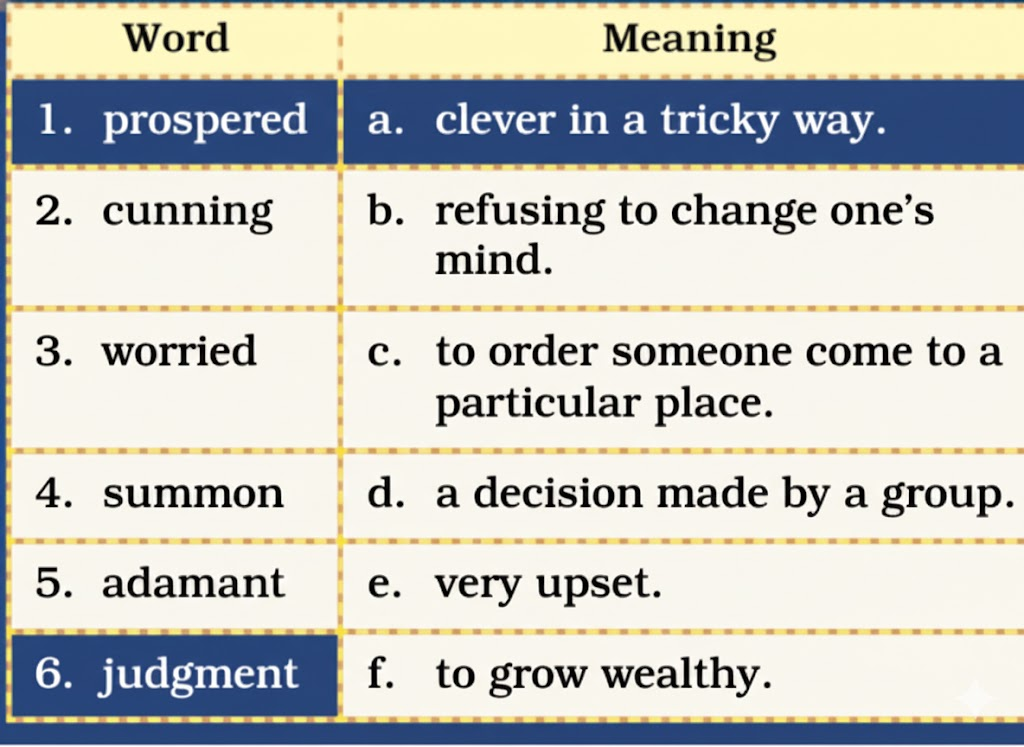
Answer:
1 – (f),
2 – (a),
3 – (e),
4 – (c),
5 – (b),
6 – (d)
B. Fill in the blanks with the correct prepositions
(in, at, by, after, before, under, with, to, for).
A preposition can be used more than once.
Question 1. The farmer went …………….. the village chief to explain his problem.
Answer: to
Question 2. The neighbour was standing ………. the well, blocking the way.
Answer: by
Question 3. The villagers tried to reason ………. the cunning man.
Answer: with
Question 4. The decision was made ……….. careful consideration of both sides.
Answer: after
Question 5. Their lived a farmer ………… the small village.
Answer: in
Question 6. The Panchayat members listen to both the sides ………. coming to decision.
Answer: before
Question 7. The villagers gathered the Panchayat ……….. the banyan tree.
Answer: under
Question 8. The neighbour was punished ………. his dishonesty.
Answer: for
Question 9. The chief listened carefully ………. both the farmer and the neighbour.
Answer: to
Question 10. The villagers agreed to meet ………… a later time to discuss the issue.
Answer: at
Question 11. The farmer decided to buy a well ……….. buying his third field.
Answer: before
C. Rearrange the events in the correct order.
1. Sam sat by a small stream to rest and enjoy the peaceful sound of the water. { }
2. Sam felt grateful for the time he spent in nature.
3. Sam decided to go for a walk in the forest near his house.
4. Sam walked along the narrow path, listening to the sound of birds chirping and leaves rustling.
5. After resting, Sam continued his walk, feeling refreshed.
Answer: 3 → 4 → 1 → 5 → 2
Let us Speak (Pages 98-99)
Look at the pictures below:
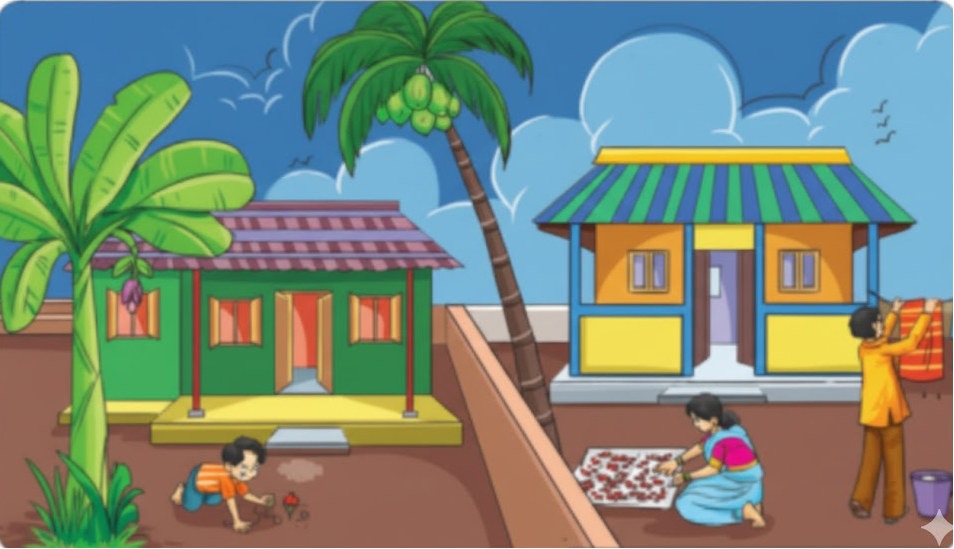
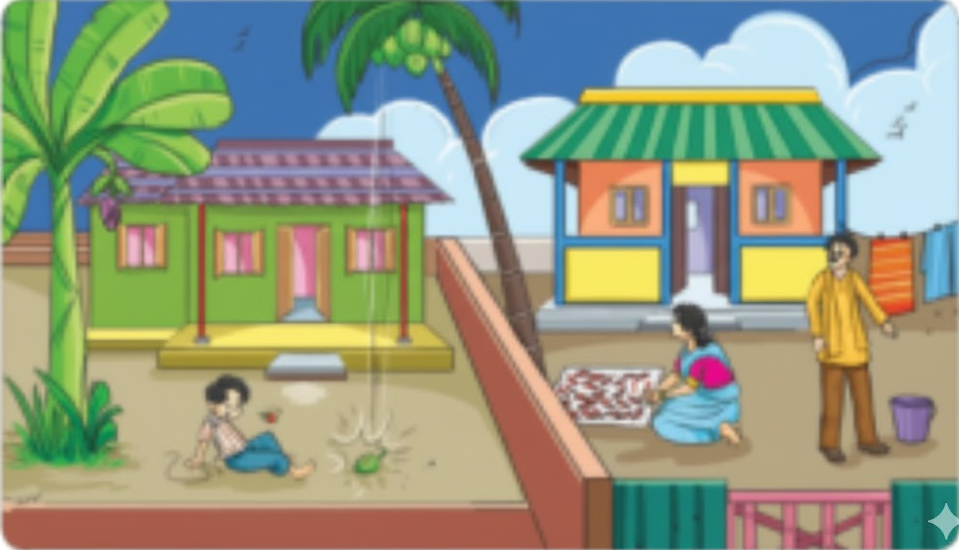
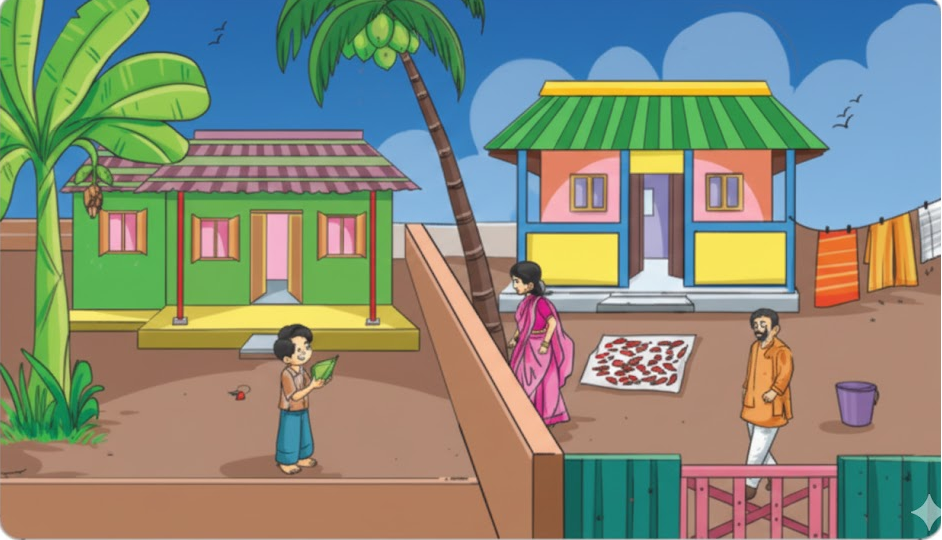
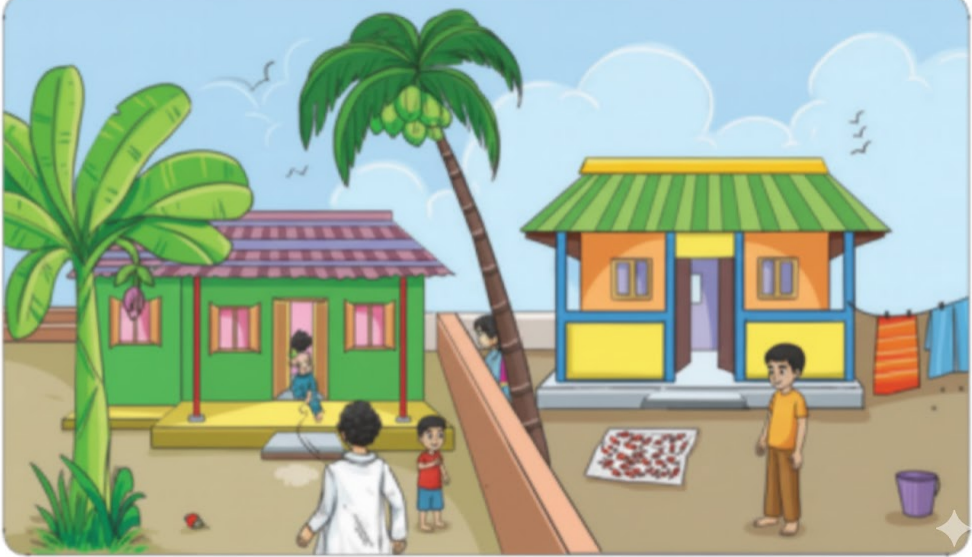
What do you think will happen next? Sit In small groups and discuss. One student from each group will narrate the ending to the whole class.
Answer: The coconut drops into the boy’s house. He quickly picks it up and takes it to his mother. However, the neighbour claims the coconut because it fell from his own tree. He plans to speak to the boy’s mother, hoping she will return it to him.
Let us Write (Page 100)
A. Imagine you are the farmer. Write a letter to your friend about the incident and the decision of the Panchayat.
You may begin as follows:
My dear friend,
Something happened last week, which I want to tell you. I wanted to buy a well …
Answer:
My dear friend,
I want to share an incident that took place last week. I had been planning to buy a well because my farm is doing quite well. There was a well close to my land, so I decided to purchase it. But the very next day, the person who sold it to me refused to let me use the water. He claimed that he had sold only the well, not the water inside it. I had no choice but to take the issue to the Panchayat for a fair solution.
When the Panchayat gathered to look into the matter, my neighbour stubbornly stuck to his claim. After hearing both sides, the Panchayat asked him to remove all the water from the well since he said it belonged to him. As that was impossible, the decision was given in my favour. I am truly grateful to the village chief for settling the dispute wisely.
I hope all is well with you and your family.
With warm regards,
Your friend
………………….
B. Read the following sentence.
Water is priceless.
It means that water is valuable. It is so valuable that you cannot put a price on it.
The ‘less’ at the end of the word is a suffix.
Complete the following by adding the suffix ‘less’ to the given words.
Words + suffix = New word
Use + less = …………..
Care + less = …………..
Hope + less = …………..
Fear + less = …………..
Colour + less = …………..
Make sentences using the new words in your notebook.
Answer:
Useless
Careless
Hopeless
Fearless
Colourless
Useless – This broken pencil is useless because it cannot write anymore.
Careless – Riya was careless and forgot to lock the door before leaving.
Hopeless – He felt hopeless when he couldn’t solve the difficult puzzle.
Fearless – The little girl was fearless and climbed the tall tree with confidence.
Colourless – The water in the glass is clean and colourless.
Note to the Teacher
Help learners understand the concept of ‘suffix.
Let us Listen (Pages 101-102)
Listen to your teacher read out this passage and answer the questions by choosing the correct option.
Sri Ramakrishna Paramahamsa
A long time ago, in a small village of West Bengal, there lived a kind and wise man named Sri Ramakrishna Paramahamsa. He loved to talk to people about God and taught that all religions are like rivers—they may take different paths, but they all lead to the same ocean. He lived a simple life, wearing plain clothes and eating very little, but his smile and loving words made everyone feel special.
One day, a curious young boy named Naren came to meet him. Ramakrishna saw something special in Naren and became his teacher. He taught Naren about courage, kindness, and how to find peace within.
Naren later grew up to become the famous Swami Vivekananda, spreading his teacher’s wisdom to the
world. Even today, Ramakrishna’s teachings inspire many people everywhere.
Question 1. Where was Sri Ramakrishna Paramahamsa born?
a. A colony in Kolkata.
b. A small village in West Bengal.
c. A mountain in the Himalayas.
d. A forest in Kerala.
Answer: b. A small village in West Bengal.
Question 2. Who was the curious boy that became Sri Ramakrishna’s student?
a. Mahatma Gandhi
b. Swami Vivekananda (Naren)
c. Rabindranath Tagore
d. Sri Aurobindo
Answer: b. Swami Vivekananda (Naren)
Question 3. What kind of life did Sri Ramakrishna live?
a. A life full of luxury,
b. A simple and loving life.
c. A life of traveling.
d. A secretive life.
Answer: b. A simple and loving life.
Question 4. What did Sri Ramakrishna compare religions to?
a. Trees in a forest
b. Stars in the sky
c. Rivers flowing to the ocean
d. Books in a library
Answer: c. Rivers flowing into the ocean
Question 5. What did Sri Ramakrishna teach Naren?
a. To find a teacher
b. To become wealthy
c. To travel the world
d. To find peace
Answer: d. To find peace
Did You Know?
The Banyan tree is the national tree of India. It can live for over 200 years and grow to cover several acres of land. Its roots grow down from the branches and become new trunks, making it look like a forest all by itself!
Let us Do (Page 103-104)
A. Read the passage carefully and answer the following questions.
The Neem Tree
You must have seen a neem tree near your house, or near the school, or beside the road. Almost everyone can recognise a neem tree.
The neem is a magic medicine tree because almost every part of the tree is used for medicine.
Sometimes, sick people are given neem juice to drink. People use the twigs of the neem tree as a toothbrush to clean their teeth. Burn some dry neem leaves inside the house and see the mosquitoes disappear! When you store winter clothing or blankets, keep dry neem leaves between them. This helps keep away insects. When you store rice, keep dry neem leaves at the bottom of the rice bin. This keeps pests away.
Answer the following questions.
Question 1. Where can you find neem trees?
Answer: Neem trees grow in many places such as near homes, beside roads, and within school campuses.
Question 2. Why do you think ‘neem’ is called a magic tree?
Answer: Neem is known as a miracle tree because nearly all of its parts are used for medicinal purposes.
Question 3. What happens when dry neem leaves are burnt?
Answer: Burning dry neem leaves helps drive away mosquitoes.
Question 4. Why do people put neem leaves in clothes and rice containers?
Answer: Placing neem leaves inside clothes or rice containers prevents insects from coming.
Question 5. How are neem twigs used?
Answer: Neem twigs are used as natural toothbrushes for cleaning teeth.
Question 6. Find the meaning of the word ‘disappear’ from the following options:
a. Appear
b. Vanish
c. Grow
d. Fly
Answer: b. Vanish
Question 7. Find the word in the passage which means ‘a short stick’:
a. Tree
b. Part
c. Twig
d. Leaf
Answer: c. Twig
B. Point out 11 differences in the two pictures given below. Work in pairs and write down the differences in your notebook.
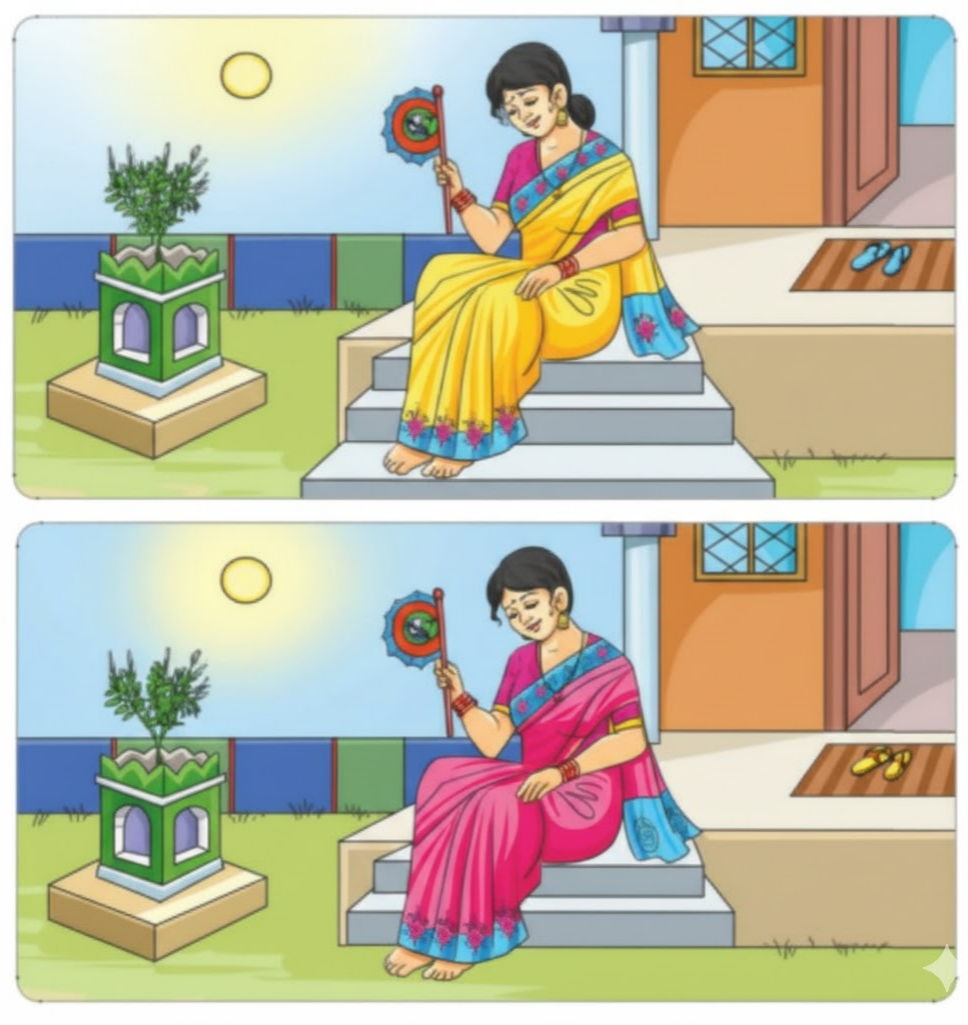
Answer:
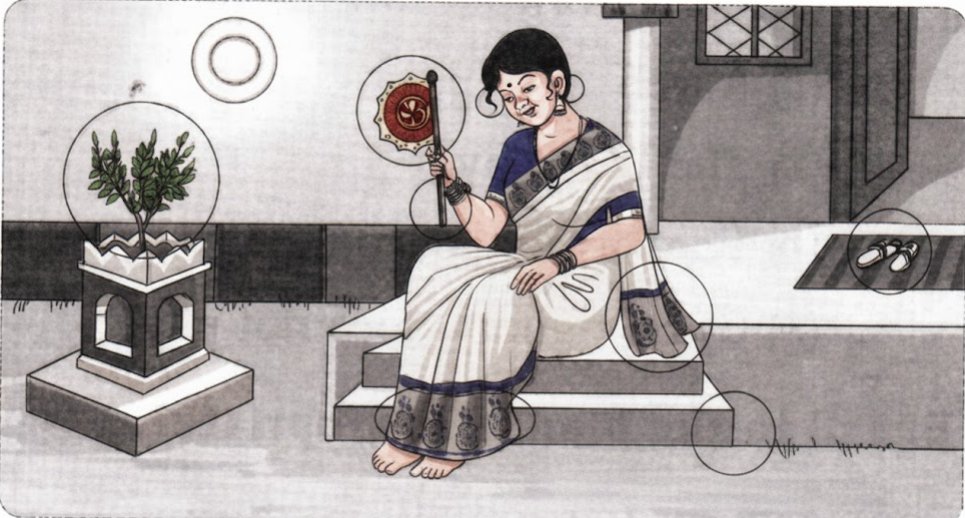
The 11 differences are as follows:
The sunlight rays are not the same.
The Tulsi plant has extra branches in one picture.
The Tulsi flowers differ between the two images.
The pattern of branching on the Tulsi plant is different.
One Tulsi plant has more leaves than the other.
The footwear is not identical in both pictures.
The fan shows a different colour pattern.
One image has one step fewer than the other.
The saree design varies in the two pictures.
The woman’s hair bun looks different.
The style of hair at the front of the woman’s head also differs.
NCERT Solutions for Class 5 English Chapter 8: The Decision of the Panchayat 2026-27
Chapter 8 The Decision of the Panchayat teaches lessons of honesty and fairness. These NCERT Solutions for Class 5 English Chapter 8 (2026-27) help students understand wise decision-making and the consequences of being cunning or truthful.
Regular reading and practicing of NCERT exercise questions and answers improve comprehension and answer-writing skills. By exploring key terms like ‘Panchayat’ and ‘judgment’, students build a strong vocabulary for exams and life situations.
To excel in Class 5 English Chapter 8, review story events, practice new words, and always reflect on the chapter’s morals. Consistent practice ensures top marks and a clear understanding of every lesson.
FAQs on NCERT Solutions For Class 5 English Chapter 8 The Decision Of The Panchayat - 2026-27 Free PDF Download (Sign-in Required)
1. What are the NCERT Solutions for Class 5 English Chapter 8: Santoor The Decision of the Panchayat?
NCERT Solutions for Class 5 English Chapter 8 provide stepwise answers to all textbook questions from Santoor The Decision of the Panchayat. Key features include:
- Accurate, exam-focused answers for intext and back exercises
- Clear definitions and important points explained
- Stepwise presentation to align with CBSE marking
- Downloadable free PDF for revision and offline practice
2. How should I write stepwise NCERT answers for Class 5 English Chapter 8 to score full marks?
To score full marks in Class 5 English Chapter 8, present your NCERT answers stepwise:
- Begin with a direct, relevant point addressing the question
- List key details or examples from the chapter
- Write in clear, simple language using important keywords like 'panchayat', 'decision', 'Santoor'
- End with a conclusion or summary sentence
3. Which questions are important for exams from Santoor The Decision of the Panchayat?
Important exam questions from Santoor The Decision of the Panchayat include:
- Short answer questions about the role of the panchayat
- Key definitions like 'panchayat', 'decision', and 'justice'
- Long answer questions on the main message of the story and character actions
- Reference to context questions based on textbook passages
4. Are diagrams or definitions necessary in Class 5 English Chapter 8 answers?
While definitions are essential for scoring better in conceptual questions, diagrams are generally not required for Class 5 English Chapter 8. Focus on:
- Providing textbook-aligned definitions for main terms (e.g., 'panchayat')
- Using neat, structured answers as per the CBSE marking scheme
5. How do I structure long answers in Class 5 English to match CBSE marking?
To structure long answers in Class 5 English and align with CBSE marking:
- Start with an introduction mentioning the main theme or character
- Write the answer in logical steps covering all parts of the question
- Use bullet points or short paragraphs for clarity and easy reading
- Conclude with a summary sentence or key learning from the story
6. Where can I download the free PDF of NCERT Solutions for Class 5 English Chapter 8?
You can download the free PDF of NCERT Solutions for Class 5 English Chapter 8 from trusted educational platforms. These resources offer:
- Stepwise answers to all exercises
- Offline study and easy revision access
- Printable formats for exam preparation
7. What is the main theme of Santoor The Decision of the Panchayat (Class 5 English Chapter 8)?
The main theme of Santoor The Decision of the Panchayat is about fairness, justice, and the importance of wise decisions in society. Key elements include:
- The role of the panchayat in resolving conflicts
- The value of honesty and truthfulness
- Lessons on community responsibility and cooperation
8. How can I avoid common mistakes in Class 5 English Chapter 8 exam answers?
Avoiding common mistakes ensures better marks in Class 5 English Chapter 8:
- Read the question carefully before answering
- Do not leave out key points or definitions
- Avoid writing irrelevant information
- Use the same terms as in the NCERT textbook
- Check your answer for spelling and grammar
9. Are NCERT Solutions enough for preparing Class 5 English exams?
NCERT Solutions are usually sufficient for Class 5 English exam preparation because they closely follow the syllabus and textbook. For best results:
- Practice all back and intext questions
- Revise definitions and key points
- Use extra sample papers for more practice
10. How do I revise Class 5 English Chapter 8 quickly before exams?
To revise Class 5 English Chapter 8 quickly:
- Read the summary of Santoor The Decision of the Panchayat
- Practice stepwise answers for all textbook questions
- Memorise key definitions and theme points
- Review quick notes or revision planners if available
