




Stepwise NCERT Exercise Answers for Class 5 English Chapter 9
Let us Think (Page 108)
A. Answer the following questions.
Question 1. Who is the speaker in the poem?
Answer: The person speaking in the poem is the poet Rabindranath Tagore himself.
Question 2. Why does the speaker want to be a hawker?
Answer: The speaker admires the hawker’s carefree life, which makes him wish to become one.
Question 3. What does he like about the gardener?
Answer: The gardener works freely, digging in the garden without anyone interrupting him, and the speaker enjoys watching this.
Question 4. What does the speaker compare the street lamp to?
Answer: The speaker likens the street lamp to a huge giant with a single red eye on top of its head.
Question 5. On the basis of the poem that you have read, share the daily schedule of the speaker.
Answer: At ten each morning, the speaker heads to school and always passes a hawker selling bangles. When he returns at four in the afternoon, he notices the gardener busy digging the soil. Later at night, as he lies in bed, he watches the watchman pacing up and down the street.
B. Think and Discuss.
Question 1. Why does the speaker admire people with different vocations?
Answer: The speaker believes that individuals in various jobs enjoy life in their own unique ways, which is why he appreciates people working in different professions.

Question 2. What are the things that you observe on your way to school and your way back home?
Answer: When I step onto the road, I notice shops beginning to open for the day. People are using different kinds of transport to reach their workplaces. Children are preparing to leave for school.
In the evening, I find many hawkers selling various items, and the roads are crowded with vehicles. Mothers wait eagerly for their children to return home. These are the sights I come across while going to school and while returning home.
Let us Learn (Pages 109-111)
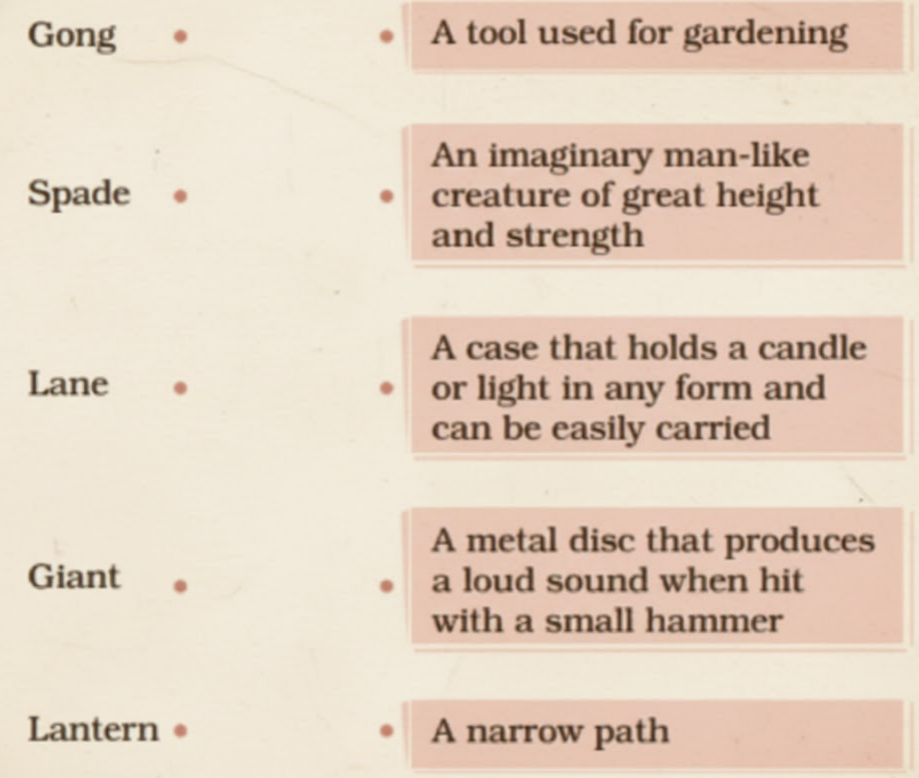
A. Here are some of the words from Vocation. Read the poem and match each word with its meaning.
Answer:
(i) – (d),
(ii) – (a),
(iii) – (e),
(iv) – (b),
(v) – (c)
B. There is one mistake in each sentence given below. Underline the mistakes and rewrite the correct sentences in the given space. One example has been done for you.
Question 1.I has recently read a new book.
I have recently read a new book.
Question 2. The speaker goes for school at ten in the morning.
Answer: The speaker goes to school at ten in the morning.
Question 3. The fox ran fast than the others.
Answer: The fox ran faster than the others.
Question 4. Mita was slept when the doorbell rang.
Answer: Mita was sleeping when the doorbell rang.
Question 5 The old elephant walked slow to the river.
Answer The old elephant walked slowly to the river.
Question 6 Radhika is tall than Suman.
Answer: Radhika is taller than Suman.
Question 7. Sudhanshu ran faster of all the runners.
Answer: Sudhanshu ran faster than all the runners.
Question 8. My mother are cooking.
Answer: My mother is cooking.
Question 9. He go to school everyday.
Answer: He goes to school everyday.
Question 10. The birds is flying.
Answer: The birds are flying.
C. Look at the pictures and read the words written under them.
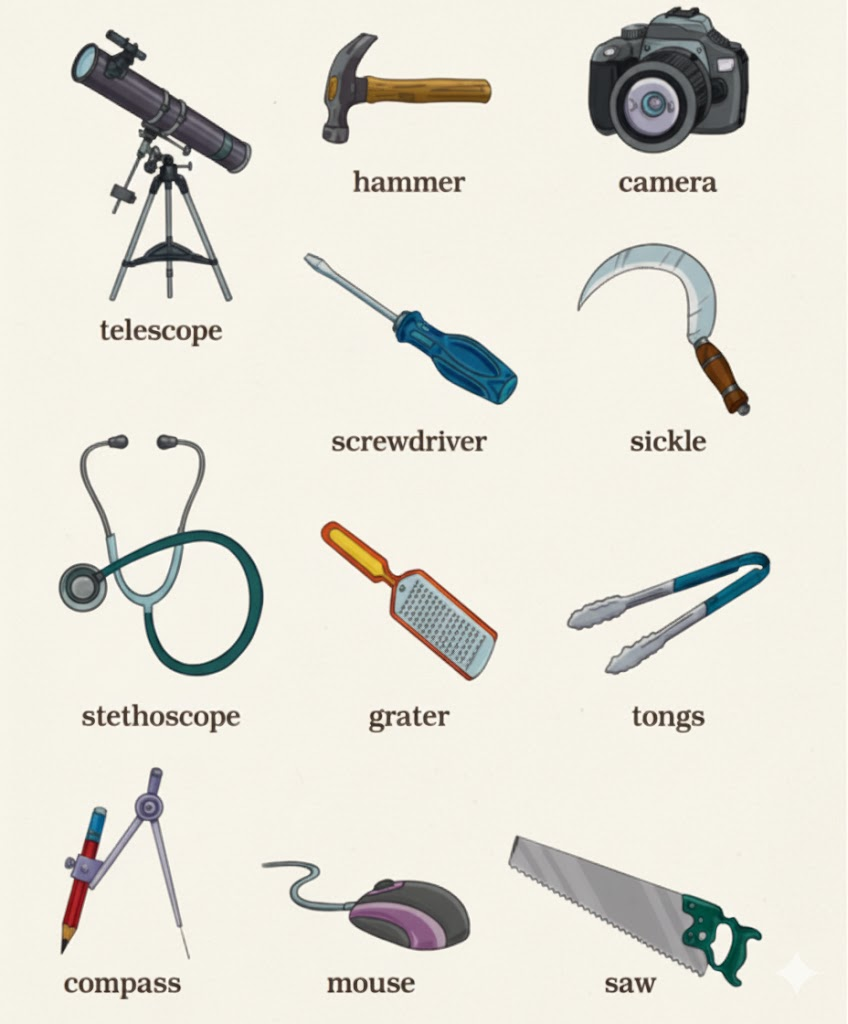
Have you seen these objects? Where have you seen them? What are they used for?
Answer:
I have seen a telescope at a space observatory. It helps us view objects in the sky such as planets, the moon, and stars.
A carpenter uses a hammer to fix nails, and we often find one in a toolbox at home.
A photographer uses a camera to take pictures, and many families also keep one for capturing memories.
A mechanic uses a screwdriver to tighten screws, and it is a common tool kept in households too.
I have seen a sickle being used in gardens and farms. It is helpful for cutting grass and is also used during crop harvesting.
Doctors use a stethoscope in clinics and hospitals to listen to a patient’s heartbeat.
A grater is commonly found in kitchens and hotels and is used to shred vegetables.
Tongs are used in the kitchen to hold hot items and are helpful while making chapatis.
A compass is part of a student’s geometry box and is used to draw circles; architects also use it.
A mouse is an essential part of a computer system and helps control the monitor’s functions.
A carpenter uses a saw to cut wood when making furniture.
Let us Listen (Page 112)
Sit in groups of five.
Each group will discuss and create two questions on the poem Vocation using the question words from the WH-family. Note down the questions.
Now, put your textbooks back in your bags.
Each group will get to share their questions with the class.
One group will present their questions, and the remaining groups will answer the questions. This will continue till all the groups have shared their questions.
Answer:
When does the speaker start for school in the morning?
What call does the hawker make?
What does the speaker wish for after watching the hawker’s life?
At what time does the speaker return from school?
Why does the speaker feel he would like to be a gardener?
Who sends the speaker to bed later in the evening?
Whom does the speaker notice in the dark street?
How does the street lamp appear during the night?
Note for the Teacher
Review different types of question words with the students.
Set aside 25–40 minutes for this activity, based on class size.
You may use this exercise with other lessons as well.
Let us Speak (Pages 112-113)
A. Listen and repeat
Your teacher will say aloud the following words. Listen carefully and repeat after the teacher.
Answer: Students should do it by themselves.
B. Listen and speak
The speaker of the poem wants to do many things.
Think of a time when you wanted to do many things but could not
What were the things you wanted to do?
What difficulties did you face in doing many things at once?
How did it make you feel?
Share your views with your classmates.
Answer: Students should do it by themselves.
Let us Write (Page 114)
Question 1. What’s missing?
The child sees only the fun part of each job. What do you think might be the difficult or boring part of being a hawker, a gardener or a watchman? Write a paragraph to express your thoughts.
Answer: If you were a hawker, you would need to work extremely hard. You would spend long hours outdoors, whether it is sunny or raining. The earnings might also be quite low, and you may have to live a simple life. The same is true for gardeners and watchmen.
Their work also demands a great deal of physical effort. A watchman must remain awake throughout the night to keep the area safe, which can affect his health. Therefore, these occupations are not easy at all.
Question 2. In the poem, the speaker tells us about the vocations of different people. Write the vocations of any three of your family members, in 50-60 words each, from the list below.
Mother, Grandmother, Aunt, Sister, Father, Brother, Uncle
Answer:
My Mother’s Profession:
My mother is a teacher, and teaching is considered a noble calling. Every citizen needs education, as it helps a country grow in all areas. My mother works in a nearby school that is well-known and respected. The school has hundreds of students, and they all admire her. She is very well-loved by her pupils.
She teaches students of Class 10, and many of the children she has taught have gone on to achieve great success. They continue to remember her fondly and thank her for the guidance she gave them.
My Father’s Profession:
My father is employed as a manager in a government hospital. He is responsible for handling the administrative work there. Since the hospital provides free services, it is always crowded with patients, and good management is necessary.
My father plays a key role in ensuring the hospital runs smoothly. He helps create the right environment for doctors and nurses to carry out their duties efficiently. The medical field is also a noble line of work, as it is dedicated to helping people and serving humanity.
Question 3. What vocations are the following people associated with?
A.P.J. Abdul Kalam
M. Visvesvaraya
Janaki Ammal
M.S. Subbulakshmi
Salim Ali
Answer:
A.P.J. Abdul Kalam: Often referred to as the "Missile Man of India," he worked as a rocket scientist. M. Visvesvaraya: A well-known engineer, he contributed greatly by designing and building dams.
Janaki Ammal: She was India’s first woman to become a botanist.
M. S. Subbulakshmi: A renowned Carnatic classical musician from India.
Salim Ali: A celebrated Indian ornithologist, who studied birds, and a respected naturalist.
Note for the Teacher
Discuss the concepts of “vocation” and “work.” For instance, consider whether household duties are paid or unpaid. Use this activity to encourage conversations about what qualifies as “work” and how gender roles influence this understanding.
Motivate students to present their written pieces to the class.
Let us Do (Page 115)
Job Mix-Up!
There is something unusual in the given pictures. Notice carefully the things that you find strange. One has been done for you.
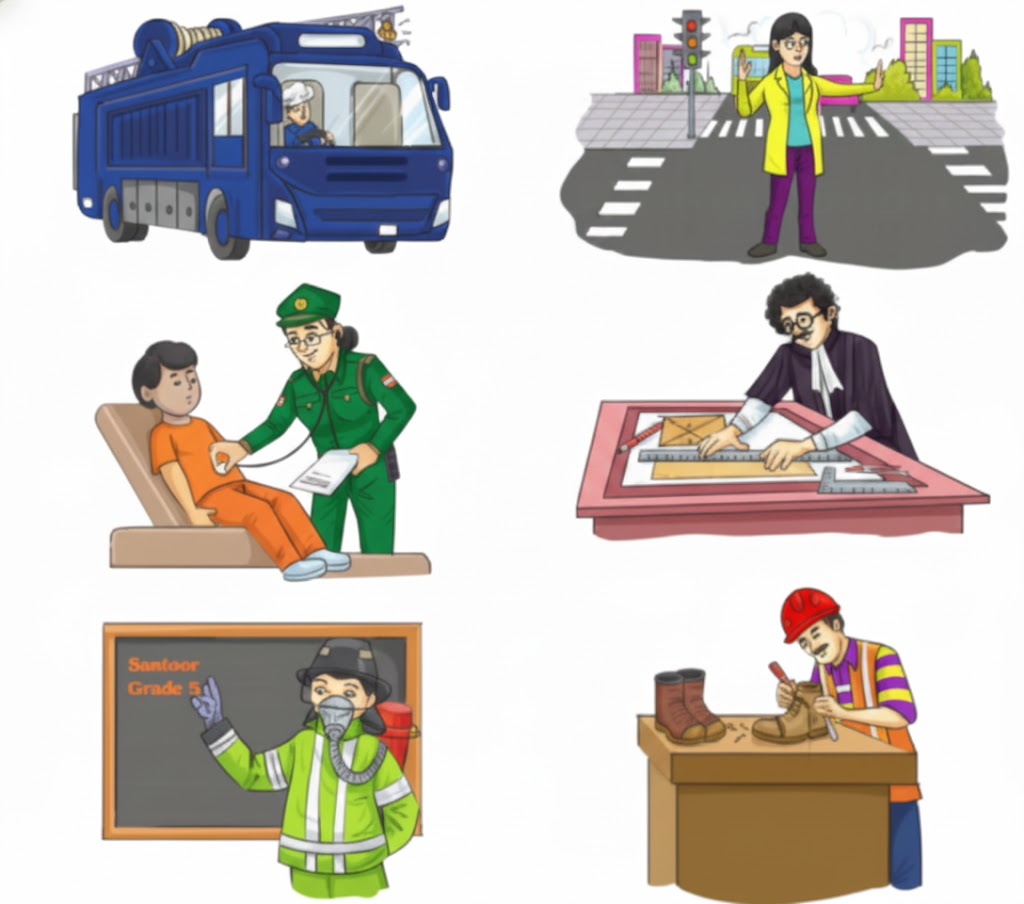
For example: A chef’s job is to cook delicious meals, not to drive a fire engine. That’s something firefighters do.
Write two sentences in your notebook for each picture, following the example provided for you.
Answer:
A chef’s job is to prepare food, not to operate a fire engine.
A doctor’s duty is to care for patients, not to control traffic on the streets.
A policeman is meant to maintain law and order, not to treat ill people like a doctor.
A lawyer’s responsibility is to handle legal matters, not to create architectural plans.
A scuba diver’s work is to explore and swim underwater, not to teach in a classroom.
A construction worker’s role is to build structures, not to repair footwear.
Let us Explore (Pages 116-118)
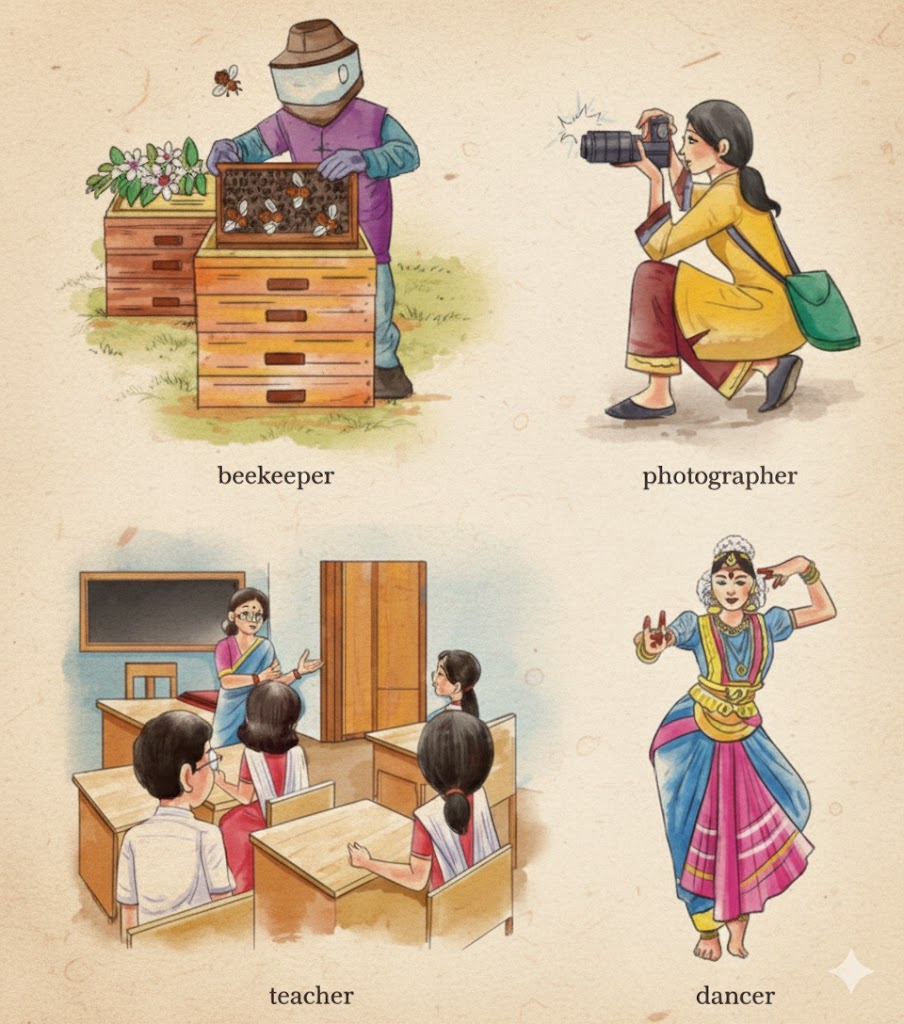
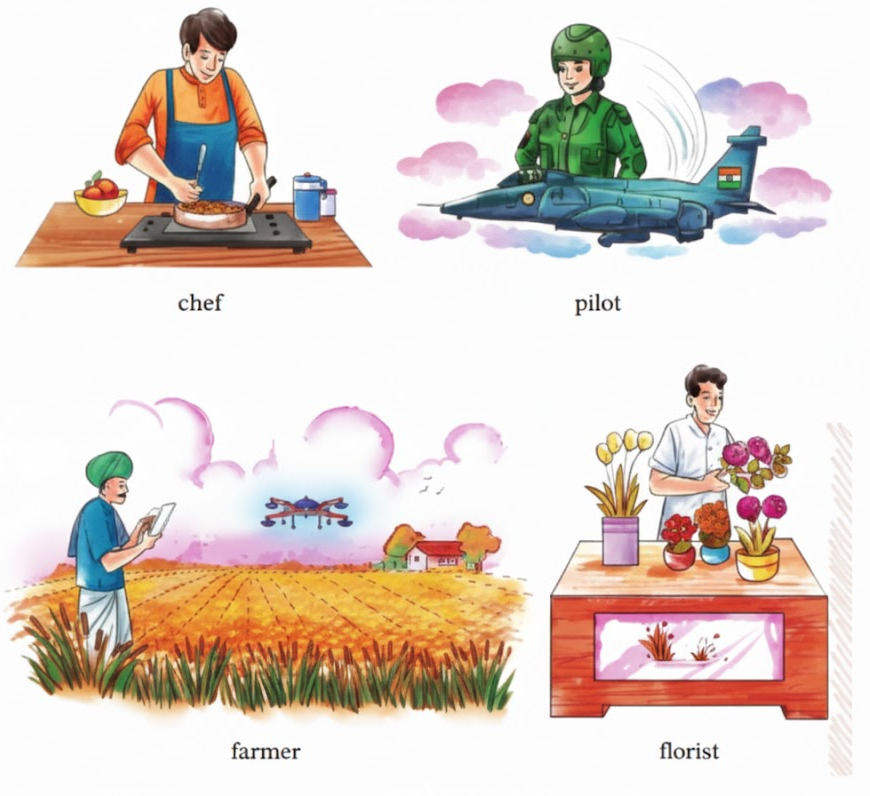
A. Which vocation from the above illustrations would you choose for yourself? And why?
Answer: Of all the professions listed, I would choose to be a teacher. Teaching is a respected and meaningful career. A teacher contributes to the growth of students, who are the nation’s future. When students learn well, they succeed in life, and this makes the teacher’s role crucial for a country’s progress. As a teacher, I would have the opportunity to serve my nation with pride and dedication.
B. Is there any other vocation not shown in the pictures that you would like to take up as your dream job? Support your answer with a reason.
Answer: Besides the occupations shown in the pictures, I would choose to become a doctor. Life would be very difficult without doctors. Good health is essential for every community, and doctors play a vital role in helping people stay healthy.
Note for the Teacher
Use this task to encourage conversation about a wide range of professions, even those not mentioned in the lesson. Guide a discussion on both traditional careers and modern, emerging ones. Help students understand that every job has value and that no occupation is better or lesser than another.
C. Draw yourself in the selected vocation in the blank space provided.
Answer: Students should do it by themselves.
Master the Chapter: NCERT Solutions Class 5 English Chapter 9 Santoor Vocation
Dive deep into NCERT Solutions Class 5 English Chapter 9 and understand every detail of the poem "Vocation". These thoroughly explained answers make your learning journey smooth and help build a strong foundation for English comprehension.
Focusing on the NCERT Solutions 2026-27 ensures you cover all important questions as per the latest syllabus. Practicing these solutions will boost your confidence and prepare you for exam success in Class 5 English Chapter 9 Santoor Vocation.
Keep revising with chapter-wise solutions and work on your writing and reading skills. Remember, consistent practice of exercise-based answers greatly improves your accuracy and presentation skills for the final exam.
FAQs on NCERT Solutions For Class 5 English Chapter 9 Vocation - 2026-27 Free PDF Download (Sign-in Required)
1. What are the NCERT Solutions for Class 5 English Chapter 9 Santoor Vocation?
NCERT Solutions for Class 5 English Chapter 9 provide stepwise answers to all exercises based on the CBSE 2026–27 syllabus.
Highlights include:
- Accurate and syllabus-aligned answers
- Exercise-wise solutions explained step-by-step
- Definitions, important points, and exam tips
- Compatible with both textbook and board exams
- Helps strengthen understanding of Santoor Vocation
2. How should I write stepwise answers for Class 5 English Chapter 9 to score full marks?
To score full marks in Class 5 English Chapter 9, follow a clear and structured approach:
Tips:
- Start with a brief introduction, if required
- Use stepwise explanation for each point
- Include keywords and vocabulary from the chapter
- Underline or highlight important definitions
- For long answers, use bullet points or sub-headings
- Keep answers neat and within the required word limit
3. Which questions from Santoor Vocation Chapter 9 are important for CBSE exams?
Some frequently asked and important questions from Chapter 9 include:
- Main idea or summary of the chapter
- Short answers on the characters and their roles
- Vocabulary and meanings from exercises
- Personal response questions related to Santoor Vocation
- Back exercise and intext questions from NCERT
4. Is it necessary to include diagrams or definitions in NCERT English answers?
For Class 5 English Chapter 9, detailed diagrams are not usually required, but definitions and vocabulary explanations are important.
- Write clear and correct definitions when asked
- Use examples from the text
- Only include diagrams if specifically mentioned in the exercise instructions
5. How can I download the free PDF of NCERT Solutions for Class 5 English Chapter 9?
You can download NCERT Solutions PDF for Class 5 English Chapter 9 from trusted study websites like Vedantu.
Steps:
- Search for the chapter name and PDF download
- Look for an official download button
- Save the file for offline reading and quick revision
6. What are the key learning outcomes of Ncert Solutions Class 5 English Chapter 9 Santoor Vocation?
The key learning outcomes of Chapter 9 are:
- Understanding the theme and message of Santoor Vocation
- Improving comprehension and writing skills
- Expanding vocabulary relevant to the lesson
- Learning to answer both short and long questions confidently
- Adhering to CBSE marking scheme for maximum marks
7. Are NCERT Solutions enough for scoring well in Class 5 English exams?
NCERT Solutions are comprehensive and align with the CBSE syllabus, making them sufficient for exam preparation when revised thoroughly.
- Cover all textbook exercises and questions
- Include important definitions and concepts
- Use as a base, but supplement with sample papers and revision notes for best results
8. What is the best way to revise Class 5 English Chapter 9 before exams?
For quick and effective revision:
- Read the chapter summary and key points
- Practice exercise-wise solutions
- Revise important vocabulary and definitions
- Attempt sample papers and MCQs
- Use revision planners for day-wise pacing
9. How are answers marked in CBSE Class 5 English board exams for Chapter 9?
Marking for Class 5 English Chapter 9 is based on:
- Stepwise presentation of points
- Use of keywords and relevant content
- Accuracy of definitions and explanations
- Neatness and proper answer structure
- Partial marks can be given for partially correct answers following the correct steps
10. Where can I find Class 5 English Chapter 9 important questions and sample papers?
You can find important questions and sample papers for Class 5 English Chapter 9 on educational platforms following CBSE and NCERT syllabus.
- Look for platforms providing exam-oriented practice
- Check for previous year papers, MCQs, and revision notes
- Use these resources for better exam practice and time management
11. How do I structure long answers for better marks in NCERT Class 5 English Chapter 9?
To maximize marks in long answers:
- Begin with a brief introduction
- Divide the answer into logical paragraphs
- Use bullet points/subheadings for clarity
- Include keywords and main ideas from the chapter
- Summarise briefly at the end for completeness
12. Do examiners award partial marks for correct steps even if the final answer is wrong in English exams?
Yes, examiners often give partial marks if your steps or approach are correct, even if the final answer is not fully accurate.
- Show clear understanding of the question
- Explain your reasoning with relevant examples
- Follow stepwise answering as per CBSE marking scheme
