




How to Write Perfect Answers for NCERT Class 5 English Chapter 2?
Let us Think (Page 15)
A. Answer the following questions.
Question 1. What was Gopi doing on the veranda?
Answer: Gopi sat in the veranda, engrossed in a book.
Question 2. What sound did Gopi hear before he went to the garden?
Answer: He noticed a soft rustling sound and then heard something drop heavily onto the garden.
Question 3. Describe Gopi’s search for the ball.
Answer: Gopi looked through the tall grass by the fence, checked around the shrubs, and at last spotted the ball resting on a pile of dry leaves.
Question 4. Complete the table given below.
Answer:
Question 5. Who grabbed the ball from Gopi? How did the game start?
Answer: Manoj snatched the ball from Gopi. The match began with Manoj guarding the goal, Gopi at the centre, and the rest of the players lining up in their spots for the hockey game.
Question 6.Why did everyone laugh at the end of the story?
Answer: Everyone burst into laughter when the ball suddenly fell into the basket of a scooter driving by and got carried off, turning the moment into a surprising and amusing scene.
B. Think and answer
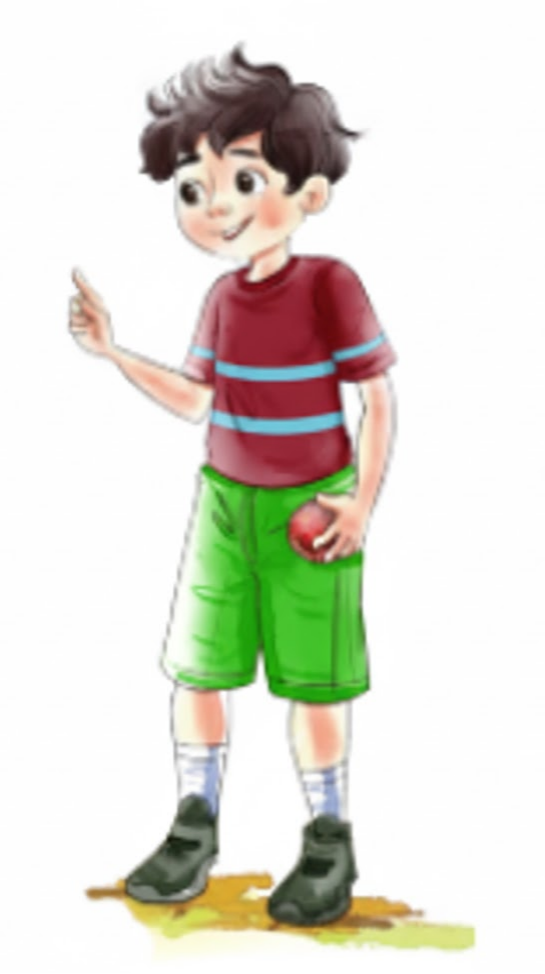
Question 1. What would you have done if, like Gopi, you had found a ball that did not belong to you?
Answer: I would check with my friends and neighbours to see if anyone was missing a ball and make sure it went back to the right owner.
Question 2. Imagine what happens to the hockey ball after it is taken away by the scooter. Where does it go? Who finds it?
Answer: I believe that when the scooter rider reaches home and notices the ball in his basket, he may hand it over to a child to play with, since he wouldn’t know who the real owner is.
Question 3. Notice that the scooterist is wearing a helmet. Why is it important to wear a helmet? Should the pillion rider also wear a helmet?
Answer: Wearing a helmet is essential because it guards the head and can prevent serious injury during an accident. The person sitting at the back should also wear a helmet to stay safe.
Note for the Teacher
Encourage a conversation about different rules and practices that ensure road safety.
Let us Learn (Pages 16-18)
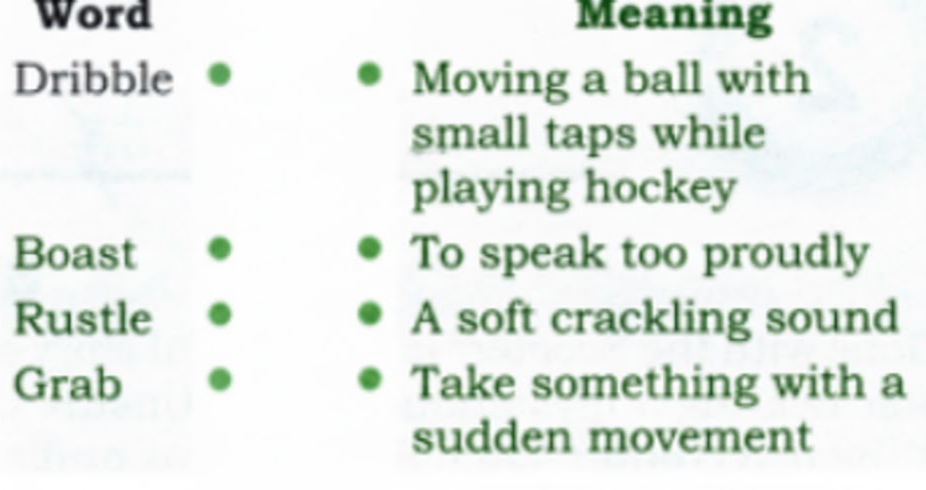
A. Match the following
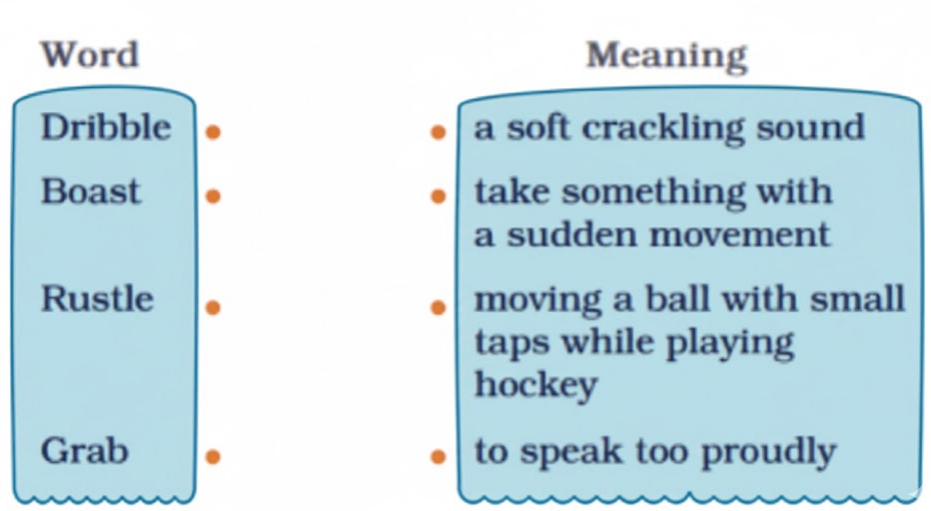
Answer:
B. Complete the following story using the words given in the box.
since, however, because, when
Gopi completed his work (i) ……… he wanted to go outside and play. (ii) …….. when he reached the playground nobody was there.
(iii) ……… his friends were yet to join him, he decided to take a walk. After 15 minutes, five of them came and everyone started to discuss the games. They decided to play hopscotch (iv) ………. they got to know that Ramani would not be joining them.
Answer:
(i) because
(ii) However
(iii) Since
(iv) when
C. Read the following sentence
Gopi usually plays hockey at school but today he is studying for his test.
The adverb ‘usually’ tells us that an action happens many times. This sentence tells us that the action of playing hockey happens most of the time. The adverb ‘today’ tells us the time of the action (studying).

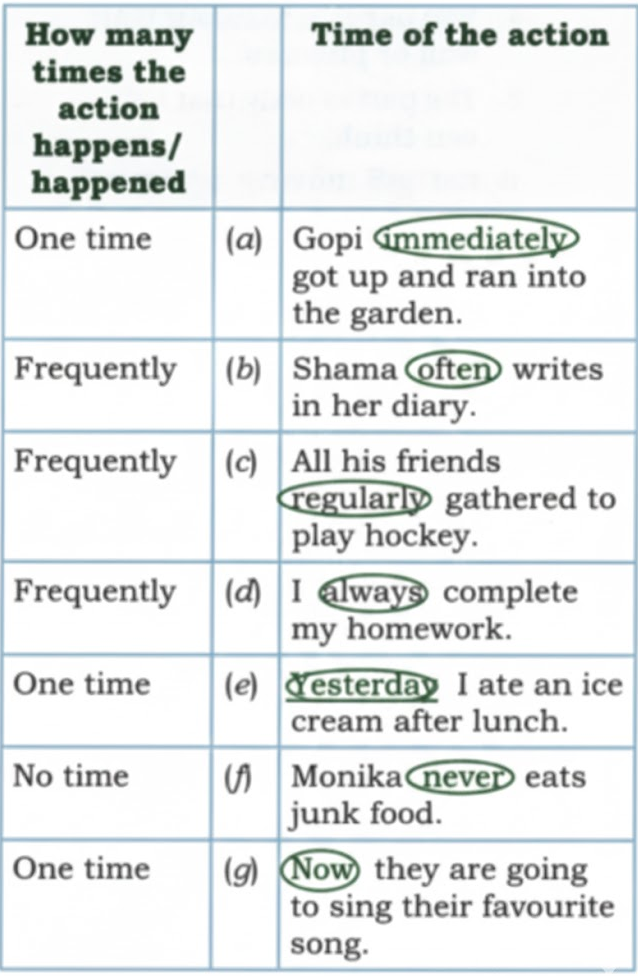
Now encircle the adverbs in the following sentences.
Answer:
Note for the Teacher
Provide learners with the meanings of different adverbs.
Use real-life examples to help them understand how adverbs of frequency differ from adverbs of time.
After the concept is clear, guide them in forming questions to identify these adverbs. For instance, adverbs of frequency answer “How many times?” while adverbs of time answer
“When?”. Encourage students to create their own questions using this approach.
Let us Listen (Page 19)
A. Listen to your teacher. Follow the instructions and draw accordingly in the space provided below.
Draw a few big dry leaves at the centre with no gap between the leaves. Draw a ball in the middle of the leaves.
Draw a few twigs here and there.
Colour the leaves yellow and brown. Colour the twigs brown.
Now you have found the ball.
Answer: Students should do it by themselves.
Let us Speak (Page 20)
A. The teacher starts a story with one sentence. Each student adds a sentence to continue the story.
For example:
Teacher: “Once upon a time, a boy found a magic key.”
Student 1: “The key opened a door to a secret garden.”
Student 2: “In the garden, he saw a talking rabbit.”
Answer: Students should do it by themselves.
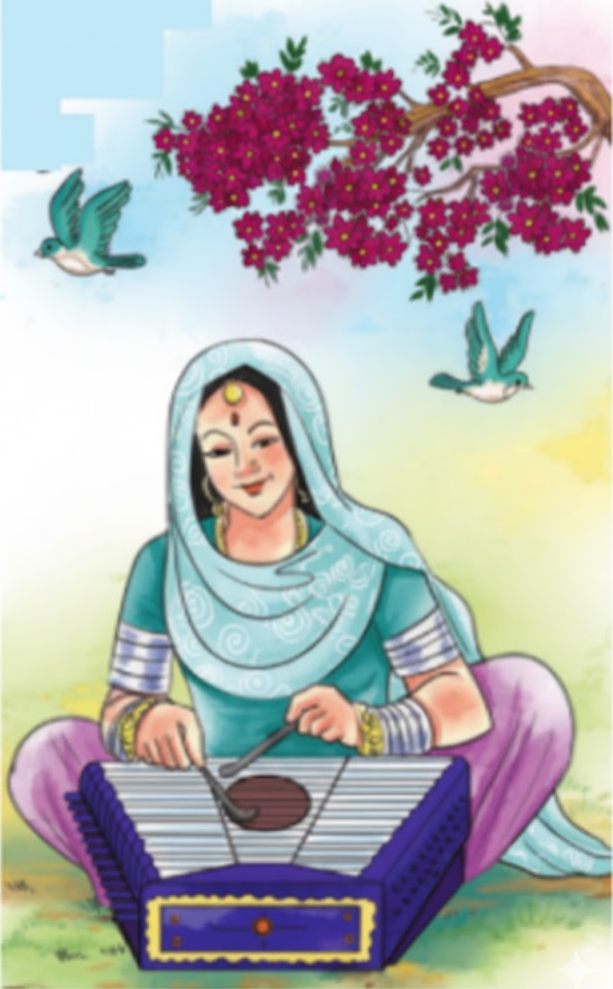
B. The title of this textbook is ‘Santoor’. Say the word ‘book’. Next, say the word ‘Santoor’. Do you notice the difference? Although, both the words have ‘oo’ in them, the sound of ‘oo’ in ‘book’ is short; the sound of ‘oo’ in ‘Santoor’ is long.
Say aloud the following words. Encircle the words which have a long ‘oo’ sound.
Hood
School
Foot
Maroon
Scooter
Shook
Bloom
Food
Look
Moon
Book
Took
Answer:
School
Scooter
Food
Maroon
Bloom
Moon
Note for the Teacher
Let the storytelling activity continue until every learner has contributed a sentence.
Make sure students clearly articulate both long and short vowel sounds during the exercise.
Let us Write (Pages 21-22)
A. By the time the children ran to the gate, the scooter was gone… and so was the ball. They looked at each other and burst into laughter.
Write a possible conversation between Gopi and his friends after this incident?
Gopi: …………………………
Ramani: …………………………
Deepak: …………………………
Manoj: …………………………
Jay: …………………………
Answer:
Sample Conversation:
Gopi: Oh dear! The scooter carried the ball away!
Ramani: Jay, that shot of yours was really strong!
Deepak: I wish the person on the scooter sees it and brings it back.
Manoj: We should be a bit more careful when we play next time.
Jay: Sorry, everyone! But the game was really fun!
B. Form new words by following the examples given below:
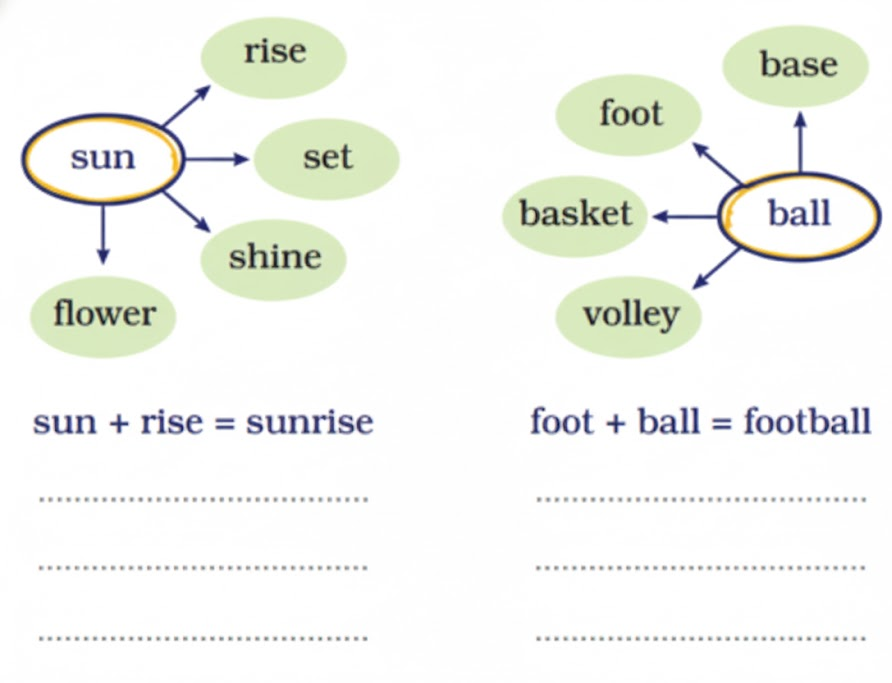
Write a sentence using each of these words in your notebook.
Answer:
sun + shine → sunshine
sun + set → sunset
sun + flower → sunflower
base + ball → baseball
volley + ball → volleyball
basket + ball → basketball
Sunshine: The bright sunshine now makes the colours on the trees glow beautifully.
Sunset: I remained at the beach all the way from morning till sunset.
Sunflower: He looked after his sunflower plants with great care throughout the summer.
Baseball: Yesterday, I went to watch a baseball match.
Volleyball: She loves playing volleyball with her group of friends.
Basketball: We play basketball every evening.
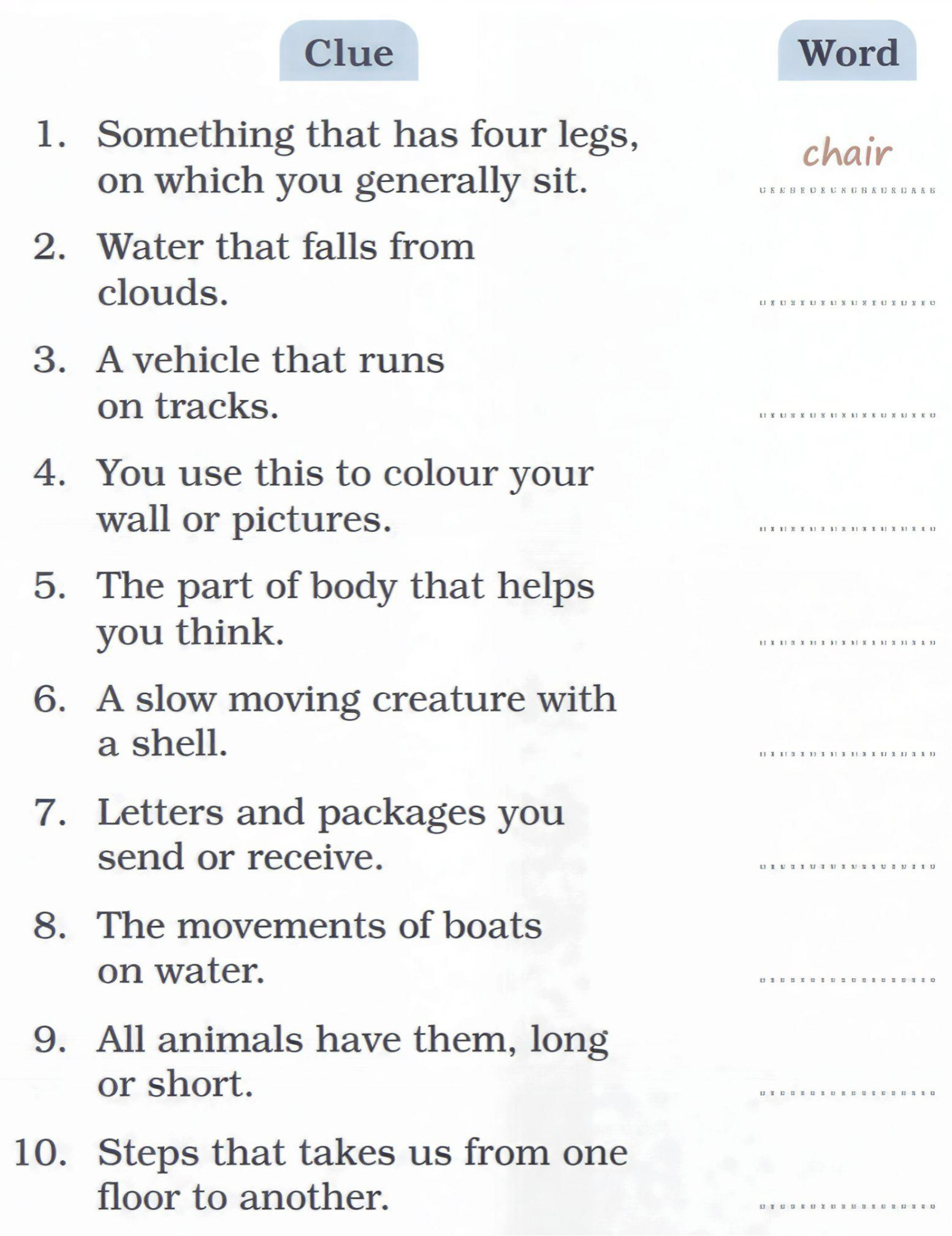
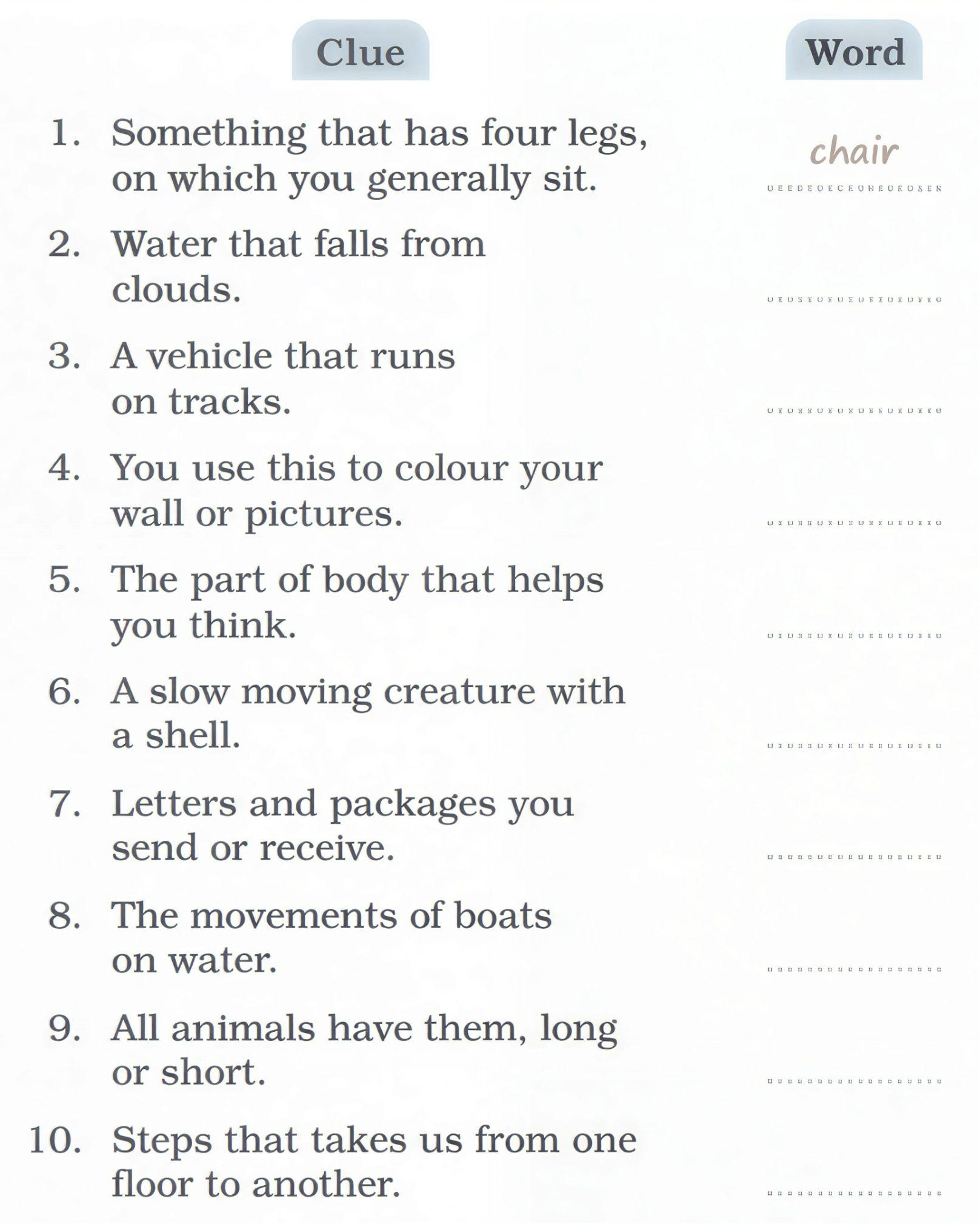
C. You have already noticed that the word ‘scooter’ has ‘oo’ in the middle. Using the clues given below, write ten words that have ‘ai’ in the middle. One has been done for you?
Answer:
1. Chair
2. Rain
3. Train
4. Paint
5. Brain
6. Snail
7. Mail
8. Sail
9. Tail
10. Stairs
Let us do (Pages 23-24)
Prepare a board game to play ‘Tigers and Goats’.
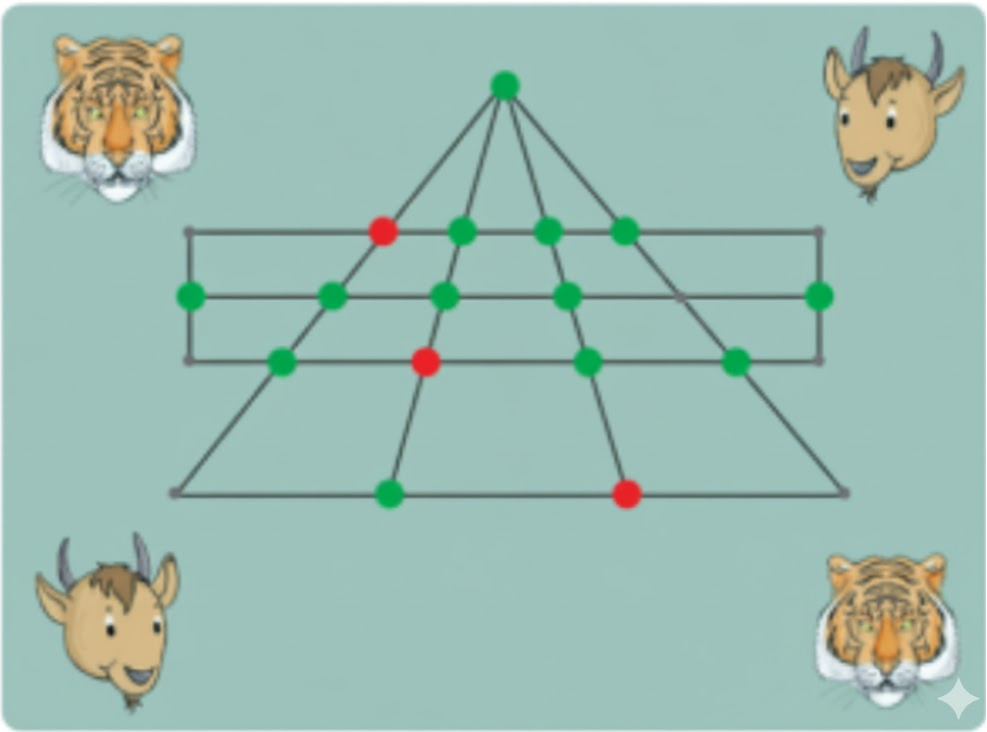
Take a square piece of cardboard.
Paste a chart paper on it.
Draw the pattern as shown in the picture.
Collect two different types of pebbles—three big pebbles and thirteen smaller ones. Paint them red for tigers and green for goats. Keep three similar pebbles for tigers and thirteen similar pebbles for goats.
How to play the game?
At least two players are needed to play the game. One player represents the ‘Goat’ and the other represents the ‘Tiger’.
If you are playing as the ‘Tiger’, your objective would be to ‘defeat’ five goats. If you are playing as the ‘Goat’, your objective would be to surround all three tigers such that the tigers cannot make a move.
Both the pebbles can be placed on the intersecting points. The goat player places a pebble first on any intersection Next, the tiger places a tiger stone on any intersection, as indicated.
The tiger may jump over the goat to the next intersection. If so, the goat is considered ‘captured’ and will be out of the board.
In order to prevent the tiger from jumping over the goat, the next intersection has to be covered. So the goat player places another pebble at that intersection.
The goat player places one goat on the board at a time. The tiger player can either place the tiger stone or move.
But, the goats cannot move until all thirteen of them are on the board. The tigers must attempt to ‘capture’ the goats by jumping over them into a free space, the goat is then taken off the board.
Answer: Students should do it by themselves.
Answer:
B. Write a mini biography about a famous sports person of your choice. You may use the following hints:
Name of the sportsperson.
Name of the sport the person is famous for.
When and where the person was born?
List one or two achievements.
Why the person is famous/inspiring?
Answer: Virat Kohli is a renowned Indian cricketer and a former captain of the national team. Born on 5 November 1988, he is considered one of the finest batsmen in cricket history. His energetic and determined approach to the sport has earned him many honours, such as the ICC Cricketer of the Year award (twice), along with the Arjuna Award, Padma Shri, and Khel Ratna.
Kohli is also admired for his exceptional fitness and commitment, motivating young sportspersons across the world. His journey includes leading India to victory in the 2008 Under-19 World Cup and guiding the senior team to several major wins. He is married to actress Anushka Sharma, and the couple has two children.
C. Find out about a famous hockey player and talk about them.
Answer: Rani Rampal is an Indian coach and a former hockey player. Born on 4 December 1994, she made history at just 15 years old by becoming the youngest member of India’s squad for the 2010 World Cup. She played in the forward position and, during her career, appeared in 212 international games, scoring 134 goals. She often took on the role of striker and also supported the team as a midfielder. In 2020, she received the Padma Shri from the Government of India for her outstanding contributions to sports.
Gain Confidence with NCERT Solutions for Gone with the Scooter
Mastering Ncert Solutions Class 5 English Chapter 2 Santoor Gone with the Scooter helps students build strong reading and comprehension skills. The step-by-step answers make even tricky questions easier, boosting your confidence for school exams.
Regular practice with NCERT solutions 2026-27 gives you an edge in understanding themes, vocabulary, and context-based questions. Focus on key phrases and summary points for quick revision and better retention.
Use these student-friendly English answers for revision before exams and to clear doubts. Stay consistent, review main ideas after each read, and you'll see great improvement in both writing and comprehension skills.
FAQs on NCERT Solutions For Class 5 English Chapter 2 Gone With The Scooter - 2026-27 Free PDF Download (Sign-in Required)
1. What are NCERT Solutions for Class 5 English Chapter 2 Santoor Gone with the Scooter?
NCERT Solutions for Class 5 English Chapter 2 Santoor Gone with the Scooter provide stepwise, syllabus-aligned answers for all textbook questions.
- Include detailed explanations, key points, and definitions.
- Follow the CBSE 2026–27 marking scheme for accuracy.
- Help students practice exam-ready answers for each chapter exercise.
- Available in free PDF format for easy revision and offline study.
2. How can practicing NCERT Solutions for Class 5 English Chapter 2 help me score better in exams?
Practicing NCERT Solutions improves exam performance by providing model answers and clarifying concepts.
- Strengthens understanding of chapter themes and vocabulary.
- Improves answer structure and presentation as per CBSE marking guidelines.
- Reduces exam stress through regular revision of solved exercises.
- Highlights important points, definitions, and key phrases likely to appear in exams.
3. Are diagrams or definitions mandatory in NCERT answers for Class 5 English Chapter 2?
Including neat diagrams and accurate definitions in your answers increases your chances of scoring full marks.
- Draw or label diagrams only if the question demands it or if it clarifies the answer.
- Always write clear, exam-ready definitions for important terms or characters mentioned in Chapter 2.
- Neat presentation and correct labelling earn easy marks.
4. What are the key topics covered in Ncert Solutions Class 5 English Chapter 2 Santoor Gone with the Scooter?
The key topics include:
- Story summary and main idea of "Santoor Gone with the Scooter"
- Character sketches and their roles
- New words and meanings from the chapter
- Question and answer practice for intext and back exercises
- Exercise-wise comprehension and grammar practice
5. How should I structure long answers to get full marks in Class 5 English Chapter 2?
To get full marks in long answers, use a clear structure following CBSE guidelines.
- Begin with an introduction stating the main idea.
- Write the answer in steps or paragraphs, using headings or bullets if allowed.
- Include key words and examples from Chapter 2 for better impact.
- Conclude with a summary or lesson learned.
6. Where can I download the NCERT Solutions PDF for Class 5 English Chapter 2?
You can access the free PDF download of NCERT Solutions for Class 5 English Chapter 2 from trusted educational websites.
- The PDF is organised according to textbook exercises for easy offline practice.
- Always ensure you use CBSE 2026–27 syllabus-aligned material for exam preparation.
7. Which important questions from Class 5 English Chapter 2 are likely to be asked in school exams?
Commonly asked questions include:
- Brief summary of the chapter Santoor Gone with the Scooter
- Character analysis (e.g., main character's actions and lessons)
- Word meanings and use in sentences
- Short and long answer questions from the textbook exercises
8. How do I avoid common mistakes in answering Class 5 English Chapter 2 NCERT questions?
To avoid common mistakes:
- Read the question carefully before answering.
- Use correct grammar and punctuation.
- Include all required points, definitions, or diagrams.
- Avoid writing unrelated information or skipping steps.
- Revise answers to ensure clarity and completeness.
9. Are NCERT Solutions sufficient for Class 5 English Chapter 2 exam preparation?
NCERT Solutions are usually sufficient for CBSE exam preparation since they cover all important textbook exercises and match the syllabus.
- Practicing these solutions ensures strong conceptual clarity.
- For extra practice, refer to sample papers or important question banks.
10. How can I quickly revise Class 5 English Chapter 2 before the exam?
For quick revision:
- Read through the summary and key points of Chapter 2.
- Practice solved NCERT Solutions and important questions.
- Revise new words, definitions, and any diagrams.
- Use short notes or a 1-day revision planner for last-minute preparation.
11. Do examiners award partial marks for correct steps even if the final answer is wrong?
Examiners may award partial marks for correct steps and relevant points, even if the final answer is incomplete or slightly incorrect.
- Always show your working and include all key steps in descriptive answers.
- This increases your chances of scoring marks based on stepwise marking.
12. Are references to textbook page numbers useful during revision?
Referring to textbook page numbers helps you quickly locate answers and revise important sections.
- It ensures you are studying from the correct syllabus portion.
- Useful for mapping solved questions directly to textbook exercises.
