




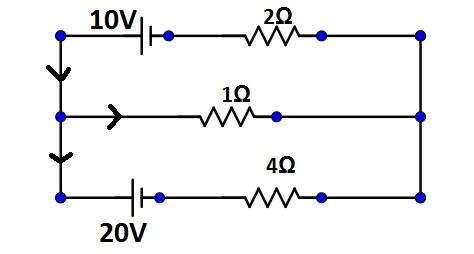
The value of current through $2\Omega $ resistor is
(A) $1.0A$
(B) $1.5A$
(C) $5.0A$
(D) $2.1A$
Answer
 Verified
292.8k+ views
Hint: The currents that pass through each resistor are marked and their values found out. The entire circuit is then divided into two loops. The question can be solved by applying Kirchhoff’s Voltage Law to the loops formed.
Complete Step by Step Solution:
Kirchhoff's voltage law (KVL) states that the sum of all voltages around any closed loop in a circuit must be equal to zero. This is a consequence of charge conservation and also conservation of energy. This means that the sum of all potential differences across the component involved in the circuit gives a zero reading, as expected.
We redraw the diagram as shown below.
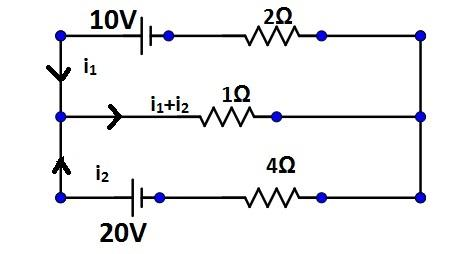
Thus,${i_1}$ is the current generated by the source of 10V and ${i_2}$ is the current generated by the 20V source.
The current passing through the resistor $1\Omega $ is the sum of ${i_1}$ and ${i_2}$ currents. Similarly, the current through the resistor $4\Omega $ is of value ${i_2}$, and the value of current passing through the $2\Omega $ resistor is of value ${i_1}$. This has been shown in the figure.
Thus there are two loops formed. Let us call the lower loop, the one with source of 20V as Loop 1 and the loop with the source 10V as Loop 2.
We apply Kirchhoff’s voltage Law to both the loops.
In the first loop of 20V, we have,
$1\left( {{i_1} + {i_2}} \right) + 4{i_2} - 20 = 0$
$ \Rightarrow 5{i_2} + {i_1} = 20$.
By applying KVL in loop 2 of 10V, we get,
$\left( {{i_1} + {i_2}} \right) + 2{i_1} - 10 = 0$
$ \Rightarrow 3{i_1} + {i_2} = 10$
From both the equations, we can write,
$5{i_2} + {i_1} = 20$ and
$2\left( {3{i_1} + {i_2}} \right) = 2 \times 10 = 20$.
Thus,
$5{i_2} + {i_1} = 6{i_1} + 2{i_2}$
$ \Rightarrow 3{i_2} = 5{i_1}$
Again, from the equations of the loops it can be written that,
$14{i_1} = 30$
$ \Rightarrow {i_1} = \dfrac{{15}}{7} = 2.1A$
The value of current through the $2\Omega $ resistor is given by the value of ${i_1}$.
Thus, the correct answer is Option D.
Note: For the second loop, where the source is of emf 20V, we have current ${i_2}$.
We know that, ${i_2} = \dfrac{5}{3}{i_1}$ and ${i_1} = \dfrac{{15}}{7}$. Thus,
${i_2} = \dfrac{5}{3} \times \dfrac{{15}}{7} = \dfrac{{25}}{7} = 3.571A$
Complete Step by Step Solution:
Kirchhoff's voltage law (KVL) states that the sum of all voltages around any closed loop in a circuit must be equal to zero. This is a consequence of charge conservation and also conservation of energy. This means that the sum of all potential differences across the component involved in the circuit gives a zero reading, as expected.
We redraw the diagram as shown below.
Thus,${i_1}$ is the current generated by the source of 10V and ${i_2}$ is the current generated by the 20V source.
The current passing through the resistor $1\Omega $ is the sum of ${i_1}$ and ${i_2}$ currents. Similarly, the current through the resistor $4\Omega $ is of value ${i_2}$, and the value of current passing through the $2\Omega $ resistor is of value ${i_1}$. This has been shown in the figure.
Thus there are two loops formed. Let us call the lower loop, the one with source of 20V as Loop 1 and the loop with the source 10V as Loop 2.
We apply Kirchhoff’s voltage Law to both the loops.
In the first loop of 20V, we have,
$1\left( {{i_1} + {i_2}} \right) + 4{i_2} - 20 = 0$
$ \Rightarrow 5{i_2} + {i_1} = 20$.
By applying KVL in loop 2 of 10V, we get,
$\left( {{i_1} + {i_2}} \right) + 2{i_1} - 10 = 0$
$ \Rightarrow 3{i_1} + {i_2} = 10$
From both the equations, we can write,
$5{i_2} + {i_1} = 20$ and
$2\left( {3{i_1} + {i_2}} \right) = 2 \times 10 = 20$.
Thus,
$5{i_2} + {i_1} = 6{i_1} + 2{i_2}$
$ \Rightarrow 3{i_2} = 5{i_1}$
Again, from the equations of the loops it can be written that,
$14{i_1} = 30$
$ \Rightarrow {i_1} = \dfrac{{15}}{7} = 2.1A$
The value of current through the $2\Omega $ resistor is given by the value of ${i_1}$.
Thus, the correct answer is Option D.
Note: For the second loop, where the source is of emf 20V, we have current ${i_2}$.
We know that, ${i_2} = \dfrac{5}{3}{i_1}$ and ${i_1} = \dfrac{{15}}{7}$. Thus,
${i_2} = \dfrac{5}{3} \times \dfrac{{15}}{7} = \dfrac{{25}}{7} = 3.571A$
Recently Updated Pages
The average and RMS value of voltage for square waves class 12 physics JEE_Main

The force between two short electric dipoles placed class 12 physics JEE_Main
The force of interaction of two dipoles if the two class 12 physics JEE_Main
The value of current through 2Omega resistor is A 10A class 12 physics JEE_MAin
when an object Is placed at a distance of 60 cm from class 12 physics JEE_Main
Formula for number of images formed by two plane mirrors class 12 physics JEE_Main
Trending doubts
JEE Main 2026: Exam Dates, Session 2 Updates, City Slip, Admit Card & Latest News
Understanding the Electric Field of a Uniformly Charged Ring
Understanding Atomic Structure for Beginners
Electron Gain Enthalpy and Electron Affinity Explained
Derivation of Equation of Trajectory Explained for Students
How to Convert a Galvanometer into an Ammeter or Voltmeter
Other Pages
CBSE Class 12 Physics Question Paper 2026: Download SET-wise PDF with Answer Key & Analysis
JEE Advanced Percentile vs Marks 2026: JEE Main Cutoff, AIR & IIT Admission Guide
JEE Advanced 2026 Notification Out with Exam Date, Registration (Extended), Syllabus and More
JEE Advanced Weightage Chapter Wise 2026 for Physics, Chemistry, and Mathematics
What Are Current and Potential Difference in Electricity?
Hybridisation in Chemistry – Concept, Types & Applications