

Courses
Courses for Kids
Free study material
Offline Centres
More
Store Icon
Store

NEET Chemistry Chapter Wise Weightage 2026 Important Chapters and Marks Distribution

ffImage
banner

Chemistry NEET Chapter Wise Weightage 2026 Topic Wise Marks Analysis FREE PDF Download

Understanding the NEET Chemistry chapter wise weightage 2026 is essential for students who want to prepare strategically for the exam. Since NEET Chemistry includes questions from Physical, Organic, and Inorganic Chemistry, knowing which chapters carry higher weightage can significantly improve your preparation efficiency.
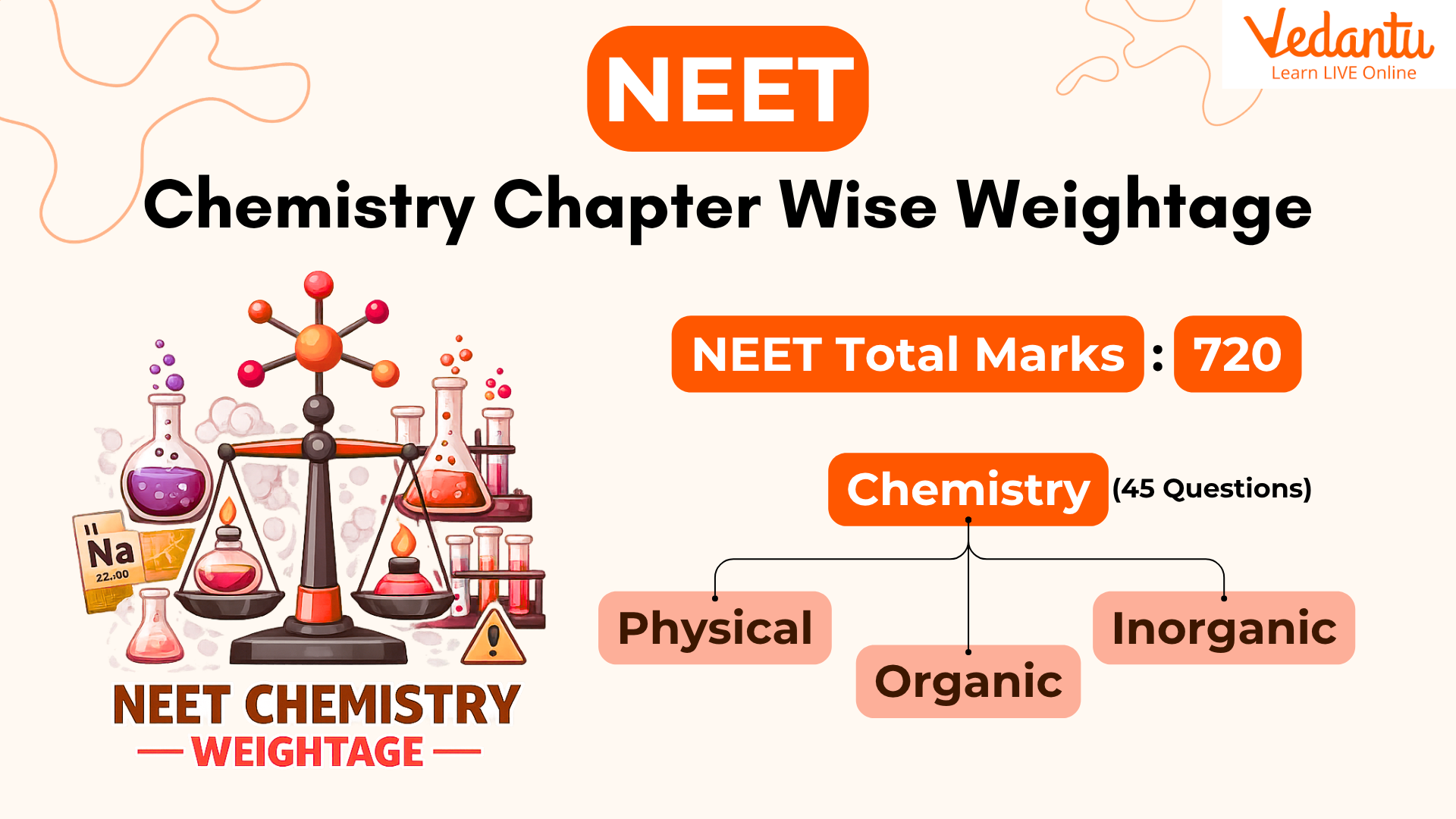

The Chemistry NEET chapter wise weightage 2026 is derived from analysing previous year’s NEET papers and syllabus trends. This analysis helps aspirants identify frequently asked topics and high-yield chapters, allowing them to focus on areas that contribute the most marks in the Chemistry section.


Also Read: NEET Syllabus 2026 NEET 2026 Exam Pattern


Click here to download the NEET Question Paper and NEET Sample Paper for NEET 2026 Exam Preparation.

NEET Chemistry Chapter Wise Weightage 2026

Understanding the NEET Chemistry chapter wise weightage 2026 helps students identify which topics are asked more frequently in the exam and plan their preparation accordingly. The Chemistry section in NEET consists of 45 questions, with topics distributed across Physical Chemistry, Organic Chemistry, and Inorganic Chemistry.


By analysing previous NEET papers, students can understand the Chemistry NEET chapter wise weightage and focus on high-yield chapters that contribute more questions. Prioritising these important topics, along with regular practice and NCERT revision, can significantly improve performance in the Chemistry section of the NEET exam.


The table below shows the NEET Chemistry chapter wise weightage 2026, including the average number of questions asked from each chapter based on exam trends. 


Chemistry NEET Chapter Wise Weightage 2026

Chemistry Chapters and Topics

Average Number of Questions

Weightage (%)

Inorganic Chemistry Weightage in NEET 2026

Inorganic Chemistry – I


22%

Chemical Bonding (Chemical Bonding and Molecular Structure)

4

8%

p-Block Elements    

3

6%

Periodic Table and Periodicity in Properties

2

4%

Hydrogen (Hydrogen and Its Compounds)

1

2%

s-Block Elements

1

2%

Inorganic Chemistry – II


12%

Coordination Compounds

2

5%

d-Block and f-Block Elements

2

3%

Metallurgy

1

2%

Qualitative Analysis

1

2%

Organic Chemistry Weightage in NEET 2026

Organic Chemistry – I


7%

General Organic Chemistry and Practical Organic Chemistry

2

4%

Hydrocarbons

2

3%

Organic Chemistry – II


27%

Aromatic Compounds

3

6%

Haloalkanes, Alkyl Halides, Alcohols and Ethers

2

3%

Biomolecules and Polymers

2

3%

Carbonyl Compounds

2

3%

IUPAC Nomenclature and Isomerism

2

3%

Aldehydes, Ketones and Carboxylic Acids

2

3%

Organic Compounds Containing Nitrogen

2

3%

Chemistry in Everyday Life and Environmental Chemistry

2

3%

Physical Chemistry Weightage in NEET 2026

Physical Chemistry – I


17%

Mole Concept

2

5%

Ionic Equilibrium

2

4%

Atomic Structure and Nuclear Chemistry

1

2%

Chemical Equilibrium and Gaseous State

1

2%

Thermodynamics and Thermochemistry

1

2%

Redox Reactions

1

2%

Physical Chemistry – II


15%

Chemical Kinetics

2

4%

Liquid Solutions and Colligative Properties

2

4%

Electrochemistry

1

3%

Solid State

1

2%

Surface Chemistry

1

2%


IMPORTANT NOTE: The chemistry NEET chapter wise weightage marks presented here are based on the analysis of previous years’ NEET question papers and exam trends. Since the NEET syllabus is periodically updated, some topics or chapters listed in the weightage analysis may have been removed or modified in the latest syllabus. Therefore, students should always cross-check the topics with the current NEET syllabus before preparing, and use this weightage mainly as a reference to understand exam trends and identify the most weightage chapters for NEET Chemistry.


Check: NEET 2026 Chemistry Syllabus


Which are the Most Weightage Chapters for NEET Chemistry?

Knowing the Chemistry NEET chapter wise weightage marks can help students focus on the chapters that contribute the most questions in the exam. Since NEET Chemistry is divided into Physical, Organic, and Inorganic Chemistry, analysing previous exam papers shows that certain chapters consistently carry higher marks.


Some of the most weightage chapters for NEET Chemistry include Chemical Bonding, Coordination Compounds, Mole Concept, Chemical Kinetics, p-Block Elements, Hydrocarbons, and Organic Reaction Mechanisms. These chapters frequently appear in NEET and often form the core of many exam questions.


Students who prioritise these high-weightage topics along with regular NCERT revision and MCQ practice can significantly improve their performance in the Chemistry section.


How Do Chemistry Chapter Weightages Help in NEET UG 2026 Preparation?

The chemistry NEET 2026 chapter wise weightage marks give students a clear idea about how questions are distributed across the syllabus. Instead of studying all chapters randomly, aspirants can prioritise the most weightage chapters for NEET Chemistry to improve their scoring potential.


Chapters like Chemical Bonding, Organic Reaction Mechanisms, Mole Concept, Coordination Compounds, and Chemical Kinetics often have a higher question frequency. Preparing these topics thoroughly ensures a strong conceptual base and increases accuracy during the exam.


A smart preparation plan includes mastering these high-weightage chapters first, followed by revision and mock test practice.


Also Read:


Important Study Materials for NEET UG 2026 Success

WhatsApp Banner

FAQs on NEET Chemistry Chapter Wise Weightage 2026 Important Chapters and Marks Distribution

1. How can I prepare Organic Chemistry for NEET UG 2026?

  • Start by building strong fundamentals in reaction mechanisms, functional groups, and named reactions, as these form the core of Organic Chemistry. 

  • Regular revision of NCERT concepts and solving previous year’s questions can help improve accuracy. 

  • Since organic chemistry weightage in NEET is significant, focusing on key chapters and practising reaction-based problems is essential for scoring well.

2. Which chapters have the highest chemistry weightage for NEET 2026?

Based on exam trends and the NEET Chemistry chapter wise weightage 2026, chapters such as Chemical Bonding, Coordination Compounds, Organic Chemistry Basics, Hydrocarbons, and Aldehydes & Ketones frequently carry higher marks. 


Preparing these high-weightage chapters thoroughly can help students improve their scoring potential in the Chemistry section.

3. Is NCERT enough for Chemistry preparation in NEET UG 2026?

NCERT should be the primary study resource for NEET Chemistry because many questions are directly or conceptually based on NCERT content. However, to perform well, students should also practise previous years’ NEET questions and mock tests along with understanding the NEET chemistry chapter wise weightage to focus on the most important topics.

4. How many questions are asked from Chemistry in NEET 2026?

In the NEET exam, the Chemistry section typically includes 45 questions, covering topics from Physical, Organic, and Inorganic Chemistry. The exact distribution of questions from each chapter varies every year but generally follows trends indicated by the NEET chemistry chapter wise weightage 2026.

5. Should I prepare for Class 11 or Class 12 Chemistry more for NEET UG 2026?

Both Class 11 and Class 12 Chemistry are equally important for NEET preparation and should be studied thoroughly. However, based on the NEET chemistry chapter wise weightage 2026, some Class 12 topics; especially in Organic and Inorganic Chemistry; often contribute slightly more questions, making them important for scoring well in the exam.

6. Where can I download the Chemistry NEET chapter wise weightage PDF 2026?

You can check the chemistry NEET 2026 chapter wise weightage and topic analysis directly on the Vedantu page, where the chapters, average questions, and marks distribution are clearly explained.

7. How are chemistry NEET 2026 chapter wise weightage marks calculated?

The chemistry NEET UG 2026 chapter wise weightage marks are estimated by analysing previous years’ NEET question papers. Experts review how many questions appear from each chapter over multiple years to identify patterns and determine which topics have higher question frequency in the exam.

8. How can chemistry NEET chapter wise weightage 2026 help in preparation?

Understanding the chemistry NEET chapter wise weightage helps students identify which chapters are asked more frequently in NEET. By focusing first on chapters with higher marks distribution, students can create a smarter study plan and improve their chances of scoring higher in the Chemistry section.

9. Should I only study the most weightage chapters for NEET Chemistry?

While it is helpful to start with the most weightage chapters for NEET Chemistry, students should not ignore the rest of the syllabus. NEET questions can appear from any chapter, so it is important to cover the entire syllabus while spending extra time revising chapters with higher weightage.

10. Do chemistry NEET chapter wise weightage marks change every year?

Yes, the chemistry NEET chapter wise weightage marks may vary slightly every year because the NEET question paper pattern can change. However, by analysing trends from previous exams, students can still identify chapters that consistently carry higher weightage.
