



 Watch Video







Complete Laws of Motion Chapter for NEET Preparation
Laws of Motion is one of the most important chapters in NEET Physics and Class 11 Physics. It connects basic concepts like force and inertia to real‑life applications such as friction, collisions, and vehicles on curved and banked roads.
In this complete guide, you’ll learn:
The three laws of motion (with NCERT‑style statements)
Free‑body diagrams (FBDs) and how to draw them correctly
Impulse and momentum, and when to use conservation of momentum
Friction (static, kinetic, rolling) and common exam traps
Uniform circular motion and banked road concepts are used in NEET questions
This article also includes representative NEET‑level examples so you can see how each idea is tested.
Force and Inertia: Historical Background: Aristotle vs Galileo
Aristotle believed that a continuous force is required to keep an object in motion.
Galileo used thought experiments to show that, in an ideal frictionless world, an object in motion would continue to move indefinitely even without a force.
This idea led to the law of inertia and laid the foundation for Newton’s First Law.
Definition of Inertia
Inertia is the property of a body to resist any change in its state of rest or of uniform motion in a straight line.
In NCERT language:`
If the net external force on a body is zero, then:
A body at rest remains at rest.
A body in uniform motion continues with the same velocity.
NEET Shortcut: Zero Net Force Condition
Whenever a question mentions:
“at rest”, or
“moving with constant velocity”,
You can immediately write:
$\sum \vec F_{\text{ext}} = \vec 0 \Rightarrow \vec a = \vec 0$
This is one of the fastest ways to convert word problems into equations in NEET.
Newton’s Laws of Motion: Newton’s First Law of Motion (Law of Inertia)
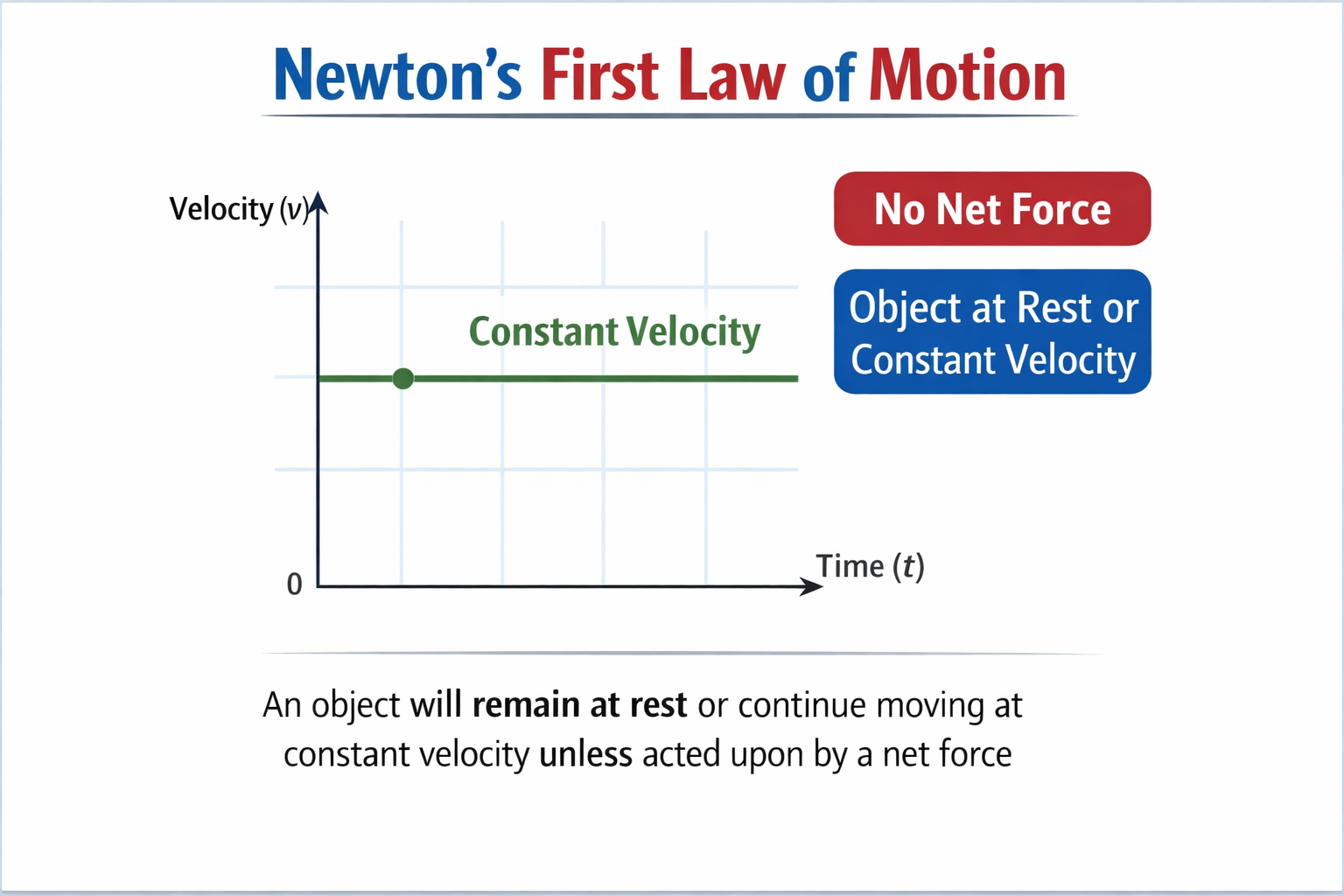
Everybody continues in its state of rest or of uniform motion in a straight line unless it is compelled by an external force to act otherwise.
Equivalently:
If the net external force = 0, then acceleration = 0.
Newton’s Second Law of Motion: Momentum Form of the Second Law
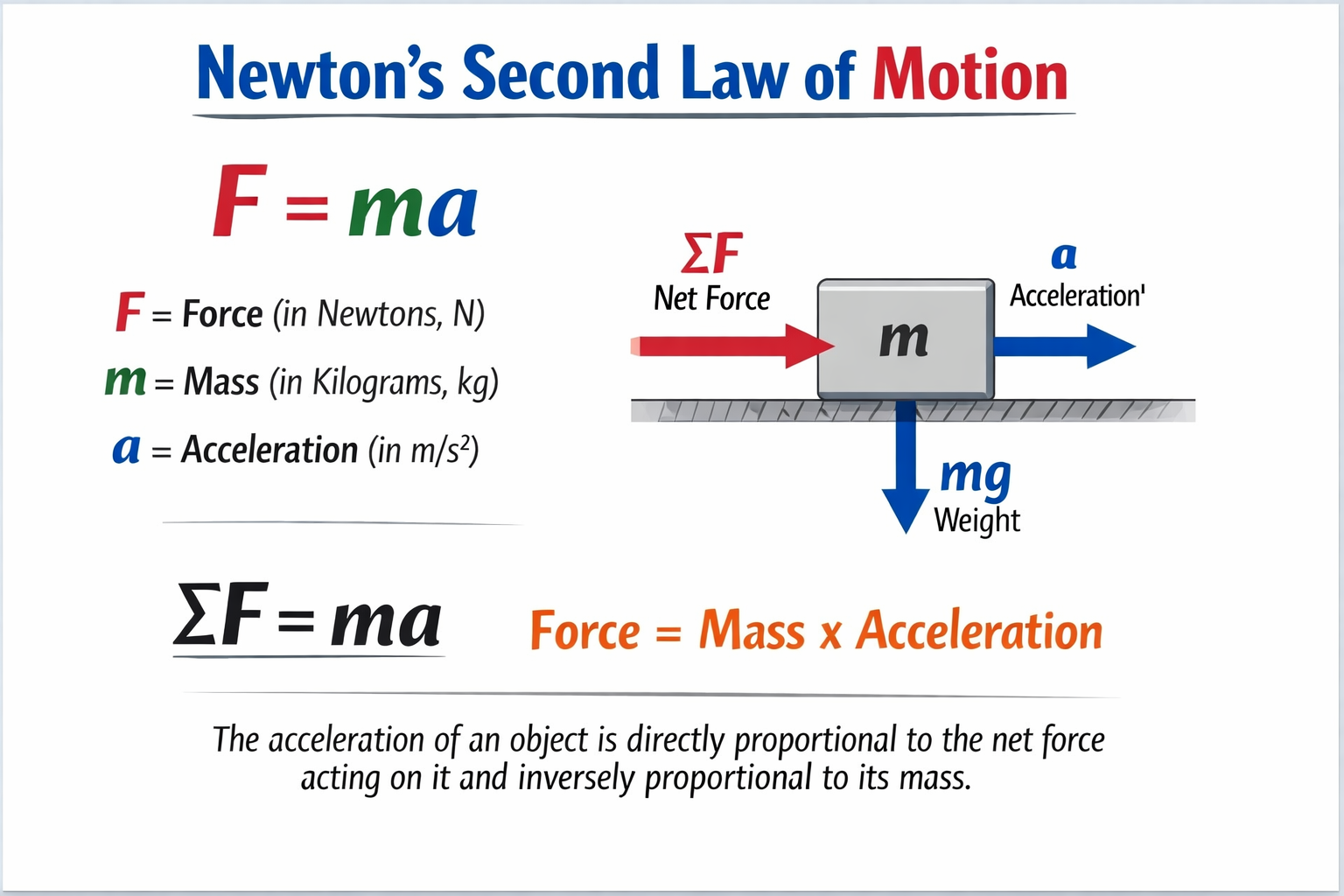
The most general form is:
$\vec F = \dfrac{d\vec p}{dt}$
where $\vec p = m\vec v$is momentum.
For constant mass m:
$\vec F = m\vec a$
This is the familiar F = ma form you use in most NEET problems.
SI Unit of Force
From $\vec F = m\vec a$:
Mass unit: kg
Acceleration unit: m s⁻²
So the SI unit of force is:
1 newton (1 N) = 1 kg·m·s⁻²
Newton’s Laws of Motion: Newton’s Third Law of Motion
Newton’s Third Law states that for every action, there is an equal and opposite reaction.
In simple words, whenever one body exerts a force on another body, the second body also exerts a force of the same magnitude and in the opposite direction on the first body.
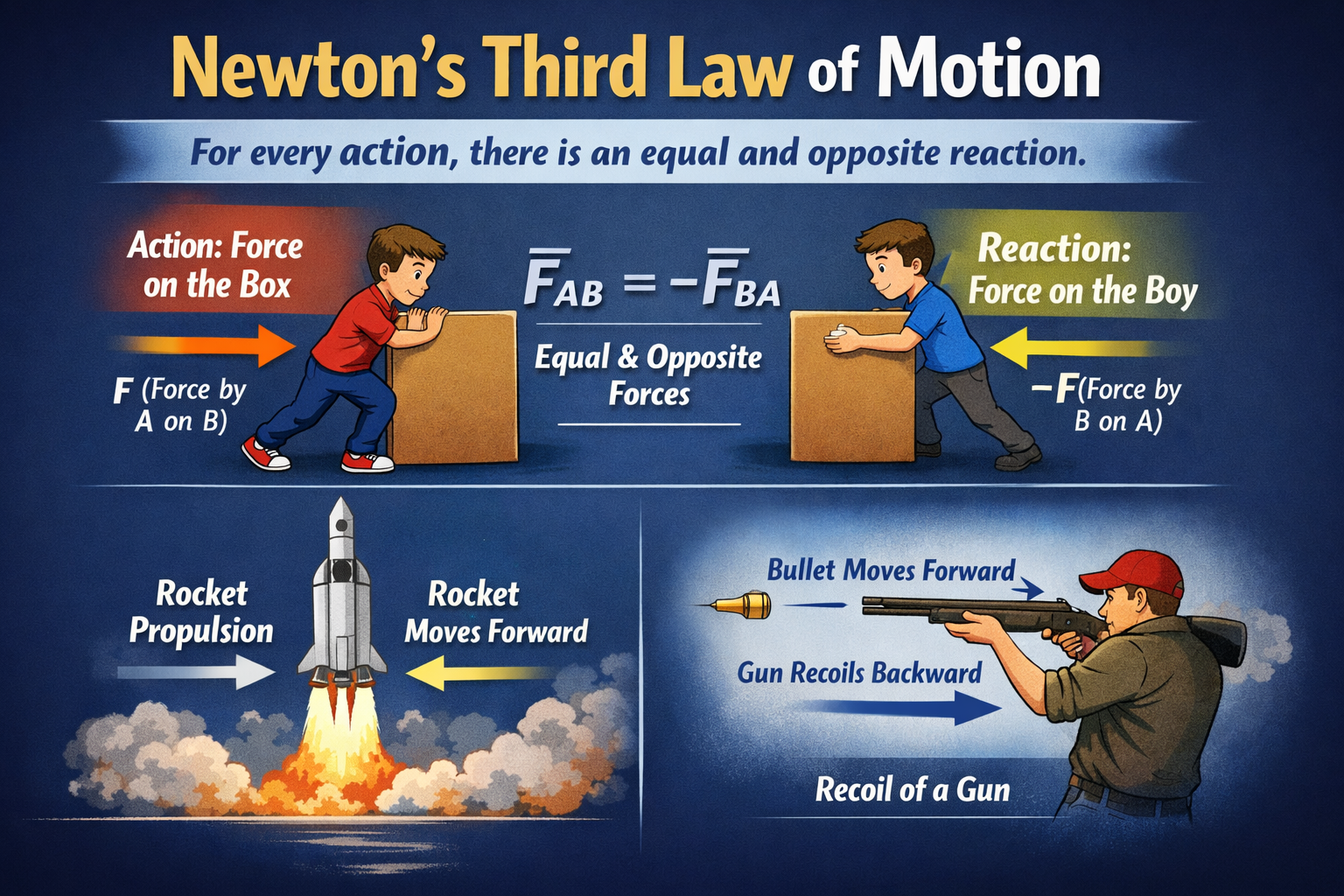
Mathematically, $\vec F_{AB} = - \vec F_{BA} $.
Here:
$\vec F_{AB} $is the force exerted by body A on body B
$\vec F_{BA} $is the force exerted by body B on body A
Examples of Newton’s Third Law
While walking, your foot pushes the ground backward, and the ground pushes you forward.
A gun recoils backward when a bullet is fired forward.
A swimmer pushes water backward, and water pushes the swimmer forward.
A rocket moves upward because gases are expelled downward.
Free Body Diagram
A Free Body Diagram, or F.B.D., is a simplified diagram that shows all the external forces acting on a single object. It helps in identifying the forces clearly before applying Newton’s laws of motion.
To draw a Free Body Diagram, first choose the body you want to analyse. Then isolate that body mentally from its surroundings and identify every external force acting on it. After that, represent each force by an arrow in the correct direction.
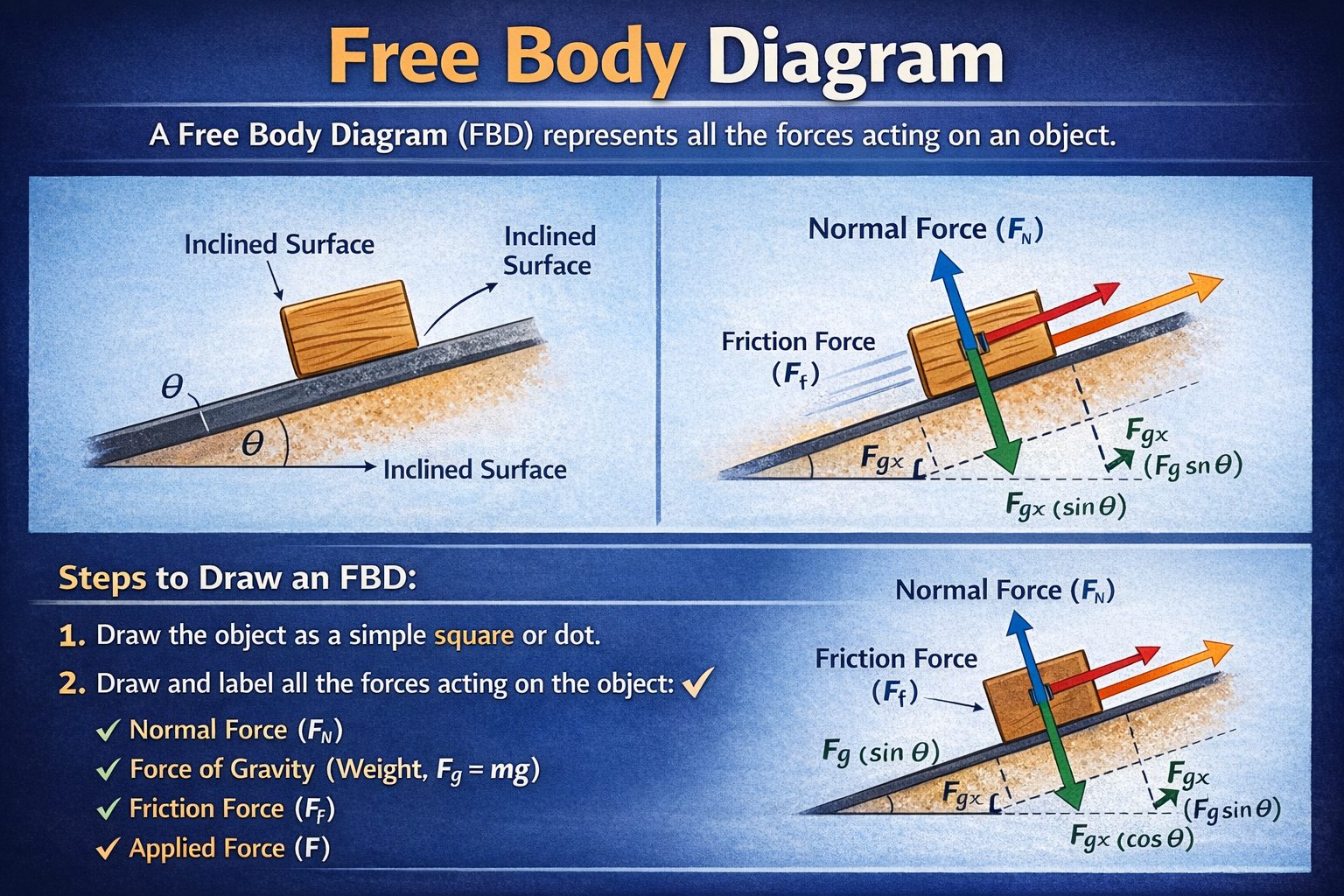
Some common forces shown in an F.B.D. are:
weight or gravitational force
normal reaction
tension
friction
applied force
air resistance, if relevant
Important Point
In Newton’s Third Law, action and reaction forces never appear in the same Free Body Diagram because they act on different objects.
For example, if a book is placed on a table:
In the F.B.D. of the book, you draw the weight of the book and the normal reaction of the table
You do not draw the force exerted by the book on the table, because that force acts on the table, not on the book
Impulse and Impulsive Force
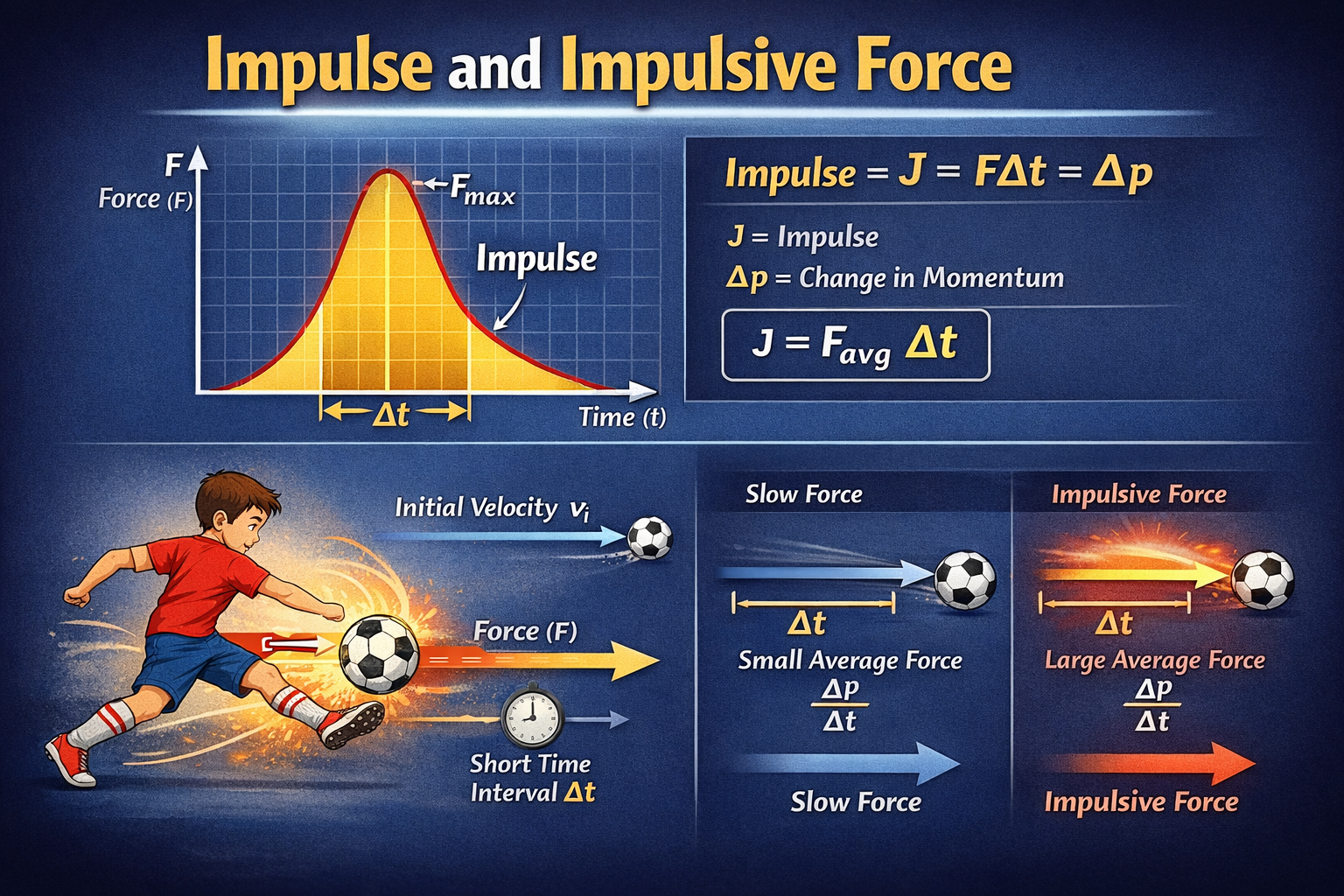
Impulse is the total effect of a force acting over a short time interval.
Mathematically, $\vec J = \int \vec F , dt $.
For constant force, $\vec J = \vec F \Delta t $.
Impulse is equal to the change in momentum, so $\vec J = \Delta \vec p = \vec p_f - \vec p_i $.
SI Unit of Impulse
Since impulse equals force multiplied by time, its SI unit is $\text{N s} = \text{kg m s}^{-1} $.
Impulsive Force
A very large force acting for a very short interval of time is called an impulsive force.
Examples:
hitting a cricket ball with a bat
hammering a nail
collision between two vehicles
Why Impulse Matters in Real Life
In many situations, the force may be large, but the contact time decides how much momentum changes.
For example:
Airbags increase the time of collision, reducing the average force.
Catching a ball by moving your hands backwards increases the time of impact and reduces the force felt.
Using $F_{\text{avg}} \Delta t = \Delta p $, for the same change in momentum, a larger $\Delta t $means a smaller average force.
Law of Conservation of Linear Momentum
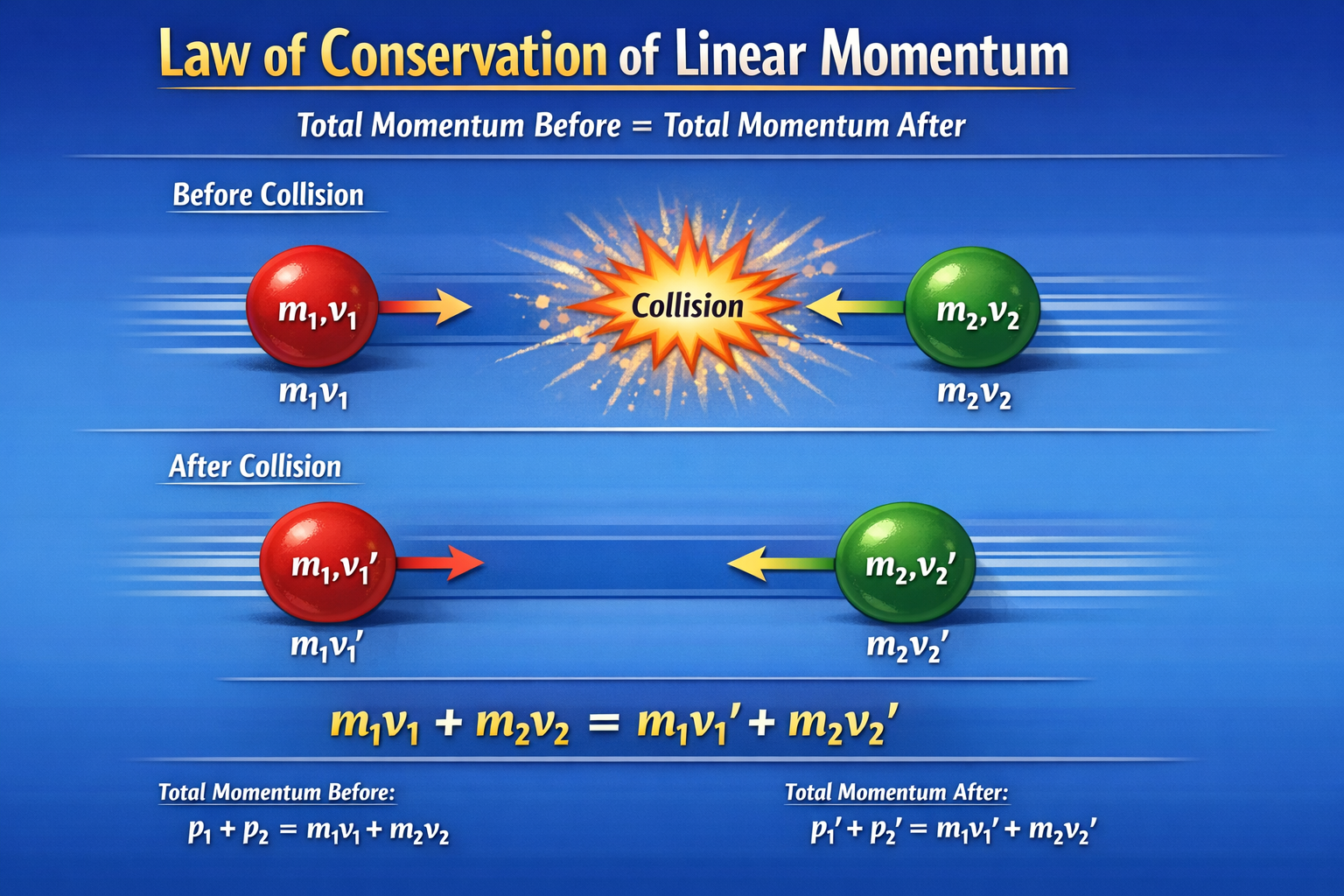
The total linear momentum of an isolated system remains constant if no external force acts on it.
If the net external force is zero, then $\dfrac{d\vec P}{dt} = 0 $.
So, $\vec P = \text{constant} $.
For two bodies before and after interaction, $m_1 \vec u_1 + m_2 \vec u_2 = m_1 \vec v_1 + m_2 \vec v_2 $.
This principle is especially useful in collisions, explosions, and recoil problems.
Applications of Conservation of Momentum
1. Recoil of a gun: Before firing, the total momentum is zero. After firing, if the bullet moves forward, the gun moves backwards so that total momentum remains zero.
If bullet mass is $m $and bullet velocity is $v $, and gun mass is $M $with recoil velocity $V $, then $mv + MV = 0 $.
So, $V = -\frac{mv}{M} $.
2. Rocket propulsion: A rocket moves upward because gases are expelled downward. This is based on momentum conservation along with Newton’s Third Law.
3. Collision problems: Whenever no significant external force acts during the short collision time, momentum conservation can be applied.
Equilibrium of Concurrent Forces
When several forces act on a body, and all of them pass through one point, they are called concurrent forces.
If the body remains at rest or moves with constant velocity, it is in equilibrium.
For equilibrium, the net force must be zero:
$\sum F_x = 0 $
$\sum F_y = 0 $
Example of Equilibrium
Suppose a body is hanging by two strings. The tensions in the strings and the weight of the body all act through the same point. These are concurrent forces. To solve such problems, resolve each force into horizontal and vertical components and apply:
$\sum F_x = 0 $
$\sum F_y = 0 $
Static Friction and Kinetic Friction
Friction is the force that opposes the relative motion or the tendency of relative motion between two surfaces in contact.
Static Friction
Static friction acts when there is no actual slipping between the surfaces.
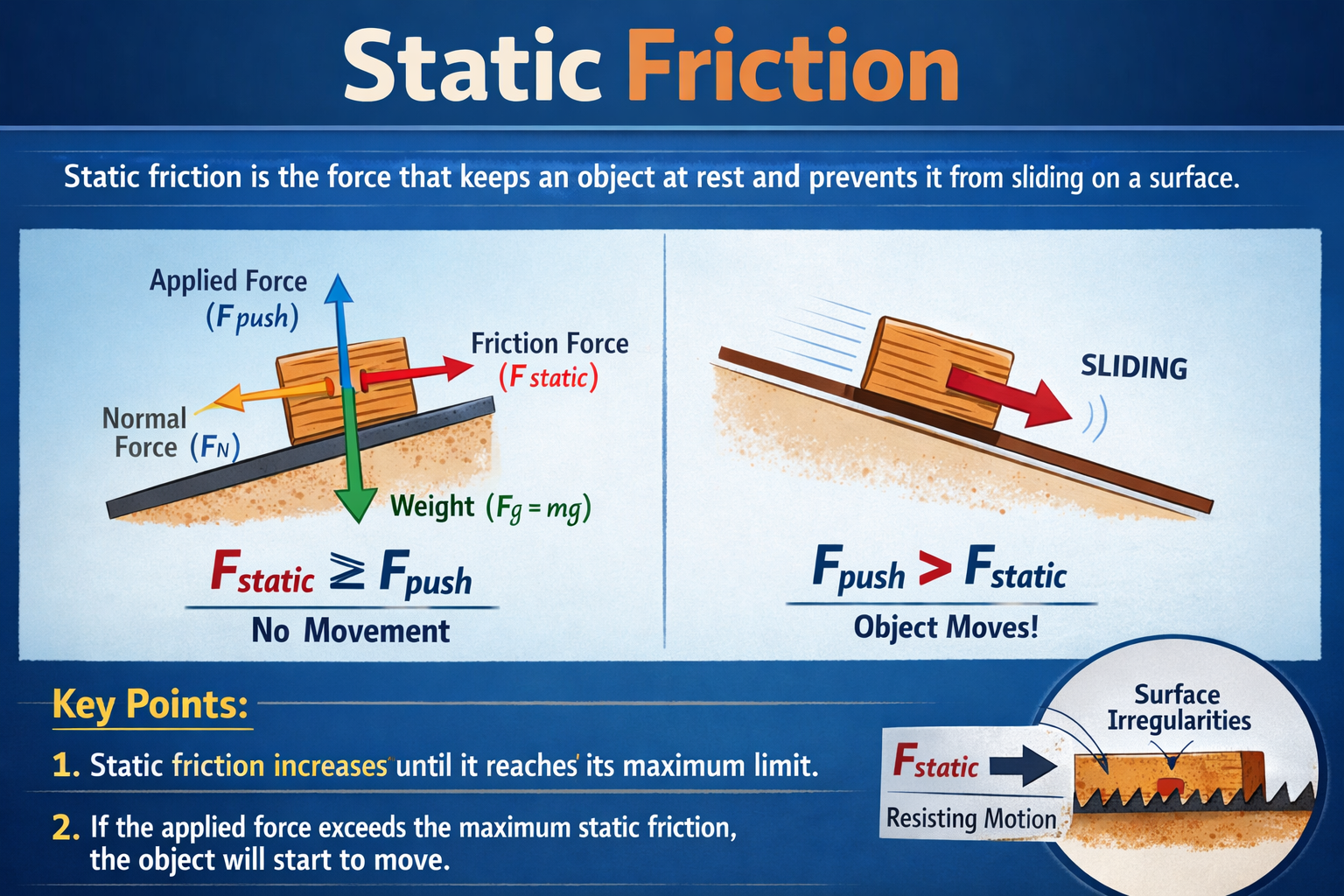
It is self-adjusting and takes the value needed to prevent motion, up to a maximum value.
So, $f_s \leq f_{s,\max} $.
The maximum static friction is $f_{s,\max} = \mu_s N $.
Here:
$\mu_s $is the coefficient of static friction
$N $is the normal reaction
Key Idea
Static friction is not always equal to $\mu_s N $.
It becomes equal to $\mu_s N $only when the body is just about to move.
This is one of the most common NEET mistakes.
Kinetic Friction
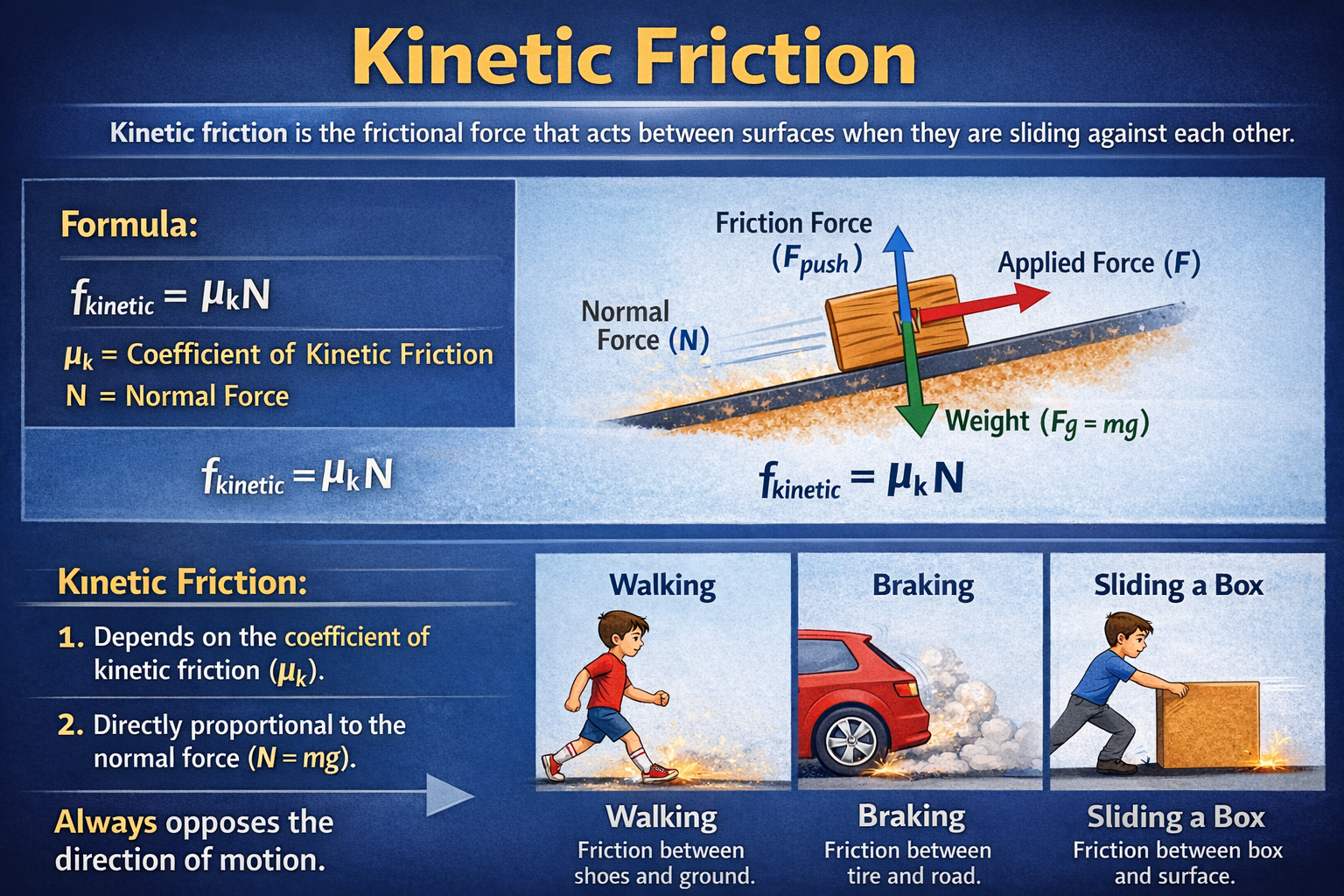
Once the body starts sliding, kinetic friction acts.
Its value is given by $f_k = \mu_k N $.
Usually, $\mu_s > \mu_k $, so kinetic friction is smaller than maximum static friction.
Laws of Friction
The standard laws of dry friction are:
Friction acts parallel to the surfaces in contact.
It opposes relative motion or the tendency of motion.
Limiting friction is proportional to normal reaction, so $f_{\max} = \mu N $.
For a given pair of surfaces, friction depends on the nature of the surfaces.
Kinetic friction is generally less than limiting friction.
Angle of Friction
If limiting friction is reached, then $\tan \phi = \mu $, where $\phi $is the angle of friction.
Rolling Friction
Rolling friction is the resistive force that acts when a body rolls over a surface.
It is much smaller than sliding friction. That is why wheels are used in vehicles and luggage bags.
Rolling friction arises because of deformation of the rolling body and the surface.
Example
It is easier to move a suitcase with wheels than to drag it because rolling friction is much less than kinetic friction.
Dynamics of Uniform Circular Motion
When a body moves in a circle with constant speed, its velocity keeps changing because the direction changes continuously.
Hence, even though speed is constant, the body has acceleration. This acceleration is called centripetal acceleration.
Its magnitude is $a_c = \frac{v^2}{r} $.
So the required centripetal force is $F_c = \frac{mv^2}{r} $.
Vehicle on a Level Circular Road
When a vehicle takes a turn on a flat road, the necessary centripetal force is provided by static friction.
So, $f = \dfrac{mv^2}{r} $.
The maximum available static friction is $f_{\max} = \mu_s N = \mu_s mg $.
For safe turning, $\dfrac{mv^2}{r} \leq \mu_s mg $.
So the maximum safe speed is $v_{\max} = \sqrt{\mu_s rg} $.
Vehicle on a Banked Road
On a banked road, the road is tilted so that a component of the normal reaction helps provide the centripetal force.
This reduces dependence on friction and allows safer turning at higher speeds.
If friction is neglected, then the ideal speed for turning on a banked road is given by $\tan \theta = \dfrac{v^2}{rg} $.
So, $v = \sqrt{rg \tan \theta} $.
Here:
$\theta $is the banking angle
$r $is the radius of the circular path
$v $is the speed of the vehicle
Significance
At this speed, the horizontal component of normal reaction provides the exact centripetal force needed, and no friction is required.
When Friction Is Present
If the speed differs from the ideal value, friction acts either up or down the slope depending on whether the vehicle tends to slide down or outward.
For NEET, the frictionless formula $\tan \theta = \dfrac{v^2}{rg} $is the most important result.
Final NEET Revision Points for Laws of Motion
If the net force is zero, then the acceleration is zero.
Always draw a correct free-body diagram before writing equations.
Use $\sum F = ma $for force-based motion problems.
Use $\Delta p = F \Delta t $or the impulse relation for short-time force interactions.
Use momentum conservation only when external impulse is negligible.
Static friction is variable, with $f_s \leq \mu_s N $.
Kinetic friction is $f_k = \mu_k N $.
Centripetal force is the net inward force, not an extra force.
On a level road, friction provides centripetal force.
On a banked road, the horizontal component of normal reaction helps provide centripetal force.
Overview: Why Laws of Motion are Crucial for NEET
The Laws of Motion unit appears explicitly in the NEET (UG) Physics syllabus (Unit: Laws of Motion) and in CBSE Class 11 Physics.
Key topics covered:
Force and inertia
Newton’s laws of motion
Impulse and conservation of momentum
Equilibrium of concurrent forces
Friction: static, kinetic and rolling
Uniform circular motion: level and banked roads
From a NEET point of view, you can summarise the chapter into two core actions:
Draw a correct free‑body diagram (FBD).
Apply either Newton’s Second Law in components $\sum F = ma$or momentum conservation for collisions and short‑time interactions.
Common NEET Traps in Laws of Motion
Be careful with these high‑yield mistakes:
Treating centripetal force as a separate force instead of as the net inward force.
Thinking action–reaction forces act on the same body (they act on different bodies).
Assuming static friction = μN in all cases (actually, it is self‑adjusting up to a maximum value).
Applying momentum conservation when the system experiences a non‑zero external impulse.
Most Important NEET 2027 Topics Physics
Laws of Motion for NEET and Class 11: Complete Guide with Examples

 Share
ShareFAQs on Laws of Motion for NEET and Class 11: Complete Guide with Examples
1. What are the three laws of motion?
The three laws of motion are Newton’s First Law, Newton’s Second Law, and Newton’s Third Law. The first law explains inertia, the second law relates force to the rate of change of momentum, and the third law states that every action has an equal and opposite reaction.
2. Why is Laws of Motion important for NEET?
Laws of Motion is important for NEET because it builds the base for many mechanics chapters. Questions from force, friction, momentum, impulse, circular motion, and free body diagrams are regularly linked to this topic.
3. What is inertia in Laws of Motion?
Inertia is the property of a body by which it resists any change in its state of rest or uniform motion in a straight line. It is directly related to mass, so a body with greater mass has greater inertia.
4. What is Newton’s First Law of Motion?
Newton’s First Law states that a body remains at rest or continues to move with uniform velocity in a straight line unless acted upon by an external unbalanced force.
5. What is Newton’s Second Law of Motion?
Newton’s Second Law states that force is equal to the rate of change of momentum. For constant mass, it is written as $ F = ma $.
6. What is Newton’s Third Law of Motion?
Newton’s Third Law states that for every action, there is an equal and opposite reaction. These two forces act on different bodies, so they do not cancel each other.
7. What is a Free Body Diagram in Physics?
A Free Body Diagram is a simplified diagram that shows all the external forces acting on a single body. It is used to identify forces correctly before applying Newton’s laws.
8. Why is a Free Body Diagram important in NEET Physics?
A Free Body Diagram is important because most mistakes in Laws of Motion happen when students identify forces incorrectly. A correct FBD helps in applying $ \sum F = ma $ or equilibrium conditions properly.
9. What is momentum in Physics?
Momentum is the product of mass and velocity. It is a vector quantity and is written as $ p = mv $.
10. What is impulse in Laws of Motion?
Impulse is the product of force and time interval, and it is equal to the change in momentum. It is written as $ J = F \Delta t $ for constant force.
11. What is the law of conservation of linear momentum?
The law of conservation of linear momentum states that if no external force acts on a system, the total linear momentum of the system remains constant.
12. When can momentum conservation be applied?
Momentum conservation can be applied when the external impulse acting on the system is zero or negligible. It is commonly used in collision, explosion, and recoil problems.
13. What is static friction?
Static friction is the frictional force that acts when there is no actual slipping between two surfaces. It opposes the tendency of motion and adjusts itself up to a maximum value.
14. Is static friction always equal to $ \mu N $?
No, static friction is not always equal to $ \mu N $. It becomes equal to $ \mu N $ only when the body is on the verge of motion.
15. What is kinetic friction?
Kinetic friction is the frictional force that acts when one surface actually slides over another. It is usually less than the maximum static friction.
16. What is rolling friction?
Rolling friction is the resistive force that acts when a body rolls over a surface. It is much smaller than sliding friction, which is why wheels make movement easier.
17. What is centripetal force?
Centripetal force is the net inward force required to keep a body moving in a circular path. It is not a separate force, but the result of actual forces like friction, tension, normal reaction, or gravity.
18. What provides centripetal force on a level circular road?
On a level circular road, static friction between the tyres and the road provides the centripetal force needed for turning.
19. What is a banked road in Physics?
A banked road is a curved road tilted at an angle so that a component of the normal reaction helps provide centripetal force. This allows vehicles to turn more safely at higher speeds.
20. What are the most common mistakes in Laws of Motion?
Common mistakes include drawing incorrect free body diagrams, treating centripetal force as a separate force, assuming static friction is always maximum, and applying momentum conservation when external impulse is not zero.
