








How Do Mitochondria Work in NEET Biology?
Mitochondria are often called the "powerhouses of the cell" due to their key role in energy production. Understanding mitochondria is essential for NEET Biology aspirants, as questions about their structure, function, and significance commonly appear in the exam. Grasping this concept builds a strong foundation in cell biology, which is a core area for NEET preparation.
What are Mitochondria? Definition and Meaning
Mitochondria are double-membrane-bound cell organelles found in almost all eukaryotic cells. Their main function is to generate energy in the form of adenosine triphosphate (ATP) through the process of cellular respiration. Structurally, they are oval or sausage-shaped and contain their own DNA, making them semi-autonomous organelles. Learning about mitochondria helps students understand vital cellular activities and energy management, which are crucial topics for NEET Biology.
Core Ideas and Fundamental Concepts about Mitochondria
Structure of Mitochondria
The structure of mitochondria directly relates to their function in cells. Each mitochondrion has:
- An outer membrane - smooth and permeable to ions and small molecules.
- An inner membrane - highly folded into structures called cristae, increasing surface area for metabolic reactions.
- Intermembrane space - space between the outer and inner membranes.
- Matrix - the innermost compartment, containing enzymes, mitochondrial DNA, and ribosomes.
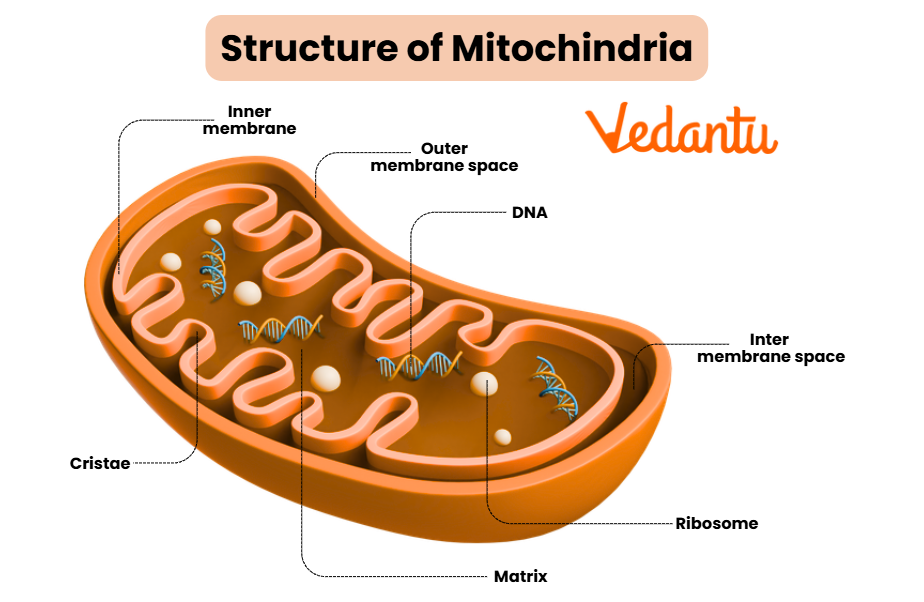
The folded cristae provide more surface area for the crucial reactions involved in ATP production.
Function of Mitochondria: Energy Production
Mitochondria are responsible for generating most of the cell’s ATP through aerobic respiration. The process involves the breakdown of glucose and other nutrients with oxygen, releasing energy, carbon dioxide, and water as end products. Without mitochondria, complex multicellular life would not be possible due to the lack of sufficient energy supply.
Unique Features: Mitochondrial DNA and Semi-autonomy
Mitochondria contain their own genetic material (mtDNA), inherited maternally. This feature allows them to replicate independently within the cell. Their bacteria-like DNA and ribosomes support the endosymbiotic theory, which suggests mitochondria originated from ancient prokaryotic cells.
Important Sub-Concepts Related to Mitochondria
Cellular Respiration and the Role of Mitochondria
Mitochondria are at the heart of aerobic cellular respiration, which can be divided into three main stages:
- Glycolysis (cytoplasm): Glucose is broken down to pyruvate.
- Krebs Cycle (mitochondrial matrix): Pyruvate is further processed to release electrons.
- Electron Transport Chain (inner mitochondrial membrane): Electrons pass through proteins, generating ATP.
The electron transport chain and ATP synthesis happen specifically on the cristae of mitochondria, highlighting their functional importance.
Mitochondrial Inheritance
Mitochondrial DNA is inherited exclusively from the mother, an important concept for genetics-based NEET questions. The uniparental inheritance pattern makes mitochondrial DNA valuable for tracing maternal lineage and studying certain inherited diseases.
Endosymbiotic Theory
The endosymbiotic theory proposes that mitochondria originated when ancestral eukaryotic cells absorbed aerobic bacteria, which then became a permanent part of the cell. Support for this theory comes from mitochondrial DNA similarity to prokaryotic DNA, and their ability to self-replicate.
Principles and Relationships Involving Mitochondria
While there are no universal formulas linked directly to mitochondria in NEET, understanding the ATP yield and chemical relationships is crucial. For instance, the process can be summarized as:
- General equation for aerobic respiration:
C6H12O6 + 6O2 → 6CO2 + 6H2O + 38 ATP - ATP production: Most ATP is produced in mitochondria - about 34 out of 38 ATP molecules per glucose during aerobic respiration.
Understanding this relationship helps students answer NEET MCQs related to cell energetics, organelle function, and bioenergetics.
Key Features and Characteristics of Mitochondria
- Double-membrane structure with inner folds (cristae) increasing the surface area.
- Site for ATP production via aerobic respiration.
- Contain their own circular DNA and ribosomes.
- Can replicate independently (semi-autonomous).
- Number per cell varies as per the cell’s energy requirement (e.g., muscle cells have more mitochondria).
- Inherited maternally in most organisms.
Why Mitochondria Are Important for NEET
Mitochondria-related questions are frequently seen in NEET Biology papers, appearing in topics such as cell organelle function, energy metabolism, genetics, and molecular biology. A clear understanding aids in solving a variety of MCQs and assertion-reason type questions. This topic is also foundational for connecting with other subjects like genetics, physiology, and even biotechnology, making it essential for both basic and advanced Biology questions.
How to Study Mitochondria Effectively for NEET
- Start with diagrams: Label mitochondrial diagrams to understand structure - practice drawing and labeling regularly.
- Connect with processes: Relate the structural parts with their functions (e.g., match cristae with ATP synthesis sites).
- Understand cellular respiration: Master steps of Glycolysis, Krebs Cycle, and the Electron Transport Chain.
- Focus on unique features like mitochondrial DNA and maternal inheritance for conceptual MCQs.
- Attempt previous years’ NEET MCQs and assertion-reason questions.
- Revise using self-created flashcards and quick notes.
- Clear doubts regarding differences with plant cell chloroplasts and prokaryotic cells.
Common Mistakes Students Make in This Concept
- Confusing the functions of mitochondria with other cell organelles, especially chloroplasts.
- Mixing up inner and outer membrane roles and the locations of key reactions.
- Ignoring the significance of mitochondrial DNA in questions about inheritance and evolution.
- Overlooking the link between structure and function in ATP production.
- Miscounting ATP yield in aerobic respiration.
- Neglecting differences between mitochondrial and nuclear DNA.
Quick Revision Points: Mitochondria
- Mitochondria create ATP - the energy currency of the cell.
- Double-membrane organelle with inner cristae for ATP synthesis.
- Matrix contains DNA, enzymes, and ribosomes.
- Site of Krebs Cycle and Electron Transport Chain.
- Inherited from the mother (maternal inheritance).
- Supports endosymbiotic theory (prokaryotic origin).
- Common NEET questions: structure, function, ATP formation, inheritance, and comparisons.
FAQs on Mitochondria in NEET Biology: Structure and Functions Explained
1. What is mitochondria and why is it called the powerhouse of the cell in NEET syllabus?
Mitochondria are called the powerhouse of the cell because they generate most of the cell’s energy in the form of ATP needed for biochemical activities.
- Mitochondria perform cellular respiration to release energy.
- They convert nutrients into adenosine triphosphate (ATP).
- Vital for NEET Biology and Class 11/12 exams.
2. What are the main functions of mitochondria in a cell for NEET?
Mitochondria perform essential cellular functions, especially in energy production.
- ATP synthesis through aerobic respiration.
- Regulation of cell metabolism.
- Involvement in apoptosis (programmed cell death).
- Synthesis of certain hormones and amino acids.
- Calcium ion storage and signaling.
3. Describe the structure of mitochondria with labels relevant for NEET exams.
Mitochondria have a unique double-membrane structure adapted for efficient energy production.
- Outer membrane: smooth and permeable to small molecules.
- Inner membrane: folded into cristae to increase surface area.
- Matrix: internal space containing enzymes, mitochondrial DNA, and ribosomes.
- Intermembrane space: region between both membranes.
4. What is the role of mitochondria in cellular respiration for NEET?
Mitochondria are the sites for aerobic cellular respiration, crucial for energy production.
- Carry out the Krebs cycle in the matrix.
- Host the electron transport chain on cristae.
- Produce majority of ATP via oxidative phosphorylation.
5. Why do muscle cells have more mitochondria than skin cells?
Muscle cells contain more mitochondria because they need extra ATP for contraction and high energy activities.
- Frequent muscle movement uses more energy.
- More mitochondria help meet higher metabolic demand.
- This concept is frequently tested in NEET exams.
6. Do mitochondria have their own DNA? If yes, what is its significance in NEET?
Mitochondria have their own circular DNA, separate from nuclear DNA.
- Enables them to produce some of their own proteins independently.
- Support the endosymbiotic theory, important for NEET.
- Inherited maternally (from mothers).
7. What is the endosymbiotic theory related to mitochondria?
The endosymbiotic theory suggests that mitochondria originated from ancient prokaryotes engulfed by ancestral eukaryotic cells.
- Explains presence of mitochondrial DNA.
- Mitochondria share similarities with bacteria (size, reproduction).
- Key point in the NEET Biology syllabus.
8. Name the major steps of aerobic respiration that occur in mitochondria for NEET preparation.
The three main steps of aerobic respiration take place in mitochondria:
- Glycolysis (in cytoplasm, outside mitochondria).
- Krebs cycle (in mitochondrial matrix).
- Electron Transport Chain (in inner mitochondrial membrane).
9. Write the main differences between mitochondria and chloroplasts (NEET point of view).
Mitochondria and chloroplasts differ in structure and function, relevant for NEET.
- Mitochondria: Site of cellular respiration, present in animal and plant cells.
- Chloroplasts: Site of photosynthesis, found only in plant cells.
- Both have double membranes and their own DNA.
10. What happens if mitochondria stop working in a human cell?
If mitochondria cease functioning, the cell cannot generate enough ATP, leading to cell death.
- Cellular processes requiring energy will halt.
- Results in tissue or organ failure in severe cases.
- Knowing this is important for NEET biology exams.
