








What is Starfish? Structure, Classification, Tube Feet, Regeneration and Types Explained for NEET
Starfish, also known as sea stars, are fascinating marine invertebrates that belong to the class Asteroidea. They are among the best-known echinoderms because of their star-shaped body, radiating arms, and remarkable ability to regenerate lost parts.
Although the common name “starfish” is widely used, they are not true fish because they do not have gills, fins, or a vertebral column. Instead, they are echinoderms, a group that also includes sea urchins, brittle stars, sea cucumbers, and crinoids.
What is the Purpose of a Starfish?
The body of a starfish is not soft like that of jellyfish or worms. It contains a supportive internal skeleton made of calcareous plates. Starfish also possess a water vascular system, which is one of the most characteristic features of echinoderms. This hydraulic system helps in movement, attachment, food handling, and gas exchange.
Another striking point is that starfish are important predators in marine ecosystems. Many species feed on molluscs, corals, and other small invertebrates, and some act as keystone species, meaning they strongly influence the balance of organisms in their habitat.
Starfish Scientific Name
The scientific group name for starfish is Asteroidea. This is the zoological class to which all true starfish belong.
If the question asks “starfish scientific name,” the most accurate answer in general biology context is:
Starfish Scientific Name: Asteroidea
This term comes from Greek roots meaning “star-like form.” Since starfish include many species, there is no single species name for all starfish. Instead, Asteroidea is the class name used for the whole group.
Some commonly discussed species include:
Asterias forbesi
Pisaster ochraceus
Acanthaster planci
Linckia laevigata
For NEET UG, it is most useful to remember the class name Asteroidea.
Starfish Classification
Explanation of Classification
Kingdom Animalia means starfish are multicellular, heterotrophic animals.
Phylum Echinodermata means they belong to the group of “spiny-skinned” animals, which typically show radial symmetry in adults and possess a calcareous endoskeleton.
Subphylum Asterozoa includes star-shaped echinoderms.
Class Asteroidea includes all true starfish or sea stars.
This classification is highly important because students often confuse starfish with brittle stars. Brittle stars belong to another group and are not true starfish.
Starfish Characteristics
Starfish show several characteristic features that help identify them.
1. They are Exclusively Marine
Starfish are found only in marine environments. They are absent from freshwater because their body fluids remain close in salt concentration to the surrounding seawater. They do not have a strong osmoregulatory mechanism like freshwater animals.
2. Adults ShowRadial Symmetry
Adult starfish are generally pentaradial, which means the body is arranged around a central axis in five radiating parts. This is one of the defining characters of echinoderms.
3. They have a Central Disc and Arms
The body consists of a central disc from which arms or rays arise. This gives the animal its star-like shape.
4. Endoskeleton is Present
The body wall contains an internal skeleton made of calcium carbonate ossicles. These give support and a rough or spiny texture to the body.
5. Tube Feet are Present
The lower surface contains numerous tube feet that help in locomotion, feeding, adhesion, and sensory reception.
6. Water Vascular System is Present
This is a hydraulic canal system unique to echinoderms and is essential for movement and food capture.
7. Regeneration is Highly Developed
Starfish are famous for their ability to regrow lost arms. Some can even form a complete individual from one arm with a part of the central disc.
8. They are Mostly Predators
Most starfish feed on molluscs and other benthic animals. Some can evert their stomach out of the mouth to digest prey externally.
9. No True Brain
Starfish do not have a centralized brain, but they have a nerve ring and radial nerves for coordination.
10. They are Ecologically important
Some starfish control populations of mussels or corals and influence biodiversity in marine habitats.
How Many Arms Does a Starfish Have?
This is one of the most common direct questions.
Most starfish have five arms, which is why they are commonly drawn as five-pointed stars. However, not all starfish have only five arms. The number of arms varies with species.
Detailed explanation
Typical number: 5 arms
Some species: 6 or 7 arms
Others: 10 to 15 arms
Rare species: more than 50 arms
So, the correct biological understanding is:
Fact: A starfish usually has five arms, but some species may have many more. This variation is important because students often assume that every starfish has exactly five arms, which is not always true.
External Structure of Starfish
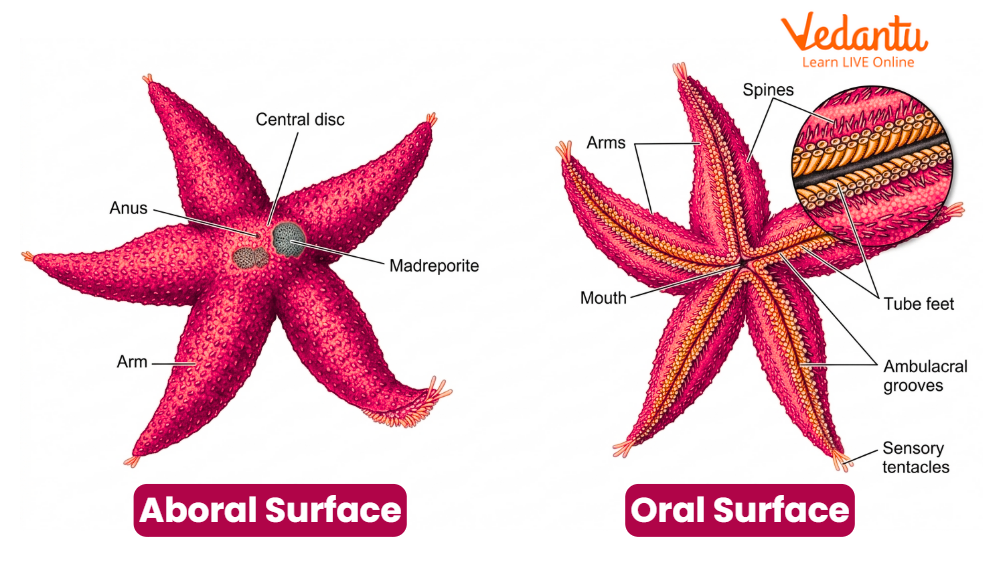
The structure of starfish can be studied under the aboral and oral surfaces.
1. Central Disc
The central disc is the main body region from which the arms arise. It contains many important organs and forms the core of the star-shaped body.
2. Arms or Rays
The arms extend outward from the central disc. They are not separate appendages like limbs in vertebrates but are extensions of the body containing parts of the digestive, nervous, and water vascular systems.
3. Aboral Surface
The upper side of the starfish is called the aboral surface. This surface may be smooth, spiny, or granular depending on species. It contains special structures such as:
spines
ossicles
madreporite
papulae
pedicellariae
4. Oral Surface
The lower side is called the oral surface. It bears:
mouth at the centre
ambulacral grooves
tube feet
The oral surface is actively involved in feeding and locomotion.
5. Body Wall and Endoskeleton of Starfish
The body wall of a starfish is not simple. It has several layers and contains the internal skeleton.
6. Layers of Body Wall
The body wall includes:
a thin outer cuticle
epidermis
dermis
muscle-containing layers
peritoneum lining the body cavity
Ossicles
Within the dermis, there is an endoskeleton formed by ossicles, which are small calcareous plates. These ossicles are composed of calcium carbonate and form a rigid but somewhat flexible framework.
Importance of Ossicles
provide protection
maintain body shape
support movement
may form spines and specialized structures
Spines
Many starfish have spines on the aboral surface. These give the body a rough texture and offer protection.
Pedicellariae
Pedicellariae are pincer-like structures found on some starfish. They help remove small organisms and debris from the body surface and may also assist in defense.
Papulae
Papulae are thin-walled body projections involved in respiration. They increase the surface area for gas exchange.
Starfish Tube Feet
The starfish tube feet are one of the most important structures for NEET biology.
Tube feet are small, tubular, extensible projections found on the oral surface of the arms, usually arranged in rows inside the ambulacral grooves. They are connected internally to the water vascular system.
Functions of starfish tube feet
1. Locomotion
Tube feet help the starfish move slowly over rocks, sand, or other surfaces. The animal does not walk like vertebrates. Instead, many tube feet coordinate their movement in waves.
2. Attachment
Tube feet allow the starfish to grip surfaces firmly. Although they look like suction cups, their adhesion mainly depends on chemical attachment rather than suction alone.
3. Feeding
Tube feet help in handling prey. They can pull open the shells of bivalves such as mussels and clams.
4. Respiration
Tube feet also function as accessory respiratory organs because gases can diffuse through their thin walls.
5. Sensory role
Tube feet can detect touch and chemicals in the surrounding water.
Thus, starfish tube feet are multifunctional organs and not just locomotory structures.
Water Vascular System of Starfish
The water vascular system is a defining feature of echinoderms and is essential for starfish biology.
It is a hydraulic system made up of fluid-filled canals.
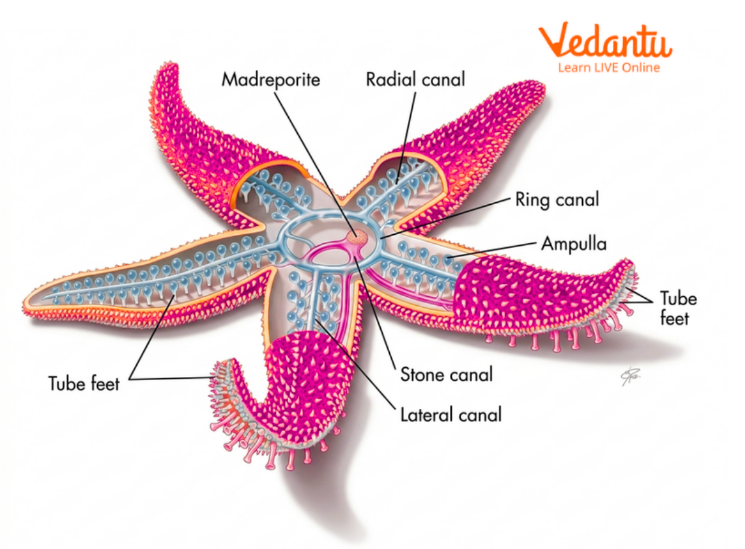
Main Parts of the System
madreporite
stone canal
ring canal
radial canals
lateral canals
ampullae
tube feet
How It Works?
Water enters through the madreporite, a sieve-like structure on the aboral surface. From there, it passes into the stone canal, then to the ring canal around the mouth, and from there into the radial canals that extend into each arm.
Each radial canal gives rise to lateral canals connected to ampullae and tube feet.
When the ampullae contracts, fluid is forced into the tube feet, causing them to extend. When the tube feet adhere to a surface and then shorten, movement occurs.
Importance of Water Vascular System
locomotion
adhesion
food capture
gas exchange
transport within the body
This topic is very high-yield for objective exams.
Digestive System of Starfish
The digestive system of a starfish is highly interesting and often tested because of the stomach eversion mechanism.
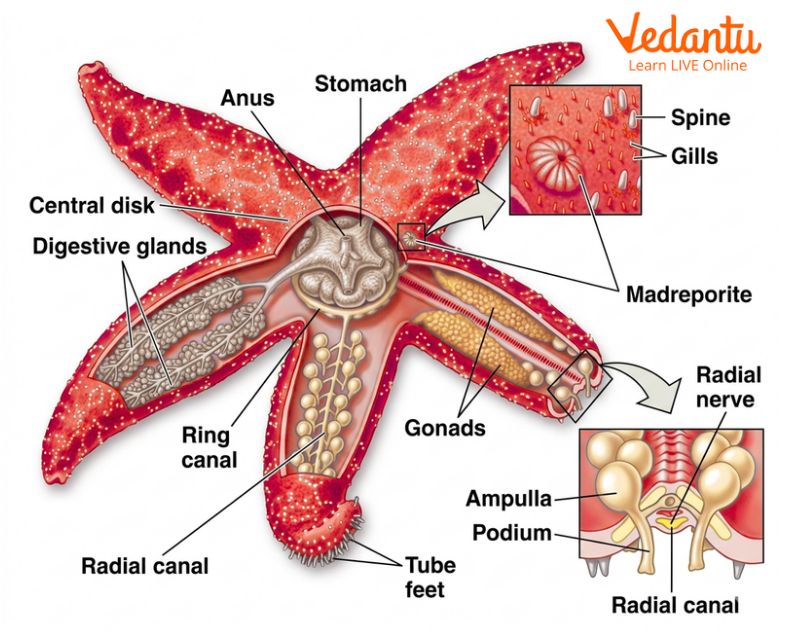
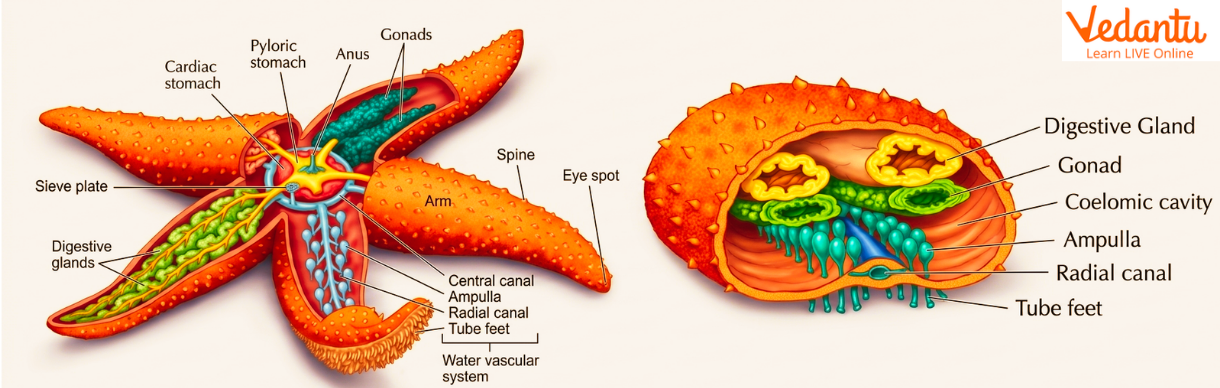
Main Parts
mouth
oesophagus
cardiac stomach
pyloric stomach
pyloric caeca
intestine
anus
1. Mouth
The mouth lies at the centre of the oral surface.
2. Cardiac Stomach
This part of the stomach can be everted, meaning it can be pushed out through the mouth. This allows the starfish to digest prey externally.
3. Pyloric Stomach and Pyloric Caeca
After partial digestion, food moves into the pyloric stomach and the pyloric caeca, where enzymes continue digestion and nutrients are absorbed.
4. Feeding Mechanism
When feeding on bivalves, the starfish uses its tube feet to pull the shell open slightly. It then inserts the everted stomach into the narrow gap and digests the soft tissues inside the shell.
This makes starfish highly effective predators.
Starfish Feeding Habits
Most starfish are generalist predators. They feed on:
bivalves
snails
sponges
coral polyps
detritus
other small invertebrates
Some species are suspension feeders, while others are detritivores. Their feeding behavior varies according to species and habitat.
Why Is Their Feeding Important Ecologically?
Because starfish prey on dominant organisms such as mussels, they help maintain species balance in marine communities.
Nervous System and Sense Organs of Starfish
Starfish do not have a brain, but this does not mean they are unresponsive. They possess a well-developed though decentralized nervous system.
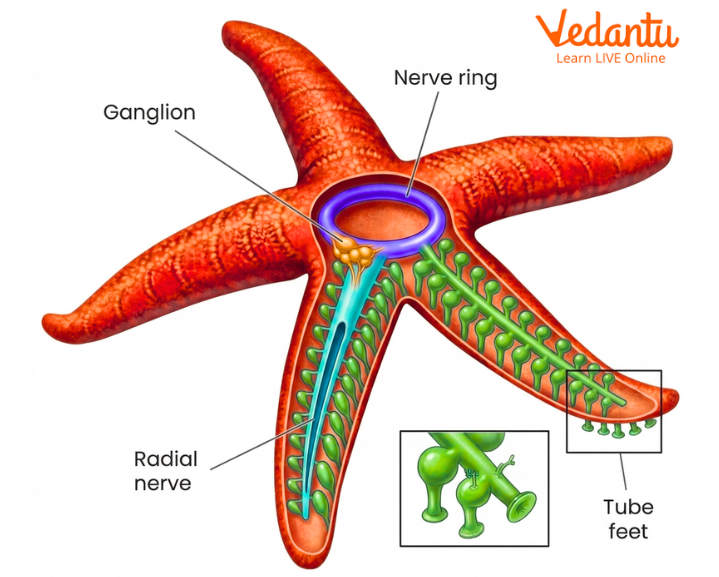
Nervous System
nerve ring around the mouth
radial nerves extending into each arm
nerve nets in the body wall
This arrangement helps coordinate locomotion and responses to stimuli.
Sense Organs
Starfish can detect:
touch
chemicals
light
temperature
water orientation
At the tips of the arms, there are eyespots that help detect light. Tube feet are also sensitive to chemicals, allowing the starfish to locate food.
Respiration and Circulation in Starfish
Gas exchange in starfish mainly occurs through:
papulae
tube feet
Oxygen diffuses into the body fluid, and carbon dioxide diffuses out.
The circulatory system is not highly advanced. It mainly helps transport nutrients within the body, while much internal transport is also supported by coelomic fluid and the water vascular system.
Starfish Regeneration
Starfish regeneration is one of the most famous biological properties of this animal.
What is Regeneration in Starfish?
Regeneration is the ability to regrow lost body parts such as arms. In some species, if one arm breaks off with part of the central disc attached, it can regenerate an entire new starfish.
Why Do Starfish Regenerate?
Regeneration serves several purposes:
recovery after injury
defense after arm loss
asexual reproduction in some species
How Does It Happen?
After loss of an arm, wound healing begins first. Then new tissues gradually grow from the cut surface. The process may take weeks to months depending on the size of the missing part and the species.
Important point for NEET
Some species can regenerate a whole individual from a single arm plus part of the disc. This is often described as a “comet form.”
Asexual Reproduction in Starfish
Although many starfish reproduce sexually, some can also reproduce asexually.
Methods of Asexual Reproduction
fission of the central disc
autotomy of arms followed by regeneration
fragmentation
In such cases, regeneration is not only a repair process but also a method of forming new individuals.
Sexual Reproduction and Life Cycle of Starfish
Most starfish reproduce sexually.
1. Gonads
Each arm usually contains gonads. Males and females are generally separate.
2. Fertilization
Fertilization is mostly external. Eggs and sperm are released into the surrounding seawater.
3. Larval Stages
Starfish development includes free-swimming larval forms such as:
bipinnaria larva
brachiolaria larva
These larvae are bilaterally symmetrical, unlike the radially symmetrical adult. During metamorphosis, the larva changes into the pentaradial juvenile starfish.
Important Biological Significance
This shows that echinoderms are secondarily radially symmetrical, while their ancestors had bilateral symmetry.
Types of Starfish
There are more than 1,900 species of starfish, and they are classified into several orders. For NEET, the idea of diversity is more important than memorizing every order, but knowing that different kinds exist is useful.
Brisingida
Forcipulatida
Notomyotida
Paxillosida
Spinulosida
Valvatida
Velatida
How Types Differ?
These types differ in:
shape of arms
presence or absence of pedicellariae
arrangement of tube feet
habitat depth
body covering
feeding style
Common Types of Starfish Students Should Know
1. Common Starfish
These are usually five-armed species found in shallow marine habitats.
2. Crown-of-thorns Starfish
This species is covered with long spines and feeds on coral polyps. It is ecologically significant because outbreaks can damage coral reefs.
3. Sunflower Starfish
These are many-armed starfish and are larger than common forms.
4. Deep-sea Starfish
Some have long slender arms adapted to life in deeper waters.
This approach is more useful for students than memorizing rare taxonomic details.
Habitat and Distribution of Starfish
Starfish are found in all the world’s oceans.
Where Do They Live?
tropical regions
temperate coasts
polar seas
intertidal zones
deep-sea floor
They are mostly benthic, which means they live on or near the seabed.
Why are They Absent in Fresh Water?
Their body fluids remain close to the salinity of seawater, so they cannot tolerate freshwater conditions well.
Ecological Importance of Starfish
Starfish are not just interesting animals; they are ecologically very important.
1. Predator Role
Many species feed on molluscs and prevent any one species from dominating the habitat.
2. Keystone Species
Some starfish, such as Pisaster ochraceus, are called keystone species because they maintain biodiversity by controlling mussel populations.
3. Coral Reef Impact
Some starfish, like the crown-of-thorns starfish, can damage coral reefs when their population increases excessively.
Thus, starfish can have both beneficial and harmful ecological effects depending on species and population size.
Starfish Defenses
Starfish protect themselves in several ways.
1. Spines
The body surface may bear spines that make predation difficult.
2. Pedicellariae
These small pincer-like structures help remove small organisms and may defend the surface.
3. Chemical Defenses
Some starfish possess unpleasant or toxic chemicals in their body wall that discourage predators.
4. Arm Shedding
Some species can shed an arm as a defense and later regenerate it.
Difference Between Starfish and Fish
This is useful for conceptual clarity.
So, despite the name, starfish are not fish.
Key Exam Points on Starfish
For quick revision, NEET aspirants should remember:
Starfish belong to class Asteroidea
They are marine echinoderms
Adults show pentaradial symmetry
Most have five arms, but some have more
Movement occurs by tube feet
Tube feet work through the water vascular system
Mouth is on the oral surface
Madreporite is on the aboral surface
Cardiac stomach can be everted
Regeneration is highly developed
Related Reading
Animal Kingdom Classification – For a comparative study of animal phyla including Echinodermata.
Echinodermata – Deep dive into the unique features and classification of starfish and relatives.
Vertebrates and Invertebrates – For understanding starfish’s place among invertebrates.
Morphology and Anatomy of Earthworm – Practice more labeled diagrams for NEET.
Protochordata – Compare and contrast with Echinodermata.
Important Diagrams for CBSE Class 8 – Build strong basics for labeling practice.
Structure of Animal Cell – For foundational understanding of biological diagrams.
FAQs on Starfish: Scientific Name, Classification, Diagram, Tube Feet, Regeneration, Types and Arm Structure
1. What is the scientific name of starfish?
The scientific group name of starfish is Asteroidea.
2. What is starfish classification?
Starfish belong to Kingdom Animalia, Phylum Echinodermata, Subphylum Asterozoa, and Class Asteroidea.
3. How many arms does a starfish have?
Most starfish have five arms, but some species may have many more.
4. What are starfish tube feet?
Starfish tube feet are small projections on the lower side of the arms used for locomotion, attachment, feeding, respiration, and sensing the surroundings.
5. What is starfish regeneration?
Starfish regeneration is the ability to regrow lost arms. In some species, an entire new starfish can develop from one arm with part of the central disc.
6. What are the types of starfish?
Starfish are grouped into several orders such as Brisingida, Forcipulatida, Paxillosida, Spinulosida, Valvatida, and Velatida.
7. What does a starfish diagram show?
A starfish diagram usually shows the central disc, arms, mouth, tube feet, madreporite, spines, and ambulacral grooves.
8. Why is starfish important in ecology?
Some starfish act as keystone predators and help maintain biodiversity in marine ecosystems.
