



Class 9 English Kaveri Chapter 7 Words Solutions
Reflect and Respond (Pages 220-221)
I. Why are words important? Can we communicate without words? How? Share your answers with your classmates and teacher.
Answer: Words are essential because they allow us to communicate our thoughts, feelings, ideas, and experiences. They can express affection, offer comfort, and make others feel valued. However, communication is also possible without words through facial expressions, gestures, body language, actions, and tone. A smile, hug, or caring expression can communicate affection and support without speaking.
II. Use the given sentences as clues to find words from the grid and fill the blanks. One example has been done for you.
My mother summoned me to introduce her friends.
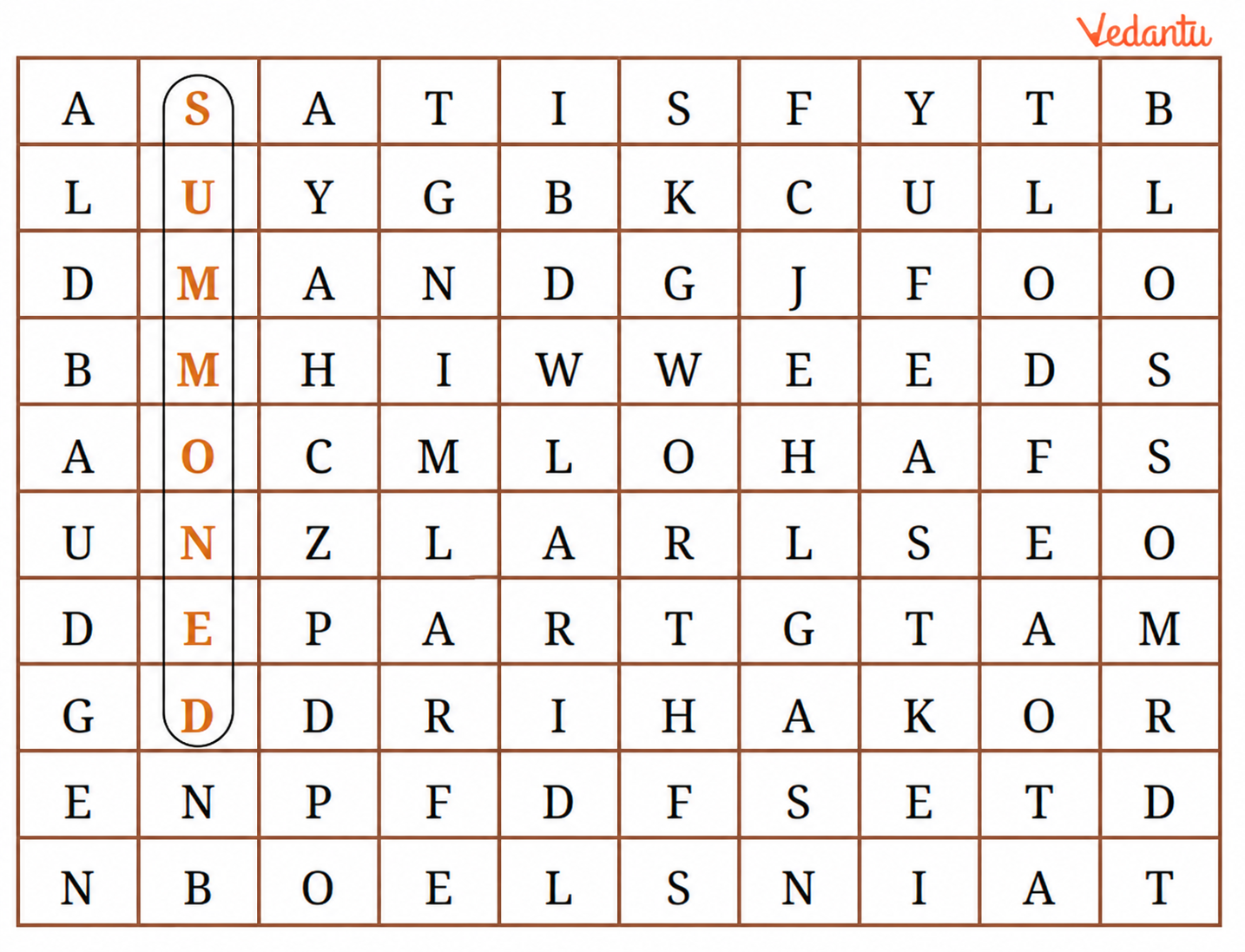
Answer:
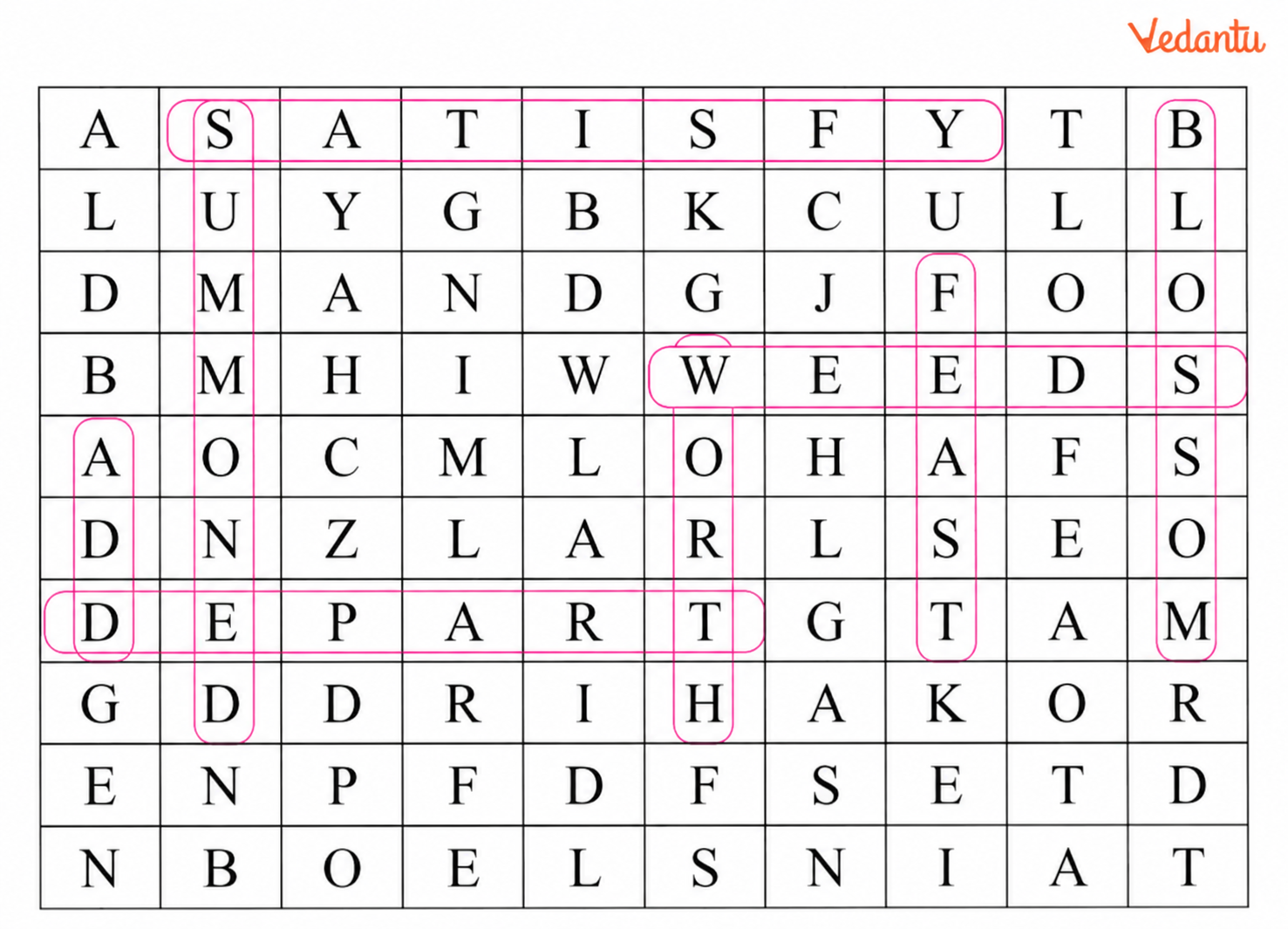
Note: In our opinion, there appears to be a misprint in the crossword because the answer to question 5 should be “add”, but the word does not appear in the given grid.
Check Your Understanding (Pages 222-224)
I. Fill in the blanks with one word from the poem. One example has been done for you.
In this poem, the poet reflects that words fail to truly satisfy what the heart wants to convey. Words are compared to summer birds who 1. ________ , leaving nothing behind. The heart, is equated to a 2 . ________ who finds that words are as worthless as 3. ________ when needed. He feels that a few sincere words can bring more 4. ________ than many meaningless ones. He adds that a voice that brings happiness to a 5. ________ place does not say much but the few words it does, are very precious. Moreover, if words could satisfy us, the 6 . ________ would celebrate but words often fail to do that. The poem ends on the note that empty words may look impressive with lots of flowers, but they cannot produce anything valuable, like a 7 . ________ .
Answer:
depart
pilgrim
weeds
joy
lonely
world
fruit
II. Let us appreciate the poem.
1. Read the poem again. Find any four sets of rhyming words and also write the rhyme scheme of the poem.
Answer:
Four pairs of rhyming words from the poem are:
heart – depart
earth – worth
said – head
way – say
The poem follows an ABAB rhyme scheme, giving the verses a regular and pleasing rhythm.
2. Read the following phrases and sentences taken from the poem. Identify the poetic device in each of them and explain what the poet wants to communicate through their usage.
(i) But words, like summer birds, depart…
(ii) heart, a pilgrim upon earth…
(iii) words are of as little worth As just so many weeds
(iv) If words could satisfy the chest … Oft satisfy the least!
(v) The world might hold a feast…
(vi) Like plants that make a gaudy show All blossom to the root
(vii) But whose poor nature cannot grow One particle of fruit!
Answer: The poet uses several poetic devices to highlight the difference between empty speech and words that carry genuine feelings.
(i) Simile – Words are compared to summer birds to suggest that they can disappear quickly without leaving anything behind.
(ii) Metaphor – The heart is described as a pilgrim, suggesting that it is constantly travelling through life in search of emotional fulfilment.
(iii) Simile – Words are compared to weeds to show that words without sincerity may have very little value.
(iv) Irony – The poet presents the expectation that words should satisfy the heart, while pointing out that they often fail to do so.
(v) Hyperbole – The poet uses exaggeration to imagine a great celebration if words could truly fulfil the needs of the heart.
(vi) Simile and Imagery – Empty words are compared to attractive plants that produce a colourful display, creating an image of beauty without real value.
(vii) Metaphor – The fruitless plants represent words that may appear impressive but fail to produce anything meaningful.
3. Which words are repeated in the poem? Why does the poet use repetition?
Answer: The words “words” and “heart” occur repeatedly in the poem. This repetition keeps the central theme in focus and highlights the relationship between spoken language and genuine feelings. It also reinforces the idea that words have value only when they connect with the heart.
4. The stanzas 4, 5, and 6 end with exclamation marks. Choose the option that displays the emotions being expressed through them.
(i) 4. disillusionment
5. admiration and
6. frustration
(ii) 4. frustration
5. admiration and
6. disillusionment
(iii) 4. admiration
5. frustration and
6. disillusionment
(iv) 4. frustration
5. disillusionment and
6. admiration
Answer:
(iii) 4. admiration
5. frustration and
6. disillusionment
III. Identify examples of hyperbole from the given lines.
If words could satisfy the chest,
The world might hold a feast.
Answer: The idea that words could satisfy the “chest” is an exaggeration used to express the depth of human emotional needs. Similarly, the image of the whole world holding a feast if words could satisfy us is an exaggerated idea. These expressions emphasise how difficult it is for ordinary words to fulfil deep emotional desires.
Work in pairs. Complete the sentences given below with hyperboles. Use the hints given in the brackets.
1. I have ________ things to do on this weekend. (lots of/tonnes of)
Answer: I have tonnes of things to do this weekend.
2. The player missed the basket by ________ . (a mile / an inch)
Answer: The player missed the basket by a mile.
3. My mother is so tired that she can sleep for a ________ . (night / decade)
Answer: My mother is so tired that she can sleep for a decade.
4. I will be back in ________ . (five minutes / two seconds)
Answer: I will be back in two seconds.
IV. Rhythm gives a lyrical quality to a poem. The rhythm (pattern of beats) in a line of poetry is described by a metrical form. A metre is formed by a stressed and an unstressed syllable. Syllable is the name given to a single unit of speech/beats of spoken language.
The metrical form in the first four lines is given below. The stressed syllables have been underlined.
If words could sa tis fy the heart,
The heart might find less care;
But words, like sum mer birds, de part.
And leave but emp ty air:
Now, listen to the teacher read the poem. As you listen, underline the syllables that are stressed in all the lines of the poem. Share your answers with the teacher.
Answer:
The heart, a pil grim up on earth,
Finds of ten, when it needs,
That words are of as lit tle worth
As just so ma ny weeds.
A lit tle said, and tru ly said,
Can dee per joy im part
Than hosts of words, which reach the head,
But ne ver touch the heart.
The voice that wins its sun ny way,
A lone ly home to cheer,
Hath oft the few est words to say;
But, oh! those few how dear!
If words could sa tis fy the chest,
The world might hold a feast;
But words, when sum moned to the test,
Oft sa tis fy the least!
Like plants that make a gau dy show,
All blos som to the root;
But whose poor na ture can not grow,
One par ticle of fruit!
Critical Reflection (Pages 224-225)
I. Read the following lines and answer the questions.
1. The heart, a pilgrim upon earth, Finds often, when it needs,
That words are of as little worth As just so many weeds.
(i) Why has the poet referred to the heart as ‘a pilgrim’?
Answer: The poet calls the heart a “pilgrim” because it is constantly moving through the journey of life in search of love, understanding, comfort, and emotional fulfilment. Like a pilgrim travelling towards a destination, the heart keeps searching for what it truly needs.
(ii) When would a heart ‘need’ words?
Answer: A heart may need words during moments of sadness, loneliness, pain, or emotional difficulty. At such times, sincere words can provide comfort, reassurance, understanding, and hope. They can also help people share feelings that are difficult to express otherwise.
(iii) Complete the sentence with an appropriate reason.
The words are like weeds because
Answer: they may appear in abundance but often have little value when they lack sincerity and genuine feeling. Like weeds, meaningless words can grow easily but do not provide the emotional nourishment that the heart seeks.
(iv) Mention two emotions the heart might be experiencing when it finds words to be of ‘little worth’.
Answer: The heart may experience sadness and disappointment when words seem unable to express or understand its deepest feelings. It may feel unheard or emotionally unsatisfied despite receiving many words.
(v) What do these lines suggest about the nature of communication?
Answer: These lines suggest that meaningful communication requires more than simply speaking words. Genuine feelings, sincerity, empathy, tone, and actions also play an important role. Words become meaningful when they truly connect with another person’s emotions.
2. If words could satisfy the chest,
The world might hold a feast;
But words, when summoned to the test,
Oft satisfy the least!
(i) How can words ‘satisfy the chest’?
Answer: Words can “satisfy the chest” when they sincerely express emotions and provide the comfort, understanding, or encouragement that the heart needs.
(ii) How can words be ‘summoned to the test’?
Answer: Words are “summoned to the test” when they are required to prove their value in situations where genuine support, comfort, or emotional expression is needed.
(iii) What does ‘the world’ holding ‘a feast’ imply?
Answer: It suggests a situation of great happiness and celebration. The poet imagines that the whole world would rejoice if words were truly capable of satisfying every emotional need.
(iv) Complete the sentence with an appropriate reason.
The poet mentions that words satisfy the least because ________ .
Answer: they often cannot fully express or fulfil the deeper emotions and needs of the human heart.
(v) Select the word that does not mean the same as ‘oft’.
A. always
B. usually
C. frequently
D. often
Answer: A. always
II. Answer the following questions.
Question 1. What is the comparison that the poet draws between words and ’empty air’?
Answer: The poet compares words without genuine feeling to “empty air” because they may disappear without leaving any meaningful effect. Such words lack substance and fail to provide emotional value.
Question 2. According to the poet, meaningful words are more precious than a lot of them. Explain.
Answer: A few sincere words can have a stronger emotional impact than a long speech filled with empty expressions. Meaningful words reach beyond the mind and touch the heart, making them more valuable than a large number of insincere words.
Question 3. Do you agree that the poet presents contrasting ideas related to ‘words’ in the poem? If yes, why? If no, why not?
Answer: Yes, the poet presents contrasting ideas about “words.” He shows that many words can be empty and ineffective, while a few sincere and heartfelt words can bring comfort, joy, and emotional connection.
Question 4. The theme of loneliness hovers over the poem. Support this statement with examples from the text.
Answer: The theme of loneliness appears in the line “A lonely home to cheer.” It suggests a person or place that needs warmth and companionship. The poem also reflects the emotional need for sincere words when the heart feels alone or unsupported.
Question 5. How does the poet convey the superficial nature of words? What ought to be done to address this?
Answer: The poet presents the superficial nature of words by comparing them with weeds and attractive plants that produce no fruit. These images suggest that words may look impressive but remain meaningless when they lack sincerity. We should therefore speak thoughtfully, honestly, and with genuine feeling rather than using unnecessary or empty words.
Vocabulary in Context (Pages 226-227)
I. The poet has used some figurative phrases. Match the phrases in Column 1 with their correct meanings in Column 2. Use each phrase in a sentence of your own.
Answer:
II. Create a ‘Word Map’ for each of the words from the poem given in the box.

To complete the word map include:
Meaning (in your own words)
Synonyms of the word
Antonyms of the word
Sentence using the word
A quick sketch or symbol that represents the word
One example has been done for you.

Word: cheer
Meaning: to give a loud shout of approval or encouragement
Synonym: comfort
Antonym: sadden
Sentence: The audience cheered her for great performance.
Sketch: Picture of sunshine, sunflower, or a smiling face.
Answer:
1. Word: depart
Meaning: to leave or go away
Synonym: leave
Antonym: arrive
Sentence: The birds depart before the arrival of winter.
Sketch: A flying bird, a person waving goodbye, or a setting sun.

2. Word: pilgrim
Meaning: a person who travels on a religious or spiritual journey
Synonym: devotee, traveller
Antonym: inhabitant, native
Sentence: The pilgrim travelled a long distance to reach the holy place.
Sketch: A traveller walking with a small bag or carrying a walking stick.

3. Word: Cheer
Meaning: a feeling of happiness or a joyful expression of approval
Synonym: joy, delight, applause
Antonym: sadness, gloom, silence
Sentence: The crowd erupted in cheer when the team won the match.
Sketch: A smiling face or a group of people celebrating.

4. Word: word
Meaning: a unit of language used to communicate an idea or thought
Synonym: expression, speech
Antonym: silence
Sentence: A kind word can make someone feel better.
Sketch: An open book or a speech bubble containing “Hello”.

5. Word: sunny
Meaning: bright, cheerful, and full of happiness
Synonym: cheerful, bright
Antonym: gloomy, dull
Sentence: Her sunny nature made everyone feel comfortable.
Sketch: A bright sun, clear sky, or smiling face.

6. Word: satisfy
Meaning: to fulfil a need, desire, or expectation
Synonym: fulfil, please
Antonym: disappoint
Sentence: Sincere words can satisfy the heart.
Sketch: A peaceful smiling face or a thumbs-up symbol.

7. Word: heart
Meaning: the centre of a person’s feelings and emotions
Synonym: spirit, emotions
Antonym: heartlessness
Sentence: Her kind words touched my heart.
Sketch: A simple heart symbol.

Listen and Respond (Page 227)
I. You will listen to a conversation between a girl and a boy. As you listen, mark four statements from 1-6 that are true. (Transcript for teacher on page 273)
1. The girl was excited to participate in the declamation contest.
Answer:
True.
The girl says she was among the first students to register for the contest, which shows her enthusiasm for participating.
2. The boy was doubtful about the suitability of the topic chosen for the contest.
Answer:
True.
The boy questions whether the selected topic would make an engaging speech, showing that he is uncertain about its suitability.
3. The girl explained that people prefer to keep their personal experiences to themselves.
Answer:
False.
The girl explains that people generally share their experiences rather than keeping them completely to themselves.
4. The boy was unaware of the role played by body language in reflecting the speaker’s confidence.
Answer:
True.
The boy asks about body language when the girl mentions it, indicating that he was not previously aware of its importance.
5. According to the girl, body language had an insignificant role to play in communication.
Answer:
False.
The girl explains that body language is an important part of communication and can reveal a speaker’s confidence and feelings.
6. The girl had issued the book on body language earlier from the library.
Answer:
True.
The girl is familiar with books on body language and explains how to find and issue one from the library, suggesting she has used the resource before.
Speaking Activity (Pages 227-228)
I. Read the following quotations and select the one you like the most. Explain the quotation and share the reason for your choice with your classmates and teacher. You may talk about a connected personal experience too.
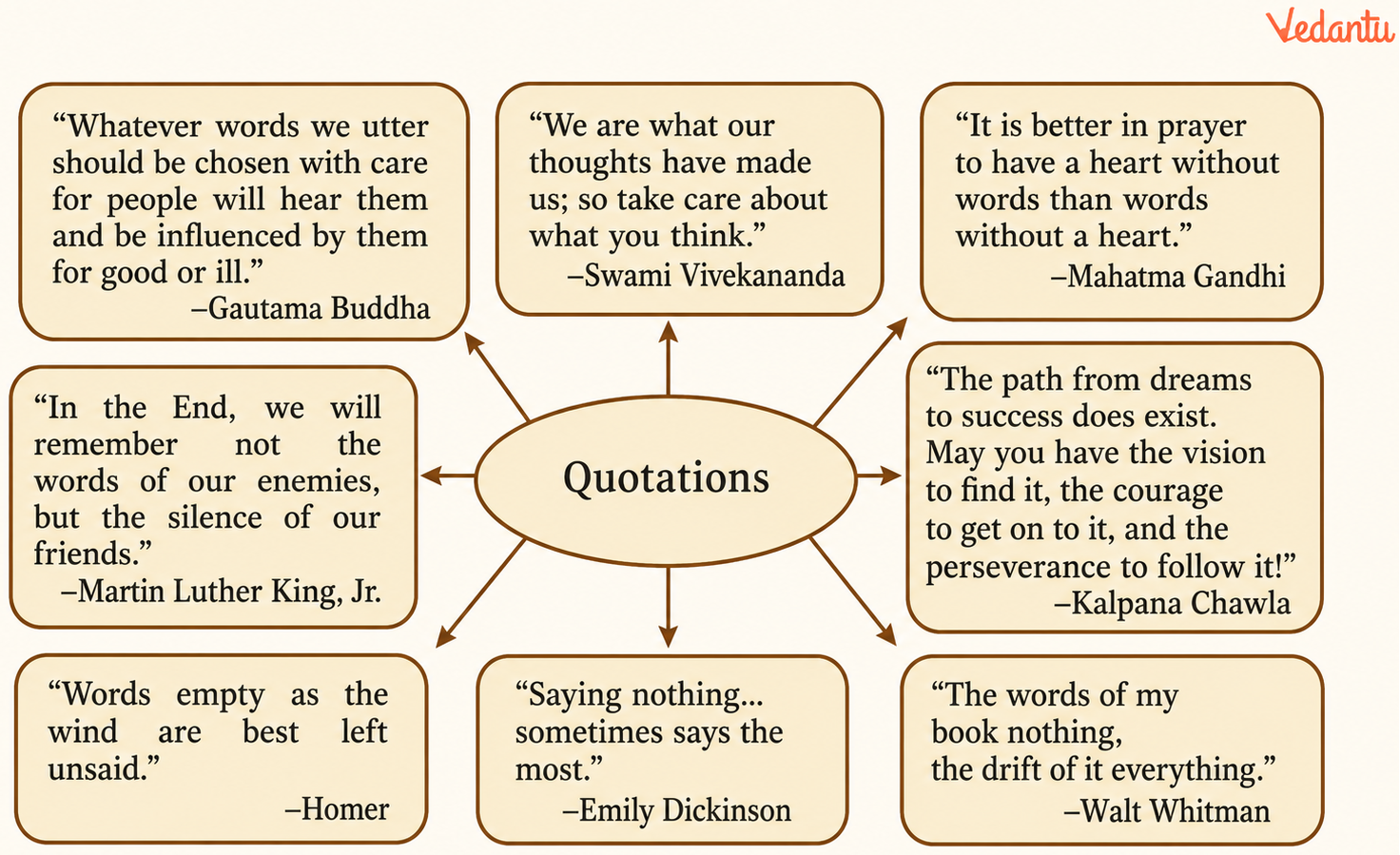
You may use the cues given below to state your choice and the reason.
I chose ________ because…
I selected ________ since…
I decided on ________ due to…
I picked ________ as…
I settled for ________ because…
Answer: The following are sample explanations for all the quotations. Students can select any one according to their preference.
1. “Whatever words we utter should be chosen with care for people will hear them and be influenced by them for good or ill.”
I chose the quotation by Gautama Buddha because it reminds us that our words can have a strong effect on others. Kind and thoughtful speech can encourage people, whereas harsh or careless words can cause pain. The quotation teaches us to think before speaking and consider how our words may affect others. Even a simple word of encouragement can make someone feel supported.
2. “We are what our thoughts have made us; so take care about what you think.”
I selected the quotation by Swami Vivekananda since it explains how our thoughts influence our character and actions. Positive thoughts can encourage confidence, kindness, and determination, while negative thinking can hold us back. The quotation inspires us to develop constructive thoughts because our mindset influences how we respond to situations and challenges.
3. “It is better in prayer to have a heart without words than words without a heart.”
I decided on the quotation by Mahatma Gandhi because it highlights the importance of sincerity. It suggests that genuine feelings are more valuable than a large number of words spoken without emotion. Whether in prayer or everyday communication, honesty and heartfelt feeling give words their real meaning.
4. “In the End, we will remember not the words of our enemies, but the silence of our friends.”
I picked the quotation by Martin Luther King, Jr. because it highlights the importance of friendship and support. The silence of someone we trust can be especially painful when we need their encouragement. The quotation reminds us that true friends should stand beside one another during difficult moments and show courage, care, and loyalty.
5. “The path from dreams to success does exist. May you have the vision to find it, the courage to get on to it, and the perseverance to follow it.”
I settled for the quotation by Kalpana Chawla because it encourages us to pursue our dreams with determination. Having a clear goal is only the beginning; we also need courage to take action and perseverance to continue despite difficulties. The quotation teaches us that consistent effort and patience can help turn dreams into achievements.
6. “Words empty as the wind are best left unsaid.”
I chose the quotation by Homer because it teaches us that meaningless words have little value. Speaking simply for the sake of speaking can create confusion or hurt others. Sometimes silence is wiser than using words that lack sincerity or purpose. The quotation encourages us to make our speech meaningful.
7. “Saying nothing… sometimes says the most.”
I selected the quotation by Emily Dickinson since it shows that silence can also communicate powerful emotions. At times, remaining quietly beside someone can express sympathy, respect, or understanding more effectively than a long conversation. It reminds us that communication does not always require spoken words.
8. “The words of my book nothing, the drift of it everything.”
I decided on the quotation by Walt Whitman because it focuses on the importance of the overall meaning of a written work. Individual words are simply tools for conveying ideas, while the deeper message is what stays with the reader. The quotation teaches us to look beyond the surface and understand the central thought of what we read.
Writing Task (Pages 228-229)
Essay writing is the process of expressing ideas, arguments, or information in a structured piece of writing. It is one of the most common forms of academic writing and helps students organise their thoughts clearly.
I. Write an essay on any one quotation from speaking activity. Follow the guidelines given below while drafting the essay.
Answer: The following are sample essays on all the quotations. Students may select any one for the activity.
1. Gautama Buddha once said, “Whatever words we utter should be chosen with care for people will hear them and be influenced by them for good or ill.”
This quotation appealed to me because it highlights the influence our words can have on other people. Speech is an important part of everyday communication, so it should be used thoughtfully. A kind sentence can encourage someone who is struggling, while an insensitive remark can hurt a person deeply.
Careful speech also helps build trust and healthy relationships. When people communicate with honesty and respect, misunderstandings can be reduced, and others feel valued. In schools, homes, and friendships, thoughtful words can create a positive environment.
Although people may sometimes speak without thinking, taking a moment to consider our words can prevent unnecessary hurt. Therefore, Buddha’s message reminds us that speech carries responsibility. We should choose words that encourage, respect, and positively influence those around us.
2. Swami Vivekananda said, “We are what our thoughts have made us; so take care about what you think.”
This quotation appealed to me because it explains the powerful connection between our thoughts and our actions. The way we think can influence our attitude, behaviour, decisions, and relationships.
Positive thoughts can give us confidence when facing challenges. A student who believes that improvement is possible is more likely to keep practising after making mistakes. Similarly, thoughtful and positive thinking can help us treat others with patience and understanding.
It is true that circumstances also affect our lives, but our response to those circumstances depends greatly on our mindset. Therefore, we should try to develop constructive thoughts and avoid unnecessary negativity. Vivekananda’s words teach us that a healthy mind can guide us towards better choices and a more purposeful life.
3. Mahatma Gandhi once said, “It is better in prayer to have a heart without words than words without a heart.”
This quotation appealed to me because it shows that sincerity matters more than how many words we speak. Words have real value when they express genuine emotions and intentions.
In prayer, sincere feeling can matter more than a long prayer spoken without devotion. The same principle applies to everyday relationships. A few heartfelt words from a friend can provide more comfort than a lengthy speech that lacks genuine concern.
Some people may believe that words are always necessary to express feelings, but words without sincerity cannot create a strong emotional connection. Therefore, Gandhi’s quotation reminds us that honesty and genuine feeling should be at the centre of our communication.
4. Martin Luther King, Jr. once said, “In the End, we will remember not the words of our enemies, but the silence of our friends.”
This quotation appealed to me because it highlights the importance of standing by people we care about. An enemy's words may hurt, but a trusted friend's silence in a difficult situation can cause a deeper sense of disappointment.
Friendship involves support, understanding, and loyalty. Even when a friend cannot solve a problem, simply listening or standing beside someone can provide great comfort. Such small acts can strengthen relationships and build trust.
Friends may not always be able to help in every situation, but showing concern is still important. Therefore, the quotation teaches us that genuine friendship is shown not only through words but also through support and presence when it's needed most.
5. Kalpana Chawla said, “The path from dreams to success does exist. May you have the vision to find it, the courage to get on to it, and the perseverance to follow it.”
This quotation appealed to me because it encourages people to pursue their dreams with courage and determination. A dream becomes achievable when it is supported by a clear goal, consistent effort, and the willingness to face difficulties.
Vision gives us a sense of direction, while courage helps us take the first step. Perseverance is equally important because success may require repeated effort and patience. Kalpana Chawla’s own journey demonstrates the importance of dedication and determination in pursuing ambitious goals.
Although luck can sometimes influence opportunities, lasting success generally requires preparation and hard work. Thus, this quotation inspires students to believe in their abilities, face challenges confidently, and continue working towards their dreams.
6. Homer said, “Words empty as the wind are best left unsaid.”
This quotation appealed to me because it stresses the value of meaningful communication. Words that lack purpose or sincerity may fail to communicate anything useful and can sometimes create misunderstanding.
There are situations in which silence is better than speaking without thinking. Thoughtful communication helps people understand one another and prevents unnecessary conflict. Meaningful words also strengthen relationships because they show honesty and consideration.
Some may feel that speaking freely is always harmless, but careless words can have lasting effects. Therefore, Homer’s message encourages us to speak with purpose and sincerity and to remain silent when our words have no meaningful contribution.
7. Emily Dickinson once said, “Saying nothing… sometimes says the most.”
This quotation appealed to me because it demonstrates that silence can communicate powerful emotions. People do not always need words to show sympathy, love, respect, or understanding.
For example, sitting quietly beside someone who is upset can provide comfort without requiring a long conversation. Silence can also give people time to think and understand their emotions. In some situations, speaking unnecessarily can make matters more difficult.
Although silence can sometimes be misunderstood, it can be meaningful when used thoughtfully. Dickinson’s quotation therefore reminds us that communication is not limited to speech. Sometimes, quiet presence and understanding can express more than words.
8. Walt Whitman said, “The words of my book nothing, the drift of it everything.”
This quotation appealed to me because it suggests that the central meaning of a written work matters more than the individual words used. Words are tools through which writers communicate their thoughts and ideas.
A simple story can leave a powerful message, while complicated language may have little impact if it lacks meaning. Readers should therefore try to understand the main idea and purpose of a text rather than focusing only on its vocabulary or style.
While good writing requires effective language, the message ultimately gives a work its value. Whitman’s quotation teaches us to look beyond individual words and appreciate the deeper meaning of what we read.
Learning Beyond the Text (Pages 229-230)
I. In groups of six, follow the instructions to play the ‘Non-verbal’ game.
Each student writes or makes an emoji with an expression on one slip and a gesture on the other.
Jumble the slips and keep them upside down.
Pick the slips in turns and enact it in 30 seconds.
The person who can identify the expression or gesture first, gets 10 points.
Continue it for two rounds and find the Nonverbal Champion.
For example, an expression to denote tired could be:
and a gesture to denote united could be:
This game is similar to Dumb Charades, in which participants communicate words, phrases, or ideas through actions and gestures instead of speaking. One person performs the action while the others try to identify what is being conveyed.
II. Do you know?
The French priest Charles-Michel de l’Épée (1712-89) is recognised as ‘The Father of Sign Language and Deaf Education’.
III. You must have read poems and songs in English and in your own language. Now, read and enjoy the poem given below.
Weigh Your Words
If we would “weigh” the words we say,
And speak but those we mean,
We’d save a lot of talk each day,
And keep our conscience clean.
The idle words we often speak,
And promises we make,
If given credence by the weak,
May cause some heart to ache.
We never know the pain and sting
An idle word may start;
We never can erase one thing,
We’ve written on a heart.
‘Tis best to “weigh” each sentence well,
And as I’ve said before,
Tho “we’d not have so much to tell, ‘
Twould mean a whole lot more.
-E.F. Hayward
Answer: Students can read and enjoy the poem as directed and discuss its central idea with their classmates and teacher. The poem reinforces the importance of choosing our words carefully because careless speech can hurt others, while thoughtful and sincere words have greater value.
Key Takeaways fromVedantu’s Class 9 English Kaveri Chapter 7 Words
Class 9 English Kaveri Chapter 7 question answers cover the poem Words, including its exercises, poetic devices, vocabulary, and interpretations. These Class 9 English Kaveri Chapter 7 Solutions help students understand the importance of sincere and meaningful communication.
The Class 9 Kaveri Poem 7 Words question-answer section also helps with revision of discussions, writing tasks, and other chapter-based activities.
Related Study Materials for Class 9 English Chapter 7 Words (Poem)
Class 9 English Chapter-wise Solutions For Prose & Poem
Important Study Materials for Class 9 English
FAQs on NCERT Solutions for Class 9 English Kaveri Chapter 7 Words (Poem) 2026-27
1. What does the poet mean by saying that words are “of as little worth as just so many weeds”?
The poet means that words without sincerity or genuine feeling may be plentiful but have little value, just like weeds that do not produce anything useful.
2. What does the poem “Words” teach Class 9 students about communication?
It teaches that effective communication is not about using many words. Sincerity, emotion, tone, and understanding make communication meaningful.
3. What is the importance of the heart in Class 9 English Kaveri Poem Chapter 7?
The heart represents human emotions and inner feelings. The poet suggests that words become valuable when they reach and connect with the heart.
4. Why are words compared to weeds in the poem?
Words are compared to weeds when they are empty or meaningless. Like weeds, such words may exist in large numbers but offer little real value.
5. Which poetic devices are important in Class 9 English Kaveri Chapter 7 Words?
Students should focus on devices such as simile, metaphor, irony, hyperbole, and imagery. The poem uses them to strengthen its message about meaningful communication.
6. What does “hosts of words” mean in the poem?
“Hosts of words” refers to a large number of words. The poet contrasts these many words with a few sincere expressions that can touch the heart.
7. How can students prepare the Class 9 English Chapter 7 question answer section?
Students can first understand the poem's central idea, then revise the textbook questions under Reflect and Respond, Check Your Understanding, Critical Reflection, and other activities.
8. Does Class 9 Kaveri Poem 7 Words question answer cover only the poem-based questions?
No. The chapter exercises also include vocabulary, poetic appreciation, listening, speaking, writing, rhythm, and activities connected with non-verbal communication.
9. What can students learn from the “Words” poem beyond the English subject?
The poem encourages students to think before speaking and understand how their words may affect others. This makes its message useful in everyday conversations and relationships.
10. Why should students practise the Class 9 English Kaveri Chapter 7 Solutions before exams?
Practising the solutions helps students recall the poem’s central ideas, literary devices, meanings, and expected approaches to textbook questions without relying only on memorisation.
11. How does Chapter 7 “Words” connect with the other Class 9 Kaveri poems?
Like the other poems in the book, “Words” uses a simple poetic situation to explore a deeper human idea. Here, it focuses on sincerity, emotions, and the limits of language.
12. Is Class 9 English Chapter 7 Words useful for writing and speaking practice?
Yes. The chapter includes speaking and essay-writing activities based on quotations about words, thoughts, silence, communication, and meaningful expression.
13. What should students revise along with Words Class 9 English Kaveri question answers?
Along with the question answers, students should revise the poem’s theme, rhyme scheme, poetic devices, vocabulary, important expressions, and the activities given in the chapter.
14. How does the poem explain the difference between many words and meaningful words?
The poet suggests that many words may fail to satisfy the heart, whereas a few honest, heartfelt words can bring deeper joy and comfort.
15. Where can students find solutions for the other chapters of Class 9 English Kaveri?
Students can use the chapter-wise NCERT Solutions Class 9 English section from Vedantu to access solutions for other prose and poems in the Kaveri textbook.
