



Class 9 English Chapter 4 I Cannot Remember My Mother Question Answers
Reflect and Respond
I. Work in pairs. Discuss the memories from your childhood that you remember. List them and share with your classmates and teacher.
Answer: Some memorable experiences from my childhood include listening to bedtime stories from my parents, spending time playing with friends, celebrating festivals with my family, and receiving comfort from my mother whenever I felt scared or upset. These memories bring feelings of happiness, care, and security. Sharing such experiences helps us understand how childhood moments influence our emotions and shape our personality.
II. Discuss how children’s relationship with their mother can influence their emotions and memories.
Answer: A child’s bond with the mother is very important for emotional growth. A mother provides love, care, comfort, and a sense of security, helping the child develop trust and confidence. The experiences shared with a mother often stay with the child throughout life and influence their understanding of relationships, emotions, and feelings. Even if specific memories become unclear over time, the emotional connection and impact remain strong.
III. Match the words given in Column 1 with their meanings in Column 2.
Answer
Check Your Understanding
I. Fill in the blanks with appropriate words.
Stanza 1
The poet remembers his mother while he ____________.
The poet remembers the ____________ but not the ____________. Setting: ____________ (outdoor/indoor)
Answer
The poet remembers his mother while he is playing.
The poet remembers the tune but not the song (lullaby); Setting: indoor
Stanza 2
The poet remembers his mother in the ____________ season.
The poet remembers his mother by the smell of ____________. Setting: ____________ (outdoor/indoor)
Answer
The poet remembers his mother in the early autumn season.
The poet remembers his mother by the smell of shiuli flowers. Setting: outdoor (outdoor/indoor)
Stanza 3
The poet feels that his mother ____________ at him from the ____________. Setting: ____________ (outdoor/indoor)
Answer
The poet feels that his mother is gazing at him from the sky. Setting: outdoor (outdoor/indoor)
II. The senses of olfactory (smell), auditory (hearing), and visual (sight), are three of the five basic senses in humans. Give examples of references to senses from the poem. Complete the table given below.
Note: We believe there may be a typographical error in the textbook. The line “…the tune of some song…” appears in stanza 1, not stanza 3 as indicated in the NCERT textbook.
Answer
III. Read the poem silently once again and complete the following.
1. Two examples of alliteration from the poem are
(i) __________ and (ii) ___________.
Answer
(i) some song,
(ii) smell of the shiuli flowers
2. An example of onomatopoeia is ________________.
Answer: Hum
3. The poem uses imagery extensively. Explain.
Answer: The poem uses vivid imagery connected with the senses of sound, smell, and sight. The mother’s lullaby creates auditory imagery, the scent of shiuli flowers creates olfactory imagery, and the wide blue sky creates visual imagery. These sensory images make the poem more expressive and help readers understand the poet’s deep emotional bond with his mother.
4. Although the poem does not have a rhyme scheme, it is enjoyable because ______________.
Answer: The poem has a smooth and natural rhythm created through repetition, simple words, and vivid imagery. Even without a regular rhyme scheme, the steady flow of emotions and thoughts makes the poem pleasant and engaging to read.
5. What is the tone of the poet? Why do you say so?
Answer: The poet’s tone is nostalgic, gentle, and affectionate. He remembers his mother with warmth and a sense of quiet longing. Instead of expressing deep sorrow, the poet uses soft sensory images to show his love and emotional connection with her.
6. What impact does the title of the poem have on the overall mood of the poem?
Answer: The title initially suggests a sense of loss and sadness. As the poem develops, this feeling is balanced by the warm memories of the mother’s presence. This contrast makes the poem more emotional and strengthens its message about lasting love and remembrance.
7. The poet uses ‘I cannot remember my mother’ as a refrain because __________________.
Answer: It highlights how physical memories may fade with time, while the poet’s emotional bond with his mother remains strong and lasting.
8. The poet uses symbolism to indicate the memory of his mother’s presence. Identify the symbols used in the poem.
Answer: The poem uses several symbols to express deeper emotions and ideas:
The humming tune symbolises a mother’s care, comfort, and affection.
Shiuli flowers symbolise purity, devotion, and a sense of spiritual warmth.
The sky symbolises the mother’s vast, lasting, and protective love.
Symbolism is a literary device in which an object, idea, or image represents a meaning beyond its literal sense. It helps the poet communicate deeper emotions and connect with readers more effectively.
Refrain is a poetic device in which a line or group of lines is repeated at regular intervals in a poem.
Onomatopoeia is a literary device in which a word imitates or resembles the sound it describes, helping readers imagine the sound more clearly.
Critical Reflection
I. Read the extracts given below and answer the questions that follow.
1. I cannot remember my mother only sometimes in the midst of my play a tune seems to hover over my playthings,
(i) Complete the following sentence appropriately. The poet is reminded of his mother during his ________________.
Answer: Playtime
(ii) What is the primary emotion conveyed by the line ‘a tune seems to hover over my playthings’?
A. It enhances the joy of play.
B. It disrupts the playtime atmosphere.
C. It activates memories of the mother.
D. It symbolises the carefree nature of childhood.
Answer: C. It activates memories of the mother.
(iii) In the context of the poem, what role does the hovering tune play during the speaker’s playtime?
Answer: The hovering tune connects the poet’s present with memories of the past. As he hears it, he is reminded of his mother’s love, care, and the comfort he experienced during childhood.
(iv) State whether the following sentence is true or false.
The poet experiences the tune lingering over playthings only occasionally during playtime.
Answer: True. Reason: The lines in the poem clearly support this statement.
(v) How could the poet feel his mother’s presence, even though she isn’t there?
Answer: The poet senses his mother’s presence through memories linked to the senses, especially the lullaby she once hummed. The tune comes back to him naturally while he is playing, bringing back memories of her love and care.
2. I feel that the stillness of
my mother’s gaze on my face
has spread all over the sky.
(i) What does the poet suggest about the stillness of his mother's gaze spreading over the sky?
A. The mother’s gaze is physically present in the sky.
B. The sky is a symbolic extension of the mother’s presence.
C. The sky mirrors the mother’s emotions.
D. The stillness is fleeting and unrelated to the mother.
Answer: B. The sky is a symbolic extension of the mother’s presence.
(ii) What emotion does the poet associate with the ‘stillness’ of his mother’s gaze?
A. a sense of grief
B. a sense of anticipation
C. a sense of nostalgia
D. a sense of serenity
Answer: D. a sense of serenity
(iii) State whether the following sentence is true or false.
The poet suggests that the mother’s gaze has a tangible and visual effect on the sky.
Answer: False. Reason: The mother’s gaze does not physically or visibly affect the sky; rather, the child feels and imagines its presence emotionally.
(iv) What is the purpose of likening the mother’s gaze to the sky?
Answer: By comparing his mother’s gaze to the sky, the poet highlights its vast, peaceful, and everlasting nature, suggesting that her love continues to surround and protect him.
(v) Complete the sentence appropriately.
The tone of the poet in the given extract is _____________ because _____________.
Answer: peaceful and reflective; he associates his mother’s memory with calmness and emotional comfort rather than sorrow.
II. Answer the following questions.
1. What is the emotional impact of the refrain, ‘I cannot remember my mother’?
Answer: The refrain expresses a feeling of loss while also showing how strong emotional memories can be. It suggests that even when clear memories fade over time, the bond of love and affection continues to remain strong.
2. Interpret the connection between the poet’s mother and the following:
(i) shiuli flowers (ii) humming tune
Answer:
(i) Shiuli flowers symbolise purity, devotion, and spiritual warmth, reflecting the gentle and caring nature of the mother.
(ii) The humming tune represents the mother’s love, care, comfort, and the affection associated with early childhood.
3. What role does nature play in the poet’s description of the memory of his mother?
Answer: Nature becomes a means through which the poet remembers his mother. Images such as the shiuli flowers and the sky connect his personal memories with feelings of love, warmth, and comfort that readers can easily relate to.
4. What can be inferred about the poet’s perception of the mother–child relationship?
Answer: The poet presents the mother-child bond as deep, nurturing, and everlasting. Even when the mother is no longer physically present, her love and memories continue to influence the child emotionally.
Vocabulary in Context
I. Work in pairs to classify the sensory words given in the box below. One example has been done for you.
Answer:
II. Fill in the blanks with sensory words in the box for the following passage written by Sarojini Naidu. There are two extra words.
Come and share my exquisite March morning with me: this sumptuous blaze of gold and sapphire sky; these 1. ______lilies that adorn the sunshine; the voluptuous 2. _____ of neem and champak and serisha that beat upon the languid air with their implacable 3. _______; the thousand little gold and blue and silver breasted birds bursting with the 4. _______ ecstasy of life in nesting time. And, do you know that the scarlet lilies are woven petal by petal from my heart’s blood, these little quivering birds are my soul made incarnate music, these heavy 5. ________ are my emotions dissolved into aerial 6. _______, this 7. ______ blue and gold sky is the ‘very me’…
Answer:
scarlet
perfumes
shrill
sweetness
flaming
scents
smooth
Word-Meaning
Exquisite: Very beautiful.
Sumptuous: Very rich and grand.
Voluptuous: Full and pleasant to the senses.
Languid: Slow and relaxed.
Implacable: Cannot be stopped or controlled.
Scarlet: Bright red.
Quivering: Shaking a little.
Incarnate: In a real or living form.
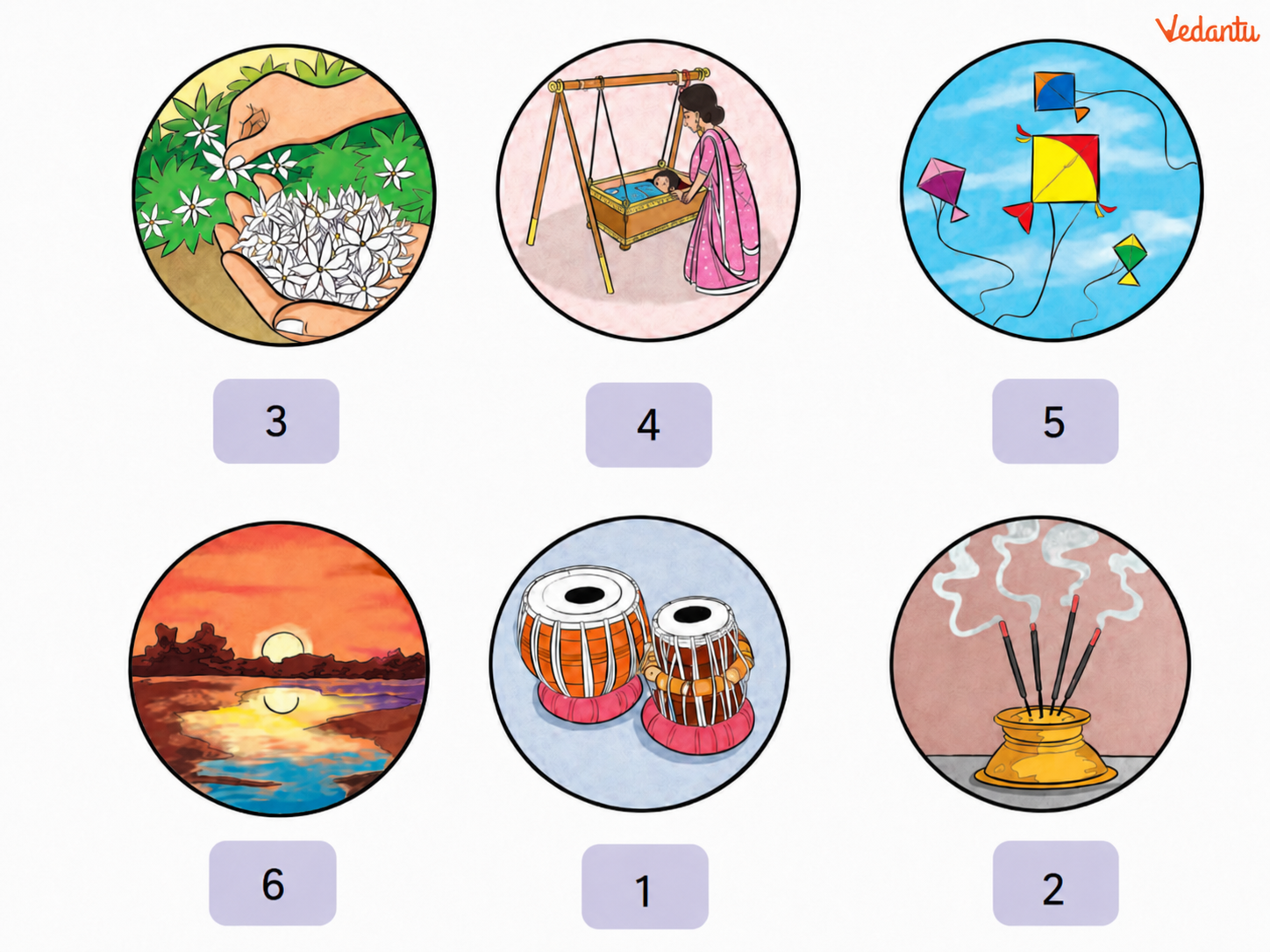
III. Write numbers against each picture with the phrases that describe them with their sensorial associations. One example has been done for you.
beats of music echo in air
melody of soothing scent, dancing in the air
fragrant breeze of blooming buds
gentle lullaby, a soft melody
colourful sky, painting a lively sight
attractive canvas painting the horizon

Answer:
Listen and Respond
I. You will listen to four short extracts of people expressing their childhood memories. As you listen, match each statement 1–6 to each speaker (i)–(iv). There are two statements that you do not need. (Transcript for teacher on page 266)
Answer
Speaking Activity
I. Work in pairs. Think of an object, song, or a place that is memorable for you. Take turns to speak about it using the prompts given below.
Introduce it briefly
Describe it in detail including sensory details
Narrate the specific memory associated with it
Explain how it has impacted your life
Summarise why this memory is meaningful to you even now
You may use the following phrases.
During my childhood...
Growing up, I fondly remember...
Recalling those early years, I can’t forget...
In my younger days, I used to...
I have a clear memory of...
A routine activity in my childhood involved...
A cherished part of my childhood includes...
As a child, I was fond of...
One of my favourite childhood moments is...
Thinking about my early years, I recall...
A common occurrence during my youth was...
Answer:
One of my favourite childhood memories is connected with a small park near my home. During my childhood, I often visited this park in the evening with my family and friends.
The park was full of green trees, colourful flowers, and the cheerful sounds of children playing. I still remember the cool breeze, the smell of fresh grass, and the sound of birds chirping.
Growing up, I fondly remember playing on the swings and running around with my friends. We would laugh, play games, and sometimes sit together to share snacks.
These moments taught me the importance of friendship, spending time with family, and enjoying simple things in life. Visiting the park also helped me develop a love for nature and outdoor activities.
Even today, this memory is special to me because it reminds me of the happiness, freedom, and warmth of my childhood.
Writing Task
A diary entry is a personal record written in a diary or journal, usually dated, where someone expresses their thoughts, feelings, experiences, or events of the day. It is written in the first person (using “I”) and often has an informal, reflective tone.
I. Imagine you had been on a school trip to a scenic place which appealed to all your senses. Write a diary entry describing the place and why it was memorable experience.
Contents of the diary entry:
begin with day, date, and time
use only first person (I, my)
capture sensory details
express emotions
focus on significant moments and experiences
conclude with reflection
Note: Anne Frank and Zlata Filipovic considered their diaries as their friends and therefore began their diary entries with ‘Dear diary’. However, Samuel Pepys considered his diary to be a documentation of facts, his thoughts and feelings. So, he did not begin his diary entries with ‘Dear diary’.
Answer:
Saturday, 15 August 2026
8:30 p.m.
Dear Diary,
Today was one of the most memorable days of my school life. I went on a school trip to a beautiful hill station with my classmates and teachers.
As soon as I reached there, I was amazed by the green hills, tall trees, and clear blue sky. I could hear birds chirping and leaves rustling in the cool breeze. The fresh mountain air felt pleasant on my face, and the sweet fragrance of flowers filled the surroundings. I also enjoyed the taste of the warm snacks I carried with me.
I spent time walking along the peaceful paths, taking photographs, and enjoying the wonderful scenery. One of my favourite moments was standing at a viewpoint and watching the sunlight spread across the hills. I felt calm, happy, and close to nature.
This trip reminded me how beautiful and refreshing nature can be. I will always remember this experience because it filled me with joy and gave me a break from my usual routine.
Good night!
Learning Beyond the Text
For questions I and II, students should read the text from pages 135-136 of the textbook.
I Remember, I Remember
I remember, I remember
The house where I was born,
The little window where the sun
Came peeping in at morn;
He never came a wink too soon
Nor brought too long a day;
But now, I often wish the night
Had borne my breath away.
I remember, I remember
The roses red and white,
The violets and the lily cups-
Those flowers made of light!
The lilacs where the robin built,
And where my brother set
The laburnum on his birthday,
The tree is living yet!
THOMAS HOOD
How Vedantu’s I Cannot Remember My Mother Class 9 Question Answers Help Students?
Vedantu’s Class 9 English Chapter 4 Questions Answers help students understand I Cannot Remember My Mother through clear, simple, and exam-focused explanations. The answers make it easier to understand the poem, revise important ideas, and frame responses confidently in exams.
Here’s how these solutions help:
Clear understanding: The Class 9 English Kaveri Chapter 4 Question Answers explain important ideas, emotions, and poetic expressions in easy language.
Quick revision: Students can use the Class 9 English Kaveri Chapter 4 Questions Answers In Short to recall key points before tests and exams.
Better answer writing: The solutions show students how to present relevant points clearly and in an organised manner.
Complete preparation: The Class 9 English Kaveri Chapter 4 Questions And Answers support both detailed learning and last-minute revision.
These solutions are useful for students who want to understand the poem better, revise efficiently, and prepare well for their Class 9 English exams.
Related Study Materials for Class 9 English Chapter 4 I Cannot Remember My Mother
Class 9 English Chapter-wise Solutions For Prose & Poem
Important Study Materials for Class 9 English
FAQs on NCERT Solutions for Class 9 English Chapter 4 I Cannot Remember My Mother 2026-27
1. How can Class 9 English Kaveri Chapter 4 question answers help in exam preparation?
The Class 9 English Kaveri Chapter 4 question answers help students revise the poem’s theme, important images, sensory details, and key ideas. Short answers support quick revision, while detailed solutions help students practise complete exam responses.
Study resources commonly include textbook questions, extract-based questions, poetic devices, and extra practice.
2. What is the significance of the repeated line “I cannot remember my mother”?
The repetition highlights the contrast between the poet’s inability to remember his mother clearly and his continuing emotional connection with her. Her memory survives through feelings, sounds, scents, and images around him.
3. What do the Class 9 English Kaveri Chapter 4 questions and answers cover?
The Class 9 English Kaveri Chapter 4 questions and answers cover important textbook questions, themes, meanings, poetic ideas, and explanations related to I Cannot Remember My Mother.
4. Are Class 9 English Kaveri Chapter 4 questions answers available in short form?
Yes. Class 9 English Kaveri Chapter 4 questions answers in short are useful for quick revision and for preparing concise responses to short-answer questions.
5. Are Class 9 English Kaveri Chapter 4 question answers useful for exam preparation?
Yes. The Class 9 English Kaveri Chapter 4 question answers help students revise important ideas, understand the poem better, and practise presenting answers in a structured way for exams.
6. Where can students find Class 9 English Chapter 4 questions and answers?
Students can refer to the Class 9 English Chapter 4 questions and answers to understand the poem, revise textbook questions, and practise writing clear exam-ready responses.
7. What is the main theme of I Cannot Remember My Mother?
The main theme of the poem is love, memory, and the lasting emotional bond between a child and mother. Although the poet cannot remember his mother clearly, he continues to feel her presence around him.
