



Class 9 English Chapter 3 Question Answer and Detailed Solutions
Reflect and Respond
I. Work in pairs. Discuss what all you see in a garden. Think of the colours you see and where you see them. Share your responses with your teacher.
Answer: A garden is filled with many beautiful colours and natural sights. Bright flowers such as roses, marigolds, lilies, and sunflowers bloom in shades of red, yellow, pink, orange, purple, and white. Green leaves and grass cover the garden, while the soil is brown. Above, the blue sky and soft white clouds add to its beauty.
Colourful butterflies may be seen flying around the flowers, while birds rest on the branches of trees. The garden also has tall trees, small plants, fresh buds, and blooming flowers. Sometimes, a small pond reflects the blue sky. With so many colours and natural elements, a garden looks like a beautiful painting created by nature.
II. Look at the picture of a garden and a painting given below. Speak about any similarities between the garden and the painting.
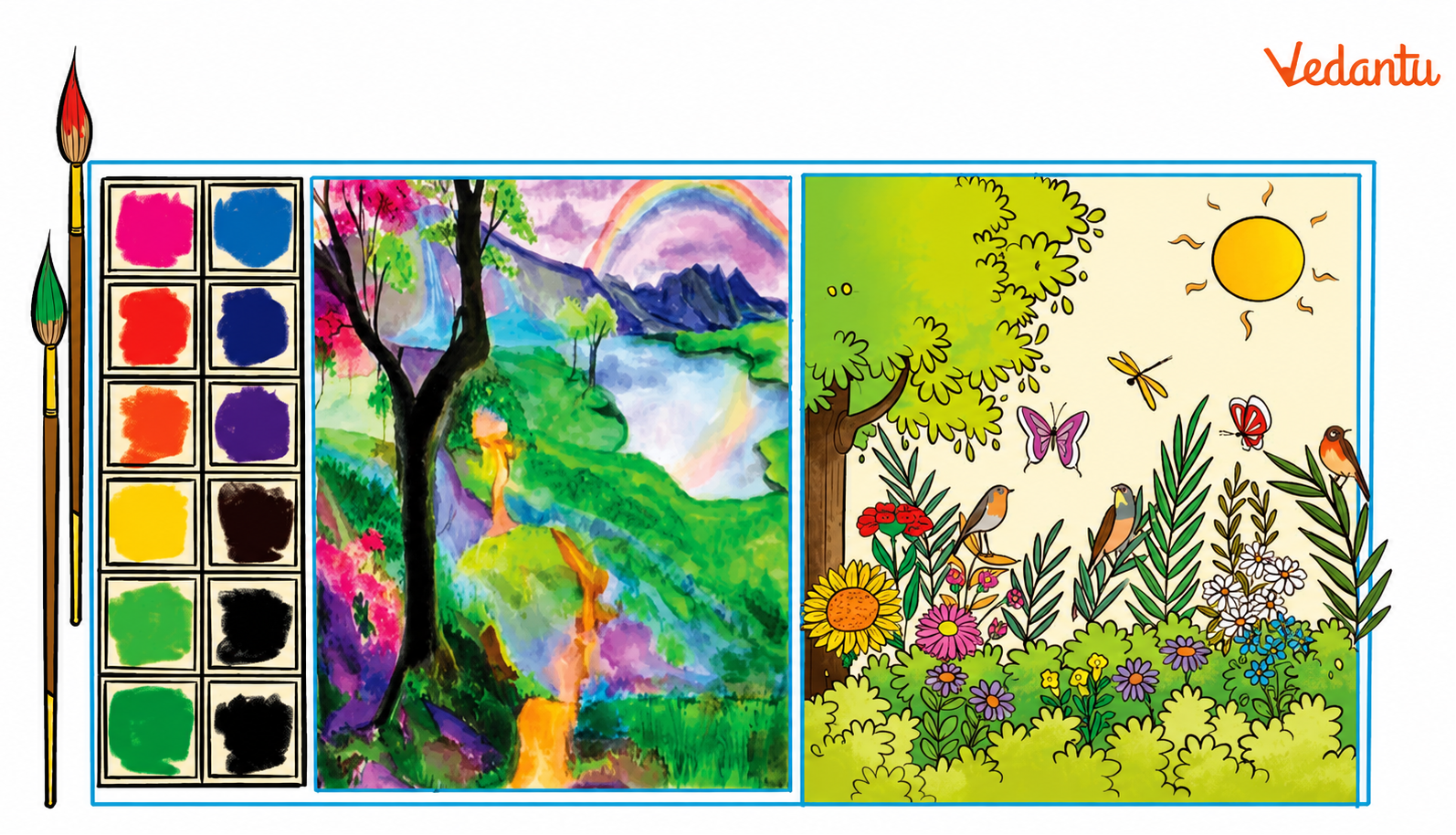
Speak using the following:
Just as a garden _________ , similarly, a painting _________ .
A garden and a painting, both _________ .
_________ is common to both a garden and a painting.
Like a garden, a painting too _________ .
Answer:
Just as a garden is filled with colours and life,similarly, a painting is full of colours and creativity.
A garden and a painting, both are beautiful and pleasing to the eyes.
Colour is common to both a garden and a painting.
Like a garden, a painting too reflects beauty and imagination.
III. Let us acquaint ourselves with the meanings of palette, hue, and canvas.
1. Palette: a thin oval or rectangular board or tablet that a painter holds and mixes colours on.
2. Hue: shade of a colour
3. Canvas: (here) painting
Now, look at the painting given above and identify palette, canvas, and select a hue.
Answer: The first picture shows a palette, the third picture shows a canvas, and the second picture represents hue, or different shades of colour.
Check Your Understanding
I. Read the poem again and complete the summary of each stanza by filling in the blanks.
The _________ is portrayed as a rich palette where gardeners’ _________ a_s flourish in the form of _________ , awaiting spring.
The garden flowers _________ into a beautiful display of different b _________ ms, resembling a _________ by Mother Nature, in the light of morning.
Each garden is likened to a wide _________ ns, integrating art and _________ . Through the efforts of gardeners, gardens transform into still-life _________ .
Answer:
The earth is portrayed as a rich palette where gardeners’ dreams flourish in the form of blossoms, awaiting spring.
The garden flowers bloom into a beautiful display of different blossoms, resembling a painting by Mother Nature, in the light of morning.
Each garden is likened to a wide canvas, integrating art and life. Through the efforts of gardeners, gardens transform into still-life paintings.
II. Select the appropriate title for each stanza from those given below. There are two extra titles.
1. Nature’s Work of Art
2. Sweet-smelling Blossoms
3. Gardens as Living Canvases
4. Earth and Possibilities
5. The Painter’s Canvas
Answer:
Stanza 1: 4. Earth and Possibilities
Stanza 2: 1. Nature’s Work of Art
Stanza 3: 3. Gardens as Living Canvases
III. Match the poetic devices in Column 1 to the examples in Column 2. Discuss your responses in pairs. Then share the responses with your classmates and teacher.
The poem may be interpreted as an allegory.
An allegory is a literary device used to express larger ideas than those presented without explicitly stating them. Allegory operates on two levels—the surface meaning and the deeper meaning. Upon considering this poem as an allegory, the garden could symbolise various aspects of life or nature.
Life’s journey and growth—The garden, with its changing seasons and blooming flowers, could represent the journey of life, growth, and the cyclical nature of existence.
Harmony and diversity—The interaction of different colours in the garden could symbolise the beauty and importance of diversity and harmony in our world.
Answer:
Critical Reflection
I. Read the given extracts from the poem and answer the questions that follow.
1. Brushstrokes of seeds, planted true,
Awaiting spring’s vibrant hue.
(i) The poet has used a metaphor in ‘Brushstrokes of seeds’. Which option from those given below uses a metaphor?
A. Her mother’s heart heard her heartfelt request with kindness.
B. She has a heart of gold.
C. Her heart did a dance of joy on seeing the new doll.
D. She has a very kind heart.
Answer: B. She has a heart of gold. (Here, “heart of gold” is a metaphor for kindness without using ‘like’ or ‘as’)
(ii) Complete the sentence appropriately.
The phrase ‘planted true’ is significant because it implies __________.
Answer:
It implies that the gardener plants the seeds with sincerity, care, and genuine effort.
(iii) Why has the poet used the word ‘hue’ instead of ‘colours’ in the extract?
Answer: The word ‘hue’ sounds more poetic and gives a sense of soft, balanced, and harmonious colour, making the line feel more musical and artistic.
(iv) Complete the following analogy correctly with a word from the extract. Summer: hot :: Spring : _________
Answer: Vibrant (hue)
(v) Read the Assertion (A) and the Reason (R) and select the option that is correctly suited.
(A): Gardeners wait for Spring.
(R): Gardens are worth painting in Spring.
A. Both (A) and (R) are true and (R) is the correct explanation of (A).
B. Both (A) and (R) are true but (R) is not the correct explanation of (A).
C. (A) is true but (R) is false.
D. (A) is false but (R) is true.
Answer: A. Both (A) and (R) are true, and (R) is the correct explanation of (A).
2. Each plot, a canvas wide, Where art and life coincide.
(i) What does ‘Each plot’ refer to in this extract?
Answer: “Each plot” in the extract refers to every piece of land in the garden where plants are grown.
(ii) Select which option imitates the rhyme scheme of the extract.
A. beautiful and clear laughter and cheer
B. beautiful and clear laughter and tears
Answer: A. beautiful, clear laughter and joyful cheer.
(iii) Select the line from the extract that conveys that gardening blends aesthetic beauty with natural growth
Answer: “Where art and life coincide.”
(iv) Complete the following sentence appropriately. The plot is likened to a canvas suggesting that _____________.
Answer: A garden is like a painting because a gardener creates its beauty with love, care, and attention.
(v) Why has the poet most likely used the word ‘wide’ instead of ‘long’ in ‘canvas wide’?
Answer: The word “wide” suggests a large space for creativity and imagination, similar to the broad canvas used by a painter.
II. Give reasons for the comparisons made by the poet in the poem.
1. A painter is compared to a gardener because ______________.
Answer: A painter is compared to a gardener because both create something beautiful with skill, patience, and care. A painter uses colours, while a gardener uses seeds, plants, and flowers.
2. A palette is like earth as __________________.
Answer: A palette is compared to the earth because both contain many colours and offer endless possibilities for creating something beautiful.
3. The brushstrokes are like seeds because _________________.
Answer: Brushstrokes are compared to seeds because both begin the process of creation. Brushstrokes form a painting, while seeds grow into plants and flowers.
4. A canvas is similar to a garden plot as __________________.
Answer: A canvas is similar to a garden plot because both start as empty spaces that can be transformed into beautiful creations.
III. Answer the following questions.
1. How does the metaphor ‘Brushstrokes of seeds’, enhance the understanding of gardening as an art form?
Answer: It suggests that planting seeds is similar to painting, as both gardening and art require creativity, care, and patience.
2. What can you infer about the poet’s perspective on the relationship between nature and creativity from the following lines?
‘Each plot, a canvas wide,/Where art and life coincide.’
Answer: The poet feels that nature and creativity are closely connected, and gardening brings art and life together.
3. Do you think the imagery in the poem successfully paints a vivid picture in the reader’s mind? If yes, why? If no, why not?
Answer: Yes, because the poet uses colour-related words and painting imagery such as palette, canvas, brushstrokes, and blossoms, which help create a vivid picture of a bright and colourful garden.
4. Support the view that the poet’s mention of the colour yellow, besides red, blue and green, would have lent effectively to the imagery.
Answer: Yes, yellow would have made the garden picture brighter, warmer, and more cheerful.
5. Considering the line ‘Gardens become paintings still’, what can you interpret about the poet’s view on the timelessness of nature’s beauty?
Answer: It suggests that nature’s beauty is calm and timeless, like a beautiful still painting that can be admired forever.
6. Justify the title of the poem, ‘Canvas of Soil’
Answer: The title is appropriate because the soil is compared to a canvas, while the seeds are like brushstrokes that gradually transform it into a beautiful and colourful garden.
Vocabulary in Context
I. The poet refers to the shades of green, red, and blue in the poem. Let us read some of the names of different shades of these colours.
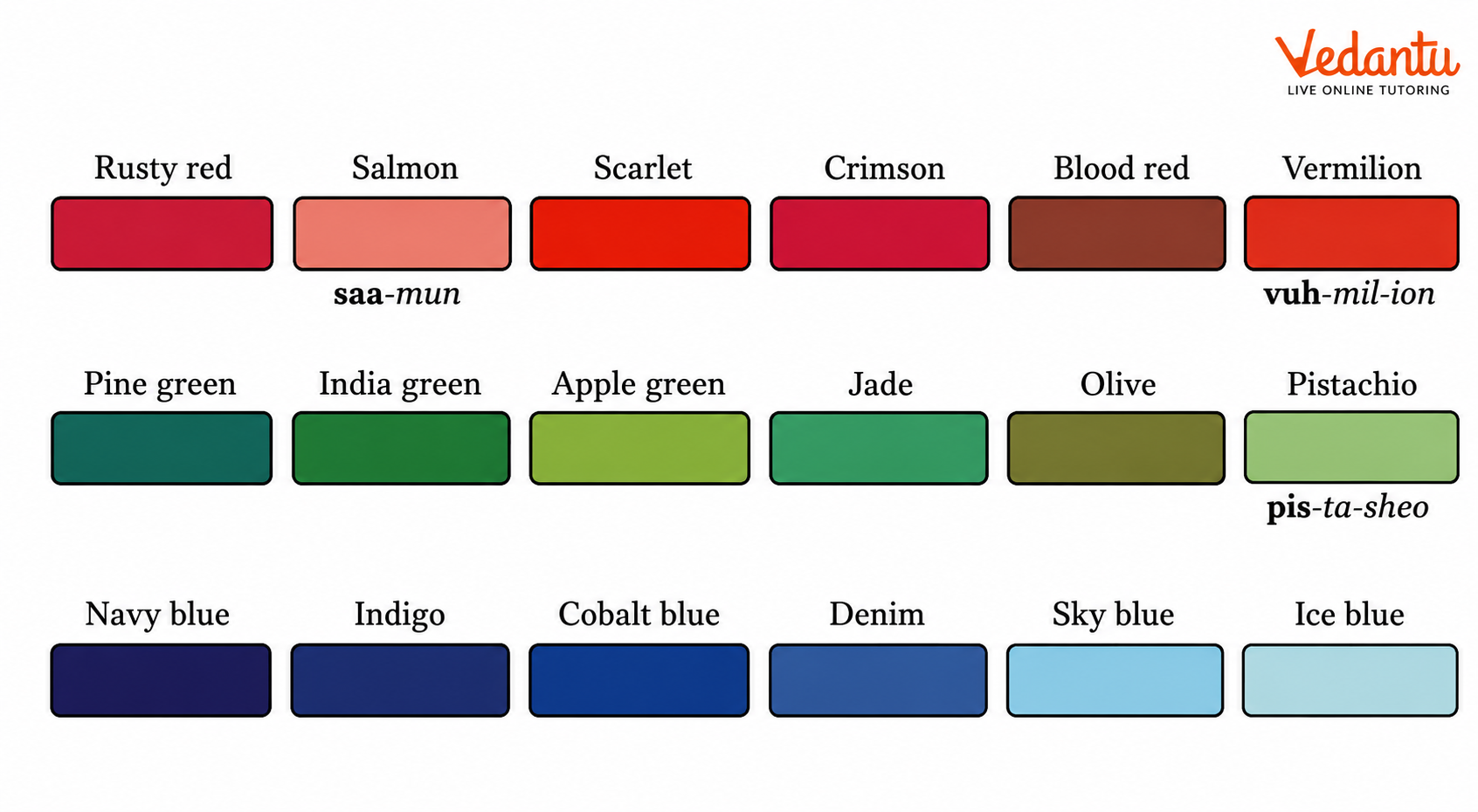
Now, Discuss in pairs, any two things that you can associate with these colours.
Answer: Two things that can be associated with each colour are:
Red: Blood, Rose
Green: Trees, Grass
Blue: Sky, Sea
II. You have studied painting-related words like palette, brushstrokes, shades, hue, colours, and canvas. Now, read the following paragraph and discuss in pairs what the underlined painting-related words might mean.
Discuss this way:
I think ____________ means ____________ because the passage talks about ____________.
Example: I think portrait means a picture of someone’s face because the passage talks about capturing a friend’s features.
In the art studio, young painters eagerly approached their easels, each framing a canvas that they had to work on. The teacher encouraged them to experiment with a diverse tonal range, playing with shades and hues to bring their paintings to life. One student focused on a detailed portrait, capturing his friend’s features, first with careful underpainting and then filling the final colours. Another student worked on a mural, depicting a Spring Day on the right wall of the classroom. The room continued to buzz with artistic energy.
Answer:
The meanings of the underlined words are as follows:
Easels: I think easels are stands used to hold canvases while painting, as the passage mentions painters working on canvases.
Tonal range: I think tonal range means different shades and tones of colours, as the passage talks about experimenting with colours.
Portrait: I think a portrait is a drawing or painting of a person, especially their face, as the passage refers to capturing a friend’s features.
Underpainting: I think underpainting is the first layer of paint applied to a canvas before adding the final colours, as the passage mentions painting the base first.
Mural: I think a mural is a large painting made on a wall, as the passage talks about painting on the classroom wall.
Listen and Respond
I. You will listen to a young girl describe her school garden. As you listen identify which of the following 1–3, she does not talk about. (Transcript for teacher on page 264)
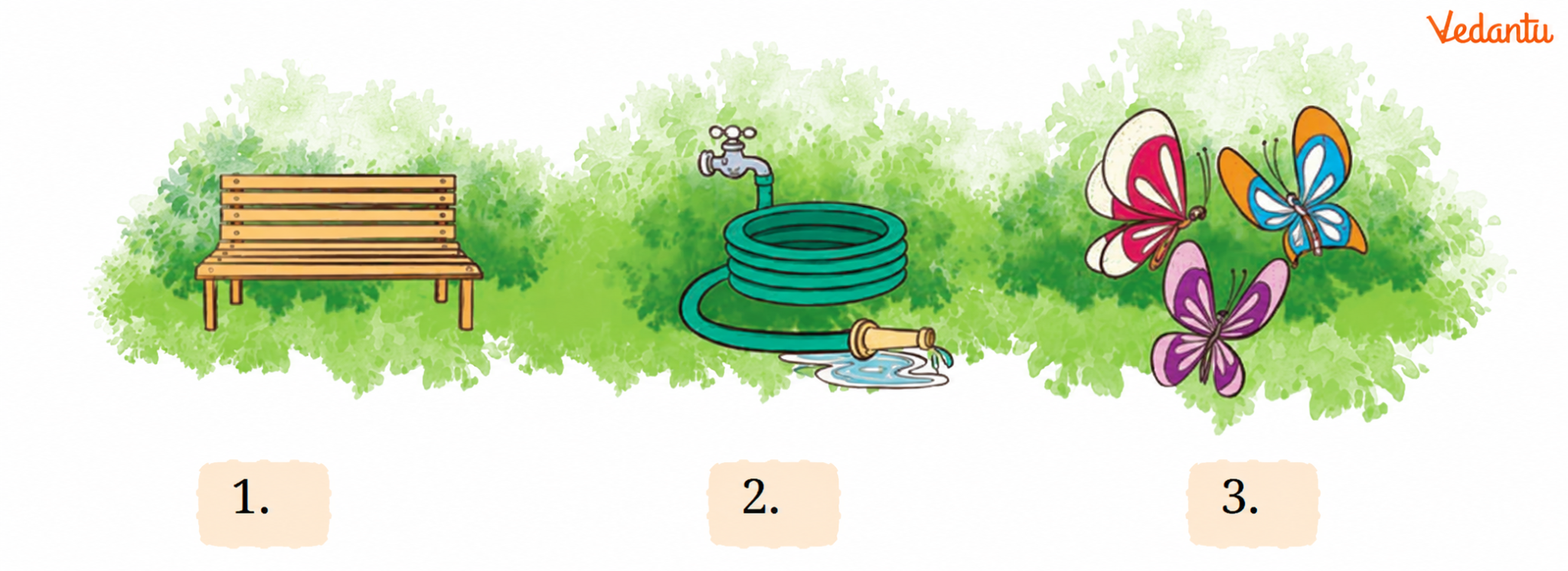
Answer: The young girl does not mention the garden hose shown in Picture 2 when she talks about her school garden.
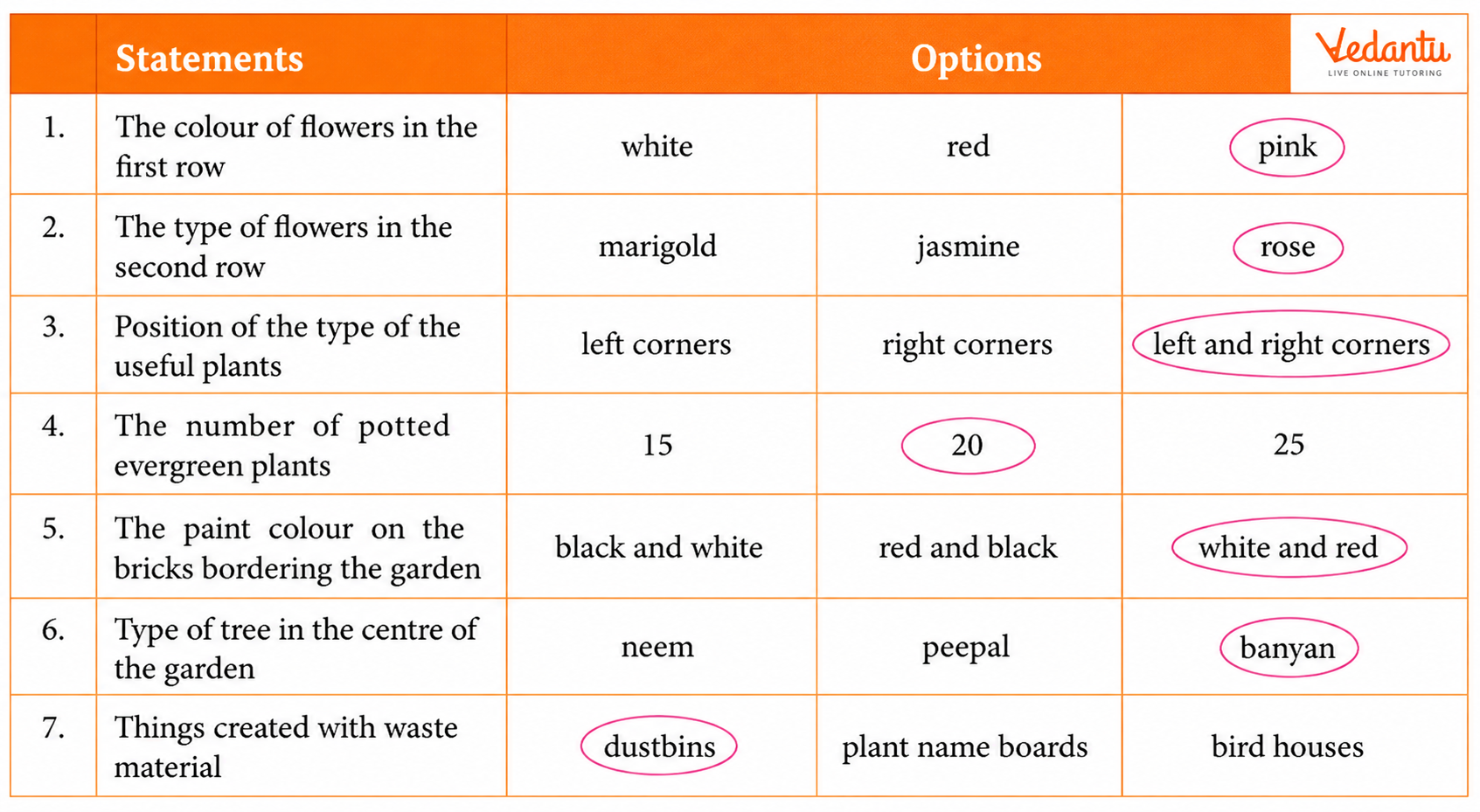
II. You will once again listen to the young girl. As you listen, circle the correct answer from the options given below.
Answer:
Speaking Activity
I. People wish to have a garden at home. Some like a flower garden and some a vegetable garden. Think and note some advantages of both these types, as gardens for homes.
Answer:
Advantages of a Flower Garden
A flower garden adds beauty and colour to the surroundings and makes the environment more pleasant. Flowers also attract pollinators such as bees and butterflies, which help other plants grow. Flower gardens can be created even in small spaces and can help improve air quality. Spending time among flowers also creates a peaceful atmosphere and supports mental well-being. Flowers are also widely used during festivals, celebrations, and worship. Gardening further helps develop a love and respect for nature.
Advantages of a Vegetable Garden
A vegetable garden provides fresh and nutritious vegetables, encourages healthy eating, and can also reduce household expenses. Activities such as digging, planting, watering, and weeding provide useful physical exercise. Growing vegetables naturally can also improve soil quality and reduce dependence on packaged produce.
Taking care of plants teaches discipline, responsibility, and patience. Eco-friendly gardening practices can help reduce plastic waste and the overall carbon footprint. Organic farming and natural gardening methods should be encouraged because they are environmentally friendly, healthy, and sustainable.
II. Would you like to have a flower garden or a vegetable garden at home? Why?
Take turns with your partner and speak your points aloud, one by one, by using the given sentence prompts to express your preference, with reasons.
I prefer __________ to __________ because ...
For me , it is a __________ instead of a __________ due to ...
If I had a choice I’d rather have a ________than a __________ as ...
I would prefer __________ rather than __________ since ...
Answer:
I prefer a flower garden to a vegetable garden because it is colourful, beautiful, and attracts butterflies and bees.
For me, it is a vegetable garden instead of a flower garden due to the fresh and healthy vegetables it provides.
If I had a choice, I’d rather have a flower garden than a vegetable garden as I enjoy seeing colourful flowers around me.
I would prefer a vegetable garden rather than a flower garden since it gives us fresh vegetables for everyday use.
Writing Task
I. Write a descriptive piece of two to three paragraphs describing the details and colours in the garden you have visited.
Focus on how different shades of blue, red, and green interact, create contrast, and bring the garden to life.
Pay attention to details like the texture of petals, the varying greens of leaves, and the way light affects the colours.
Answer:
My Visit to Amrit Udyan
Last week, I visited the beautiful Amrit Udyan at Rashtrapati Bhavan, and the garden looked like a colourful painting brought to life. As soon as I entered, I was surrounded by a wonderful variety of colours. Deep red roses stood beside soft pink flowers, while bright scarlet blooms added warmth and energy to the garden. Shades of blue, from pale sky blue to rich indigo, created a calm and peaceful atmosphere. All the colours blended beautifully, making the garden pleasant and soothing to the eyes.
The different shades of green leaves formed a perfect background for the colourful flowers. Some leaves were light and fresh, while others were dark, smooth, and glossy. The flower petals felt soft and velvety, and some had gently ruffled edges that shone under the sunlight. As the golden sunlight fell on the flowers, their colours appeared brighter and more vibrant, creating beautiful patterns of light and shadow.
The entire garden felt lively, peaceful, and full of natural beauty. Every corner of Amrit Udyan was filled with colour and charm, making my visit a memorable and refreshing experience.
Learning Beyond the Text
I. Mini-Project
Objective: Explore the multifaceted world of gardens— their design, cultural significance, artistic inspiration, and the art of gardening itself.
Duration: This project can span over a few weeks, allowing students adequate time for research and creative processes.
Select any TWO assignments. Any one from 1 or 2, and any one from 3 or 4
(1)
Do research and collect information on any FIVE famous gardens of India, such as Amrit Udyan, Brindavan Gardens, and many others.
Focus on history, design elements, and cultural significance.
Prepare a short report and make a presentation.
(2)
Explore various art forms (painting, sculpture) inspired by gardens. Select an art piece and analyse how the garden is represented.
Create a visual or written response inspired by the garden.
(3)
Design your own garden
Design a garden on paper or using digital tools.
Incorporate elements and artistic inspirations learned from parts (1)/(2).
Present your choices indesignandartistic influences to the class.
(4)
Interview with a Gardener or Landscaping Expert
Approach a local gardener or a landscaping expert for an interview.
Prepare questions focussed on understanding the practical aspects of gardening/landscaping.
Write a summary of your experience.
Answers: I have selected Assignments 1 and 4.
Assignment (1) – Five Famous Gardens of India
1. Shalimar Bagh – Srinagar
History: Shalimar Bagh was built in 1619 by Mughal Emperor Jahangir for his wife, Noor Jahan.
Design Elements: The garden is known for its Mughal-style terraces, flowing canals, fountains, and symmetrical layout.
Cultural Significance: It reflects the Mughal appreciation for nature, beauty, and Persian-inspired garden architecture.
2. Brindavan Gardens – Mysuru
History: Brindavan Gardens was developed near the Krishnaraja Sagar Dam and was completed in the early 20th century.
Design Elements: It is famous for its musical fountains, beautifully lit pathways, landscaped lawns, and geometric garden patterns.
Cultural Significance: It is one of the most popular gardens in India and attracts a large number of tourists every year.
3. Amrit Udyan (Rashtrapati Bhavan Gardens) – New Delhi
History: The gardens of Rashtrapati Bhavan were designed by Sir Edwin Lutyens during the British period.
Design Elements: They combine Mughal and English garden styles and include colourful roses, fountains, lawns, and carefully arranged flower beds.
Cultural Significance: Amrit Udyan represents India’s rich gardening heritage and is opened to visitors during the annual Udyan Utsav.
4. Lalbagh Botanical Garden – Bengaluru
History: Lalbagh Botanical Garden was started by Hyder Ali and was later developed further by Tipu Sultan.
Design Elements: The garden features the famous Glass House, spacious lawns, and a wide variety of rare and exotic plants.
Cultural Significance: It is an important centre for botanical study, plant conservation, and horticultural research.
5. Rock Garden – Chandigarh
History: The Rock Garden was created by Nek Chand, who used discarded and waste materials to develop the garden.
Design Elements: It contains unique sculptures made from recycled materials, waterfalls, narrow pathways, and creative structures.
Cultural Significance: The garden highlights the importance of creativity, recycling, and environmental awareness.
Assignment (4) – Interview with a Gardener
Questions Asked
What are the most important factors for healthy plant growth?
How often should plants be watered?
Which plants are suitable and easy to grow for beginners?
What are some natural ways to protect plants from pests?
What is the biggest challenge you face while gardening?
Summary of the Experience
I interviewed a local gardener from my neighbourhood to learn more about gardening and plant care. He explained that adequate sunlight, proper watering, and nutrient-rich soil are the main requirements for healthy plant growth. He also mentioned that overwatering is one of the most common mistakes people make while caring for plants.
For beginners, he recommended easy-to-grow plants such as tulsi, marigold, and money plant, as they require relatively simple care. He also suggested using natural methods such as neem oil and compost to keep plants healthy and protect them from pests instead of relying heavily on chemicals.
According to him, one of the biggest challenges in gardening is protecting plants from extreme weather conditions, such as excessive heat, heavy rain, or strong winds.
This interview helped me understand that successful gardening requires patience, regular care, observation, and responsibility. It was an interesting and informative experience that increased my appreciation for plants and the effort needed to maintain a healthy garden.
II. You must have read poems and songs about beauty of nature and different seasons in English and in your own language. Now, read and enjoy the poem given below.
A Sea of Foliage Girds
Our Garden Round
A sea of foliage girds our garden round,
But not a sea of dull unvaried green,
Sharp contrasts of all colours here are seen;
The light-green graceful tamarinds abound
Amid the mango clumps of green profound,
And palms arise, like pillars gray, between;
And o’er the quiet pools the seemuls lean,
Red-red, and startling like a trumpet’s sound.
But nothing can be lovelier than the ranges
Of bamboos to the eastward, when the moon
Looks through their gaps, and the white lotus
changes
Into a cup of silver. One might swoon
Drunken with beauty then, or gaze and gaze
On a primeval Eden, in amaze.
Toru Dutt
Answer: Classroom Activity.
Why Refer to Vedantu’s Canvas of Soil Class 9 Solutions for Better Preparation?
Vedantu’s Class 9 English Kaveri Chapter 3 Question Answers PDF helps students understand Canvas of Soil through clear, simple, and well-structured answers.
The Class 9 English Chapter 3 answers can help students:
Understand the key ideas and important points of the chapter.
Check their textbook answers for better accuracy.
Improve answer-writing skills with clear explanations.
Revise important questions quickly before exams.
Build confidence while preparing Class 9 English Chapter 3.
Students can use these solutions along with the NCERT textbook for effective revision and better exam preparation.
Related Study Materials for Class 9 English (Kaveri) - Chapter 3 Canvas of Soil
Class 9 English Chapter-wise Solutions For Prose & Poem
Important Study Materials for Class 9 English
FAQs on NCERT Solutions for Class 9 English Chapter 3 Canvas of Soil 2026-27
1. What is the main idea of Canvas of Soil Class 9?
The main idea of Canvas of Soil is how traditional Indian pankhas (hand fans) have changed with the arrival of modern cooling devices. The chapter also highlights the importance of preserving traditional craftsmanship, regional art, and the livelihoods of artisans.
2. What is the message of Canvas of Soil Solutions?
The chapter conveys that nature is like a beautiful work of art created with soil, seeds, colours, and care. It highlights the importance of patience, hard work, and nurturing plants while encouraging us to appreciate the beauty of gardens and develop a deeper connection with nature.
3. Where can I find Class 9 English Chapter 3 question answers?
Students can refer to Vedantu’s Class 9 English Kaveri Chapter 3 (Canvas of Soil)Question Answers for clear and easy-to-understand solutions. These answers can be used along with the textbook for learning, revision, and exam preparation.
4. How can I prepare Canvas of Soil for exams?
Start by reading the chapter carefully and understanding its central idea about gardening, nature, colours, and the connection between soil and creativity.
Focus on the poem’s important images, comparisons, word meanings, and message. Revise the textbook questions and key points, and practise writing short, clear answers for better exam preparation.
5. Are Canvas of Soil Class 9 solutions available in PDF?
Yes. Students can use the Class 9 English Kaveri Chapter 3 Question Answers PDF to revise the chapter, understand important answers, and prepare conveniently for examinations.
