



Chapter 6 A Friend Found in Music: Class 9 English Kaveri Solutions
Reflect and Respond (Page 194)
I. Read the questions given below and share your answers with your classmates and teacher.
Question 1. What kind of music do you prefer to listen to: vocal or instrumental?
Answer: I prefer vocal music because I enjoy the emotions and stories conveyed through lyrics. The words make songs feel personal and memorable. However, I also like instrumental music when I want to relax or concentrate.
Question 2. Name your favourite musician(s).
Answer: My favourite musician is A. R. Rahman because his music combines meaningful melodies with soulful vocals. I admire the way he blends different musical styles while preserving the emotional depth of his compositions.
Question 3. Give reasons for your choice.
Answer: I enjoy instrumental music while studying because it creates a peaceful background without distracting me with lyrics. Vocal music, on the other hand, helps me express and understand emotions. Both forms of music can refresh my mind and improve my mood.
Check Your Understanding (Page 195)
I. Read the poem again to complete the poet’s diary about her feelings on music. Fill in the blanks with words from the poem.
Today, I’ve been thinking about how essential music is to me. It is like an ocean that calls me to its 1. __________ Music is the 2. __________ that harmonises with my 3. __________ , moving me in ways I can’t explain. When I feel sad or upset about things, music is the 4. __________ that eases the ache. It is amazing how music has the power to lift my 5. __________ , and give me strength to pull through difficult times. I know that it is the effect of music whenever I feel 6. __________ . Music is the much 7. __________ , dependable friend when there is no one to 8. __________ : Thank you, my dear music, for being my all-time comfort.
Answer:
shore
rhythm
core
therapy
spirit
cheerful
needed
Care
II. Let us appreciate the poem.
Question 1. The phrase ‘moves me’ in the line ‘That moves me to the core,’ is an example of __________ .
Answer: Alliteration.
Question 2. The poet uses metaphors for music. List these metaphors and rewrite them as similes. For example, Music is as __________ as __________ .
Answer:
Metaphor: “Music is the ocean”
Simile: Music is as vast as the ocean.Metaphor: “Music is the therapy”
Simile: Music is as healing as therapy.Metaphor: “Music is the needed friend”
Simile: Music is as comforting as a trusted friend.
Question 3. What is the rhyme scheme of the poem? What impact does it have?
Answer: The poem follows an ABCB rhyme scheme, in which the second and fourth lines of each stanza rhyme. This creates a smooth, musical flow that suits the poem’s central theme and makes the verses pleasant to read.
Question 4. What is the purpose of the poet in using the word ‘music’ repetitively?
Answer: The poet repeats the word ‘music’ to underline its importance in her life. The repetition draws attention to music as a constant source of comfort, strength, and happiness.
Question 5. What is the message the poet wishes to convey through the poem?
Answer: The poet conveys that music can be a powerful source of emotional support. It brings comfort during difficult moments, lifts our spirits, and remains a dependable companion through different phases of life.
Question 6. Identify the mood of the poem from the options given below.
(i) nostalgic
(ii) thoughtful
(iii) amused
(iv) playful
Answer: (ii) thoughtful
Question 7. Give evidence from the poem to support that the speaker is the poet herself.
Answer: The poem uses first-person expressions such as “I” and “me”, showing that the speaker is describing her own feelings towards music. Lines such as:
“That pulls me to the shore”
“That moves me to the core”
“I need when I feel blue”
“Music lifts my spirits.”
“When I’m most cheerful”
show that the speaker is sharing a personal experience and emotional connection with music.
Critical Reflection (Page 196)
I. Read the extract given below and answer the questions that follow.
1. Music is the therapy
I need when I feel blue.
Music lifts my spirits.
To make sure I pull through.
(i) Complete the following sentence suitably.
The phrase ‘feel blue’ indicates __________ .
Answer: The phrase “feel blue” indicates that the poet is feeling sad or low.
(ii) Identify the line which shows music makes the poet happy.
Answer: “Music lifts my spirits.”
(iii) What does the last line of the extract signify?
Answer: The last line means that music gives the poet the emotional strength she needs to overcome difficult situations and keep going.
(iv) State whether the following sentence is true or false.
Music plays a vital role in the poet’s life.
Answer: True. Music is an important part of the poet’s life because it provides her with comfort, happiness, and emotional strength during challenging moments.
(v) Select the central idea of the extract from the following options.
A. Music brings comfort during sadness.
B. Music is a necessity in times of happiness.
C. Music improves our ability to pull heavy loads.
D. Music is a source of knowledge and excitement.
Answer: A. Music brings comfort during sadness.
II. Answer the following questions.
Question 1. How is music able to move the poet ‘to the core’?
Answer: Music moves the poet “to the core” because its rhythm and melody affect her deeply. It reaches her innermost emotions and creates a powerful feeling that she experiences both emotionally and physically.
Question 2. Why does the poet compare music to a ‘needed friend’?
Answer: The poet calls music a “needed friend” because it stays with her when she feels lonely or sad. Like a caring friend, music comforts her, lifts her mood, and supports her emotionally.
Question 3. Explain the poet’s attitude towards music.
Answer: The poet has a deep sense of love, gratitude, and appreciation for music. She considers it more than a form of entertainment; for her, it is a source of healing, happiness, comfort, and strength.
Question 4. Support the opinion that this poem has a universal appeal.
Answer: The poem has universal appeal because people of different ages and backgrounds experience emotions such as happiness, sadness, loneliness, and hope. Music often helps people deal with these emotions, making the poet’s experience relatable to readers everywhere.
Question 5. Compare your experience of music with the feelings expressed in the poem.
Answer: My experience of music is similar to the poet's. I listen to music when I feel stressed or upset because it helps me relax and feel positive. During happy occasions, music also adds to my enjoyment. Like the poet, I feel that music can be a comforting companion.
Vocabulary in Context (Pages 197-198)
I. Read the following phrases from the poem denoting happiness and sadness.
Classify the words given in the box below as positive emotions and negative emotions.

Positive emotions (happiness): __________.
Negative emotions (sadness): __________.
Answer:
Positive emotions (happiness): lifts my spirits, most cheerful
Negative emotions (sadness): feel blue
Now, fill in the blanks by choosing the correct word from those given in the brackets.
1. The familiar tune stimulated a rush of __________ , transporting listeners back to cherished moments from their past. (nostalgia/ elation)
Answer: Nostalgia
2. The soulful ballad expressed the singer’s __________ , leaving the audience moved by the intensity of their emotions. (despondence/ anguish)
Answer: Anguish
3. The pianist played a soulful melody on the stage, creating an ambience of __________ . (melancholy/despair)
Answer: Melancholy
4. The festive symphony filled the air with __________ tones, lifting the spirits of everyone present on the joyous occasion. (jubilant/ euphoric)
Answer: Euphoric
II. Read the highlighted word in the line given below.
To make sure I pull through
The meaning of the verb ‘pull’ is ‘move or remove something’. The preposition ‘through’ means ‘from one end or side to the other’. However, when they come together, they convey a completely different meaning. Here, ‘pull through’ means ‘to succeed in doing something very difficult’.
When a verb consists of two parts, the first part is a verb; the second part is a preposition or an adverb. When they come in such combinations, the verbs convey a totally different meaning. Such multi-verbs are called phrasal verbs.
Now, read the following lines from the poem.
Music is the rhythm
That moves me to the core.
The phrase ‘moves me’ means ‘to make somebody do something’.
‘Move’ also has different meanings. For example, to change position, to make progress, to take action, or to cause strong feelings.
III. Choose the correct meaning from the box given below for the underlined phrasal verbs in the following sentences.
He’s planning to move out of his parents’ house next month.
Our new neighbours moved in yesterday.
I’ve been in this job long enough-it’s time I moved on.
Can you move over a bit so I can sit down?
The police officer told the crowd to move along.
The bus moved off as soon as all the passengers were seated.
(i) to start doing or discussing something new
(ii) to begin living in a new home or place
(iii) to start moving, to leave
(iv) to go to a new position, especially to make room for other people
(v) to leave a place where one has been living
(vi) to shift position to make space for someone or something
1. He’s planning to move out of his parents’ house next month.
Answer: To leave a place where one has been living.
2. Our new neighbours moved in yesterday.
Answer: To begin living in a new home or place.
3. I’ve been in this job long enough-it’s time I moved on.
Answer: To start doing or discussing something new.
4. Can you move over a bit so I can sit down?
Answer: To shift position to make space for someone or something.
5. The police officer told the crowd to move along.
Answer: To go to a new position, especially in order to make room for other people.
6. The bus moved off as soon as all the passengers were seated.
Answer: To start moving or to leave.
IV. Create phrasal verbs from the verbs ‘put’, ‘get’, ‘look’, ‘break’. Find the meanings of the phrasal verbs you create. Make sentences with the phrasal verbs. Discuss them with your classmates and teacher.
Answer:
1. Put
Phrasal Verb: Put on
Meaning: To wear or put on something.
Sentence: Please put on your coat before going outside.
2. Get
Phrasal Verb: Get up
Meaning: To rise from bed or wake up.
Sentence: I usually get up at seven o’clock every morning.
3. Look
Phrasal Verb: Look for
Meaning: To try to find someone or something.
Sentence: I need to look for my keys because I cannot find them.
4. Break
Phrasal Verb: Break down
Meaning: To stop functioning, especially when referring to a machine or vehicle.
Sentence: Our old car may break down during the long journey.
Listen and Respond (Page 199)
I. Before you listen, read the questions and guess the responses to the given questions.
Question 1. How are the two speakers connected?
(i) parent-child
(ii) teacher-student
(iii) brother-sister
Answer: (i) parent-child
Question 2. Where is the conversation taking place?
(i) music centre
(ii) park
(iii) school reception area
Answer: (i) music centre
Question 3. Which musical instrument is the reason for the problem?
(i) sitar
(ii) santoor
(iii) sarod
Answer: (ii) santoor
Question 4. What is the problem being discussed?
(i) inability to play the musical instrument
(ii) irregularity of the music class
(iii) lack of choice of the musical instrument
Answer: (i) inability to play the musical instrument
Question 5. What has been the unsuccessful solution?
(i) practising for longer hours
(ii) singing while playing the instrument
(iii) watching videos about playing the instrument
Answer: (iii) watching videos about playing the instrument
Question 6. What is the final decision taken?
(i) change classes
(ii) pick a simpler instrument
(iii) purchase the musical instrument
Answer: (iii) purchase the musical instrument
II. Now, listen to the conversation between the two people. As you listen, check your answers and rectify them wherever needed. Once done, discuss your responses with your classmates and teacher. (Transcript for teacher on page 270)
Answer: After listening to the conversation, I checked my responses and found that all my answers were correct.
Speaking Activity (Page 200)
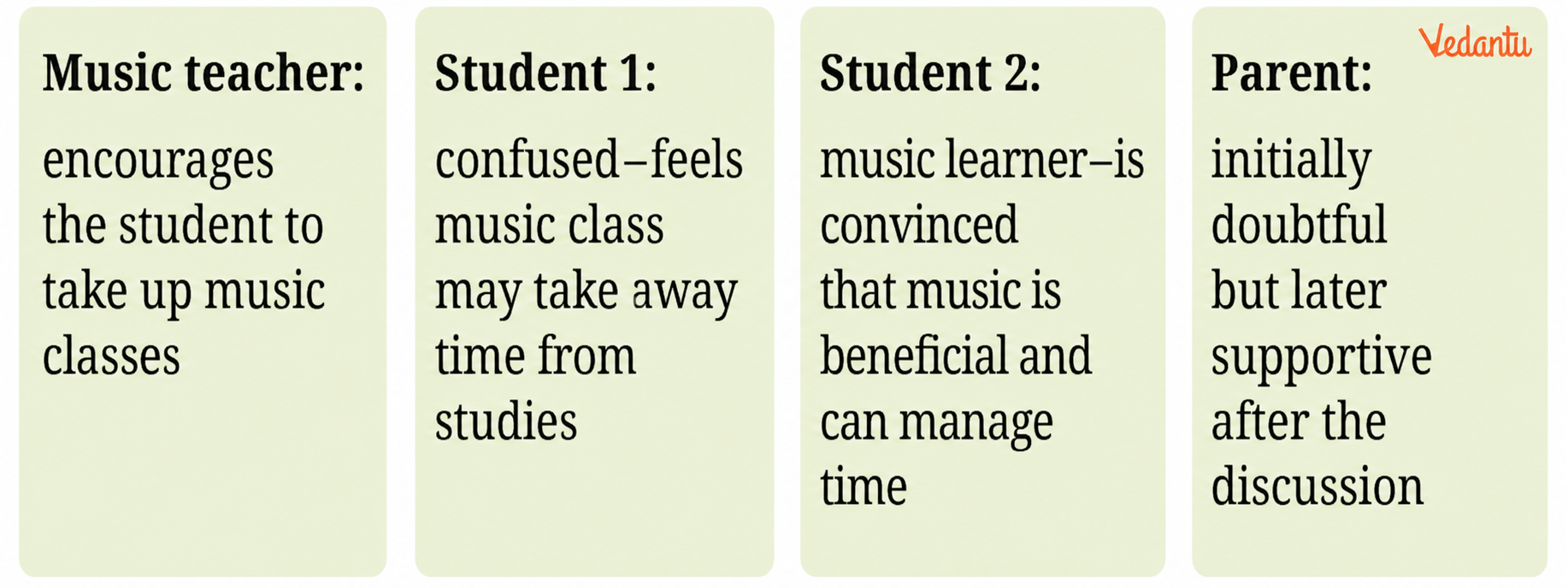
I. Work in groups of four and choose a role each. Use the cues given below to present a role play in the class. Frame your responses logically in complete sentences. You may frame appropriate questions to ensure continuity in the conversation.
Answer:
Music Class Discussion
Music Teacher: I believe learning music can enrich your life. Have you considered joining a music class?
Student 1 (confused): I am not sure, sir. I already have a lot of homework. Won’t attending music classes reduce the time I have for my studies?
Student 2 (music learner): I had a similar concern when I started. However, I learned to manage my time. Music actually helps me concentrate and gives me a refreshing break. Don’t you think learning something creative can be useful?
Parent (initially doubtful): That sounds good, but I am concerned that music might affect academic performance. How can it help with studies?
Music Teacher: Music can improve concentration, memory, and relaxation. With proper time management, students can balance their studies and practice effectively. Wouldn’t it be useful for the child to develop both academic and creative skills?
Student 1: So, you mean learning music can actually support my studies instead of taking away from them?
Student 2: Exactly! I feel more focused and refreshed after practising music. It helps me manage my studies more confidently.
Parent (supportive): I understand now. If music helps my child stay balanced and brings happiness while developing a useful skill, I am willing to support it.
Music Teacher: That is wonderful. With encouragement from the family, the student can enjoy music while maintaining a healthy balance between studies and other interests.
Writing Task (Pages 200-201)
I. Your school is organising a musical evening on 21 June, World Music Day. You are presenting a Sitar recital at the event. Draft an invitation letter requesting your grandparents to attend the event.

Follow the guidelines given below to draft the invitation letter.
Format:
Sender’s address
Date
Salutation: Dear…
Body of the letter:
Ask about their well-being.
Mention the event and give details-date, time, and venue.
Request them to attend.
Complimentary close: Yours affectionately, Name of the sender
Language:
Use first person-‘I’ and second person ‘We’ and ‘You’.
Write in a warm and personalised style.
Answer:
17, Shastri Nagar
Noida
20 April, 2027
My Dearest Dadaji and Dadiji,
I hope you are both keeping well. I am very excited to share some special news with you.
Our school is organising a Musical Evening on 21 June to celebrate World Music Day, and I will be performing a Sitar recital. I have been practising regularly for the programme, and I am really looking forward to the performance.
Your encouragement has always given me confidence whenever I try something new. It would make the occasion even more memorable if you could come and watch me perform. Having you both there would mean a lot to me.
The programme will start at 5:00 p.m. in the school auditorium. I sincerely hope you will be able to attend and bless me on this special day.
I am eagerly waiting to see you both there!
Yours lovingly,
Abhay
Learning Beyond the Text (Pages 201-202)
I. Did you know India’s rich musical heritage has a lot to offer to our well-being? Raga Chikitsa, one of the ancient texts, elaborates on the healing properties of music. A seventeenth-century work titled Sangita Sudha gives an account of the effects of music on emotions. Find out how music is used as an alternative therapy in the present times.
Answer: Music is used today as a supportive form of therapy because it can positively influence emotions and promote relaxation. It is used in settings such as hospitals, counselling sessions, and wellness programmes to help people manage stress and emotional difficulties.
Music-based activities can also support memory, communication, and rehabilitation. For example, familiar songs may help people recall memories, while rhythm can assist certain rehabilitation exercises. Music is also commonly included in meditation, yoga, and relaxation practices. Thus, music can complement conventional care by supporting emotional and mental well-being.
II. Everything in nature has a rhythm or sound vibration, even our heartbeat. Speak to your music teacher and find out about the origin of the seven swaras (notes) of Indian classical music.
Answer: The seven swaras of Indian classical music are Sa, Re, Ga, Ma, Pa, Dha, and Ni. Traditional accounts associate these notes with sounds found in nature and the calls of different animals and birds:
Shadaja (Sa) – associated with the sound of a peacock
Rishabha (Re) – associated with the call of a cow
Gandhara (Ga) – associated with the sound of a goat
Madhyama (Ma) – associated with the cry of a heron
Panchama (Pa) – associated with the song of the Indian cuckoo
Dhaivata (Dha) – associated with the neighing of a horse
Nishada (Ni) – associated with the sound of an elephant
Together, these seven notes form the saptak, or octave, and provide the basic framework for melodies and ragas in Indian classical music. Their connection with nature reflects the traditional understanding of music as a way of creating harmony between people and their surroundings.
III. You must have read or heard poems and songs about music-both in English and in your own language. Share some of them with your classmates and create a collection of these poems and songs together.
Answer:
Poems in English:
The Song Within
When morning breaks and silence fills the air,
I hear a tune that no one else can know,
It rises from a place beyond compare,
A gentle rhythm, soft and sweet and slow.
The melody lives deep inside my chest,
It beats along with every breath I take,
Through busy days it gives my heart its rest,
And soothes the worry that would make me break.
This music has no words, no band, no stage,
It needs no instrument to make it real,
It flows through every moment of my age,
And helps me know exactly how I feel.
The song within will never fade away,
It is the soundtrack of my every day.
Music’s Magic
A simple chord can change the way I see,
Three notes together paint the world anew.
The drum beats like a heart that’s come alive,
The guitar weaves its stories in the air.
One song can make us all feel we belong,
It breaks down walls and brings us close and strong.
When words alone can’t say what’s in my heart,
Music steps in to play its healing part.
संगीत और जीवन
सुरों की दुनिया है निराली,
संगीत ही मन की प्यास है।
जब उदासी दिल को घेरे,
वही सुकून और एक आस है।
धड़कन में इसकी लय बस्ती,
ये रूह को छू जाता है।
हर मुश्किल में सच्चा साथी,
जीना हमें सिखाता है।
संगीत की महिमा
मीठे सुरों की बहती गंगा,
मन का मैल मिटाती है।
थके हुए इस खाली दिल में,
नई उमंग जगाती है।
बिन शब्दों के हाल सुनाए,
ये मरहम बन जाता है।
सूनी रातों की तन्हाई में,
गीत साथ निभाता है।
IV. Read and enjoy the poem given below.
Music
When music sounds, gone is the earth I know,
And all her lovely things even lovelier grow;
Her flowers in vision flame, her forest trees
Lift burdened branches, stilled with ecstasies.
When music sounds, out of the water rise
Naiads* whose beauty dims my waking eyes,
Rapt in strange dreams burns each enchanted face,
With solemn echoing stirs their dwelling-place.
When music sounds, all that I was I am,
Ere to this haunt of brooding dust I came;
And from Time’s woods break into distant song.
The swift-winged hours, as I hasten along.
Walter De La Mare
Note: Naiad-a water nymph said to inhabit a river, spring. or waterfall.
Key Takeaways from A Friend Found in Music
A Friend Found in Music shows how music can offer comfort, strength, and companionship during different emotions. These Class 9 English Kaveri Chapter 6 question answers cover the poem’s exercises, poetic devices, vocabulary, and activities in a simple, exam-friendly way.
The A Friend Found in Music Class 9 question answers section helps students understand the poem’s deeper meaning while making revision easier.
Related Study Materials for Class 9 English Chapter 6 A Friend Found in Music (Poem)
Class 9 English Chapter-wise Solutions For Prose & Poem
Important Study Materials for Class 9 English
FAQs on NCERT Solutions for Class 9 English Kaveri Chapter 6 A Friend Found in Music (Poem) 2026-27
1. What does A Friend Found in Music suggest about the role of music?
The poem presents music as a quiet companion that understands and supports the poet’s emotions. It brings comfort when she feels low and adds to her happiness when she is cheerful.
2. Why does the poet say that music moves her “to the core”?
The expression shows that music affects the poet very deeply. Its rhythm reaches her innermost feelings and creates an emotional response that goes beyond ordinary enjoyment.
3. What does the poet mean by “Music is the therapy I need”?
The poet means that music helps her deal with sadness and emotional difficulties. Listening to it gives her relief and helps her regain the strength to face challenging situations.
4. How does the repetition of the word “music” strengthen the poem?
The repeated use of “music” keeps the central idea in focus. It also shows how closely music connects to the poet’s thoughts, feelings, and everyday experiences.
5. What does “feel blue” mean in the poem?
“Feel blue” means feeling sad or emotionally low. The poet explains that music becomes a source of comfort whenever she feels this way.
6. Why does the poet describe music as a friend?
The poet describes music as a friend because it offers companionship without expecting anything in return. It remains a source of comfort when the poet feels no one else cares for her.
7. What kind of mood does the poem create?
The poem creates a thoughtful and reflective mood. Instead of simply describing music, the poet reflects on its emotional influence and the special place it holds in her life.
8. Which poetic devices should students revise from Chapter 6?
Students should focus on metaphor, simile, alliteration, repetition, and rhyme scheme. Understanding how these devices are used makes the poem’s expressions easier to interpret.
9. What can students learn from the Class 9 Kaveri Poem 6 question-answer section?
The solutions help students connect the poem’s expressions with its central theme. They also provide practice with literary appreciation, vocabulary, listening activities, speaking tasks, and written responses.
10. How should students revise Class 9 English Chapter 6 before an exam?
Begin with the poem’s central idea, then revise the textbook questions and important poetic devices. After that, practise the vocabulary, listening, speaking, and writing activities to cover the chapter more completely.
