


NCERT Solutions for Class 8 Social Science Chapter 1 PDF Download
The Big Questions?
1. What are the unique physical features of the continents?
Answer:
Each continent has its own combination of physical features such as mountains, plateaus, plains, deserts, rivers, forests and grasslands. For example, Asia has the Tibetan Plateau and the Gobi Desert; Europe has the European Plain and the Alps; Africa has the Sahara Desert and the River Nile; and South America has the Andes Mountains and the Amazon River. These features make each continent geographically distinct.
2. Why do we need to understand world geography?
Answer:
Understanding world geography helps us learn how landforms, oceans, rivers, climate and natural resources influence people's lives. It explains why people settle in certain places, how agriculture and trade develop, and how regions connect. It also helps us understand how human activities relate to the natural environment.
3. How do human actions trigger environmental issues?
Answer:
Human activities such as deforestation, pollution, overfishing and excessive use of natural resources can disturb ecosystems. They can lead to biodiversity loss, damage to coral reefs and forests, and climate change. Protecting natural resources and using them responsibly can help reduce these environmental problems.
THINK ABOUT IT
Oceans give us almost half the oxygen we breathe. Tiny marine organisms, such as plankton, make this possible. What do you think would happen to all living beings if pollution harmed these plankton, and they could no longer produce enough oxygen?
Answer:
If pollution severely harmed plankton, their oxygen production would decrease. This could reduce the oxygen available and disrupt marine food chains because many sea organisms depend directly or indirectly on plankton for food.
A decline in plankton could therefore affect marine ecosystems, biodiversity and ultimately life on Earth. This shows why protecting oceans from pollution is important for both marine and land-based life.
LET’S EXPLORE
Study the map in Fig.1.11. What are the different physical features represented here? (Hint: You may refer to LET’S EXPLORE on page 2 of this chapter.)
Answer:
The map represents different physical features and natural regions of Asia.
These include:
- Tibetan Plateau – a vast highland region.
- Gobi Desert – a major desert region.
- Eurasian Steppes – extensive grasslands.
- Siberian Taiga – a large forest region.
- Ural Mountains – an important mountain range.
- Pacific Ocean – a major water body bordering Asia.
These features show Asia's great physical diversity.
LET’S EXPLORE
Assess and describe the Himalayas from the perspective of these different roles.
Answer:
The Himalayas perform several important geographical and environmental roles:
Climate: They influence climatic conditions and rainfall patterns across a large part of Asia.
Water towers: Snow and glaciers in the Himalayas supply water to several major rivers.
Biodiversity: Different elevations support a wide range of plants, animals and ecosystems.
Natural boundary: The mountain range forms a major natural barrier and boundary across parts of Asia.
Thus, the Himalayas are important not only as mountains but also for water, climate, biodiversity and geography.
LET’S EXPLORE
Observe the area covered by the European Plain. Now turn to the world political map at the end of this textbook. List the countries that are part of the European Plain (you need not memorise them).
Answer:
The European Plain stretches across much of northern and eastern Europe. Countries wholly or partly within this region include France, Belgium, the Netherlands, Germany, Poland, Belarus, Ukraine, and parts of western Russia, among others.
The region mainly consists of low-lying land, gentle terrain and broad river valleys. Its relatively favourable physical conditions support agriculture, settlements and many major European cities.
LET’S EXPLORE
On the map (Fig. 1.22), locate the course of the River Nile. Where does it originate from and in which direction does it flow? Turn to the political map at the end of the book, and identify some of the areas that the river flows through.
Answer:
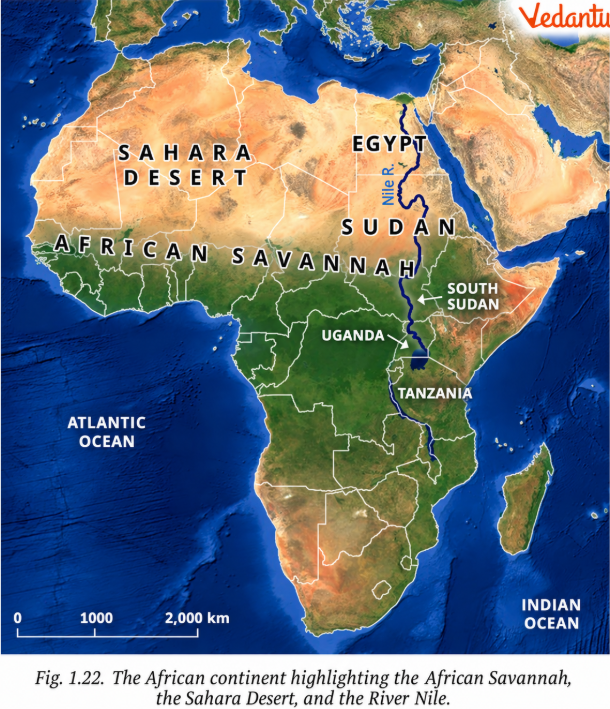
The River Nile originates in East Africa and generally flows northwards. Along its course, it passes through or borders Uganda, South Sudan, Sudan, and Egypt before emptying into the Mediterranean Sea.
The Nile is especially important in the dry regions of Sudan and Egypt, where it provides water and supports agriculture and human settlements.
LET’S EXPLORE
1. The Amazon Rainforest has been called the ‘Lungs of the Earth’. Why do you think this might be so?
Answer:
The Amazon Rainforest is called the ‘Lungs of the Earth’ because its vast vegetation plays an important role in the Earth's environmental and climate systems. It stores large amounts of carbon, supports the water cycle and contains enormous biodiversity.
The rainforest also provides a habitat for countless species and supports many indigenous communities. Its protection is therefore important for both the region and the planet.
2. The countries in this region need land for development but risk losing the Amazon Rainforest. Discuss in groups: What are the short- and long-term effects of deforestation, and how can we protect the Amazon for the planet?
Answer:
In the short term, clearing forests may provide land for agriculture, roads, settlements and other development activities. However, it also destroys habitats and can affect communities that depend on forests.
Over the long term, large-scale deforestation can reduce biodiversity, degrade soil, disrupt the water cycle, and change climate patterns.
The Amazon can be protected by controlling unnecessary deforestation, conserving important forest areas, using natural resources sustainably and involving indigenous and local communities in conservation.
LET’S EXPLORE
The Atacama Desert is famous for stargazing, offering some of the clearest night skies, and its rocky, Mars-like landscape has even been used by NASA to test rovers. However, it has also become one of the world’s fastest-growing dumps for discarded clothes, caused by the rise of cheap fast fashion. The UN has called this waste problem ‘an environmental and social emergency’.
Answer:
The Atacama Desert example shows how human consumption can create environmental problems even in remote natural landscapes. Large quantities of discarded fast-fashion clothes create waste that can remain in the environment for a long time.
Reducing unnecessary clothing purchases, reusing and recycling clothes, improving textile-waste management and encouraging responsible production can help reduce this problem.
Questions and activities
1. Why do all map projections have some amount of distortion?
Answer:
The Earth has a curved, three-dimensional surface, while a map is flat. When you represent the Earth's surface on a flat sheet, some characteristics cannot be shown perfectly. As a result, map projections may distort shape, area, distance or direction to some extent.
2. What makes the Tibetan Plateau unique?
Answer:
The Tibetan Plateau is unique because it is the world's highest and largest plateau, with an average elevation of more than 4,500 metres. It lies north of the Himalayas and contains extensive snow and ice.
It is sometimes called the ‘Third Pole’ because it holds vast freshwater reserves outside the polar regions. It also influences Asia's climate and is connected to the sources of several major rivers.
3. Why are coral reefs called the ‘rainforests of the sea’?
Answer:
Coral reefs are called the ‘rainforests of the sea’ because they support an extraordinary variety of marine life. They provide food, shelter and breeding areas for many organisms, including fish, crabs, turtles and sponges.
Like tropical rainforests on land, coral reefs support rich biodiversity despite covering only a small part of the Earth's surface.
4. How do the oceans help to regulate the Earth’s climate?
Answer:
Oceans absorb large amounts of heat and release it gradually, helping to regulate temperatures. They also supply moisture to the atmosphere, which contributes to cloud formation and rainfall.
Ocean currents redistribute warm and cold water around the planet. In this way, they influence temperatures and weather conditions, particularly in coastal regions.
5. What is the main reason for the Great Barrier Reef facing threats today?
Answer:
The Great Barrier Reef faces major threats from climate change and human activities. Rising ocean temperatures can cause coral bleaching, while pollution, overfishing and changes in ocean conditions can further damage the reef ecosystem.
Protecting marine environments and reducing the causes of climate change are important for the reef's long-term survival.
6. Why is the Amazon Rainforest often called the ‘Lungs of the Earth’?
Answer:
The Amazon Rainforest is often called the ‘Lungs of the Earth’ because its vast forest helps regulate the climate and maintain environmental balance. It stores carbon, supports the water cycle, and supports exceptional biodiversity.
It is also home to many indigenous communities and countless plant and animal species, making its conservation important for the entire planet.
7. Choose two different types of geographical features you have explored in this chapter. Write short paragraphs on how they influence the flora and fauna or human lives in that area. Do they also apply to the whole Globe?
Answer:
1. Mountains:
Mountains influence climate, vegetation, wildlife and human life. Different heights support different types of plants and animals. Mountains also store snow and glaciers, making them important sources of freshwater for rivers. People use this water for drinking, farming and other activities.
Their importance extends beyond the local region because mountain systems can influence climate, river systems, freshwater availability and biodiversity.
2. Rainforests:
Rainforests such as the Amazon contain a remarkable variety of plants and animals. They also support indigenous communities whose lives and livelihoods are closely connected with forests.
Rainforests matter globally because they store carbon, influence the water cycle, support biodiversity, and affect the climate. Therefore, damage to large rainforests can have consequences beyond their regions.
8. Discuss how oceans influence climate and trade. Use examples from the Indian and Pacific Oceans.
Answer:
Oceans influence climate by absorbing, storing and redistributing heat. Ocean currents affect temperatures and weather in coastal regions, while evaporation supplies moisture that contributes to rainfall.
Oceans are also major routes for international trade. The Indian Ocean connects important parts of Asia and Africa and has supported maritime trade for centuries. The Pacific Ocean, the world's largest ocean, provides important shipping routes connecting Asia, Oceania and the Americas.
Thus, oceans influence both the natural climate system and economic connections between countries.
9. Choose one environmental issue (deforestation, reef bleaching, or desertification) and explain its causes, impacts, and possible solutions.
Answer:
Environmental Issue: Deforestation
Causes:
- Clearing forests for agriculture and grazing
- Cutting trees for timber
- Construction of roads and settlements
- Mining and other development activities
- Forest fires
Impacts:
- Loss of wildlife habitats and biodiversity
- Increased soil erosion
- Disturbance of the water cycle
- Increased carbon dioxide in the atmosphere
- Effects on forest-dependent communities
Possible Solutions:
- Afforestation and reforestation
- Sustainable management of forests
- Controlling illegal logging
- Protecting important forest ecosystems
- Reducing unnecessary consumption of forest products
- Involving local and indigenous communities in conservation
10. Imagine you are a geographer asked to advise a government about protecting one major landscape in your country. Which one would you choose, and why?
Answer:
I would choose the Himalayas. They are important because they act as natural water towers, with snow and glaciers feeding many rivers. These rivers provide water for drinking, farming and other human activities.
The Himalayas also support rich biodiversity and influence the Indian subcontinent's climate. Protecting their forests, rivers, glaciers and ecosystems is therefore important for water security, biodiversity and environmental balance.
11. Imagine that someone is funding a group of you for a road trip across two continents. There are differences of opinion on which two they should be. Make a pitch for the ones you would like everyone to go to. Use a blank map, trace your route and locate the places on it, and try to convince the others of your point of view. You could use a variety of creative ways.
Answer:
I would choose Asia and Europe because the journey would let us experience a wide variety of landscapes, cultures, and historical places.
In Asia, the route could include the Himalayas, the Tibetan Plateau and major plains. We could then travel towards Europe and explore the European Plain and the Alps. On a blank map, we could mark these places and connect them to show our proposed route.
This trip would let us compare mountains, plateaus, and plains across two continents while also seeing how geography shapes people's lifestyles, settlements, and cultures.
Understand World Geography: Some Glimpses with NCERT Solutions
Understand the geographical terms, places, features and connections introduced in World Geography: Some Glimpses instead of simply memorising answers.
Use the NCERT Class 8 Social Science Chapter 1 Solutions alongside Exploring Society: India and Beyond, Part 2 to check textbook answers and revise important concepts.
Read the chapter first and then refer to the solutions to identify important points and write clearer answers in your own words.
Revise the solved questions before school assessments to strengthen your understanding of the chapter.
Download the NCERT Class 8 Social Science Chapter 1 Solutions PDF for convenient revision whenever required.
Related Study Materials for CBSE Class 8 Social Science Chapter 1 World Geography: Some Glimpses
Explore Chapter-Wise NCERT Solutions for Class 8 Social Science Part 2
Related Study Material for Class 8 Social Science
FAQs on Class 8 Social Science Chapter 1: World Geography: Some Glimpses Solutions
1. What is Class 8 Social Science Chapter 1 World Geography: Some Glimpses about?
The chapter introduces students to world geography and helps them understand important geographical features, regions and related concepts discussed in the Class 8 Social Science textbook.
2. Where can I find NCERT Solutions for Class 8 Social Science Chapter 1?
Students can use the chapter-wise NCERT solutions to check answers to the textbook questions from World Geography: Some Glimpses. It is better to attempt each question independently before referring to the solution.
3. How should I study World Geography: Some Glimpses in Class 8?
Read the chapter carefully and identify important geographical terms, places and concepts. After completing each section, revise the key points and practise the textbook questions to check your understanding.
4. Are the Class 8 Social Science Chapter 1 NCERT Solutions useful for exams?
Yes. The solutions can help students understand how to organise their answers and identify important points from the chapter. Students should also read the NCERT textbook thoroughly instead of depending only on solved answers.
5. How can I write better answers for Class 8 Social Science Chapter 1 World Geography: Some Glimpses?
Start with the main point asked in the question and then add the relevant geographical explanation or supporting details. Keep the answer clear and use appropriate terms from the chapter wherever required.
6. Can I download NCERT Class 8 Social Science Chapter 1 Solutions as a PDF?
Yes. You can download the chapter solutions as a PDF for convenient revision and reference from Vedantu.
7. Should I read the Chapter 1 World Geography: Some Glimpses before using the NCERT solutions?
Yes. Reading the chapter first helps you understand the context behind each question. Attempt the textbook questions yourself and then use the solutions to check and improve your answers.