


Class 9 Maths Chapter 8 Exercise 8.3 Solutions


1. Can you predict the number of squares in Stages 5 and 6 of the pattern? In Stages 10, 11 and 12? In Stage 20? At any stage? How is this different from the growing pattern in Fig. 8.3?
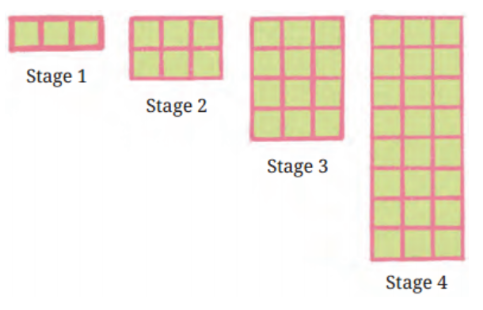
Fig. 8.6: A growing pattern of squares
Solution:
We observe that the number of squares increases in a consistent pattern. Each number is double the previous number.
Number of squares in each stage:
Stage 1: 3 squares
Stage 2: 6 squares (3 × 2)
Stage 3: 12 squares (3 × 2 × 2 = 3 × 2²)
Stage 4: 24 squares (3 × 2 × 2 × 2 = 3 × 2³)
This shows that the number of squares doubles at each stage. Following this pattern:
Stage 5: 3 × 2⁴ = 3 × 16 = 48 squares
Stage 6: 3 × 2⁵ = 3 × 32 = 96 squares
Stage 10: 3 × 2⁹ = 3 × 512 = 1536 squares
Stage 11: 3 × 2¹⁰ = 3 × 1024 = 3072 squares
Stage 12: 3 × 2¹¹ = 3 × 2048 = 6144 squares
Stage 20: 3 × 2¹⁹ = 3 × 524288 = 1572864 squares
Now, in the figure, the growth does not follow a strict multiplication rule. Instead, squares are added to specific positions. As the stages progress, new squares are added symmetrically, creating a different growth pattern.
In conclusion, the pattern in the figure shows exponential growth, with the number of squares doubling at each stage. The other pattern grows by adding and arranging squares rather than by simple multiplication.
Think and Reflect
1. Observe the Sierpinski triangle and try to answer the following questions
(a) How many black triangles are there in Stages 0 to 3 of Fig. 8.7?
(b) Can you predict the number of black triangles at Stages 4 and 5?
(c) Can you find a rule for the number of black triangles at the nth stage?
(d) Suppose the area of the triangle (that is, the black region) in Stage 0 is 1 square unit. What is the area of the black region in Stages 1,2 and 3? What will be the area of the black region in Stages 4 and 5? Find a rule for the area of the black region at the nth stage. What happens to this area as n, the number of stages, increases?
Solution:
(a) Let’s count the number of black triangles at each stage:
Stage 0: 1 = 3⁰ = 1 black triangle
Stage 1: 1 × 3 = 3¹ = 3 black triangles
Stage 2: 3 × 3 = 3² = 9 black triangles
Stage 3: 9 × 3 = 3³ = 27 black triangles
Total black triangles from Stage 0 to Stage 3:
1 + 3 + 9 + 27 = 40
Thus, there are 40 black triangles from Stage 0 to Stage 3.
(b) Each stage has 3 times the number of triangles in the previous stage.
Stage 4: 27 × 3 = 3⁴ = 81 black triangles
Stage 5: 81 × 3 = 3⁵ = 243 black triangles
Thus, Stage 4 has 81 black triangles, and Stage 5 has 243 black triangles.
(c) The number of black triangles forms a geometric progression with first term 1 (Stage 0) and common ratio 3.
Thus, the number of black triangles at the nth stage is:
tₙ = 3ⁿ
(d) Stage 0: Area of the black triangle = 1 sq. unit
Stage 1: Area = 3/4 of Stage 0 = 3/4 sq. unit
Stage 2: Area = 3/4 × 3/4 = (3/4)² sq. unit
Stage 3: Area = 3/4 × (3/4)² = (3/4)³ sq. unit
Therefore, the area at Stage n is:
Area at Stage n (Aₙ) = (3/4)ⁿ
As n increases, the black region's area decreases and approaches 0. Thus, the area of the black region in the Sierpinski triangle decreases exponentially as the number of stages increases.
Exercise Set 8.3
1. Find the 12th term of a GP with common ratio 2, whose 8th term is 192.
Solution:
We know that the nth term of a GP is:
tₙ = a × rⁿ⁻¹
Given: 8th term = 192 and common ratio = 2
192 = a × 2⁸⁻¹
⇒ 192 = a × 2⁷
⇒ 192 = a × 128
⇒ a = 12
Now, find the 12th term:
t₁₂ = 12 × 2¹²⁻¹
= 12 × 2¹¹
= 3 × 2¹⁰
= 3 × 1024
= 3072
Therefore, the 12th term is 3072.
2. Find the 10th and nth terms of the GP: 5, 25, 125, …
Solution:
Given that the GP is 5, 25, 125, …
Here, the first term (a) = 5
and the common ratio (r) = 25/5 = 5
Now, the 10th term of the GP:
t₁₀ = ar¹⁰⁻¹
= ar⁹
= 5(5)⁹
= (5)¹⁰
= 5¹⁰
The nth term of the GP:
tₙ = arⁿ⁻¹
= 5(5)ⁿ⁻¹
= 5ⁿ
*3. A sequence is given by the recursive rule t₁ = 2, tₙ ₁ = 3tₙ – 2 for n ≥ 1. Which term of the sequence is 730?
Solution:
We are given the recursive rule:
t₁ = 2, tₙ₊₁ = 3tₙ − 2, for n ≥ 1
To find which term is 730, we calculate the terms of the sequence.
t₁ = 2
t₂ = 3t₁ − 2
= 3 × 2 − 2
= 4
t₃ = 3t₂ − 2
= 3 × 4 − 2
= 10
t₄ = 3t₃ − 2
= 3 × 10 − 2
= 28
t₅ = 3t₄ − 2
= 3 × 28 − 2
= 82
t₆ = 3t₅ − 2
= 3 × 82 − 2
= 244
t₇ = 3t₆ − 2
= 3 × 244 − 2
= 730
Therefore, 730 is the 7th term of the sequence.
4. Which term of the GP: 2, 6, 18, … is 4374? Write the explicit formula as well as the recursive formula for the nth term.
Solution:
The given geometric progression (GP) is:
2, 6, 18, …
Here, the first term (a) = 2
Common ratio (r) = 3
The nth term of a geometric progression is given by:
tₙ = a × rⁿ⁻¹
We need to find the term tₙ = 4374.
Substituting a = 2 and r = 3:
4374 = 2 × 3ⁿ⁻¹
⇒ 2187 = 3ⁿ⁻¹
⇒ 3⁷ = 3ⁿ⁻¹
Therefore,
n − 1 = 7
n = 8
Thus, 4374 is the 8th term of the given GP.
5. A ball is dropped from a height of 80 metres. After hitting the ground, it bounces back to 60% of its previous height. It continues bouncing in this way — each time rising to 60% of the previous height.
(i) What height does the ball reach after the 5th bounce?
(ii) What is the total vertical distance the ball has travelled by the time it hits the ground for the 6th time?
Solution:
(i) The height after each bounce forms a geometric progression.
First term, a = 80 metres
Common ratio, r = 0.6
The nth term of the GP is:
tₙ = 80 × (0.6)ⁿ⁻¹
Therefore, the height of the ball after the 5th bounce:
t₆ = 80 × (0.6)⁶⁻¹
= 80 × (0.6)⁵
= 6.2208 m
Thus, the ball reaches a height of approximately 6.22 metres after the 5th bounce.
(ii) The total distance travelled is the sum of the distances fallen and risen. The ball falls 80 metres initially and then rises to 60% of the previous height after each bounce.
t₁ = 80
t₂ = 80 × 0.6 = 48 (after first bounce)
t₃ = 48 × 0.6 = 28.8 (after second bounce)
t₄ = 28.8 × 0.6 = 17.28 (after third bounce)
t₅ = 17.28 × 0.6 = 10.368 (after fourth bounce)
t₆ = 10.368 × 0.6 = 6.2208 (after fifth bounce)
The total distance is:
80 + 2 × (48 + 28.8 + 17.28 + 10.368 + 6.2208)
= 301.3376 m
Therefore, the ball travels a total vertical distance of approximately 301.34 m.
6. Which term of the sequence 22, 24, … is 128?
Solution:
We have the sequence:
2, 2√2, 4, …
Here,
(2√2) / 2 = √2
4 / (2√2) = √2
The ratio of consecutive pairs of terms is constant, √2.
Hence, the sequence is a GP with:
a = 2
r = √2
Let 128 be the nth term of the GP.
The nth term of a GP is:
tₙ = arⁿ⁻¹
Therefore,
128 = 2(√2)ⁿ⁻¹
⇒ (√2)ⁿ⁻¹ = 64
Since 64 = 2⁶ and √2 = 2¹ᐟ²,
(2¹ᐟ²)ⁿ⁻¹ = 2⁶
⇒ (n − 1)/2 = 6
⇒ n − 1 = 12
⇒ n = 13
Hence, the 13th term of the GP is 128.
7. Fig. 8.12 shows Stages 0 to 3 of the Sierpiński square carpet. Stage 0 of this fractal is a square sheet of paper. To construct Stage 1, trisect each side of the square and join the trisection points on opposite sides to obtain nine smaller squares. Then remove the centre square and retain the 8 smaller squares, leaving a square hole in the centre. Repeat the same process on the eight smaller shaded squares to obtain Stage 2, and so on.
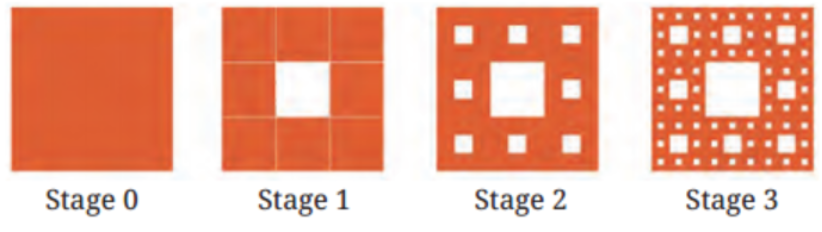
Fig. 8.12: Stages 0, 1, 2 and 3 of the Sierpiński square carpet
Look at Fig. 8.12 and try to answer the following questions.
(i) How many red squares are there in Stages 0 to 3?
(ii) Can you predict the number of red squares in Stages 4 and 5?
(iii) Can you find a rule for the number of red squares at the nth stage? Write the explicit formula as well as the recursive formula for the number of red squares at any stage.
(iv) Suppose the area of the square in Stage 0 is 1 square unit. What is the area of the red region in Stages 1, 2 and 3? What will be the area of the red region in Stages 4 and 5? Find the explicit as well as the recursive formula for the area of the red region at the nth stage. What happens to this area as n, the number of stages, increases?
Solution:
(i)
Stage 0: There is 1 red square.
Stage 1: The square is divided into 9 smaller squares, and 1 square is removed from the centre, leaving 8 red squares.
Stage 2: Each of the 8 smaller red squares in Stage 1 is divided into 9 smaller squares, and 1 square is removed from each. This leaves 64 red squares.
Stage 3: Each of the 64 smaller red squares in Stage 2 is divided into 9 smaller squares, and 1 square is removed from each. This leaves 512 red squares.
Now, we add the number of red squares from Stages 0 to 3:
1 + 8 + 64 + 512 = 585
Thus, there are 585 red squares in Stages 0 to 3.
(ii)
The number of red squares increases by a factor of 8 at each stage.
Stage 0: 1 red square
Stage 1: 8 red squares
Stage 2: 64 red squares
Stage 3: 512 red squares
Thus, the number of red squares is multiplied by 8 at each stage.
Therefore:
Stage 4: 512 × 8 = 4096 red squares
Stage 5: 4096 × 8 = 32768 red squares
Thus, the number of red squares at Stage 4 is 4096 and at Stage 5 is 32768.
(iii)
The number of red squares at each stage is given by:
tₙ = 8ⁿ
where tₙ is the number of red squares at Stage n.
This is because the number of red squares is multiplied by 8 at each stage.
The recursive formula is:
t₀ = 1
tₙ₊₁ = tₙ × 8, for n ≥ 0
(iv)
The total area of the square in Stage 0 is 1 square unit. As the Sierpinski carpet forms, each red square occupies a fraction of the previous stage's area.
In Stage 1, the square is divided into 9 smaller squares, and 8 are left. Therefore, each red square has an area of 1/9 of the original square.
Area of red region in Stage 1:
= 8 × 1/9
= 8/9 square units
In Stage 2, each of the 64 smaller red squares is divided into 9 smaller squares, and 1 square is removed from each.
Area of red region in Stage 2:
= 64 × (1/9)²
= 64/81 square units
= (8/9)² square units
In Stage 3, each of the 512 smaller red squares is divided into 9 smaller squares.
Area of red region in Stage 3:
= 512 × (1/9)³
= 512/729
= (8/9)³ square units
Therefore:
Explicit formula:
Aₙ = (8/9)ⁿ
Recursive formula:
Aₙ = (8/9)Aₙ₋₁, where A₀ = 1
The area of the red region at each stage follows the same pattern, decreasing by a factor of 8/9 from one stage to the next.
As n approaches infinity, (8/9)ⁿ approaches zero.
Why Use Class 9 Maths Chapter 8 Exercise 8.3 Solutions from Vedantu?
Class 9 Maths Chapter 8 Exercise 8.3 Solutions help students understand geometric progressions, recursive sequences and number patterns with clear explanations and step-by-step methods. These solutions follow the NCERT textbook approach, making it easier for students to solve questions, revise concepts and prepare effectively for exams.
Using Class 9 Maths NCERT Solutions for Chapter 8, Exercise 8.3 helps students learn correct problem-solving techniques and understand how to approach different question types in the exercise. The solutions also help students check their answers and improve their accuracy.
The NCERT Class 9 Maths Chapter 8 Exercise 8.3 Solutions
provide several benefits for students:
Helps in understanding important concepts of sequences and geometric progressions
Provides step-by-step solutions for exercise questions in PDF format for offline use
Helps students identify and correct mistakes
Makes revision faster and more effective
Improves problem-solving skills and confidence
Supports better preparation for school exams
Students can also use Class 9 Maths Chapter 8 Solutions PDF Ganita Manjari to practise regularly and strengthen their understanding through clear, easy-to-follow solutions.
Access Exercise-wise NCERT Solutions for Chapter 8 Maths Class 9
CBSE Class 9 Maths Chapter 8 Predicting What Comes Next: Exploring Sequences and Progressions Study Materials
Chapter-Specific NCERT Solutions for Class 9 Maths
Additional Study Materials for Class 9 Maths
FAQs on NCERT Solutions for Class 9 Maths Chapter 8 Exercise 8.3 | 2026-27
1. What topics are covered in Class 9 Maths Chapter 8 Exercise 8.3?
Exercise 8.3 covers geometric progressions, recursive sequences, nth-term formulas and pattern-based questions, including applications involving repeated bouncing and fractals.
2. Where can I find Class 9 Maths Chapter 8 Exercise 8.3 Solutions?
Students can find step-by-step solutions to Class 9 Maths Chapter 8 Exercise 8.3 on Vedantu to understand the questions and verify their answers.
3. Are Class 9 Maths Chapter 8 Exercise 8.3 Solutions available in PDF format?
Yes, students can use Vedantu’s Class 9 Maths Chapter 8 Exercise 8.3 Solutions PDF for revision and offline practice.
4. How can these solutions help with CBSE Class 9 Maths preparation?
The solutions explain each question step by step, help students understand the correct method, check their answers, and revise key concepts from Chapter 8.
5. What is the main concept in Exercise 8.3 ?
Exercise 8.3 mainly focuses on geometric progressions and sequences. Students also work with recursive rules, patterns and applications of these concepts.