



Exercise-wise Answers for Expressions using Letter-Numbers Class 7 Maths
4.1 The Notion of Letter-Numbers
NCERT In-Text Questions (Pages 81-83)
Example 1.
Shabnam is 3 years older than Aftab. When Aftab’s age 10 years, Shabnam’s age will be 13 years. Now, Aftab’s age is 18 years, what will Shabnam’s age be? ____________
Solution:
Shabnam’s age will be 18 + 3 = 21 years
Use this expression to find A’ftab’s age if Shabnam’s age is 20.
According to the given expression,
Aftab is 3 years younger than Shabnam.
So, if Shabnam is 20 years old, Aftab’s age = 20 − 3 = 17 years.
How much should she pay if she buys 8 coconuts and 9 kg jaggery?
Solution: The cost of 8 coconuts is calculated as 8 × ₹35 = ₹280.
The cost of 9 kg of jaggery is 9 × ₹60 = ₹540.
Therefore, the total cost = ₹280 + ₹540 = ₹820.
Use this expression (or formula) to find the total amount to be paid for 7 coconuts and 4 kg jaggery.
Solution: The expression for the total amount is c × 35 + j × 60.
Substituting c = 7 and j = 4, we get:
7 × 35 + 4 × 60
= 245 + 240
= 485
Therefore, the total cost for 7 coconuts and 4 kg of jaggery is ₹485.
What is the perimeter of a square with sidelength 7 cm? Use the expression to find out.
Solution: The perimeter of a square with side length q is given by 4 × q.
So, for a square with each side measuring 7 cm, the perimeter is:
4 × 7 cm = 28 cm.
Figure it Out (Pages 84-85)
Question 1.
Write formulas for the perimeter of:
(a) triangle with all sides equal.
(b) a regular pentagon (as we have learnt last year, we use the word ‘regular’ to say that all sidelengths and angle measures are equal)
(c) a regular hexagon.
Solution:
(a) If each side of the triangle is a, then its perimeter is 3a.
(b) If the side length of a regular pentagon is a, then its perimeter becomes 5a.
(c) If the side length of a regular hexagon is a, then its perimeter is 6a.
Question 2.
Munirathna has a 20 m long pipe. However, he wants a longer watering pipe for his garden. He joins another pipe of some length to this one. Give the expression for the combined length of the pipe. Use the letter-number ‘k’ to denote the length in meters of the other pipe.
Solution: Munirathna has a pipe that is 20 m long.
He wants to attach another pipe of length k meters.
So, the total length of the combined pipe becomes (20 + k) meters.
Question 3.
What is the total amount Krithika has, if she has the following number of notes ₹ 100, ₹ 20 and ₹ 5? Complete the following table:
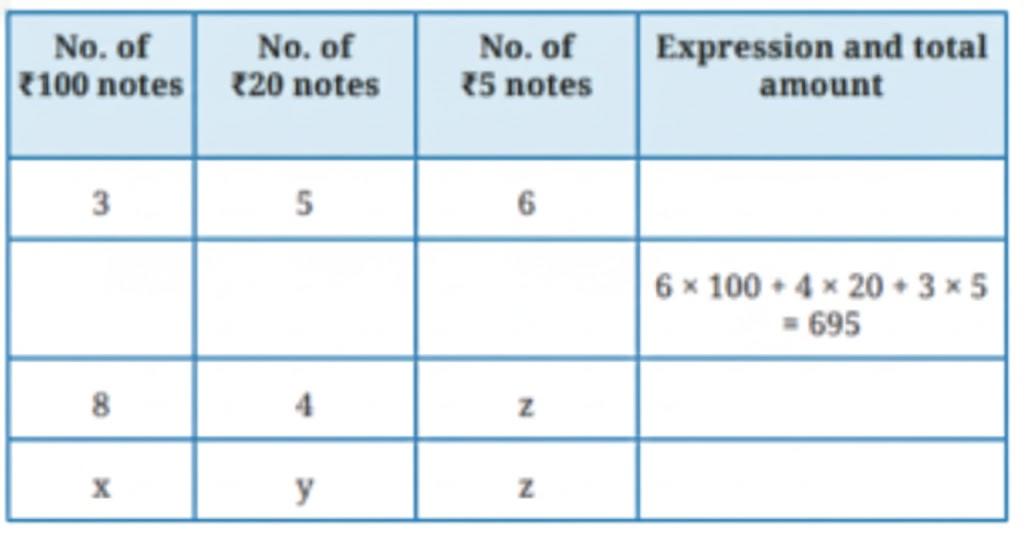
Solution:
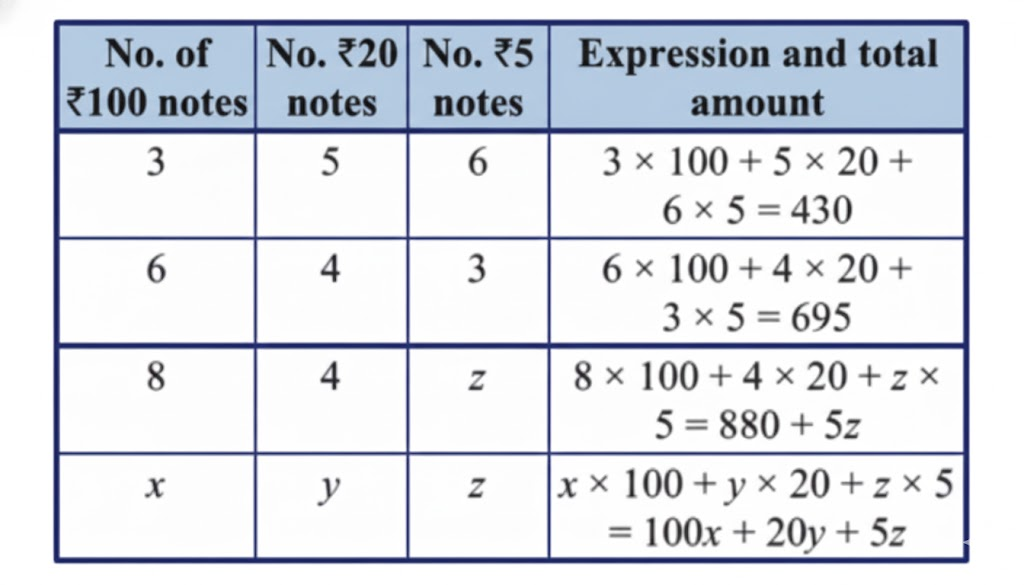
Question 4.
Venkatalakshmi owns a flour mill. It takes 10 seconds for the roller mill to start running. Once it is running, each kg of grain takes 8 seconds to grind into powder. Which of the expressions below describes the time taken to complete grind ‘y’ kg of grain, assuming the machine is off initially?
(a) 10 + 8 + y
(b) (10 + 8) × y
(c) 10 × 8 × y
(d) 10 + 8 × y
(e) 10 × y + 8
Solution:
The roller mill takes 10 seconds to start.
It needs 8 seconds to grind each kilogram of grain.
Therefore, the total time required to grind y kilograms of grain is:
10 + 8y
Thus, the expression 10 + 8y correctly represents the given situation.
Question 5.
Write algebraic expressions using letters of your choice.
(a) 5 more than a number
(b) 4 less than a number
(c) 2 less than 13 times a number
(d) 13 less than 2 times a number
Solution: Let letter ‘n’ represents the number, then
(a) n + 5
(b) n – 4
(c) 13 × n – 2
(d) 2 × n – 13
Question 6.
Describe situations corresponding to the following algebraic expressions:
(a) 8 × x + 3 × y
(b) 15 × j – 2 × k
Solution: (a) Kritika buys x notebooks and y pencils.
If each notebook costs ₹8 and each pencil costs ₹3, then the total amount she must pay is:
8x + 3y.
(b) Rohan earns ₹15 for each glass of lemonade he sells.
He gives a ₹2 discount for every glass that a customer returns to him.
If he sells j glasses and k glasses are returned, then his total earnings will be:
15j − 2k.
Question 7.
In a calendar month, if any 2 × 3 grid full of dates is chosen as shown in the picture, expression for the dates in the blank cells if the bottom middle cell has date ‘w’.
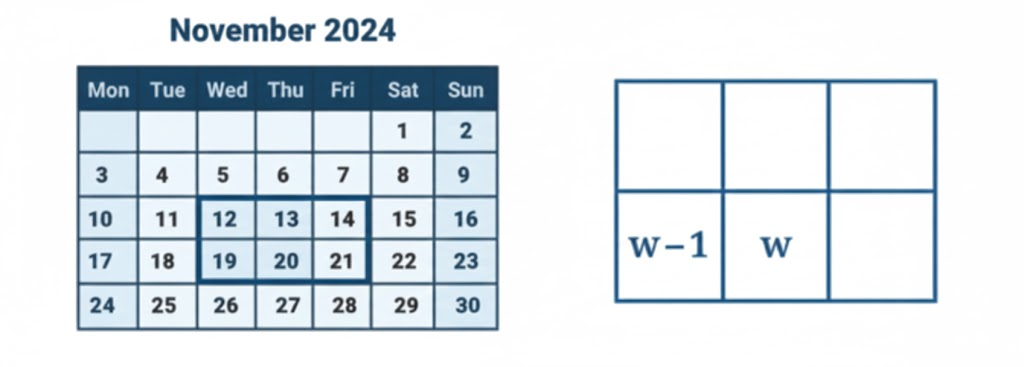
Solution:
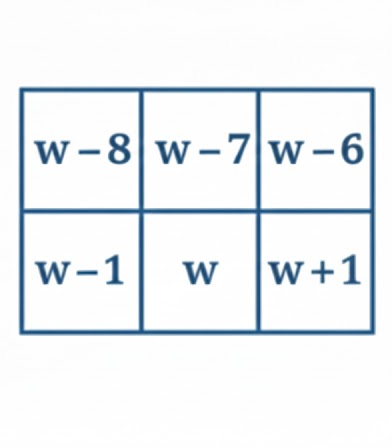
4.2 Revisiting Arithmetic Expressions
NCERT In-Text Questions (Pages 85-86)
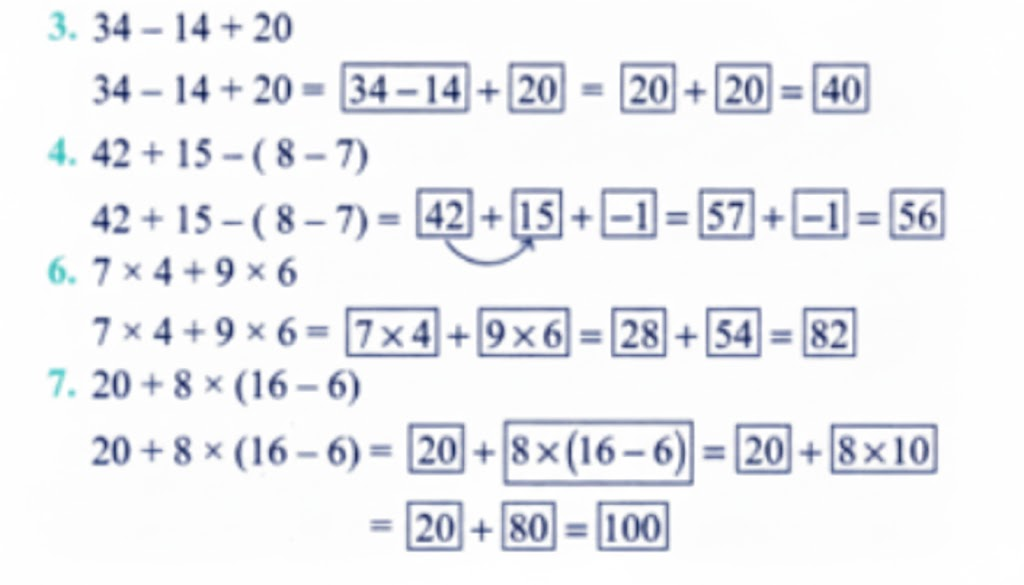
We learnt to write expressions as sums of terms, and it became easy for us to read arithmetic expressions. Many times, they could have been read in multiple ways, and it was confusing. We used swapping (adding two numbers in any order) and grouping (adding numbers by grouping them conveniently) to find easy ways of evaluating expressions. Swapping and grouping terms does not change the value of the expression. We also learnt to use brackets in expressions, including brackets with a negative sign outside. We learnt the distributive property (multiple of a sum is the same as sum of multiples).
Now, find the values of the other arithmetic expressions.
1. 23 – 10 × 2
2. 83 + 28 – 13 + 32
3. 34 – 14 + 20
4. 42 + 15 – (8 – 7)
5. 68 – (18 + 13)
6. 7 × 4 + 9 × 6
7. 20 + 8 × (16 – 6)
Solution:
Mind the Mistake, Mend the Mistake
NCERT In-Text Questions (Page 87)
Below are some simplifications, where the letter numbers are replaced by numbers, and the value of the expression is obtained.
1. Observe each of them and identify if there is a mistake.
2. If you think there is a mistake, try to explain what might have gone wrong.
3. Then, correct it and give the value of the expression.
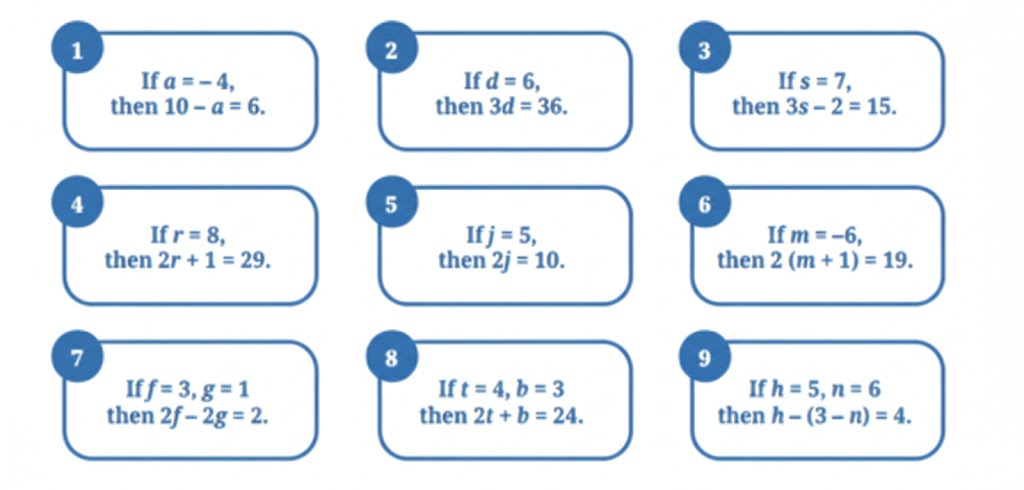
Solution:
1. When a = –4, the statement 10 – a = 6 is incorrect.
Since 10 – a = 10 – (–4) = 10 + 4 = 14,
the correct result is 10 – a = 14.
2. When d = 6, the statement 3d = 36 is wrong.
Because 3d = 3 × 6 = 18,
the correct expression is 3d = 18.
3. When s = 7, the statement 3s – 2 = 15 is incorrect.
As 3s – 2 = 3 × 7 – 2 = 21 – 2 = 19,
the correct expression is 3s – 2 = 19.
4. When r = 8, the statement 2r + 1 = 29 is wrong.
Since 2r + 1 = 2 × 8 + 1 = 16 + 1 = 17,
the correct value is 2r + 1 = 17.
5. When j = 5, the expression 2j = 10 is correct
because 2j = 2 × 5 = 10.
6. When m = –6, the statement 3(m + 1) = 19 is incorrect.
Since 3(m + 1) = 3(–6 + 1) = 3 × (–5) = –15,
the correct expression is 3(m + 1) = –15.
7. When f = 3 and g = 1, the statement 2f – 2g = 2 is wrong.
Because 2f – 2g = 2 × 3 – 2 × 1 = 6 – 2 = 4,
the correct value is 2f – 2g = 4.
8. When t = 4 and b = 3, the statement 2t + b = 24 is incorrect.
Since 2t + b = 2 × 4 + 3 = 8 + 3 = 11,
the correct expression is 2t + b = 11.
9. When h = 5 and n = 6, the statement h – (3 – n) = 4 is wrong.
Because h – (3 – n) = 5 – (3 – 6) = 5 – (–3) = 5 + 3 = 8,
the correct expression is h – (3 – n) = 8.
4.4 Simplification of Algebraic Expressions
NCERT In-Text Questions (Pages 88-89)
Example 5.
Here is a table showing the number of pencils and erasers sold in a shop. The price per pencil is c, and the price per eraser is d. Find the total money earned by the shopkeeper during these three days.
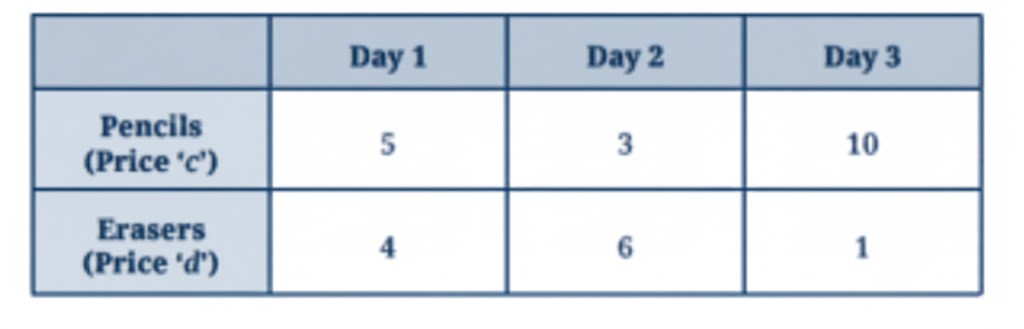
If c = ₹ 50, find the total amount earned by the sale of pencils.
Solution:
Total amount earned by the sale of pencils = (5 + 3 + 10) × c
= (5 + 3 + 10) × ₹ 50
= 18 × ₹ 50
= ₹ 900
Write the expression for the total money earned by selling erasers. Then, simplify the expression.
Solution: If the cost of one eraser is d, then the total money earned from selling them is:
4d + 6d + d
= (4 + 6 + 1)d
= 11d
So, the total earning from erasers is 11d.
Check that both expressions take the same value when c is replaced by different numbers.
Solution: If we take c = 5, then:
5c + 3c + 10c
= 5 × 5 + 3 × 5 + 10 × 5
= 25 + 15 + 50
= 40 + 50
= 90
Also,
18c = 18 × 5 = 90
So, when c = 5, both expressions give the same value.
The same can be checked for other values of c as well.
NCERT In-Text Questions (Pages 91-93)
Could we have written the initial expression as (40x + 75y) + (-6x – 10y)?
Solution:
Yes, as (40x + 75y) + (-6x – 10y)
= (40x + 75y) + -(6x + 10y)
= (40x + 75y) – (6x + 10y)
Example 8.
Charu has been through three rounds of a quiz. Her scores in the three rounds are 7p – 3q, 8p – 4q, and 6p – 2q. Here, p represents the score for a correct answer and q represents the penalty for an incorrect answer.
What are her scores in the second and third rounds?
Solution:
Her score in the second round = 8p – 4q
= 8 × 4 – 4 × 1 [As p = 4 and q = 1]
= 32 – 4
= 28
Her score in the third round = 6p – 2q
= 6 × 4 – 2 × 1 [As p = 4, q = 1]
= 24 – 2
= 22
What if there is no penalty? What will be the value of q in that situation?
Solution: If no penalty is charged, then the value of q becomes 0 in that case.
Give some possible scores for Krishita in the three rounds so that they add up to give 23p – 7q.
Solution: Krishita’s possible scores in three rounds could be:
8p – 4q, 9p – 2q, and 6p – q, or
7p – 3q, 10p – 3q, and 6p – q
Now, adding the first set of scores:
8p – 4q + 9p – 2q + 6p – q
= (8 + 9 + 6)p – (4 + 2 + 1)q
= 23p – 7q
Adding the second set of scores:
7p – 3q + 10p – 3q + 6p – q
= (7 + 10 + 6)p – (3 + 3 + 1)q
= 23p – 7q
So, in both cases, the total score comes out to be 23p – 7q.
Can we say who scored more? Can you explain why?
How much more has Krishita scored than Charu? This can be found by finding the difference between the two scores.
23p – 7q – (21p – 9q)
Simplify this expression further.
Solution:
23p – 7q – (21p – 9q)
= 23p – 7q – + 21p – 9q
= 23p – 21p – 7q + 9q
= 23p – 21p + 9q – 7q
= (23 – 21)p + (9 – 7)q
= 2p + 2q
= 2 × (p + q)
= 2(p + q)
The value of 2p + 2q is always positive as long as both p > 0 and q > 0 (since marks and penalties are positive). So, Krishita scored 2(p + q) marks more than Charu.
Fill in the blanks below by replacing the letter-numbers with numbers; an example is shown. Then compare the values that 5u and 5 + u take.
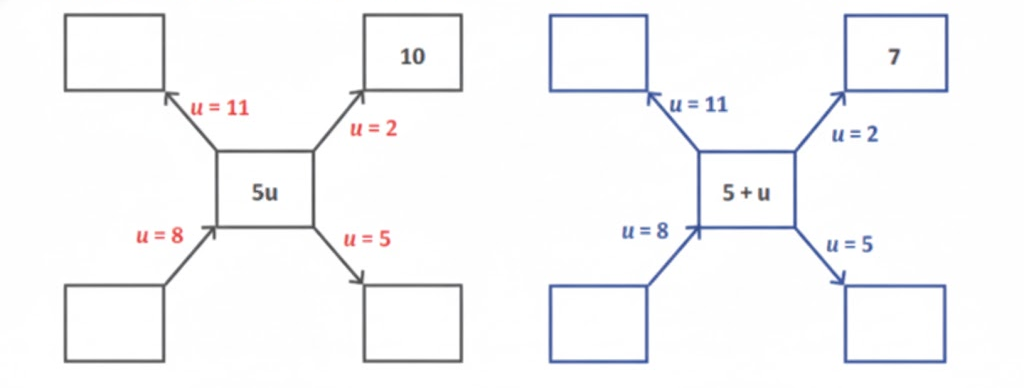
Solution:
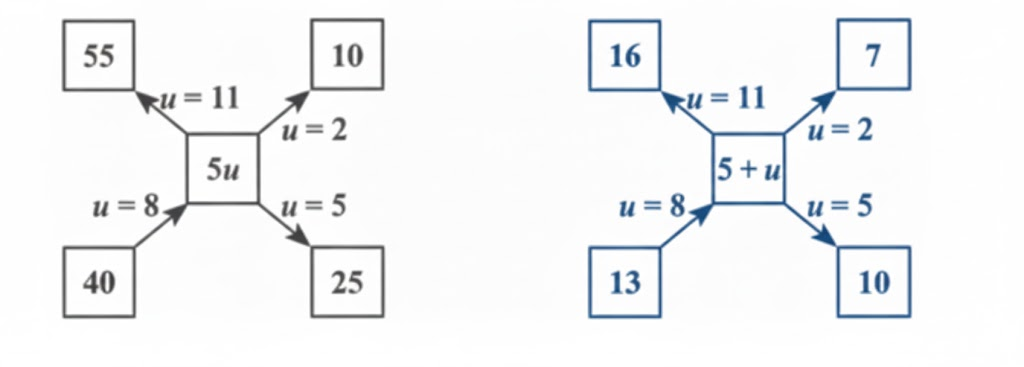
We observe that 5u and 5 + u give different results for different values of u.
Therefore, the two expressions 5u and 5 + u are not equal.
Question: Are the expressions 10y – 3 and 10(y – 3) equal?
10y – 3, short for 10 × y – 3, means 3 less than 10 times y,
10(y – 3), short for 10 × (y – 3), means 10 times (3 less than y).
Let us compare the values that these expressions take for different values of y.
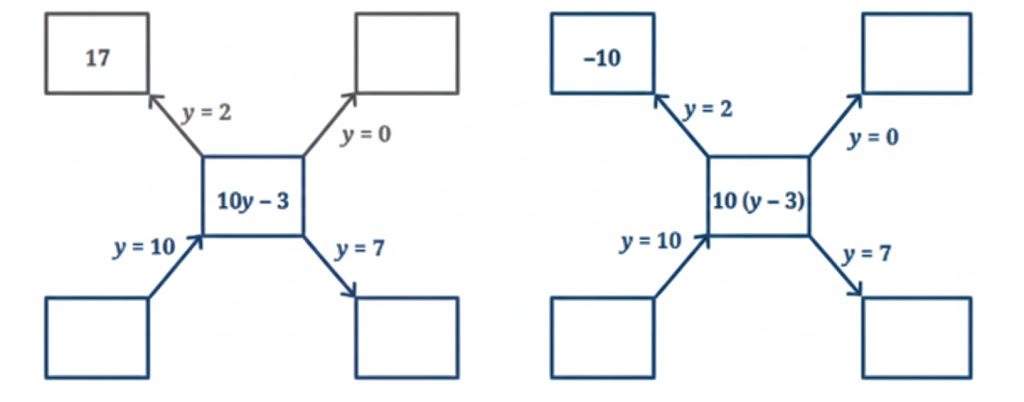
Solution:
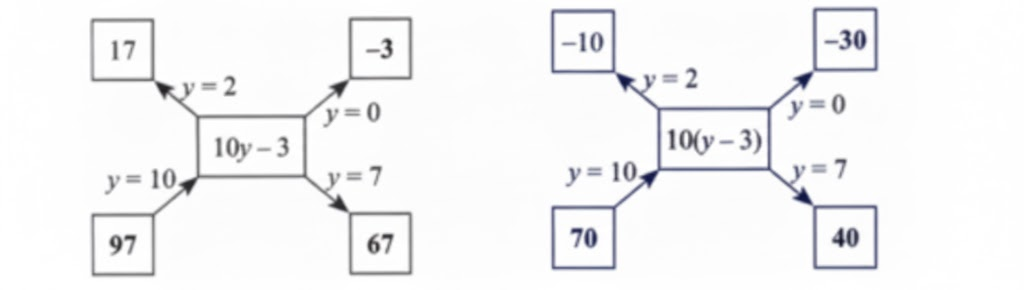
After filling in the two diagrams, do you think the two expressions are equal?
Solution:
We notice that 10y – 3 and 10(y – 3) give different results for various values of y.
Thus, the expressions 10y – 3 and 10(y – 3) are not equal.
Figure it Out (Pages 93-94)
Question 1.
Add the numbers in each picture below. Write their corresponding expressions and simplify them. Try adding the numbers in each picture in a couple of different ways and see that you get the same thing.
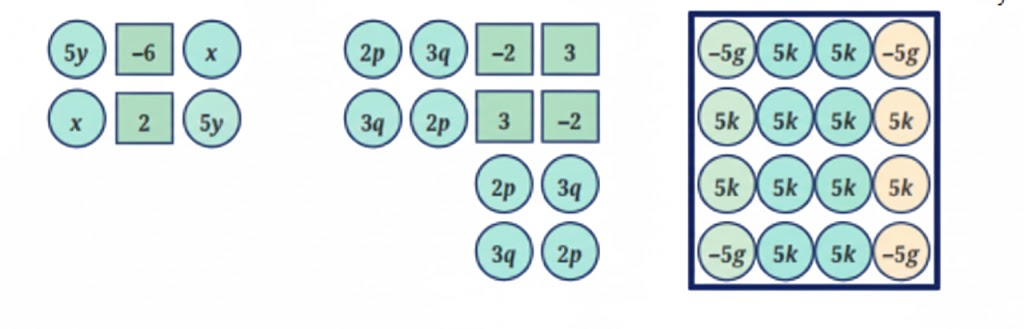
Solution:
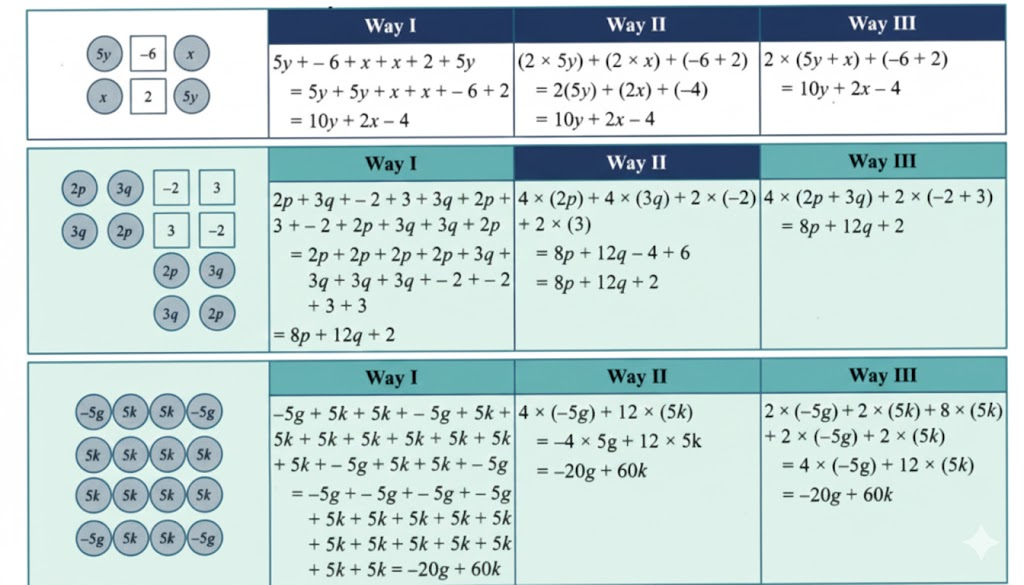
Thus, we observe that even if we group the expressions differently while adding, the final sum always remains the same.
Question 2.
Simplify each of the following expressions:
(a) p + p + p + p, p + p + p + q, p + q + p – q
(b) p – q + p – q, p + q – p + q
(c) p + q – (p + q), p – q – p – q
(d) 2d – d – d – d, 2d – d – d – c
(e) 2d – d – (d – c), 2d – (d – d) – c
(f) 2d – d – c – c
Solution:
(a) p + p + p + p = 4p
p + p + p + q = 3p + q
p + q + p – q = 2p
(b) p – q + p – q = 2p – 2q
p + q – p + q = 2q
(c) p + q – (p + q) = 0
p – q – p – q = -2q
(d) 2d – d – d – d = -d
2d – d – d – c = -c
(e) 2d – d – (d – c) = c
2d – (d – d) – c = 2d – c
(f) 2d – d – c – c = d – 2c
Mind the Mistake, Mend the Mistake
NCERT In-Text Questions (Pages 94-95)
Some simplifications of algebraic expressions are done below. The expression on the right-hand side should be in its simplest form.
Observe each of them and see if there is a mistake.
If you think there is a mistake, try to explain what might have gone wrong.
Then, simplify it correctly.
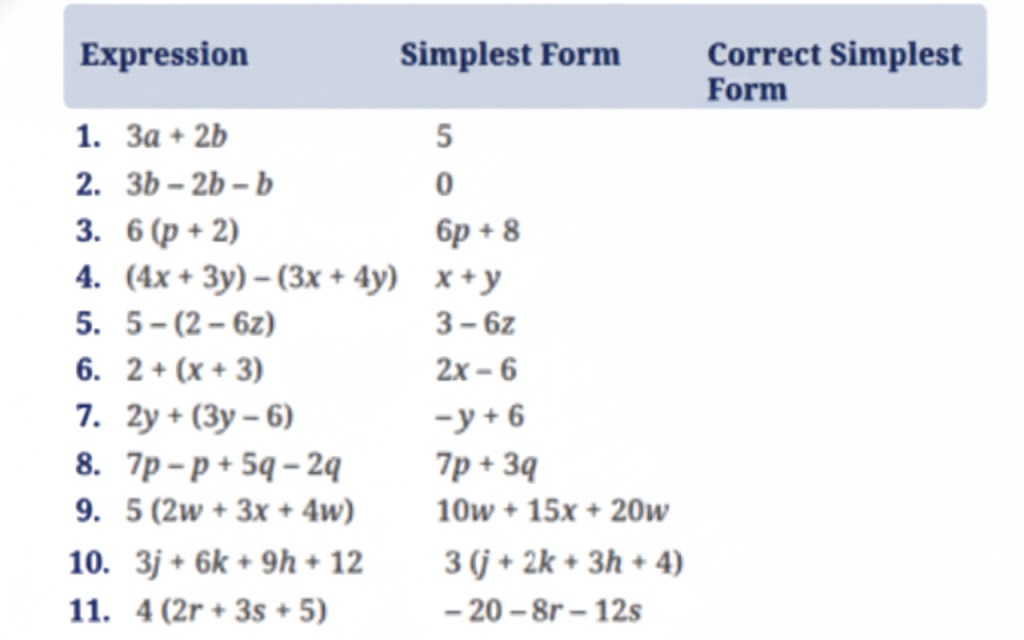
Solution:
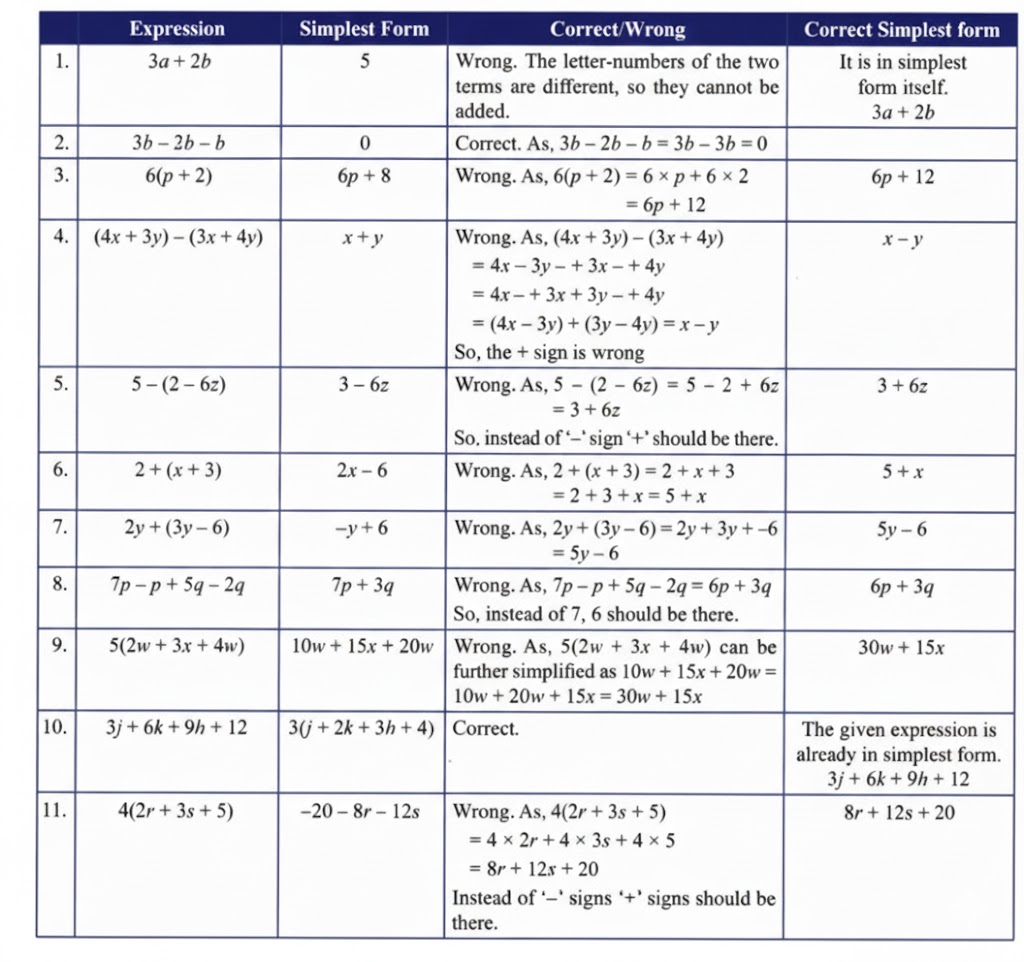
Take a look at all the corrected simplest forms (i.e., brackets are removed, like terms are added, and terms with only numbers are also added). Is there any relation between the number of terms and the number of letter-numbers these expressions have?
Solution: Yes.
If an expression includes a term that is only a number,
then:
Number of terms = Number of letter-terms + 1
If the expression has no term that contains only a number,
then:
Number of terms = Number of letter-terms
4.5 Pick Patterns and Reveal Relationships
Formula Detective
NCERT In-Text Questions (Pages 95-96)
Find out the formula of this number machine.
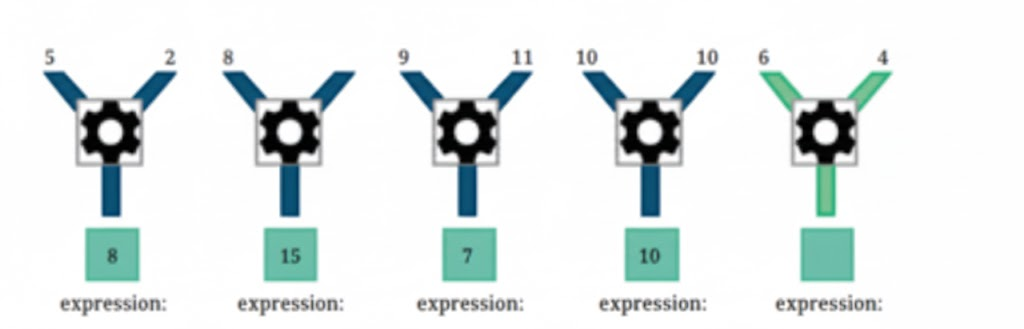
The formula for the number machine above is “two times the first number minus the second number”. When written as an algebraic expression, the formula is 2a-b. The expression for the first set of inputs is 2 × 5 – 2 = 8. Check that the formula holds for each set of inputs.
Solution: Yes, the formula is valid for each set of inputs.
For example:
2 × 8 – 1 = 15
2 × 9 – 11 = 7
2 × 10 – 10 = 10
2 × 6 – 4 = 8
Question: Find the formulas of the number machines below and write the expression for each set of inputs.
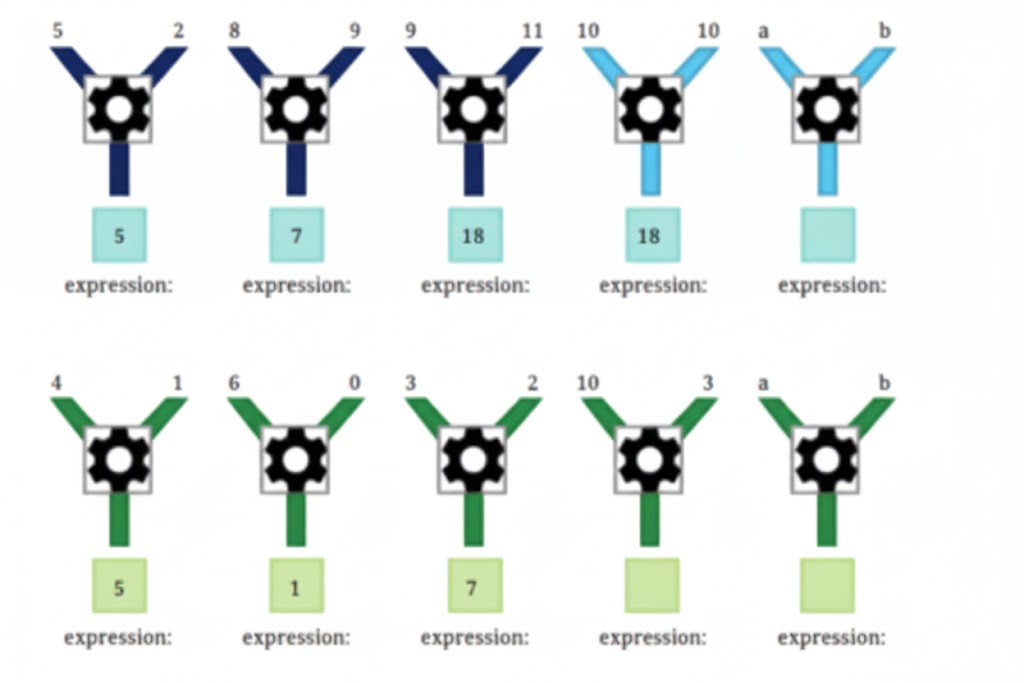
Solution:
The formula for the number machines in the first row is “sum of first number and second number minus two,” and the expression is a + b – 2.
The expression for each set of inputs is:
5 + 2 – 2 = 5, 8 + 1 – 2 = 7, 9 + 11 – 2 = 18, 10 + 10 – 2 = 18, and a + b – 2
The formula for the number machines in the second row is “product of first number and second number plus one,” and the expression is a × b + 1.
The expression for each set of inputs is:
4 × 1 + 1 = 5, 6 × 0 + 1 = 1, 3 × 2 + 1 = 7, 10 × 3 + 1 = 31, and a × b + 1 = ab + 1.
Now, make a formula on your own. Write a few number machines as examples using that formula. Challenge your classmates to figure it out!
Solution:
Students should do it by themselves.
Algebraic Expressions to Describe Patterns
NCERT In-Text Questions (Pages 96-97)
Example 12.
Somjit noticed a repeating pattern along the border of a saree.
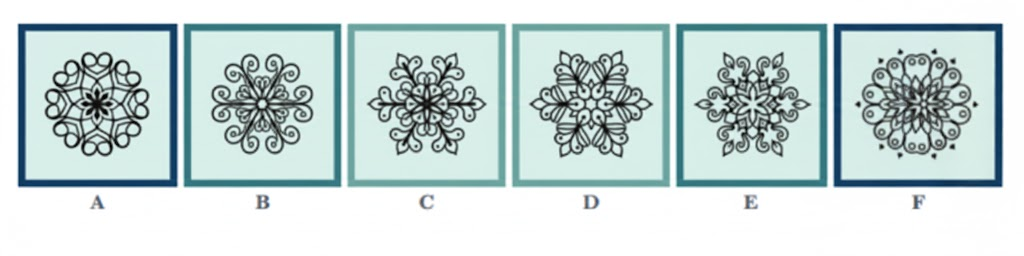
Use this to find what design appears at positions 99, 122, and 148.
Solution:
For 99, the remainder when divided by 3 is 0, which means 99 is a multiple of 3.
Therefore, design C will appear at position 99.
For 122, the remainder on dividing by 3 is 2, which means it is of the form 3n – 1.
So, design B will appear at position 122.
For 148, the remainder when divided by 3 is 1, meaning it is of the form 3n – 2.
Thus, design A will appear at position 148.
Patterns in a Calendar
NCERT In-Text Questions (Page 99)
Verify this expression for diagonal sums by considering any 2 × 2 square and taking its top left number to be ‘a’.
Solution:
Let a = 2, then
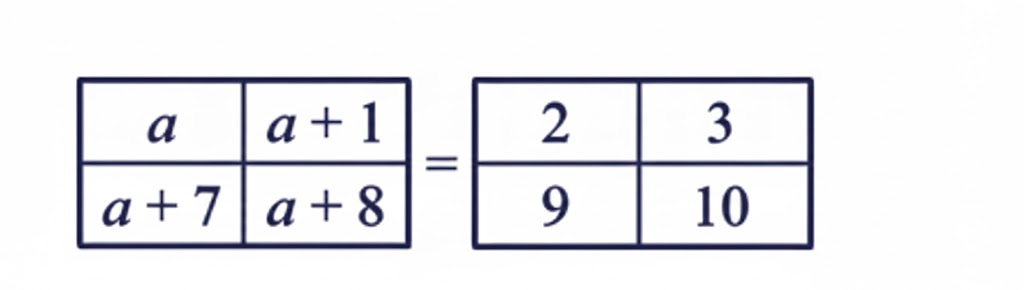
In this case, the diagonal sums are:
2 + 10 = 12 and 9 + 3 = 12.
Also,
2a + 8 = 2 × 2 + 8 = 12.
Therefore, the diagonal sum is equal to 2a + 8.
Find the sum of all the numbers. Compare it with the number in the centre: 15. Repeat this for another set of numbers that form this shape. What do you observe?
Solution: The total of all the numbers is:
8 + 14 + 15 + 16 + 22 = 75
This total is 5 times the number placed at the centre.
If the number at the centre is 20, then the figure becomes:
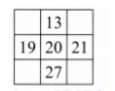
The total of all the numbers is:
13 + 19 + 20 + 21 + 27 = 100, and 100 = 20 × 5.
If the number at the centre is taken as 12, then the completed shape will look like this:
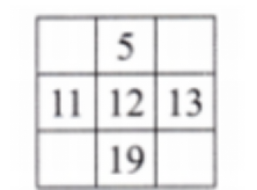
The sum of all the numbers is:
5 + 11 + 12 + 13 + 19 = 60, and 60 = 12 × 5.
Therefore, we observe that the total sum of the numbers is always 5 times the value placed at the centre.
Will this always happen? How do you show this?
Solution: The general formula for a 3 × 3 magic-type square with the centre number a can be represented as follows:
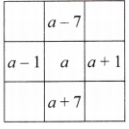
The total of all the numbers is:
(a – 7) + (a – 1) + a + (a + 1) + (a + 7)
= a + a + a + a + a – 7 – 1 + 1 + 7
= 5a
Thus, the sum of all the numbers in the square is always 5a, which is 5 times the centre number.
Find other shapes for which the sum of the numbers within the figure is always a multiple of one of the numbers.
Solution:
Students should do it by themselves.
Matchstick Patterns
Look at the picture below. It is a pattern using matchsticks. Can you identify what the pattern is?

We observe that Step 1 contains 1 triangle, Step 2 contains 2 triangles, Step 3 contains 3 triangles, and the pattern continues in the same way.
NCERT In-Text Questions (Page 101)
What are these numbers in Step 3 and Step 4?
Solution: In Step 3, there are 3 horizontal matchsticks and 4 diagonal matchsticks.
In Step 4, there are 4 horizontal matchsticks and 5 diagonal matchsticks.
How does the number of matchsticks change in each orientation as the steps increase? Write an expression for the number of matchsticks at Step ‘y in each orientation. Do the two expressions add up to 2y + 1?
Solution: The horizontal matchsticks follow the pattern 1, 2, 3, 4, …,
so, in general, the number of horizontal matchsticks in the nth step is n.
The diagonal matchsticks follow the pattern 2, 3, 4, 5, …,
so, in general, the number of diagonal matchsticks in the nth step is n + 1.
Therefore, at step y:
Horizontal matchsticks = y
Diagonal matchsticks = y + 1
Adding them gives:
y + (y + 1) = 2y + 1.
Figure it Out (Pages 102-105)
For the problems asking you to find suitable expression(s), first try to understand the relationship between the different quantities in the situation described. If required, assume some values for the unknowns and try to find the relationship.
Question 1.
One plate of Jowar roti costs ₹ 30, and one plate of Pulao costs ₹ 20. If x plates of Jowar roti and y plates of pulao were ordered in a day, which expression(s) describe the total amount in rupees earned that day?
(a) 30x + 20y
(b) (30 + 20) × (x + y)
(c) 20x + 30y
(d) (30 + 20) × x + y
(e) 30x – 20y
Solution:
(a) The cost of one plate of Jowar roti is ₹30,
so the cost of x plates is 30x.
The cost of one plate of Pulao is ₹20,
so the cost of y plates is 20y.
Therefore, the expression for the total amount earned that day is:
30x + 20y.
Question 2.
Pushpita sells two types of flowers on Independence Day: champak and marigold. ‘p’ customers only bought champak, ‘q’ customers only bought marigold, and ‘r’ customers bought both. On the same day, she gave away a tiny national flag to every customer. How many flags did she give away that day?
(a) p + q + r
(b) p + q + 2r
(c) 2 × (p + q + r)
(d) p + q + r + 2
(e) p + q + r + 1
(f) 2 × (p + q)
Solution: (a) Let the number of customers who bought only Champak be p,
those who bought only Marigold be q,
and those who bought both flowers be r.
Since Pushpita gave one tiny national flag to every customer,
the total number of flags she distributed that day is:
p + q + r.
Question 3.
A snail is trying to climb up the wall of a deep well. During the day it climbs up ‘u’ cm and during the night it slowly slips down ‘d’ cm. This happens for 10 days and 10 nights.
(a) Write an expression describing how far away the snail is from its starting position.
(b) What can we say about the snail’s movement if d > u?
Solution: a) During the daytime, the snail climbs u cm,
and during the night it slips down d cm.
So, the net distance covered in one full day is u – d.
In 10 days and 10 nights, the snail will cover a net distance of:
10(u – d) cm.
Thus, the expression that shows how far the snail is from its starting point after this duration is 10(u – d) cm.
(b) If d > u, the snail slips down more than it climbs up.
In this situation, the snail will never be able to reach the top.
Question 4.
Radha is preparing for a cycling race and practices daily. The first week, she cycles 5 km every day. Every week, she increases the daily distance cycled by ‘z’ km. How many kilometers would Radha have cycled after 3 weeks?
Solution: In the first week, Radha cycled 5 km each day.
So, in 7 days she cycled:
5 × 7 = 35 km
In the second week, she cycled (5 + z) km per day.
Thus, the total for the week is:
(5 + z) × 7 = 35 + 7z km
In the third week, her daily distance becomes 5 + z + z = 5 + 2z km.
So, in that week she cycles:
(5 + 2z) × 7 = 35 + 14z km
Therefore, the total distance Radha cycles in three weeks is:
35 + (35 + 7z) + (35 + 14z)
= (35 + 35 + 35) + (7z + 14z)
= 105 + 21z km
Question 5.
In the following figure, observe how the expression w + 2 becomes 4w + 20 along one path. Fill in the missing blanks on the remaining paths. The ovals contain expressions, and the boxes contain operations.
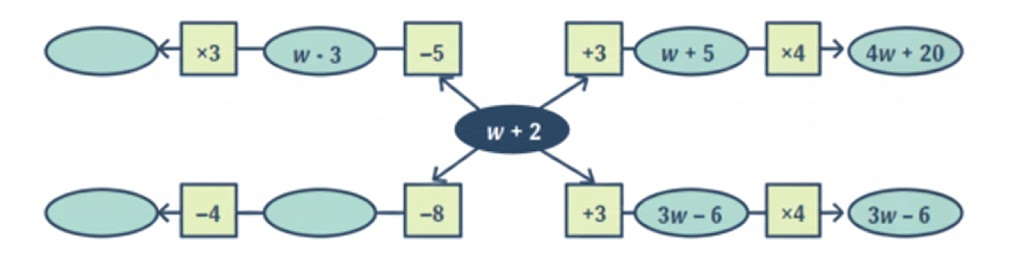
Solution:
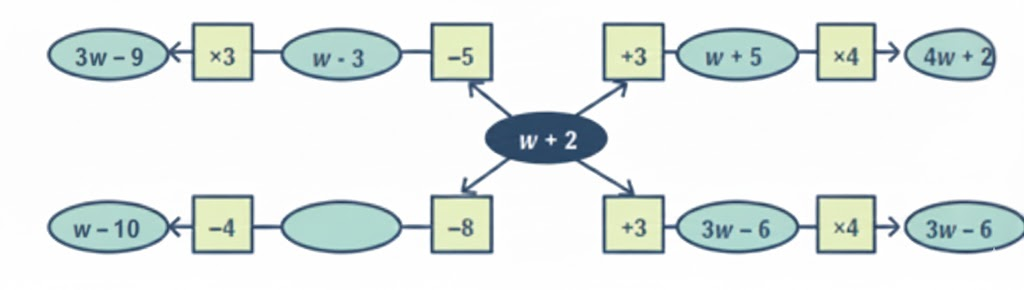
Question 6.
A local train from Yahapur to Vahapur stops at three stations at equal distances along the way. The time taken in minutes to travel from one station to the next station is the same and is denoted by t. The train stops for 2 minutes at each of the three stations.
(a) If t = 4, what is the time taken to travel from Yahapur to Vahapur?
(b) What is the algebraic expression for the time taken to travel from Yahapur to Vahapur?
[Hint: Draw a rough diagram to visualise the situation]
Solution:
The train travelling from Yahapur to Vahapur stops at 3 stations, and at each station it stops for 2 minutes.
Time taken for travelling between the stations = 4t.
For t = 4, the travelling time becomes:
4 × 4 = 16 minutes
Time spent during the stoppages = 3 × 2 = 6 minutes
Therefore, the total time taken to travel from Yahapur to Vahapur is:
16 + 6 = 22 minutes

(b)
Let the time taken to travel between two consecutive stations be t.
Then the total travelling time from Yahanpur to Vahapur is 4t.
Since the train stops 3 times, and each stop lasts 2 minutes,
the total stoppage time is:
3 × 2 = 6 minutes
Thus, the algebraic expression for the total travel time is:
4t + 6.
Question 7.
Simplify the following expressions:
(a) 3a + 9b – 6 + 8a – 4b – 7a + 16
(b) 3(3a – 3b) – 8a – 4b – 16
(c) 2(2x – 3) + 8x + 12
(d) 8x – (2x – 3) + 12
(e) 8h – (5 + 7h) + 9
(f) 23 + 4(6m – 3n) – 8n – 3m – 18
Solution:
(a) 3a + 9b – 6 + 8a – 4b – 7a + 16
= (3a + 8a – 7a) + (9b – 4b) + (-6 + 16)
= 4a + 5b + 10
(b) 3(3a – 3b) – 8a – 4b – 16
= 9a – 9b – 8a – 4b – 16
= (9a – 8a) + (-9b – 4b) – 16
= a – 13b – 16
(c) 2(2x – 3) + 8x + 12
= 4x – 6 + 8x + 12
= (4x + 8x) + (-6 + 12)
= 12x + 6
(d) 8x – (2x – 3) + 12
= 8x – 2x + 3 + 12
= 6x + 15
(e) 8h – (5 + 7h) + 9
= 8b – 5 – 7b + 9
= (8b – 7b) + (-5 + 9)
= b + 4
(f) 23 + 4(6m – 3n) – 8n – 3m – 18
= 23 + 24m – 12n – 8n – 3m – 18
= (23 – 18) + (24m – 3m) + (-12n – 8n)
= 5 + 21m – 20n
Question 8.
Add the expressions given below:
(a) 4d – 7c + 9 and 8c – 11 + 9d
(b) -6f + 19 – 8s and -23 + 13f + 12s
(c) 8d – 14c + 9 and 16c – (11 + 9d)
(d) 6f – 20 + 8s and 23 – 13f – 12s
(e) 13m – 12n and 12n – 13m
(f) -26m + 24n and 26m – 24n
Solution:
(a) 4d – 7c + 9 and 8c – 11 + 9d
= 4d – 7c + 9 + 8c – 11 + 9d
= (4d + 9d) + (-7c + 8c) + (9 – 11)
= 13d + c – 2
(b) -6f + 19 – 8s and -23 + 13f + 12s
= -6f + 19 – 8s + -23 + 13f + 12s
= (-6f + 13f) + (-8s + 12s) + (19 – 23)
= 7f + 4s – 4
(c) 8d – 14c + 9 and 16c – (11 + 9d)
= 8d – 14c + 9 + 16c – 11 – 9d
= 8d – 9d – 14c + 16c + 9 – 11
= -d + 2c – 2
= 2c – d – 2
(d) 6f – 20 + 8s and 23 – 13f – 12s
= 6f – 20 + 85 + 23 – 13f – 125
= (6f – 13f) + (8s – 12s) + (-20 + 23)
= -7f – 4s + 3
(e) 13m – 12n and 12n – 13m
= 13m – 12n + 12n – 13m
= (13m – 13m) + (-12n + 12n)
= 0
(f) -26m + 24n and 26m – 24n
= -26m + 24n + 26m – 24n
= (-26m + 26m) + (24n – 24n)
= 0
Question 9.
Subtract the expressions given below:
(a) 9a – 6b + 14 from 6a + 9b – 18
(b) -15x + 13 – 9y from 7y – 10 + 3x
(c) 17g + 9 – 7h from 11 – 10g + 3h
(d) 9a – 6b + 14 from 6a – (9b + 18)
(e) 10x + 2 + 10y from -3y + 8 – 3x
(f) 8g + 4h – 10 from 7h – 8g + 20
Solution:
(a) (6a + 9b – 18) – (9a – 6b + 14)
= 6a + 9b – 18 – 9a + 6b – 14
= (6a – 9a) + (9b + 6b) + (-18 – 14)
= -3a + 15b – 32
(b) (7y – 10 + 3x) – (-15x + 13 – 9y)
= 7y – 10 + 3x + 15x – 13 + 9y
= (7y + 9y) + (3x + 15x) + (-10 – 13)
= 16y + 18x – 23
(c) (11 – 10g + 3h) – (17g + 9 – 7h)
= 11 – 10g + 3h – 17g – 9 + 7h
= (11 – 9) + (-10g – 17g) + (3h + 7h)
= 2 – 27g + 10h
= 10h – 27g + 2
(d) 6a – (9b + 18) – (9a – 6b + 14)
= 6a – 9b – 18 – 9a + 6b – 14
= (6a – 9a) + (-9b + 6b) + (-18 – 14)
= -3a – 3b – 32
= -(3a + 3b + 32)
(e) (-3y + 8 – 3x) – (10x + 2 + 10y)
= -3y + 8 – 3x – 10x – 2 – 10y
= (-3y – 10y) + (-3x – 10x) + (8 – 2)
= -13y – 13x + 6
(f) (7h – 8g + 20) – (8g + 4h – 10)
= 7h – 8g + 20 – 8g – 4h + 10
= (7h – 4h) + (-8g – 8g) + (20 + 10)
= 3h – 16g + 30
Question 10.
Describe situations corresponding to the following algebraic expressions:
(а) 8x + 3y
(b) 15x – 2x
Solution: (a)
The cost of one notebook is ₹8, and the cost of one pen is ₹3.
If you purchase x notebooks and y pens, then the total amount you spend is:
₹(8x + 3y).
(b)
A fruit seller has 15 boxes of apples, with x apples in each box.
Before selling, he discovers that 2 boxes are rotten.
So, the number of fresh apples remaining is:
15x – 2x
= 13x.
Question 11.
Imagine a straight rope. If it is cut once as shown in the picture, we get 2 pieces. If the rope is folded once and then cut as shown, we get 3 pieces. Observe the pattern and find the number of pieces if the rope is folded 10 times and cut. What is the expression for the number of pieces when the rope is folded r times and cut?
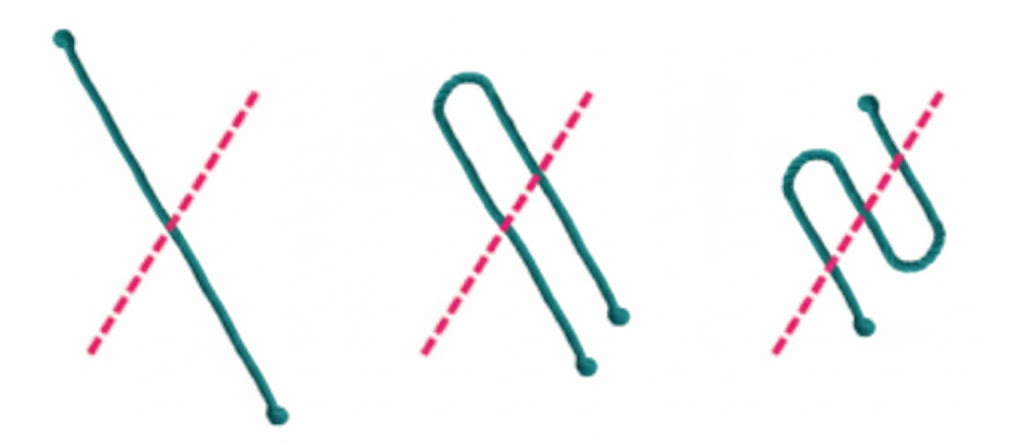
Solution:
Step 1 (0 fold): We get 0 + 2 = 2 pieces
Step 2 (1 fold): We get 1 + 2 = 3 pieces
Step 3 (2 folds): We get 2 + 2 = 4 pieces
In the same way, if the rope is folded 10 times and cut, we get 10 + 2 = 12 pieces.
In the same way, when the rope is folded r times and cut, we get r + 2 pieces.
Question 12.
Look at the matchstick pattern below. Observe and identify the pattern. How many matchsticks are required to make 10 such squares? How many are required to make w squares?
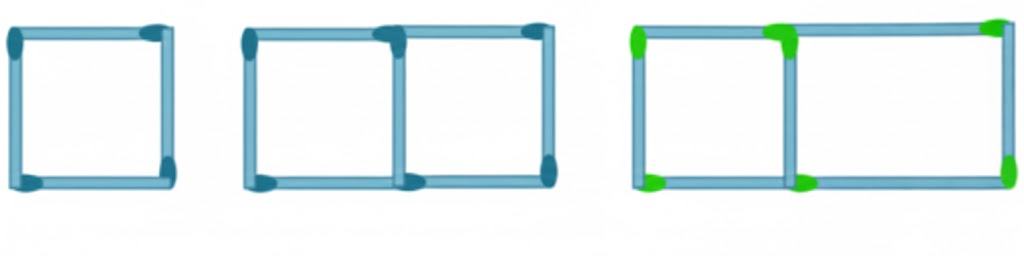
Solution:
Step 1: To make 1 square, we need 4 matchsticks.
Step 2: To make 2 squares, we need 4 + 3 = 7 matchsticks
Step 3: To make 3 squares, we need 4 + 3 + 3 = 10 matchsticks.
And to make w squares we need = 4 + (w – 1) × 3
= 4 + 3(w – 1)
= (4 + 3w – 3)
= 3w + 1 matchsticks.
To make 10 squares, substitute 10 for w:
3(10) + 1 = 30 + 1 = 31 matchsticks
Question 13.
Have you noticed how the colours change in a traffic signal? The sequence of colour changes is shown below. Find the colour at positions 90, 190, and 343. Write expressions to describe the positions for each colour.
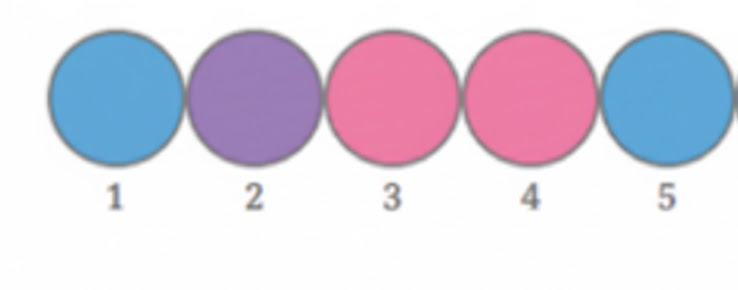
Solution:
The sequence for the red light appears at positions:
1, 5, 9, …
In general, these positions are of the form 4n – 3.
The sequence for the green light appears at positions:
3, 7, 11, …
In general, these positions are of the form 4n – 1.
The sequence for the yellow light appears at positions:
2, 4, 6, …
In general, these follow 2n positions (all even numbers).
Since 90 and 190 are even, they fall under 2n, so both are yellow.
For 343:
343 ÷ 4 = 85 remainder 3.
A remainder of 3 corresponds to a 4n – 1 pattern,
so position 343 is green.
Therefore, the colours at positions 90, 190, and 343 are:
yellow, yellow, and green, respectively.
Question 14.
Observe the pattern below. How many squares will be there in Step 4, Step 10, Step 50? Write a general formula. How would the formula change if we want to count the number of vertices of all the squares?

Solution:
In step 1, the number of squares is 5.
In step 2, it becomes: 5 + 4 = 9
In step 3, it becomes: 5 + 4 + 4 = 5 + 2×4 = 13
In step 4, it becomes: 5 + 3×4 = 17
Following this pattern:
Number of squares in step 10 = 5 + 9×4 = 41
Number of squares in step 50 = 5 + 49×4 = 201
Thus, the general formula for the number of squares in step n is:
5 + (n – 1)×4
= 5 + 4(n – 1)
= 5 + 4n – 4
= 4n + 1
Since 1 square has 4 vertices,
the number of vertices in (4n + 1) squares is:
4 × (4n + 1) = 16n + 4.
Question 15.
Numbers are written in a particular sequence in this endless 4-column grid.
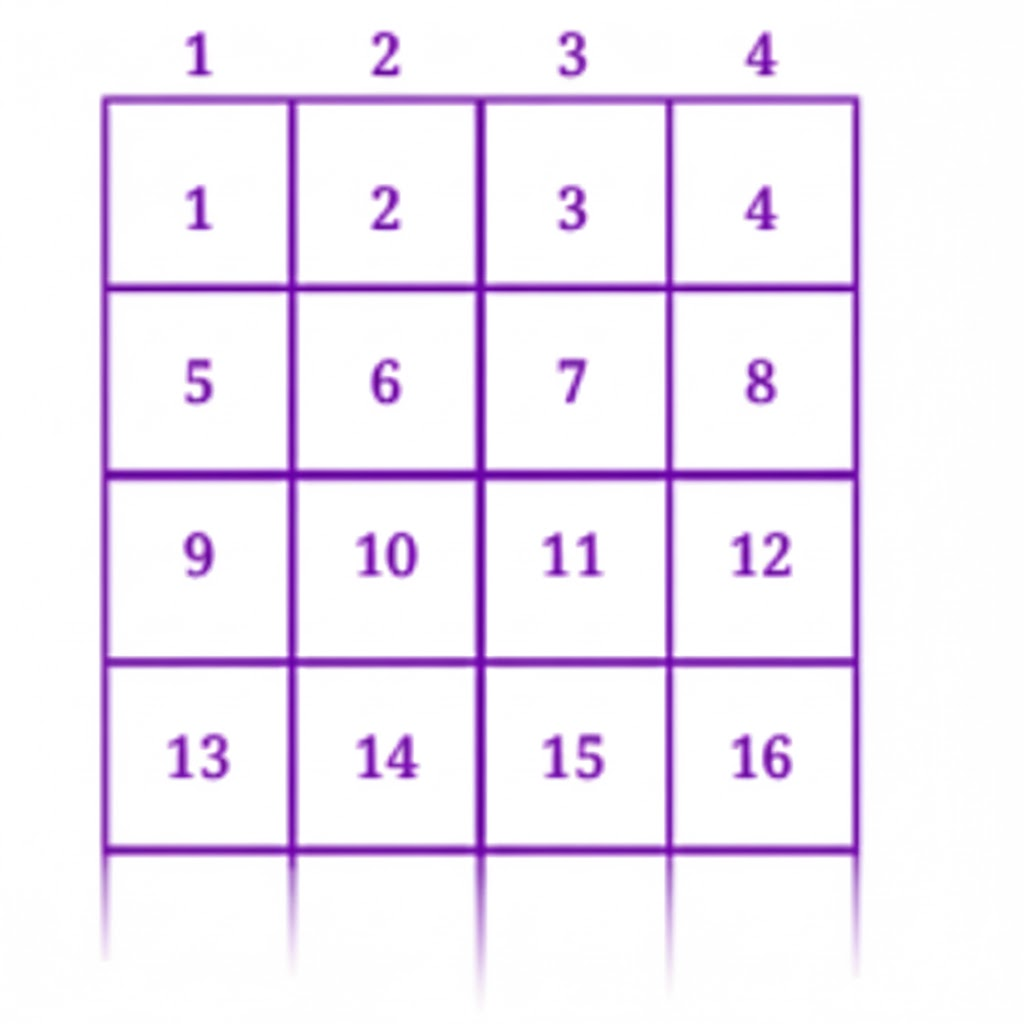
(a) Give expressions to generate all the numbers in a given column (1, 2, 3, 4).
(b) In which row and column will the following numbers appear:
(i) 124
(ii) 147
(iii) 201
(c) What number appears in row r and column c?
(d) Observe the positions of multiples of 3.
Do you see any pattern in it? List other patterns that you see.
Solution:
(a) Expression to generate all numbers in a given column (1, 2, 3, 4)
Let r be the row number.
Column 1 has the numbers: 1, 5, 9, 13, …
This sequence starts at 1 and increases by 4 each time.
So, the number in the r-th row is:
4(r – 1) + 1Column 2: 4(r – 1) + 2
Column 3: 4(r – 1) + 3
Column 4: 4(r – 1) + 4
Thus, if c is the column number, the general formula for any number is:
4(r – 1) + c
(b) Locating the row and column of given numbers
(i) For 124
124 ÷ 4 = 31 remainder 0
So,
124 = 4 × 30 + 4
Comparing with 4(r – 1) + c:
r – 1 = 30 → r = 31
c = 4
So, 124 appears in row 31, column 4.
(ii) For 147
147 ÷ 4 = 36 remainder 3
So,
147 = 4 × 36 + 3
Comparing with 4(r – 1) + c:
r – 1 = 36 → r = 37
c = 3
So, 147 appears in row 37, column 3.
(iii) For 201
201 ÷ 4 = 50 remainder 1
So,
201 = 4 × 50 + 1
Comparing with 4(r – 1) + c:
r – 1 = 50 → r = 51
c = 1
So, 201 appears in row 51, column 1.
(c) General formula
The number that appears in row r and column c is:
4(r – 1) + c
(d) Observations
Every third number in the entire grid is a multiple of 3.
All even numbers appear in column 2 and column 4.
All odd numbers appear in column 1 and column 3.
Each row contains 2 odd numbers and 2 even numbers.
The sum of each row increases by 16.
Example:
Row 1: 1 + 2 + 3 + 4 = 10
Row 2: 5 + 6 + 7 + 8 = 26
Row 3: 9 + 10 + 11 + 12 = 42
Key Concepts of Expressions using Letter-Numbers
Mastering Expressions using Letter-Numbers in Class 7 Maths is vital for building strong algebraic thinking. This chapter introduces concise ways of expressing relationships and patterns, which is a foundation for higher-level problem-solving in mathematics.
Practicing NCERT Solutions for Class 7 Maths Chapter 4 (2026-27) ensures you understand algebraic expressions, formulas, and pattern-based questions. Use clear step-by-step approaches for all exercise types—this strengthens both your understanding and exam confidence.
Regular revision of exercise-based answers will help you tackle MCQs and reasoning questions more efficiently. Focus on applying the core concepts to different scenarios to improve your performance and boost your maths score.
FAQs on NCERT Solutions For Class 7 Maths Chapter 4 Expressions - 2026-27 Free PDF Download (Sign-in Required)
1. What are NCERT Solutions for Class 7 Maths Chapter 4 Expressions using Letter-Numbers?
NCERT Solutions for Class 7 Maths Chapter 4 Expressions using Letter-Numbers offer stepwise answers to all textbook exercises, helping students master key concepts.
Highlights:
- Based on the latest CBSE 2026–27 syllabus
- Includes solved exercises and back questions
- Helps build exam confidence and clarity
- Available with free PDF download for offline study
2. How should I write stepwise NCERT answers for full marks in Class 7 Maths Chapter 4?
To score full marks in NCERT-based school exams, your answers for Chapter 4 should:
- Start with a clear statement of the given data
- Show every calculation step logically and sequentially
- Use correct mathematical notation and terms
- Highlight keywords like 'expression', 'variable', etc.
- Include a final answer box if required
3. Which topics from Expressions using Letter-Numbers are most important for exams?
The most important topics for exams in Chapter 4 are:
- Understanding and forming expressions using letters and numbers
- Using variables and distinguishing between constants and variables
- Writing expressions for word problems
- Applying rules of operations on algebraic expressions
- Solving intext and back exercises
4. Are diagrams or definitions compulsory in Class 7 Maths Chapter 4 exam answers?
Including definitions is advisable when questions ask for concept explanation.
Diagrams are not typically needed in this chapter, as it focuses on expressions, not geometry. However:
- Write precise definitions for terms like variable and constant as per NCERT
- Draw a simple box or highlight if asked to show the final form of an expression
5. Where can I download Class 7 Maths Chapter 4 NCERT Solutions PDF for free?
You can download the NCERT Solutions for Class 7 Maths Chapter 4 free PDF from trusted educational platforms.
Look for one-click PDF access and ensure the content is aligned with CBSE 2026–27.
6. How do I structure long answers in Class 7 Maths for better marks?
To structure long answers:
- Begin with a stepwise statement of what is given
- List formulae or rules used
- Show every calculation logically with clear steps
- Write the final result or conclusion in a separate line or box
- Use proper terminology as per the NCERT syllabus
7. What are key definitions and formulae needed for Class 7 Chapter 4 Expressions using Letter-Numbers?
Key definitions and formulae for Chapter 4 include:
- Variable: A letter that can take different values
- Constant: A value that does not change
- Expression: A combination of numbers, variables, and operations
- Algebraic expression: An expression with both numbers and letters
8. How can I revise Expressions using Letter-Numbers quickly before an exam?
Quick revision tips for Chapter 4 Expressions using Letter-Numbers:
- Review definitions and key formulae from your notes
- Practice exercise-wise NCERT solutions
- Try a 1-day, 3-day, or 7-day revision plan
- Attempt sample papers and MCQs for self-assessment
9. Do examiners award partial marks for correct steps even if the final answer is wrong in NCERT Maths?
Yes, in CBSE Class 7 Maths marking, partial marks are usually awarded for correct steps, even if the final answer is incorrect due to minor calculation mistakes.
- Show all calculation steps clearly
- Use labelled steps for each part
10. Are these NCERT solutions enough to score full marks in Class 7 Maths exams?
NCERT Solutions for Class 7 Maths Chapter 4 are usually sufficient for school exams if you:
- Practice all exercise and intext questions
- Revise key definitions, examples, and formulae
- Avoid common mistakes by careful stepwise work
