




How to Write Stepwise Answers for Number Play in Class 7 Maths
NCERT Solutions for Class 7 Maths Chapter 6 Number Play (2026-27)
6.1 Numbers Tell Us Things
NCERT In-Text Questions (Pages 127-128)
What do the numbers in the figure below tell us?
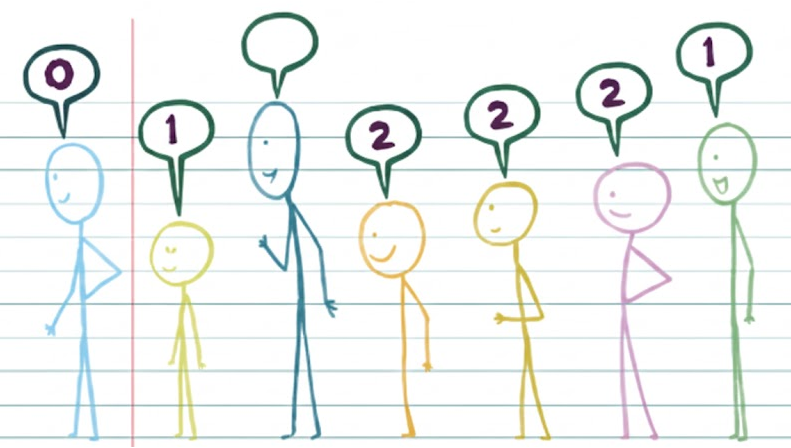
Solution: Yes, in both arrangements, the number spoken by each child follows the given rule correctly.
Write down the number each child should say based on this rule for the arrangement shown below.

Solution:
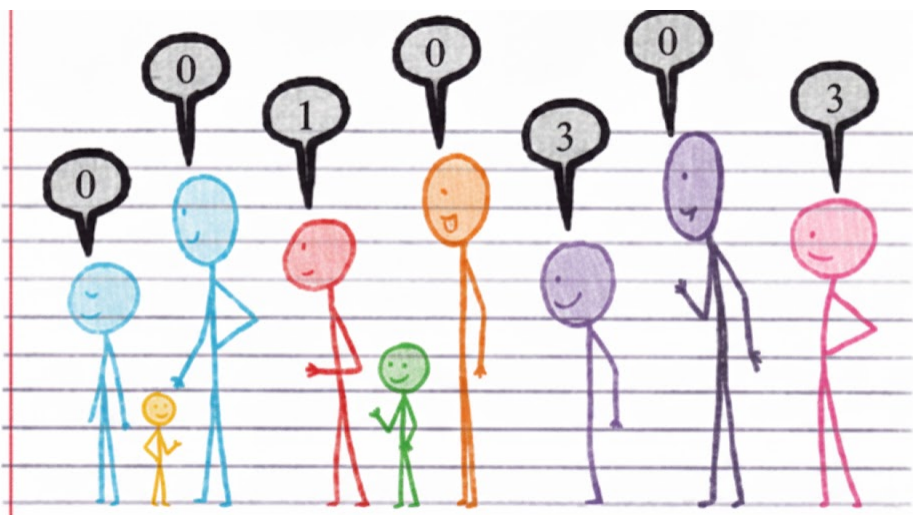
Figure it Out (Page 128)
Question 1. Arrange the stick figure cutouts given at the end, or draw a height arrangement such that the sequence reads:
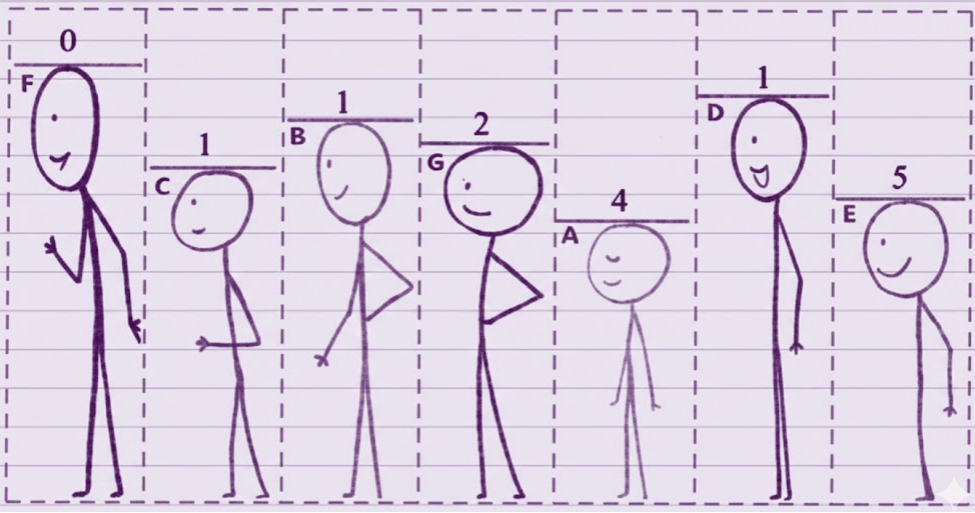
(a) 0, 1, 1, 2, 4, 1, 5
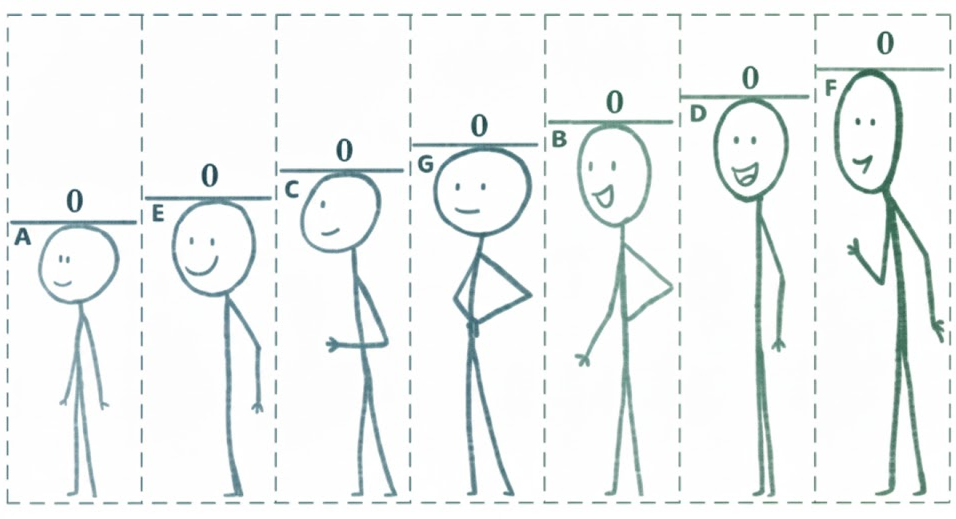
(b) 0, 0, 0, 0, 0, 0, 0
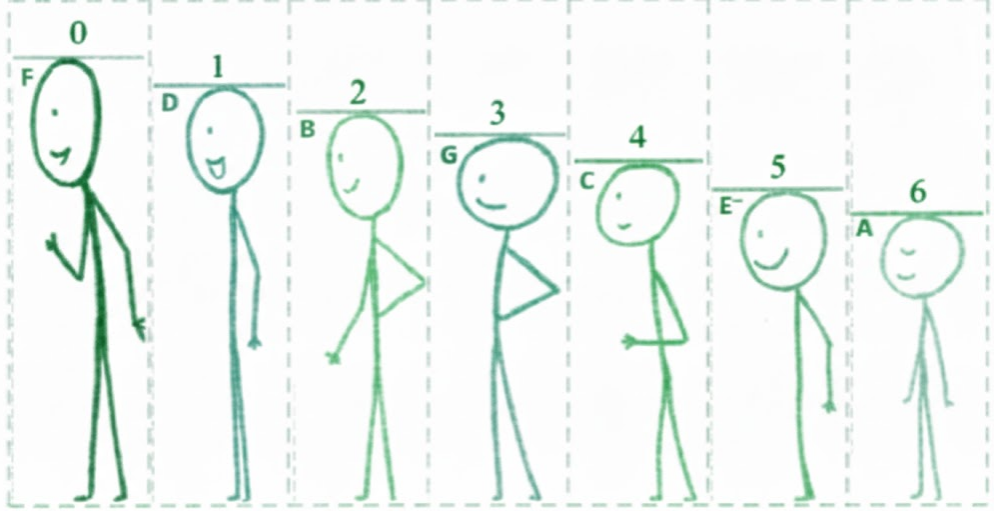
(c) 0, 1, 2, 3, 4, 5, 6
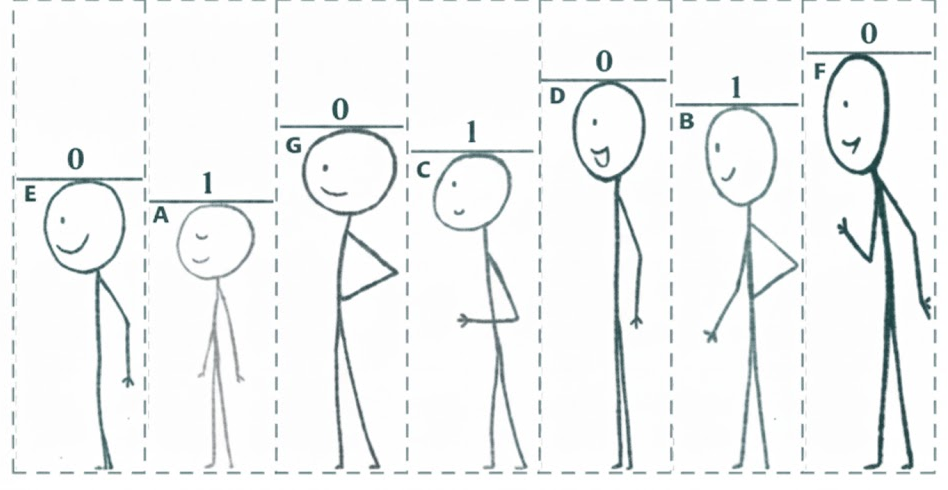
(d) 0, 1, 0, 1, 0, 1, 0
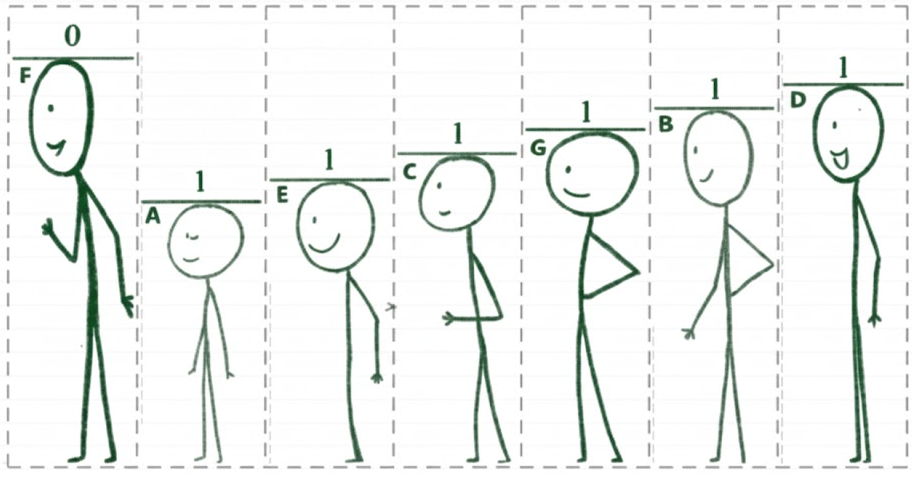
(e) 0, 1, 1, 1, 1, 1, 1
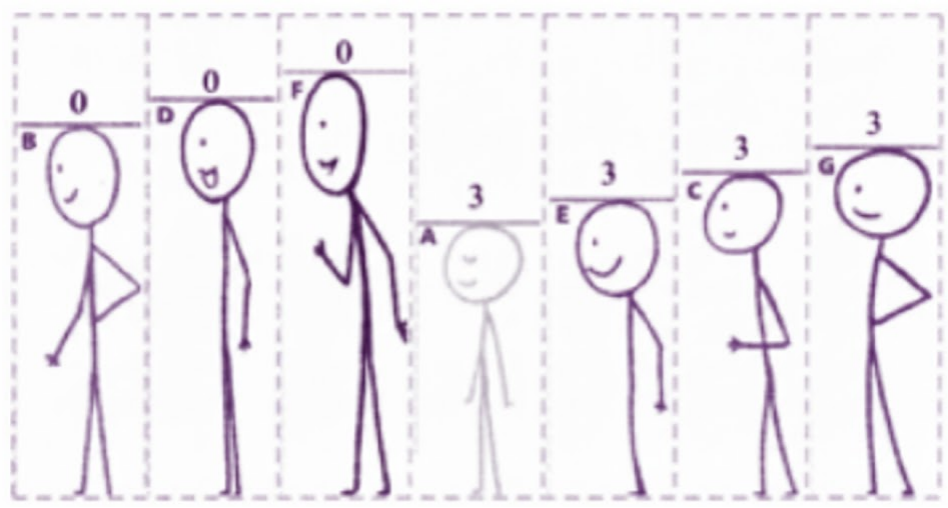
(f) 0, 0, 0, 3, 3, 3, 3
Solution:
(a) The required arrangement is FCBGADE
(b) The required arrangement is AECGBDF.
(c) The required arrangement is FDBGCEA.
(d) The required arrangement is EAGCDBF.
(e) The required arrangement is FAECGBD
(f) The required arrangement is BDFAECG.
Question 2. For each of the statements given below, think and identify if it is Always True, Only Sometimes True, or Never True. Share your reasoning.
(a) If a person says ‘0’, then they are the tallest in the group.
(b) If a person is the tallest, then their number is ‘0’.
(c) The first person’s number is ‘0’.
(d) If a person is not first or last in line (i.e., if they are standing somewhere in between), then they cannot say ‘0’.
(e) The person who calls out the largest number is the shortest.
(f) What is the largest number possible in a group of 8 people?
Solution:
(a) Only Sometimes True
A person says ‘0’ when they see no one taller than themselves.
The tallest person will always say 0, but a shorter person can also say 0 if they are standing at the front or in any position where no taller person is ahead of them.
So, the statement is only sometimes true.
(b) Always True
The tallest person has no one taller than them.
So they will always say 0.
Thus, this statement is always true.
(c) Always True
The first person in the line has no one standing ahead of them, so they will always say 0, regardless of their height.
Hence, this statement is always true.
(d) Only Sometimes True
A person standing in the middle can still say 0 if there are no taller people in front of them.
Therefore, this statement is only sometimes true.
(e) Only Sometimes True
The person who says the largest number sees the most taller people ahead of them, but this does not mean they are the shortest overall.
For example, the shortest person might stand at the front and say 0, while someone slightly taller but standing at the back may say the largest number.
So, this statement is only sometimes true.
(f)
If there are 8 people, the shortest person sees all 7 others as taller.
Therefore, the maximum number anyone can say is 7.
6.2 Picking Parity
NCERT In-Text Questions (Pages 129-131)
Kishor has some number cards and is working on a puzzle: There are 5 boxes, and each box should contain exactly 1 number card. The numbers in the boxes should sum to 30. Can you help him fid a way to do it?
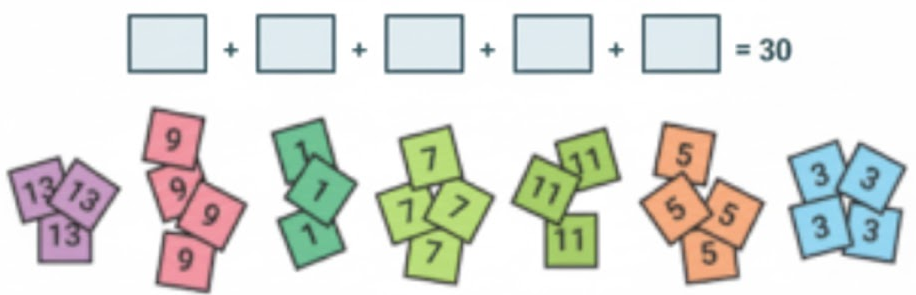
Can you figure out which 5 cards add to 30? Is it possible?
Solution:
No, it is not possible, because the sum of five odd numbers is always odd, while 30 is even. Therefore, five odd numbers can never add up to 30.
Explore what happens to the sum of (a) 4 odd numbers, (b) 5 odd numbers, and (c) 6 odd numbers.
Solution:
(a)
The sum of 4 odd numbers is:
1 + 3 + 5 + 7 = 16, which is an even number.
Since it is even, the total can be arranged in pairs.
(b)
The sum of 5 odd numbers is:
1 + 3 + 5 + 7 + 9 = 25, which is odd.
An odd total cannot be arranged in pairs.
(c)
The sum of 6 odd numbers is:
1 + 3 + 5 + 7 + 9 + 11 = 36, which is even.
So, this can also be arranged in pairs.
Figure it Out (Page 131)
Question 1. Using your understanding of the pictorial representation of odd and even numbers, find out the parity of the following sums:
(a) Sum of 2 even numbers and 2 odd numbers (e.g., even + even + odd + odd)
(b) Sum of 2 odd numbers and 3 even numbers
(c) Sum of 5 even numbers
(d) Sum of 8 odd numbers
Solution:
(a)
Even + Even = Even, and Odd + Odd = Even.
Adding these two even results gives:
Even + Even = Even
So, the final result is even.
Example:
2 + 4 + 3 + 5 = 6 + 8 = 14 (Even)
(b)
Odd + Odd = Even, and Even + Even + Even = Even.
Adding both even totals gives:
Even + Even = Even
Thus, the final sum is even.
Example:
3 + 5 + 2 + 4 + 6 = 8 + 12 = 20 (Even)
(c)
The sum of any five even numbers is always even, because adding even numbers always results in an even number.
So, the final parity is even.
Example:
2 + 4 + 6 + 8 + 10 = 30 (Even)
(d)
Odd + Odd = Even.
Here, we have 4 such pairs.
Adding these four even results gives:
Even + Even + Even + Even = Even
Hence, the final result is even.
Example:
1 + 3 + 5 + 7 + 9 + 11 + 13 + 15 = 64 (Even)
Question 2. Lakpa has an odd number of ₹ 1 coins, an odd number of ₹ 5 coins, and an even number of ₹ 10 coins in his piggy bank. He calculated the total and got ₹ 205. Did he make a mistake? If he did, explain why. If he didn’t, how many coins of each type could he have?
Solution:
Lapka has an odd number of ₹1 coins, so their total value is odd.
He also has an odd number of ₹5 coins, so their total value is also odd.
The number of ₹10 coins is even, so their total value is even.
Now,
Odd (₹1 coins) + Odd (₹5 coins) = Even
Adding the even total from the ₹10 coins:
Even + Even = Even
But the amount Lapka claims to have is ₹205, which is an odd number.
Since the total must be even based on the parity of his coins, getting ₹205 is not possible.
Therefore, Lakpa made a mistake.
Question 3. We know that:
(a) even + even = even
(b) odd + odd = odd
(c) even + odd = odd
Similarly, find out the parity for the following scenarios:
(d) even – even = ___________________
(e) odd – odd = ___________________
(f) even – odd = ___________________
(g) odd – even = ___________________
Solution:
(d) even – even
Example:
6 – 2 = 4 → even
8 – 4 = 4 → even
Parity of result = even
∴ even – even = even
(e) odd-odd
Example:
7 – 3 = 4 → even
9 – 5 = 4 → even
Parity of result = even
∴ odd – odd = even
(f) even-odd
Example:
8 – 3 = 5
12 – 5 = 7
Parity of result = odd
∴ even – odd = odd
(g) odd-even
Example:
7 – 2 = 5
9 – 6 = 3
Parity of result = odd
∴ odd – even = odd
Small Squares in Grids
NCERT In-Text Questions (Pages 131-132)
In a 3 × 3 grid, there are 9 small squares, which is an odd number. Meanwhile, in a 3 × 4 grid, there are 12 small squares, which is an even number.
Given the dimensions of a grid, can you tell the parity of the number of small squares without calculating the product?
Solution:
Yes, we can determine whether the total number of small squares in a grid is even or odd without multiplying the full dimensions. We only need to look at whether each dimension is even or odd.
Rule:
The product of two numbers is even if at least one of them is even.
The product is odd only when both numbers are odd.
Find the parity of the number of small squares in these grids:
(a) 27 × 13
(b) 42 × 78
(c) 135 × 654
Solution:
(a)
Both 27 and 13 are odd numbers.
Since Odd × Odd = Odd,
the total number of small squares is odd.
(b)
Both 42 and 78 are even numbers.
Since Even × Even = Even,
the total number of small squares is even.
(c)
135 is odd, and 654 is even.
Since Odd × Even = Even,
the total number of small squares is even.
Parity of Expressions
NCERT In-Text Questions (Pages 132-133)
Consider the algebraic expression: 3n + 4.
For different values of n, the expression has different parity:
Come up with an expression that always has even parity.
Some examples are: 100p and 48w – 2. Try to find more.
Solution:
Expressions such as 2p + 10, 8n, 6m – 2, and similar ones have even parity, because every term in them is even, and the sum or difference of even numbers remains even.
Come up with other expressions, like 3n + 4, which could have either odd or even parity.
Solution:
Expressions like 3n + 4 can have either odd or even parity, depending on the value of the variable.
Other examples of such expressions are 5k – 2, n + 5, and similar forms.
Are there expressions that we can use to list all the even numbers?
Hint: All even numbers have a factor of 2.
Solution: All even numbers are multiples of 2.
So, to generate every even number, we can use the expression 2n, where n = 1, 2, 3, ….
This formula produces all even numbers in order.
Are there expressions that we can use to list all odd numbers?
We saw earlier how to express the nth term of the sequence of multiples of 4, where n is the letter-number that denotes a position in the sequence (e.g., fist, twenty third, hundred and seventeenth, etc.).
Solution: To list all odd numbers, we can use the expression 2n – 1, where n = 1, 2, 3, ….
This formula generates the sequence 1, 3, 5, 7, 9, …, which includes all odd numbers.
What would be the nth term for multiples of 2? Or, what is the nth even number?
Solution: The formula for the nth multiple of 2 is 2n.
Since every even number is a multiple of 2, the nth even number is also given by 2n.
6.3 Some Explorations in Grids
NCERT In-Text Questions (Pages 133-136)
Observe this 3 × 3 grid. It is filed following a simple rule— use numbers from 1 – 9 without repeating
any of them. There are circled numbers outside the grid.
Are you able to see what the circled numbers represent?
The numbers in the yellow circles are the sums of the corresponding rows and columns.
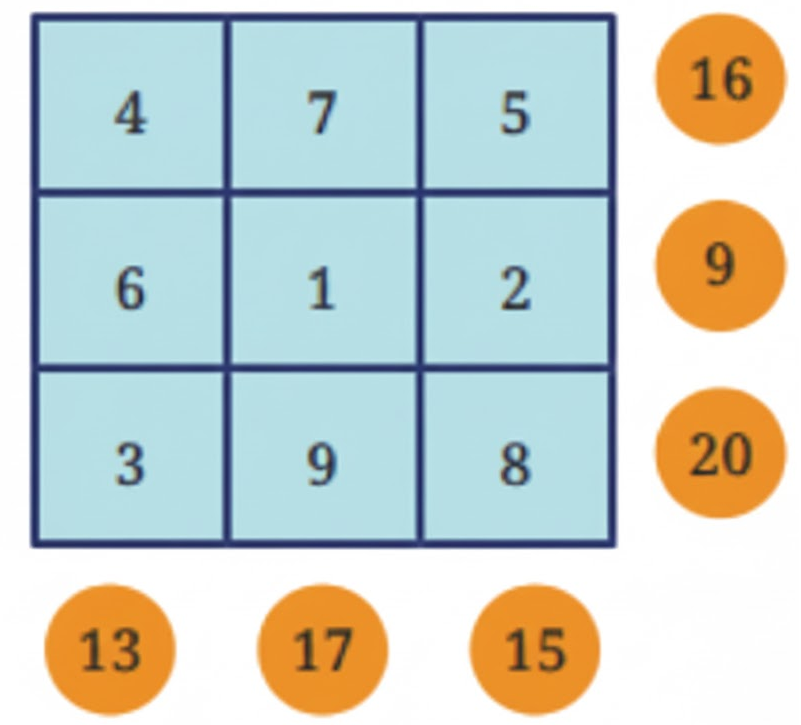
Fill the grids below based on the rule mentioned above:
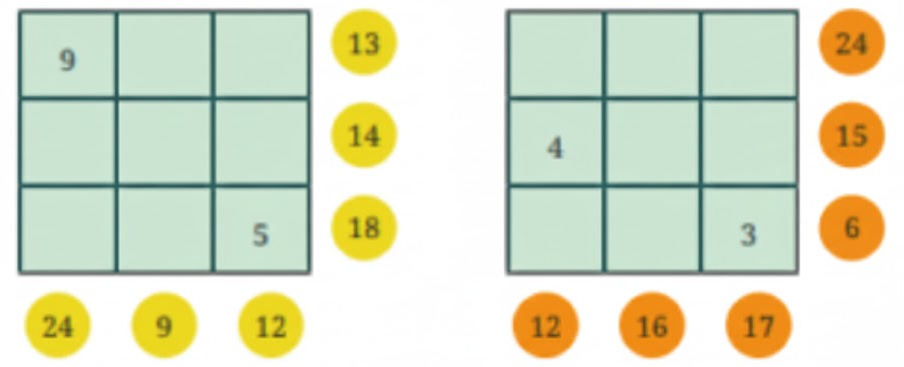
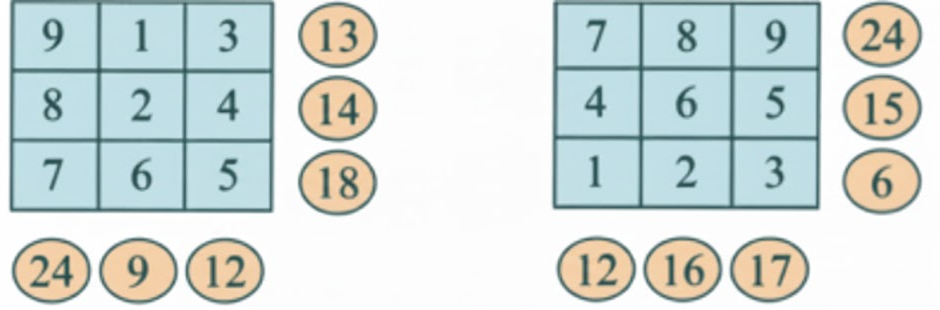
Solution:
Make a couple of questions like this on your own and challenge your peers.
Solution:
Students should do it by themselves.
Can you find the other possible positions for 1 and 9?
Now, we have one full row or column of the magic square! Try completing it!
[Hint: First fill the row or columns containing 1 and 9]
Solution:
Figure it Out (Page 136)
Question 1. How many different magic squares can be made using numbers 1-9?
Solution:
When using the numbers 1 to 9, there is only one unique magic square, if we ignore its rotations and mirror reflections.
If we include transformations such as rotations and reflections, the same magic square can appear in 8 different forms.
Question 2. Create a magic square using numbers 2-10. What strategy would you use for this? Compare it with the magic squares made using 1-9.
Solution:
The numbers 2 to 10 form a set of nine consecutive integers, just like 1 to 9, but each number is increased by 1.
Strategy:
Begin with the classic 1–9 magic square.
Then, add 1 to every number in the square to create a magic square using the numbers 2–10.
Original:
After adding 1 to each number:
If you want, I can fill in the actual squares as well.
The magic square formed using the numbers 2 to 10 will have a different magic sum than the one using 1 to 9.
For numbers 1 to 9, the magic sum is 15.
When we add 1 to every entry of that magic square to get a square using 2 to 10, each row, column, and diagonal increases by 3 (since 3 numbers per line × 1).
So, the new magic sum becomes 18.
The pattern and arrangement of the numbers stay the same, but every value is shifted up by 1, which changes the magic sum from 15 to 18.
Question 3. Take a magic square, and
(a) Increase each number by 1
(b) Double each number
In each case, is the resulting grid also a magic square? How do the magic sums change in each case?
Solution:
Original:
(a) After increasing each number by 1:
This is still a magic square.
New magic sum = 18
(b) After doubling each number
Still a magic square
New magic sum = 30
When we transform a 3 × 3 magic square:
(a) If we add a constant to every number in the magic square,
then the magic sum increases by 3 times that constant.
(b) If we multiply every number in the magic square by a constant,
then the magic sum is also multiplied by that constant.
Question 4. What other operations can be performed on a magic square to yield another magic square?
Solution:
Do it yourself.
Question 5. Discuss ways of creating a magic square using any set of 9 consecutive numbers (like 2-10, 3-11, 9-17, etc.).
Solution:
The magic square formed using the numbers 2 to 10 is the one already constructed in Solution 2 above.
For the magic square using numbers 3-11, add 2 to each number in the original, and we get the adjoining magic square.
The magic sum of the original square is 21.
To create a magic square using the numbers 9 to 17, we add 8 to every entry of the original magic square. This gives a new magic square (shown alongside), in which:
Each row, column, and diagonal now adds up to 39.
So, the new magic sum is 39.
Generalising a 3 × 3 Magic Square
NCERT In-Text Questions (Pages 136-137)
We can describe how the numbers within the magic square are related to each other, i.e., the structure of the magic square.
Choose any magic square that you have made so far using consecutive numbers. If m is the letter-number of the number in the centre, express how other numbers are related to m, how much more or less than m.
[Hint: Remember how we described a 2 × 2 grid of a calendar month in the Algebraic Expressions chapter].
Solution:
Consider the magic square
We can express it using the letter-number m as:
Once the generalised form is obtained, share your observations with the class.
Solution:
Do it yourself.
Figure it Out (Page 137)
Question 1. Using this generalised form, find a magic square if the centre number is 25.
Solution:
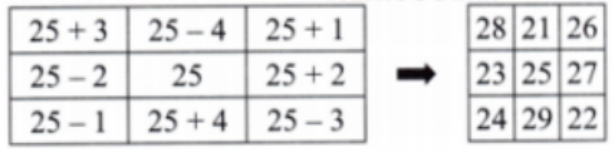
Question 2. What is the expression obtained by adding the 3 terms of any row, column, or diagonal?
Solution:
Row sum (1st row) = 28 + 21 + 26 = 75
Column sum (1st column) = 28 + 23 + 24 = 75
Diagonal sum (1st column) = 28 + 25 + 22 = 75
The expression obtained = 3 × m
where m is the letter-number representing the number in the centre.
Question 3. Write the result obtained by
(a) Adding 1 to every term in the generalised form.
(b) Doubling every term in the generalised form.
Solution:
(a)
(b)
Question 4. Create a magic square whose magic sum is 60.
Solution:
A 3 × 3 magic square has its magic sum equal to 3 × the middle element.
So, if the magic sum is 60, then the middle element must be:
60/3=20
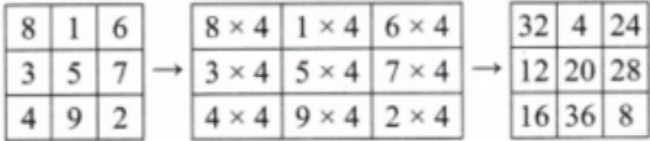
To get a magic sum of 60, we take the original 1–9 magic square and multiply every entry by 4:
Original magic square (sum = 15):
8 1 6
3 5 7
4 9 2
Multiply each number by 4:
32 4 24
12 20 28
16 36 8
Now, each row, column and diagonal adds up to 60, and the middle element is 20, as required.
Question 5. Is it possible to get a magic square by filling nine non-consecutive numbers?
Solution:
Yes, it is possible.
Justification: Let us consider the two magic squares with a magic sum 45.
9 consecutive numbers
and
9 non-consecutive numbers
The First-ever 4 × 4 Magic Square
NCERT In-Text Questions (Pages 137)
The first ever recorded 4 × 4 magic square is found in a 10th-century inscription at the Parshvanath Jain temple in Khajuraho, India, and is known as the Chautisa Yantra
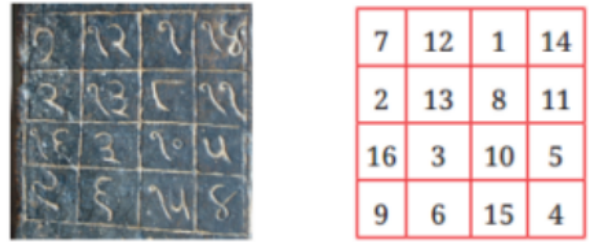
The first ever recorded 4 × 4 magic square, the Chautlsa Yantra, at Khajuraho, India
Chautls means 34. Why do you think they called it the Chautisa Yantra?
Every row, column, and diagonal in this magic square adds up to 34.
Can you find other patterns of four numbers in the square that add up to 34?
Solution:
Yes, we can find different combinations of 4 numbers that add up 34 in the given square.
Sum of 4 comer numbers: 7 + 14 + 4 + 9 = 34
Sum of 4 central numbers: 13 + 8 + 10 + 3 = 34
Sum of 4 numbers in any 2 × 2 squares:
For example, top-left square: 7 + 12 + 13 + 2 = 34
6.4 Nature’s Favourite Sequence: The Virahahka-Fibonacci Numbers!
Discovery of the Virahanka Numbers
NCERT In-Text Questions (Pages 141-142)
Use the systematic method to write down all 6-beat rhythms, i.e., write 6 as the sum of 1’s and 2’s in all possible ways. Did you get 13 ways?
Solution:
Since n = 6, we can build all 6-beat rhythms from the smaller rhythms.
Write “1+” in front of every rhythm that has 5 beats, and write “2+” in front of every rhythm that has 4 beats.
This produces all possible rhythms that have a total of 6 beats.
Yes, we get a total of 13 ways.
Write the next 3 numbers in the sequence:
1, 2, 3, 5, 8, 13, 21, 34, 55, 89, ____, ____, ____, ……
If you have to write one more number in the sequence above, can you tell whether it will be an odd number or an even number (without adding the two previous numbers)?
Solution:
The next three terms in the sequence are:
55 + 89 = 144
89 + 144 = 233
144 + 233 = 377
To determine whether the term after 377 is odd or even without performing the addition, we can observe the parity pattern (odd/even pattern) in the sequence:
1 (odd),
2 (even),
3 (odd),
5 (odd),
8 (even),
13 (odd),
21 (odd),
34 (even),
55 (odd),
89 (odd),
144 (even),
233 (odd),
377 (odd)
This shows a repeating pattern:
Odd, Even, Odd, Odd, Even, Odd, Odd, Even, …
So, after two odd numbers, the next term is always even.
Thus, the term after 377 will be even, even without calculating the sum.
What is the parity of each term in the sequence? Do you notice any pattern in the sequence of parities?
Solution:
The parity in the Fibonacci sequence follows a repeating cycle: odd, odd, even.
This means every three consecutive terms follow this pattern.
Looking at the given sequence:
odd, odd, even
1, 1, 2
odd, odd, even
3, 5, 8
odd, odd, even
13, 21, 34
odd, odd, even
55, 89, 144
odd, odd, even
233, 377, ?
Since 377 is odd and it matches the second “odd” position in the cycle, the next term must be even.
Thus, the parity of the number after 377 will be even, following the repeating pattern:
Odd → Odd → Even → Odd → Odd → Even → …
6.5 Digits in Disguise
NCERT In-Text Questions (Pages 142-143)
Let us look at one more example shown on the right.
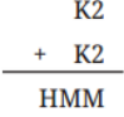
Here, K2 means that the number is a 2-digit number having the digit ‘2’ in the units place and ‘K’ in the tens place. K2 is added to itself to give a 3-digit sum HMM. What digit should the letter M correspond to?
Both the tens place and the units place of the sum have the same digit.
What about H? Can it be 2? Can it be 3?
Solution:
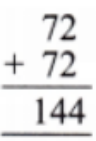
A valid example of a two-digit number ending in 2 is 72.
Adding it to itself gives:
72 + 72 = 144
So, the digit M corresponds to 4, and H corresponds to 1 in the sum 144.
Therefore, H cannot be 2 or 3.
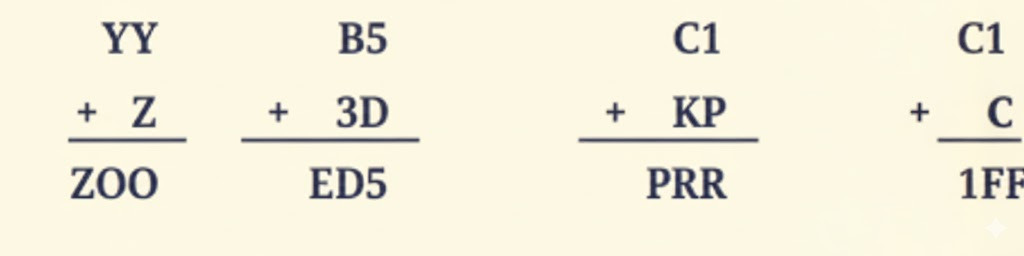
Question: These types of questions can be interesting and fun to solve! Here are some more questions like this for you to try out. Find out what each letter stands for.
Share how you thought about each question with your classmates; you may find some new approaches.
Solution:
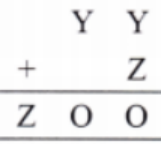
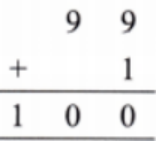
YY represents a two-digit number where both digits are the same,
so it could be 99, 88, 77, … and so on.
Z is a single-digit number, and ZOO is a three-digit number where the first digit is Z and the last two digits are both O.
From the conditions, we get:
Y = 9
Z = 1
O = 0.
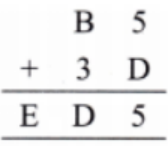
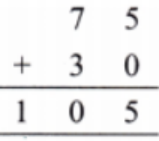
Here, 5 + D = 5 ⇒ D = 0
Now, B + 3 = E0 ⇒ B = 7
If B = 7, then E = 1
So, we have B = 7, D = 0, and E = 1
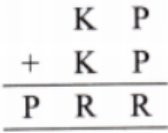
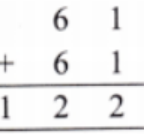
Here, KP is a 2-digit number and PRR is a 3-digit number.
Basically, 2 × (KP) = PRR. So, P = 1.
If P = 1, then R = 2.
Hence, K = 6, P = 1, R = 2.
Here, C + 1 is a two-digit number i.e., 10.
So, C = 9 ⇒ F = 0
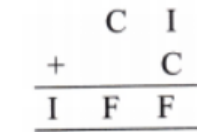
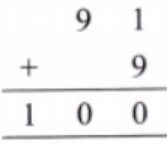
Figure it Out (Pages 143-144)
Question 1. A light bulb is ON. Doijee toggles its switch 77 times. Will the bulb be on or off? Why?
Solution:
Dorjee flips the switch 77 times.
Each flip changes the bulb’s state — from ON to OFF or from OFF to ON.
Since the bulb starts ON, and an odd number of toggles always reverses the final state, the bulb will end up OFF.
Because 77 is odd, after 77 toggles, the bulb will be OFF.
Question 2. Liswini has a large old encyclopaedia. When she opened it, several loose pages fell out of it. She counted 50 sheets in total, each printed on both sides. Can the sum of the page numbers of the loose sheets be 6000? Why or why not?
Solution: Suppose we have 50 loose sheets from a book. Each sheet contains two page numbers:
The front page is odd, of the form 2n – 1,
The back page is even, of the form 2n.
So, the sum of the two page numbers on any sheet is:
(2n – 1) + (2n) = 4n – 1
If the sheet numbers are n1,n2,…,n50n_1, n_2, …, n_{50}n1,n2,…,n50, then the total sum of all 50 sheets is:
(4n₁ – 1) + (4n₂ – 1) + … + (4n₅₀ – 1)
which can be rewritten as:
4(n₁ + n₂ + … + n₅₀) – 50
Here, 4(n₁ + n₂ + … + n₅₀) is clearly divisible by 4.
However, subtracting 50 (which is not divisible by 4) makes the entire expression not divisible by 4.
Therefore, the total of the page numbers from such 50 sheets can never be divisible by 4.
Since 6000 is divisible by 4, it cannot be the sum of the page numbers of 50 such loose sheets.
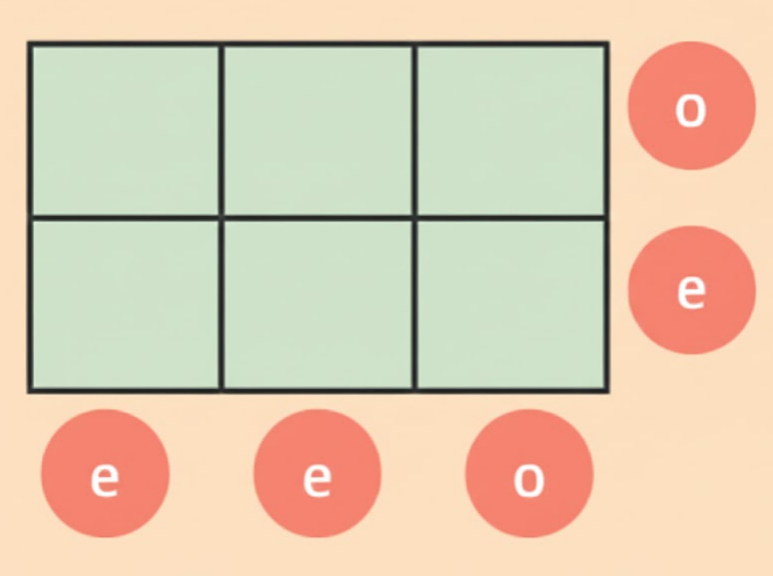
Question 3. Here is a 2 × 3 grid. For each row and column, the parity of the sum is written in the circle; ‘e’ for even and ‘o’ for odd. Fill the 6 boxes with 3 odd numbers (‘o’) and 3 even numbers (‘e’) to satisfy the parity of the row and column sums.
Solution:
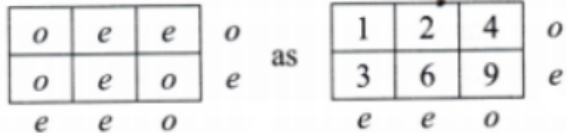
Let’s label the cells as:
So the constraints are:
We only track parity (odd = o, even = e), not actual values.
Given Conditions
Row 1 (A, B, C): sum is odd
Row 2 (D, E, F): sum is even
Column 1 (A, D): sum is even
Column 2 (B, E): sum is even
Column 3 (C, F): sum is odd
Step-by-Step Parity Assignment
1. Row 1 must sum to odd
For a row to be odd, it must contain one odd and two evens.
So choose:
A = o
B = e
C = e
(Any permutation works, but this is one valid choice.)
2. Column constraints
Column 1: A + D = even
Since A = o, to make the sum even, D must also be odd.
D = o
Column 2: B + E = even
Since B = e, E must also be even.
E = e
Column 3: C + F = odd
Since C = e, F must be odd.
F = o
Final Parity Grid
Count
Odd numbers: A, D, F → 3 odds
Even numbers: B, C, E → 3 evens
Thus, the 6 positions must contain exactly three odd and three even numbers, arranged as shown above.
Question 4. Make a 3 × 3 magic square with 0 as the magic sum. All numbers can not be zero. Use negative numbers, as needed.
Solution:
We are given that:
The magic square is of order 3 × 3.
The magic sum (sum of each row, column, and diagonal) must be 0.
All entries in the magic square cannot be zero.
We are allowed to use negative numbers.
To satisfy these conditions, we choose the integers from –4 to 4 (i.e., –4, –3, –2, –1, 0, 1, 2, 3, 4) and arrange them in a 3 × 3 grid so that the sum of every row, every column, and both diagonals is 0.
Question 5. Fill in the following blanks with ‘odd’ or ‘even’:
(a) Sum of an odd number of even numbers is ______
(b) Sum of an even number of odd numbers is ______
(c) Sum of an even number of even numbers is ______
(d) Sum of an odd number of odd numbers is ______
Solution:
(a) Sum of odd number of even numbers is even.
(b) Sum of even number of odd numbers is even.
(c) Sum of even number of even numbers is even.
(d) Sum of odd number of odd numbers is odd.
Question 6. What is the parity of the sum of numbers from 1 to 100?
Solution:
The sum of numbers from 1 to 100 is as follows:
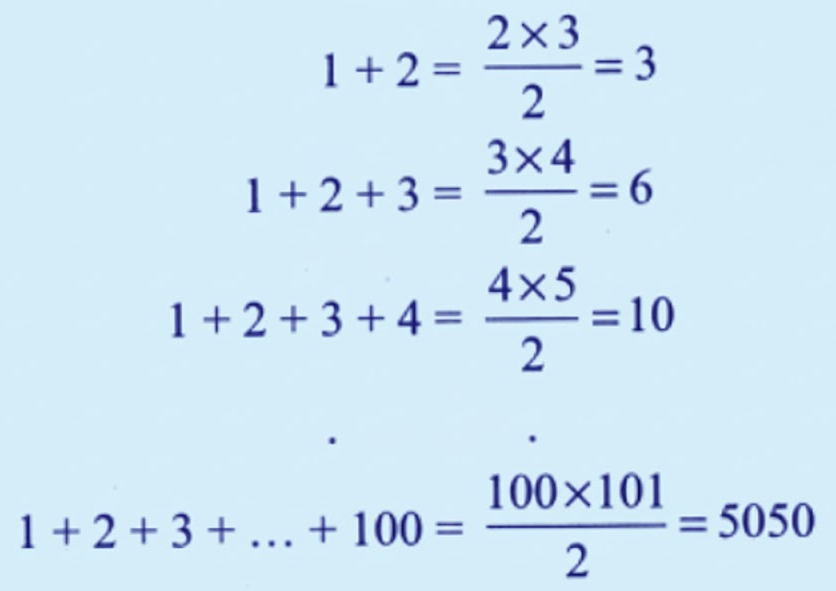
Since 5050 is an even number, the parity is even.
Question 7. Two consecutive numbers in the Virahanka sequence are 987 and 1597. What are the next 2 numbers in the sequence? What are the previous 2 numbers in the sequence?
Solution: The given numbers are 987 and 1597.
In the Virahanka sequence (similar to the Fibonacci sequence), each term is the sum of the two preceding terms.
Finding the next two numbers:
Next term = 987 + 1597 = 2584
Next term after that = 1597 + 2584 = 4181
Finding the previous two numbers:
To go backwards in such a sequence, we subtract instead of adding.
Previous term = 1597 – 987 = 610
Term before that = 987 – 610 = 377
So, the sequence around the given numbers is:
…, 377, 610, 987, 1597, 2584, 4181, …
Question 8. Angaan wants to climb an 8-step staircase. His playful rule is that he can take either 1 step or 2 steps at a time. For example, one of his paths is 1, 2, 2, 1, 2. In how many different ways can he reach the top?
Solution:
Ways in which Angaan can climb 8 steps with 1 or 2 steps are as follows:
For n = 8
Therefore, the total number of ways in which Angaan can reach the top is:
1 + 7 + 15 + 10 + 1 = 34 ways.
Question 9.What is the parity of the 20th term of the Virahanka sequence?
Solution:
Consider the Virahanka sequence:
1, 2, 3, 5, 8, 13, 21, 34, 55, 89, 144, 233, 377, 610, 987, …
Now observe the pattern of odd and even terms:
1 → odd
2 → even
3 → odd
5 → odd
8 → even
13 → odd
21 → odd
34 → even
We can see that the parity (odd/even) follows a repeating cycle of three terms:
odd, even, odd → repeats every 3 positions
Since the pattern repeats every 3 terms, we check the parity of the 20th term:
20 mod 3 = 2 → which corresponds to the second position in the cycle → even
Therefore, the 20th term of the Virahanka sequence is even.
Question 10. Identify the true statements.
(a) The expression 4m – 1 always gives odd numbers.
(b) All even numbers can be expressed as 6j – 4.
(c) Both expressions 2p + 1 and 2q – 1 describe all odd numbers.
(d) The expression 2f + 3 gives both even and odd numbers.
Solution:
(a) Substitute values of mmm into the expression 4m−14m - 14m−1:
For m=1m = 1m=1: 4(1)−1=34(1) - 1 = 34(1)−1=3 → odd
For m=2m = 2m=2: 4(2)−1=74(2) - 1 = 74(2)−1=7 → odd
Since 4m4m4m is always even, subtracting 1 always gives an odd number.
So this statement is true.
(b) Substitute values of jjj into 6j−46j - 46j−4:
For j=1j = 1j=1: 6(1)−4=26(1) - 4 = 26(1)−4=2 → even
For j=2j = 2j=2: 6(2)−4=86(2) - 4 = 86(2)−4=8 → even
The expression always produces even numbers.
However, it does not generate all even numbers—for example, it skips 4 and 6.
So this statement is false.
(c) For p=1,2,3,…p = 1, 2, 3,.....p=1,2,3,…:
2p+1=3,5,7,…2p + 1 = 3, 5, 7,......2p+1=3,5,7,…
For q=1,2,3,…q = 1, 2, 3….q=1,2,3,…:
2q−1=1,3,5,7,…2q - 1 = 1, 3, 5, 7,.....2q−1=1,3,5,7,…
Here, 2q−12q - 12q−1 generates all odd numbers, including 1.
But 2p+12p + 12p+1 does not generate 1.
Therefore, the claim that they represent the same set is incorrect.
This statement is false.
(d) Substitute values of fff into the expression 2f+32f + 32f+3:
For f=1f = 1f=1: 2(1)+3=52(1) + 3 = 52(1)+3=5 → odd
For f=2f = 2f=2: 2(2)+3=72(2) + 3 = 72(2)+3=7 → odd
Since 2f2f2f is always even and adding 3 makes it odd, the expression always gives odd numbers.
The statement claiming otherwise is incorrect.
This statement is false.
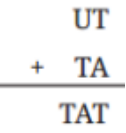
Question 11. Solve this cryptarithm:
Solution:
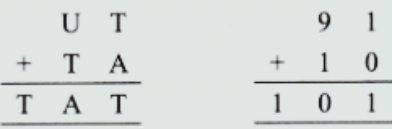
Here, T is at hundreds place, so T = 1
⇒ A = 0 and U = 9.
So, we have U = 9, T = 1, and A = 0.
Mastering Number Play for Class 7
Understanding NCERT Solutions for Class 7 Maths Chapter 6 Number Play is key to acing your exams. Dive deep into concepts like parity, magic squares, and the Fibonacci sequence to develop strong problem-solving skills.
Practice regularly using chapter-wise solutions to boost your confidence. This chapter connects mathematics to logic and creativity, making maths both fun and meaningful. Strengthening these topics will help in competitive exams ahead.
Focus on understanding how patterns and logical rules work for better concept clarity. Complete the NCERT exercises, review important formulas, and test your knowledge with similar questions for effective exam preparation.
FAQs on NCERT Solutions For Class 7 Maths Chapter 6 Number Play - 2026-27 Free PDF Download (Sign-in Required)
1. What are NCERT Solutions for Class 7 Maths Chapter 6 Number Play?
NCERT Solutions for Class 7 Maths Chapter 6 Number Play are step-by-step answers to all textbook and back exercise questions, designed according to the latest CBSE syllabus for 2026–27. These solutions help students learn concepts like factors, multiples, prime numbers, composite numbers, and tests of divisibility.
Key features include:
- Complete, accurate explanations for every exercise
- Use of diagrams, definitions, and important formulae
- Solutions formatted as per CBSE marking scheme
- Available in free PDF for offline study
2. How to write stepwise NCERT answers to score full marks in Class 7 Maths Chapter 6?
To score full marks, write stepwise NCERT answers using clear logic and CBSE-recommended structure.
Follow these tips:
- Start with a defined formula or rule (e.g., divisibility tests, factorization)
- Show all calculation steps, not just the final answer
- Use proper mathematical notation and symbols
- If asked, include neat diagrams or tables
- Highlight definitions, important results in your answers
3. Which questions from Chapter 6 Number Play are most likely to be asked in school exams?
Questions focusing on tests of divisibility, identification of prime and composite numbers, and stepwise problem-solving are often asked in exams.
Frequently tested topics include:
- Applying divisibility rules (2, 3, 4, 5, 9, 10, 11 etc.)
- Finding factors and multiples of given numbers
- Identifying if a number is prime or composite
- Short and long answer types explaining steps
4. Are diagrams or definitions compulsory in NCERT Solutions for Class 7 Maths Chapter 6?
Definitions are essential when asked in the question or needed to justify steps. Diagrams are not always compulsory in this chapter but can make answers clearer, especially for factor trees or explaining number concepts.
For best marks, always:
- Include definitions of key terms if relevant
- Draw factor trees/number line diagrams, if asked
5. How should I structure long answers in Number Play Chapter 6 for better marks?
Long answers should be structured logically, with clear steps and relevant explanations.
Tips for structuring:
- Start with the given data and what is to be found
- Write down relevant definitions/formulae
- Show each step of calculation with reasons (e.g., which divisibility rule you used)
- Conclude with a final answer statement
6. Where can I download a free PDF of NCERT Solutions for Class 7 Maths Chapter 6 Number Play?
You can download a free PDF of solutions for Class 7 Maths Chapter 6 Number Play from trusted educational websites that provide CBSE-aligned resources.
Advantages of downloading:
- Access offline study material anytime
- Easy revision and practice before exams
- Stepwise, teacher-verified answers included
7. What are the most important definitions and formulae to remember in Number Play Chapter 6?
Key definitions and formulae in Chapter 6 include:
- Factor: A number that divides another number without leaving a remainder
- Multiple: A number obtained by multiplying another number by an integer
- Prime Number: Has exactly two distinct factors: 1 and itself
- Composite Number: Has more than two factors
- Divisibility Rules: Rules to check if a number is divisible by 2, 3, 4, 5, 6, 9, 10, 11, etc.
8. How do I avoid common mistakes while answering Class 7 Maths Chapter 6 Number Play questions?
To avoid mistakes in Chapter 6 Number Play, pay attention to:
Do:
- Read questions thoroughly
- Apply correct divisibility rules
- Show all calculation steps
- Use proper definitions
- Skip steps or write only the final answer
- Mix up prime and composite number criteria
- Forget to provide reasons for true/false answers
9. Are NCERT Solutions for Class 7 Maths Chapter 6 Number Play sufficient for CBSE exams?
NCERT Solutions for Class 7 Maths Chapter 6 Number Play are sufficient for board and school exams, as they follow the latest CBSE syllabus and marking scheme.
For exam success:
- Practice all intext, back exercises, and exemplars
- Write answers stepwise as shown in solutions
- Revise key definitions and divisibility rules regularly
10. How can I revise Chapter 6 Number Play effectively in 1 day before exams?
To revise Chapter 6 Number Play in 1 day:
- Go through summary notes and formulae table
- Quickly solve one problem from each exercise
- Review divisibility rules and prime/composite examples
- Attempt 2–3 short and long questions for practice
