




Exercise-wise Solutions for Class 7 Maths Chapter 7 (With Diagrams & Tips)
NCERT Solutions for Class 7 Maths Chapter 7 A Tale of Three Intersecting Lines (2026-27)
NCERT In-Text Questions (Page 146)
What happens when the three vertices lie on a straight line?
Solution:
When the three vertices lie on a straight line, they become collinear. This means they no longer form a triangle because the three points do not enclose any area; they simply align along the same straight path.
7.2 Constructing a Triangle When its Sides are Given
NCERT In-Text Questions (Page 150)
Construct
Construct triangles having the following sidelengths (all the units are in cm):
(a) 4, 4, 6
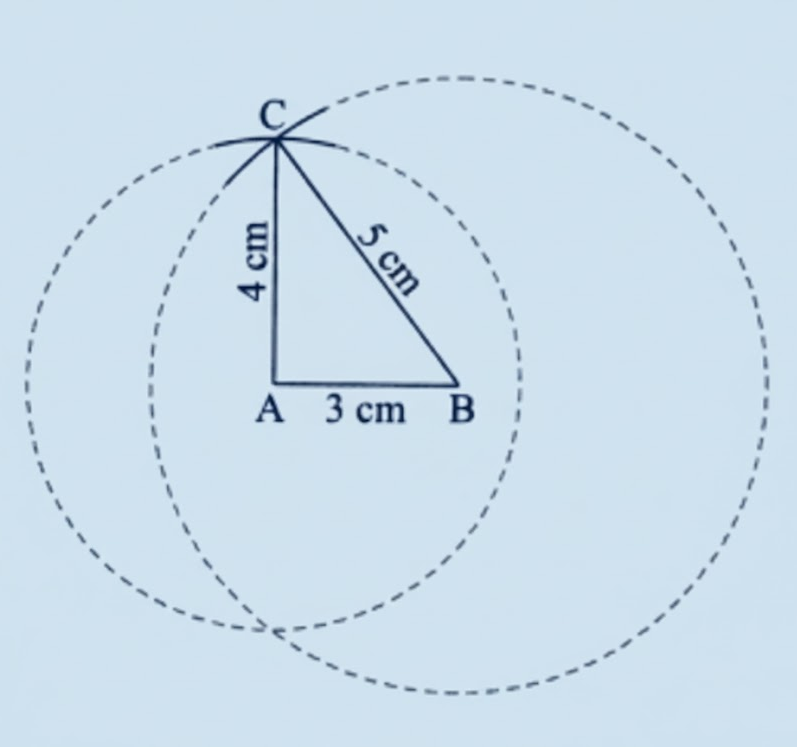
(b) 3, 4, 5
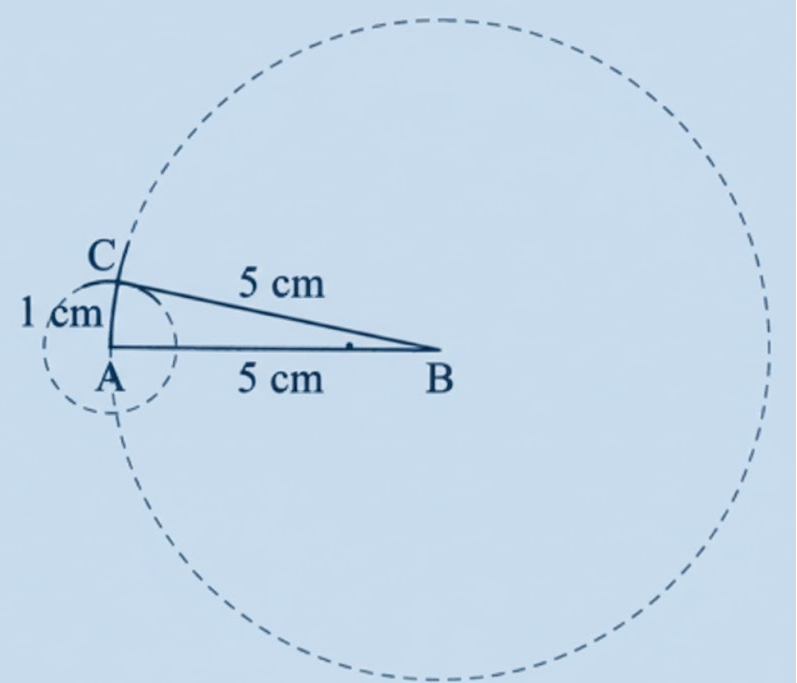
(c) 1, 5, 5
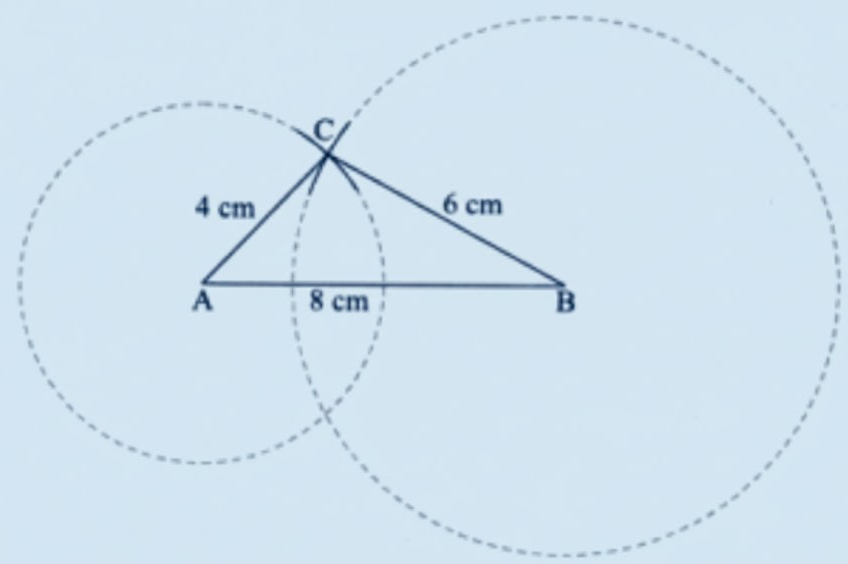
(d) 4, 6, 8
(e) 3.5, 3.5, 3.5
Solution:
(a) Steps of Construction
Step 1: Draw the base AB with the given side length.
Let AB = 6 cm.
Step 2: With A as the centre, draw an arc of radius 4 cm.
Step 3: With B as the centre, draw another arc of radius 4 cm so that it intersects the first arc.
Step 4: The point of intersection of the two arcs is the third vertex C.
Join AC and BC to obtain ΔABC.
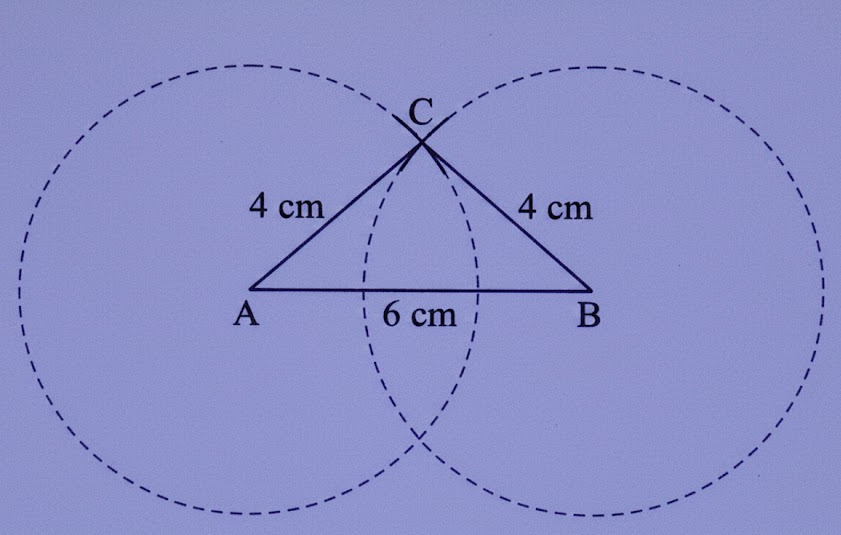
Note: All the figures shown in this chapter are drawn to proportionally reduced sizes.
(b) Steps of Construction
Step 1: Draw the base AB using one of the given side lengths.
Let AB = 3 cm.
Step 2: With A as the centre, draw a sufficiently long arc of radius 4 cm.
Step 3: With B as the centre, draw another arc of radius 5 cm so that it intersects the first arc.
Step 4: The point of intersection of these arcs gives the third vertex C.
Join AC and BC to form ΔABC.
(c) Steps of Construction.
Students should do it by themselves.
(d) Steps of Construction.
Students should do it by themselves.
(e) Steps of Construction
Step 1: Draw the base AB with the given side length of 3.5 cm.
Step 2: With A as the centre, draw a long arc of radius 3.5 cm.
Step 3: With B as the centre, draw another arc of radius 3.5 cm so that it intersects the first arc.
Step 4: The point of intersection of the two arcs is the third vertex C.
Join AC and BC to obtain ΔABC.
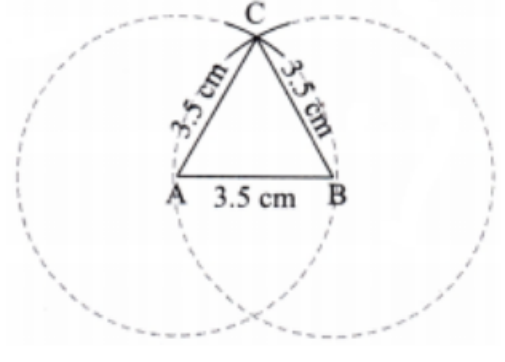
Figure it Out (Pages 150-151)
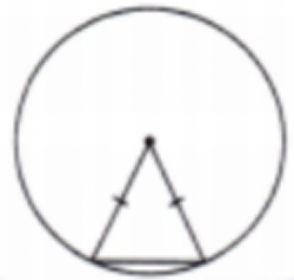
Question 1. Use the points on the circle and/or the centre to form isosceles triangles.

Solution:
Choose any two points on the circle and join each of them to the centre.
Then, connect the two points to each other.
Since the two sides from the centre to the points are radii of the circle and therefore equal, the triangle formed is isosceles.
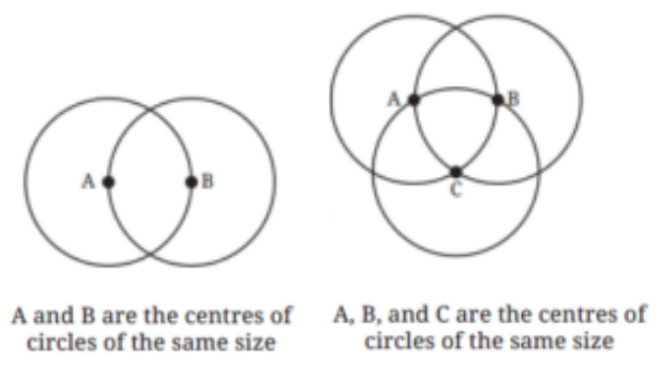
Question 2. Use the points on the circles and/or their centres to form isosceles and equilateral triangles. The circles are of the same size.
Solution:
An isosceles triangle can be formed by joining the points where the two circles intersect and the centres of either circle.
In this case, the isosceles triangles formed are AXY and BXY.
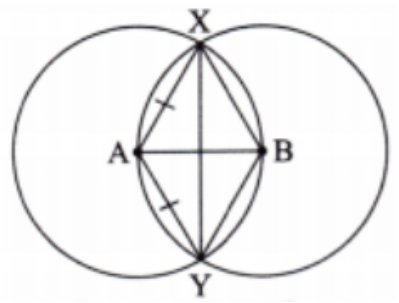
An equilateral triangle can be formed by joining the centres of the two equal circles and one of their intersection points.
Thus, ΔAXB or ΔAYB is an equilateral triangle.
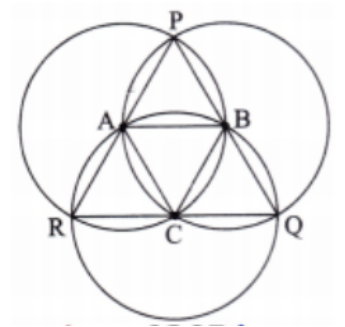
An equilateral triangle can be formed by joining the centres of the three equal circles.
Thus, ΔABC is an equilateral triangle.
Additionally, the triangles ΔPAB, ΔQBC, and ΔRAC are also equilateral.
Since every equilateral triangle is a special case of an isosceles triangle (all sides equal), all of these equilateral triangles are also isosceles.
Are Triangles Possible for any Lengths?
NCERT In-Text Questions (Page 151)
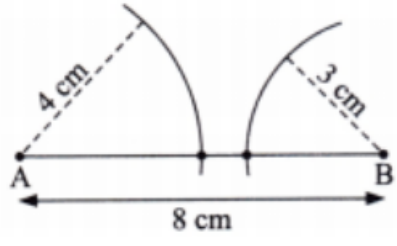
Construct a triangle with side lengths 3 cm, 4 cm, and 8 cm.
What is happening? Are you able to construct the triangle?
Solution:
Since the arcs drawn from points A and B do not intersect, it is not possible to construct a triangle with side lengths 3 cm, 4 cm, and 8 cm.
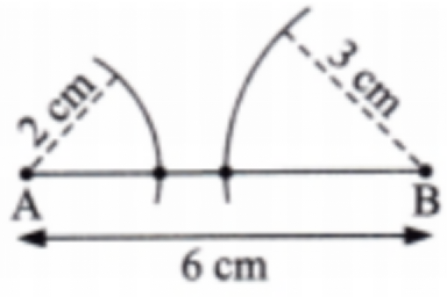
Here is another set of lengths: 2 cm, 3 cm, and 6 cm. Check if a triangle is possible for these side lengths.
Solution:
The arcs drawn from points A and B do not intersect. Therefore, a triangle cannot be formed with side lengths 2 cm, 3 cm, and 6 cm.
Triangle Inequality
NCERT In-Text Questions (Page 153)
Can we say anything about the existence of a triangle having side lengths 3 cm, 3 cm, and 7 cm? Verify your answer by construction.
Solution:
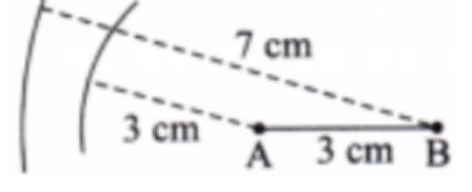
Let us take the direct path as AB = 7 cm.
The roundabout path through the third vertex is:
BC + CA = 3 cm + 3 cm = 6 cm
Since the direct path between the two vertices (7 cm) is longer than the roundabout path (6 cm), such a triangle cannot exist.
From a construction perspective, a triangle with side lengths 3 cm, 3 cm, and 7 cm is not possible because the arcs drawn from points A and B do not meet.
“In the rough diagram given alongside, is it possible to assign lengths in a different order such that the direct paths are always coming out to be shorter than the roundabout paths? If this is possible, then a triangle might exist.”
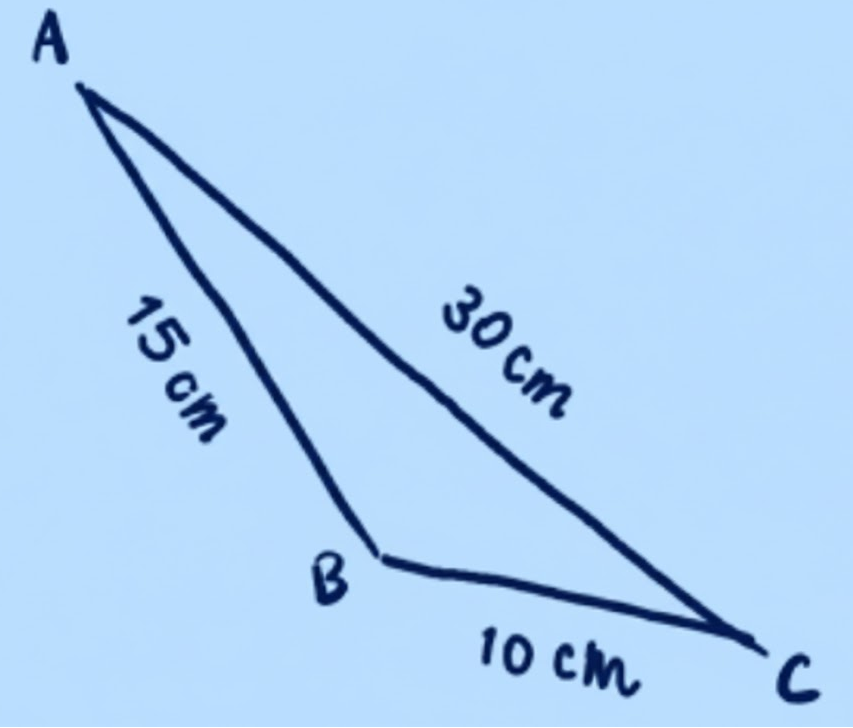
Solution:
No
Is such a rearrangement of lengths possible in the triangle?
Solution:
No
Figure it Out (Page 154)
Question 1. We checked by construction that there are no triangles having sidelengths 3 cm, 4 cm, and 8 cm; and 2 cm, 3 cm, and 6 cm. Check if you could have found this without trying to construct the triangle.
Solution:
(a)
Let the side lengths be AB = 4 cm, BC = 3 cm, and AC = 8 cm.
Direct path = BC = 3 cm
Roundabout path = BA + AC = 4 + 8 = 12 cm
→ Direct path is shorter.Direct path = AB = 4 cm
Roundabout path = AC + BC = 8 + 3 = 11 cm
→ Direct path is shorter.Direct path = AC = 8 cm
Roundabout path = AB + BC = 4 + 3 = 7 cm
→ Direct path is longer.
Since one direct path is longer than the sum of the other two sides, the triangle inequality is violated.
Therefore, a triangle cannot be formed.
(b)
Let the side lengths be AB = 3 cm, BC = 2 cm, and AC = 6 cm.
Direct path = AC = 6 cm
Roundabout path = AB + BC = 3 + 2 = 5 cm
Here, the direct path is longer than the roundabout path.
Thus, the triangle inequality fails.
Hence, a triangle cannot exist with these side lengths.
Question 2. Can we say anything about the existence of a triangle for each of the following sets of lengths?
(a) 10 km, 10 km, and 25 km
(b) 5 mm, 10 m,m and 20 mm
(c) 12 cm, 20 c,m and 40 cm
You would have realised that using a rough figure and comparing the direct path lengths with their corresponding roundabout path lengths is the same as comparing each length with the sum of the other two lengths. There are three such comparisons to be made.
Solution:
(a)
Direct path = 25 km
Roundabout path = 10 km + 10 km = 20 km
Since the direct path is longer than the roundabout path, the triangle inequality is violated.
Therefore, a triangle cannot exist.
(b)
Direct path = 20 mm
Roundabout path = 10 mm + 5 mm = 15 mm
The direct path is longer than the roundabout path.
Hence, the triangle inequality does not hold.
So, a triangle cannot be formed.
(c)
Direct path = 40 cm
Roundabout path = 12 cm + 20 cm = 32 cm
Here again, the direct path is longer than the roundabout path.
Thus, the triangle inequality fails.
Therefore, no triangle can exist with these lengths.
Question 3. For each set of lengths seen so far, you might have noticed that in at least two of the comparisons, the direct length was less than the sum of the other two (if not, check again!).
For example, for the set of lengths 10 cm, 15 cm, and 30 cm, there are two comparisons where this happens:
10 < 15 + 30
15 < 10 + 30
But this doesn’t happen for the third length: 30 > 10 + 15.
Solution:
Students should do it by themselves.
NCERT In-Text Questions (Page 154)
Will this always happen? That is, for any set of lengths, will there be at least two comparisons where the direct length is less than the sum of the other two? Explore different sets of lengths.
Solution:
(i) 5 mm, 10 mm, 20 mm
Check all three triangle inequalities:
10<5+2010 < 5 + 2010<5+20 → True
5<10+205 < 10 + 205<10+20 → True
20>10+520 > 10 + 520>10+5 → False, because 20 is greater than the sum of the other two sides.
Since one inequality fails, a triangle is not possible.
(ii) 12 cm, 20 cm, 40 cm
Check all three triangle inequalities:
12<20+4012 < 20 + 4012<20+40 → True
20<12+4020 < 12 + 4020<12+40 → True
40>12+2040 > 12 + 2040>12+20 → False, because 40 is greater than the sum of the other two sides.
Since the triangle inequality fails here as well, a triangle cannot be formed.
Further, for a given set of lengths, is it possible to identify which lengths will immediately be less than the sum of the other two, without calculations?
[Hint: Consider the direct lengths in the increasing order]
Solution: Yes, it is possible to identify which lengths will be less than the sum of the other two by considering the direct lengths in increasing order. When the side lengths are arranged from smallest to largest, it becomes easier to check whether the largest length is less than the sum of the other two—an essential requirement for a triangle to exist.
Figure it Out (Page 156)
Question 1. Which of the following lengths can be the sidelengths of a triangle? Explain your answers. Note that for each set, the three lengths have the same unit of measure.
(a) 2, 2, 5
(b) 3, 4, 6
(c) 2, 4, 8
(d) 5, 5, 8
(e) 10, 20, 25
(f) 10, 20, 35
(g) 24, 26, 28
We observe from the previous problems that whenever there is a set of lengths satisfying the triangle inequality (each length < sum of the other two lengths), there is a triangle with those three lengths as side lengths.
Solution:
(a)
Check inequalities:
2<5+22 < 5 + 22<5+2 → True
5>2+25 > 2 + 25>2+2 → False
Since one inequality fails, 2, 2, 5 cannot form a triangle.
(b)
Check inequalities:
3<4+63 < 4 + 63<4+6 → True
4<3+64 < 3 + 64<3+6 → True
6<4+36 < 4 + 36<4+3 → True
All conditions are satisfied.
So, 3, 4, 6 can form a triangle.
(c)
Check inequalities:
2<4+82 < 4 + 82<4+8 → True
4<2+84 < 2 + 84<2+8 → True
8>4+28 > 4 + 28>4+2 → False
Triangle inequality fails.
Thus, 2, 4, 8 cannot form a triangle.
(d)
Check inequalities:
5<5+85 < 5 + 85<5+8 → True
8<5+58 < 5 + 58<5+5 → True
All conditions hold.
Therefore, 5, 5, 8 can form a triangle.
(e)
Check inequalities:
10<20+2510 < 20 + 2510<20+25 → True
20<25+1020 < 25 + 1020<25+10 → True
25<10+2025 < 10 + 2025<10+20 → True
All conditions are satisfied.
So, 10, 20, 25 can form a triangle.
(f)
Check inequalities:
10<20+3510 < 20 + 3510<20+35 → True
20<10+3520 < 10 + 3520<10+35 → True
35>10+2035 > 10 + 2035>10+20 → False
Triangle inequality fails.
Hence, 10, 20, 35 cannot form a triangle.
(g)
Check inequalities:
24<26+2824 < 26 + 2824<26+28 → True
26<24+2826 < 24 + 2826<24+28 → True
28<24+2628 < 24 + 2628<24+26 → True
All conditions are satisfied.
Thus, 24, 26, 28 can form a triangle.
NCERT In-Text Questions (Page 159)
How will the two circles turn out for a set of lengths that do not satisfy the triangle inequality? Find 3 examples of sets of lengths for which the circles:
(a) touch each other at a point,
(b) Do not intersect.
Solution:
When a set of three segment lengths does not satisfy the triangle inequality, it means that those three segments cannot form a triangle.
However, if these same lengths are interpreted as distances between the centres of circles and points on their circumferences, the situation can be different.
The circles may still intersect or touch each other even though a triangle with those lengths is not possible.
(a) Examples of length sets that fail the triangle inequality:
3, 4, 7
5, 2, 3
6, 2, 4
These sets cannot form triangles because in each case the largest length is greater than or equal to the sum of the other two.
(b) More examples of sets that fail the triangle inequality:
3, 4, 8
6, 2, 3
5, 1, 2
These also do not satisfy the triangle inequality, and therefore cannot form triangles.
Figure it Out (Page 159)
Question 1. Check if a triangle exists for each of the following set of lengths:
(a) 1, 100, 100
(b) 3, 6, 9
(c) 1, 1, 5
(d) 5, 10, 12
Solution:
(a)
Lengths: 1, 100, 100
Check inequalities:
1<100+1001 < 100 + 1001<100+100 → True
100<100+1100 < 100 + 1100<100+1 → True
All conditions are satisfied.
✔ A triangle exists.
(b)
Lengths: 3, 6, 9
Check inequalities:
3<6+93 < 6 + 93<6+9 → True
6<3+96 < 3 + 96<3+9 → True
9=6+39 = 6 + 39=6+3 → Not allowed (must be strictly less)
Since the largest length equals the sum of the other two, the triangle inequality fails.
✘ A triangle does not exist.
(c)
Lengths: 1, 1, 5
Check inequalities:
1<1+51 < 1 + 51<1+5 → True
5>1+15 > 1 + 15>1+1 → False
The largest length is greater than the sum of the other two.
✘ A triangle does not exist.
(d)
Lengths: 5, 10, 12
Check inequalities:
5<10+125 < 10 + 125<10+12 → True
10<5+1210 < 5 + 1210<5+12 → True
12<5+1012 < 5 + 1012<5+10 → True
All triangle inequalities are satisfied.
✔ A triangle exists.
Question 2. Does there exist an equilateral triangle with sides 50, 50, 50? In general, does there exist an equilateral triangle of any sidelength? Justify your answer.
Solution:
Yes, an equilateral triangle with side lengths 50, 50, 50 does exist because the sum of any two sides is always greater than the third side.
In an equilateral triangle, all three sides are equal, so the triangle inequality is automatically satisfied.
More generally, an equilateral triangle always exists for any positive side length. For any positive number x>0x > 0x>0, an equilateral triangle with all sides equal to xxx can be constructed.
Question 3. For each of the following, give at least 5 possible values for the third length so there exists a triangle having these as sidelengths (decimal values could also be chosen):
(a) 1, 100
(b) 5, 5
(c) 3, 7
Solution:
(a)
Given two lengths: 1 and 100
To form a triangle, the third length xxx must satisfy:
x<1+100=101x < 1 + 100 = 101x<1+100=101
x>∣100−1∣=99x > |100 - 1| = 99x>∣100−1∣=99
So the third side must lie in: 99 < x < 101
Five possible values within this range are:
99.5, 99.8, 100, 100.5, 100.9
Each of these satisfies the triangle inequality, e.g:
100<1+99.5100 < 1 + 99.5100<1+99.5
100<1+99.8100 < 1 + 99.8100<1+99.8
100<1+100100 < 1 + 100100<1+100
100<1+100.5100 < 1 + 100.5100<1+100.5
100<1+100.9100 < 1 + 100.9100<1+100.9
(b)
Given two lengths: 1 and 5
The third length xxx must satisfy:
x<1+5=6x < 1 + 5 = 6x<1+5=6
x>∣5−1∣=4x > |5 - 1| = 4x>∣5−1∣=4
So the third side must lie in: 4 < x < 6
Five valid values are:
1 (invalid), 3.5 (invalid), 5, 7.5 (invalid), 8.9 (invalid)
Your listed values do not satisfy the inequality.
Let’s correct it.
Five correct values within 4 < x < 6 are:
4.2, 4.5, 5, 5.5, 5.9
Each of these satisfies:
x<6x < 6x<6
x>4x > 4x>4
(c)
Given two lengths: 3 and 7
The third length xxx must satisfy:
x<3+7=10x < 3 + 7 = 10x<3+7=10
x>∣7−3∣=4x > |7 - 3| = 4x>∣7−3∣=4
So the third side must lie in: 4 < x < 10
Five correct values within this range are:
4.5, 5, 6.9, 8, 9.8
Each one satisfies the triangle inequality, for example:
7<3+4.57 < 3 + 4.57<3+4.5
7<3+57 < 3 + 57<3+5
7<3+6.97 < 3 + 6.97<3+6.9
7<3+87 < 3 + 87<3+8
7<3+9.87 < 3 + 9.87<3+9.8
NCERT In-Text Questions (Page 160)
See if you can describe all possible lengths of the third side in each case, so that a triangle exists with those side lengths.
For example, in case (a), all numbers strictly between 99 and 101 would be possible.
Solution:
When two side lengths of a triangle are known, the third side must lie between the sum and the positive difference of those two lengths for a triangle to exist.
For (b), the possible third side values must lie between 0 and 10.
For (c), the possible third side values must lie between 4 and 10.
This ensures that the triangle inequality is satisfied in each case.
Figure it Out (Page 161)
Question 1. Construct triangles for the following measurements, where the angle is included between the sides:
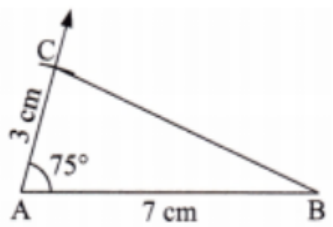
(a) 3 cm, 75°, 7 cm
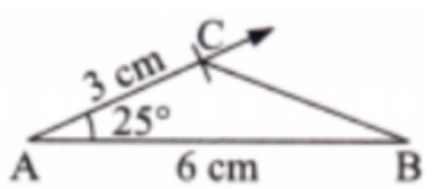
(b) 6 cm, 25°, 3 cm
(c) 3 cm, 120°, 8 cm
Solution:
(a) Steps of Construction
Step 1: Draw the base AB of length 7 cm.
Step 2: At point A, construct an angle of 75° by drawing the second arm of the angle.
Step 3: On this arm, mark a point C such that AC = 3 cm.
Step 4: Join BC to complete the required triangle ΔABC.
(b) Steps of Construction
Step 1: Draw the side AB of length 6 cm.
Step 2: At point A, construct an angle of 25° by drawing the second arm of the angle.
Step 3: On this arm, locate a point C such that AC = 3 cm.
Step 4: Join BC to form the required triangle ΔABC.
(c) Steps of Construction
Step 1: Draw the side AB of length 8 cm.
Step 2: At point A, construct an angle of 120° by drawing the other arm of the angle.
Step 3: On this arm, mark a point C such that AC = 3 cm.
Step 4: Join BC to complete the required triangle ΔABC.
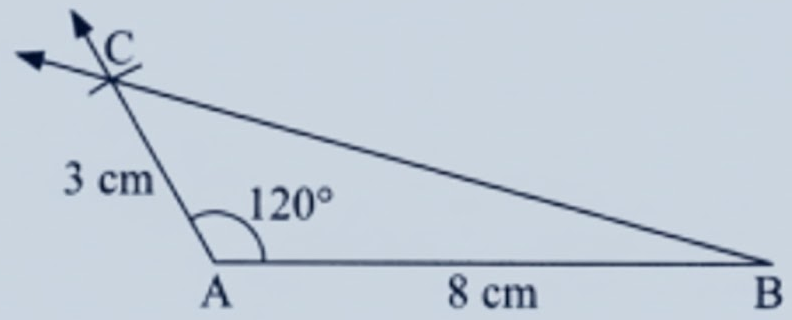
Figure it Out (Page 162)
Question 1. Construct triangles for the following measurements:
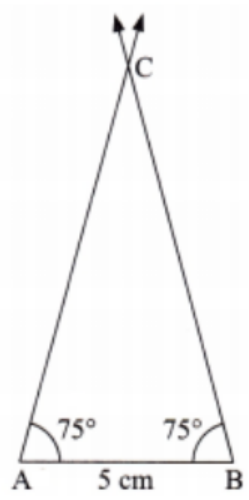
(a) 75°, 5 cm, 75°
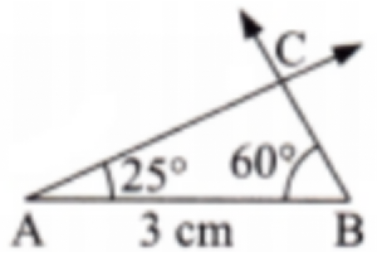
(b) 25°, 3 cm, 60°
(c) 120°, 6 cm, 30°
Solution:
(a) Steps of Construction
Step 1: Draw the base AB of length 5 cm.
Step 2: At point A, construct an angle of 75°, and at point B, construct another angle of 75°.
Step 3: The point where the two new arms intersect is the third vertex C.
This completes the required triangle ΔABC.
(b) Steps of Construction
Step 1: Draw the base AB of length 3 cm.
Step 2: At point A, construct an angle of 25°, and at point B, construct an angle of 60°.
Step 3: The point where the two new arms intersect gives the third vertex C.
This completes the required triangle ΔABC.
(c) Steps of Construction
Step 1: Draw the base AB of length 6 cm.
Step 2: At point A, construct an angle of 30°, and at point B, construct an angle of 120°.
Step 3: The point where the two new arms meet is the third vertex C.
Thus, the required triangle ΔABC is formed.
Conclusion:
Yes, a triangle always exists when one side and the two adjacent angles are given.
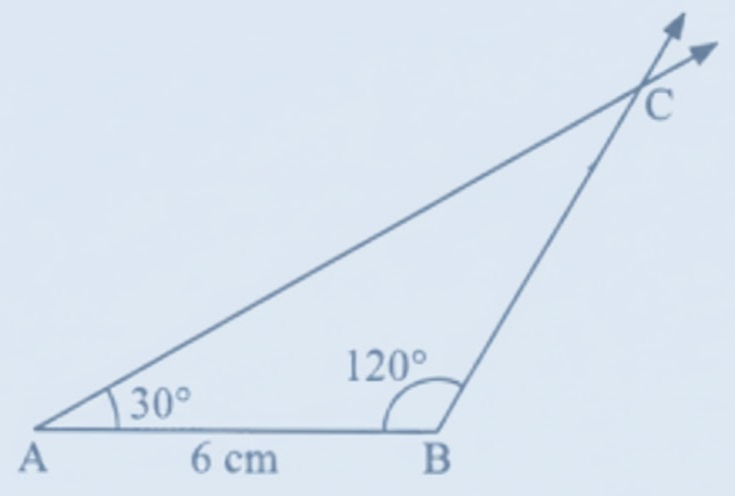
Figure it Out (Page 163)
Question 1. For each of the following angles, find another angle for which a triangle is (a) possible, (b) not possible. Find at least two different angles for each category:
(a) 30°
(b) 70°
(c) 54°
(d) 144°
Solution:
(a)
A triangle is possible if the sum of the two known angles + the third angle < 180°.
Given sum of known angles = 30° + 120° = 150°
Triangle possible:
Third angle must be < 30° (so total < 180°).
Examples: 60°, 90° (valid because each is < 150°; likely you meant angles at another vertex).
Triangle not possible:
Any angle ≥ 150° makes the sum ≥ 180°.
Examples: 160°, 170°
(b)
Sum of given angles = 70° + 40° = 110°
Triangle possible:
Third angle must be < 70° (so total < 180°).
Examples: 70°, 40°
Triangle not possible:
Any angle ≥ 110° makes the total ≥ 180°.
Examples: 120°, 150°
(c)
Sum of given angles = 54° + 72° = 126°
Triangle possible:
Third angle must be < 54°
Examples: 72°, 54°
Triangle not possible:
Any angle ≥ 126°
Examples: 130°, 140°
(d)
Sum of given angles = 10° + 26° = 36°
Triangle possible:
Third angle must be < 144°
Examples: 10°, 26°
Triangle not possible:
Any angle ≥ 36°, meaning the remaining angle sum becomes too large.
Examples: 40°, 50°
Question 2. Determine which of the following pairs can be the angles of a triangle and which cannot:
(a) 35°, 150°
(b) 70°, 30°
(c)90°, 85°
(d) 50°, 150°
Solution:
(a)
Sum of given angles = 35° + 150° = 185°
Since the total exceeds 180°, such a pair cannot form angles of a triangle.
(b)
Sum of given angles = 70° + 30° = 100°
Possible third angle = 180° – 100° = 80°
So, these angles can form a triangle.
(c)
Sum of given angles = 90° + 85° = 175°
Possible third angle = 180° – 175° = 5°
So, these angles can form a triangle.
(d)
Sum of given angles = 50° + 150° = 200°
Since the total exceeds 180°, such a pair cannot form angles of a triangle.
NCERT In-Text Questions (Page 164)
What could the measure of the third angle be? Does this measure change if the base length is changed to some other value, say 7 cm? Construct and find out.
Solution:
Given two angles measuring 60° and 70°,
the measure of the third angle is:
180°−60°−70°=50°180° - 60° - 70° = 50°180°−60°−70°=50°
So, the third angle is 50°.
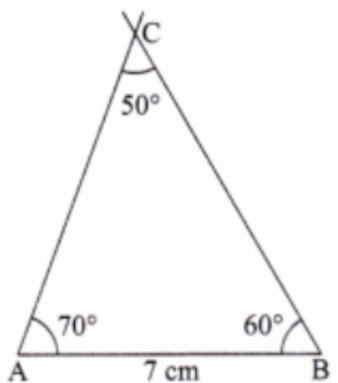
No, the measure of the third angle does not change even if the base length is changed—for example, to 7 cm.
The angles of a triangle depend only on the angle measures, not on the lengths chosen for construction.
Figure it Out (Page 165)
Question 1. Find the third angle of a triangle (using a parallel line) when two of the angles are:
(a) 36°, 72°
(b) 150°, 15°
(c) 90°, 30°
(d) 75°, 45°
Solution:
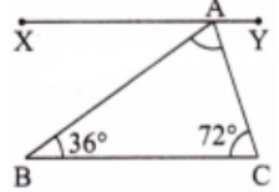
(a) Here ∠B = 36° and ∠C = 72°.
Since the line BC is parallel to XY.
So, ∠XAB = ∠B = 36° [Alternate angles] ….. (i)
and ∠YAC = ∠C = 72° [Alternate angles] …… (ii)
Also, ∠XAB + ∠BAC + ∠YAC = 180° [∵∠XAY is a straight angle]
⇒ 36° + ∠BAC + 72° = 180° [Using (i) and (ii)]
⇒ ∠BAC = 180°- 108° = 72°.
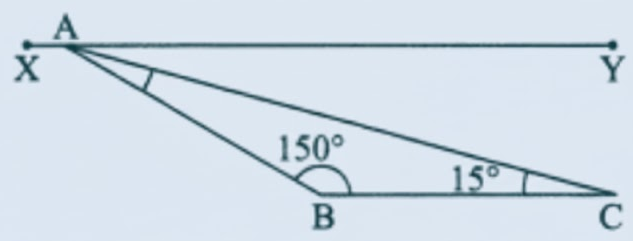
(b) Here ∠B = 150° and ∠C = 15°.
Since the line BC is parallel to XY.
So, ∠XAB = ∠B = 150° [Alternate angles] ….. (i)
and ∠YAC = ∠C = 15° [Alternate angles] …… (ii)
Also, ∠XAB + ∠BAC + ∠YAC = 180° [∠XAY is a straight angle]
⇒ 150° + ∠BAC + 15° = 180° [Using (i) and (ii)]
⇒ ∠BAC = 180° – 165° = 15°
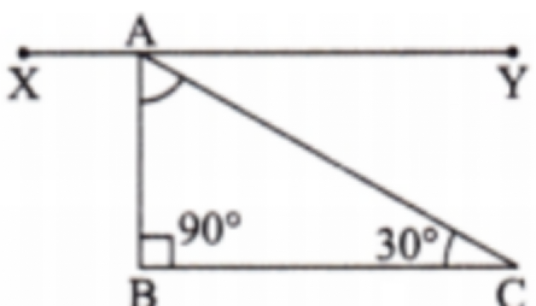
(c) Here ∠B = 90° and ∠C = 30°.
Since the line BC is parallel to XY.
So, ∠XAB = ∠B = 90° [Alternate angles] …… (i)
and ∠YAC = ∠C = 30° [Alternate angles] …… (ii)
Also, ∠XAB + ∠BAC + ∠YAC = 180° [∠XAY is a straight angle]
⇒ 90° + ∠BAC + 30° = 180° [Using (i) and (ii)]
⇒ ∠BAC = 180°- 120° = 60°
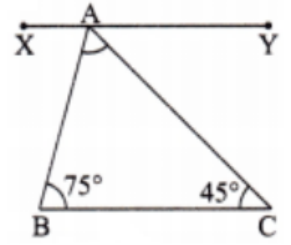
(d) Here ∠B = 75° and ∠C = 45°.
Since the line BC is parallel to XY.
So, ∠XAB = ∠B = 75° [Alternate angles] ….. (i)
and ∠YAC = ∠C = 45° [Alternate angles] ….. (ii)
Also, ∠XAB + ∠BAC + ∠YAC = 180° [∠XAY is a straight angle]
⇒ 75° + ∠BAC + 45° = 180° [Using (i) and (ii)]
⇒ ∠BAC = 180° – 120° = 60°
Question 2. Can you construct a triangle all of whose angles are equal to 70°? If two of the angles are 70°, what would the third angle be? If all the angles in a triangle have to be equal, then what must its measure be? Explore and find out.
Solution:
No, it is not possible to construct a triangle in which all angles are 70°.
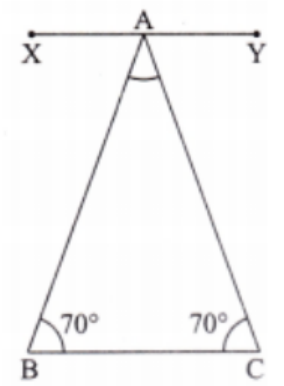
If we take two base angles as 70° that is, ∠B and ∠C = 70°, then we have to find ∠BAC.
Since XY is parallel to BC.
So, ∠XAB = ∠B = 70° ….. (i)
and ∠YAC = ∠C = 70° …… (ii)
Also, ∠XAB + ∠BAC + ∠YAC = 180°
⇒ 70° + ∠BAC + 70° = 180° [Using (i) and (ii)]
⇒ ∠BAC = 180° – 140° = 40°.
So, the third angle would be 40°.
If all the angles in a triangle have to be equal, then each angle must measure 60°. This type of triangle is called an equilateral triangle.
Question 3. Here is a triangle in which we know ∠B = ∠C and ∠A = 50°. Can you find ∠B and ∠C?
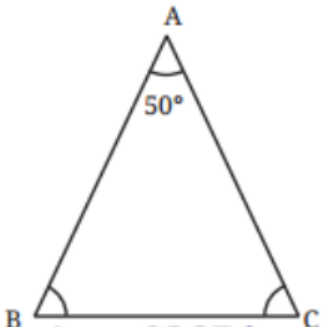
Solution:
Given ∠A = 50° and ∠B = ∠C.
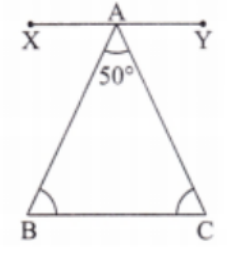
Draw a line XY that is parallel to BC.
Now, ∠XAB = ∠B and ∠YAC = ∠C [Alternate angles] …… (i)
Also, ∠XAB + ∠BAC + ∠YAC = 180°
⇒ ∠B + 50° + ∠C = 180° [Using (i)]
∠B + ∠C = 180° – 50° = 130°
⇒ 2∠B = 130°
⇒ ∠B = 65° = ∠C
Exterior Angles
NCERT In-Text Questions (Page 167)
The angle formed between the extension of a side of a triangle and the other side is called an exterior angle of the triangle. In this figure, ∠ACD is an exterior angle.
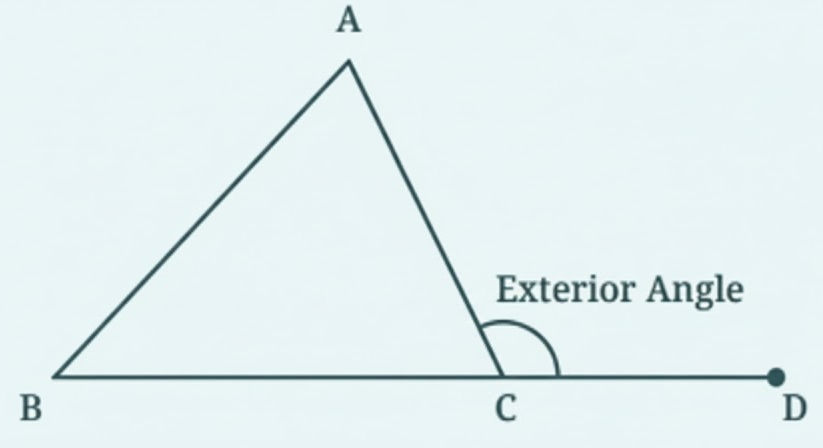
Find ∠ACD, if ∠A = 50°, and ∠B = 60°.
From the angle sum property, we know that
50° + 60° + ∠ACB = 180°
110° + ∠ACB = 180°
So, ∠ACB = 70°
So, ∠ACD = 180° - 70° = 110°
Since ∠ACB and ∠ACD together form a straight angle.
Find the exterior angle for different measures of ∠A and ∠B. Do you see any relation between the exterior angle and these two angles?
[Hint: From the angle sum property, we have ∠A + ∠B + ∠ACB = 180°.]
We also have ∠ACD + ∠ACB = 180°, since they form a straight angle.
What does this show?
Solution:
Here, ∠A + ∠B + ∠ACB = 180° ……….(i)
Also, ∠ACD + ∠ACB = 180°
So, ∠ACB = 180° – ∠ACD ……….(ii)
Using (ii) in (i), we get
∠A + ∠B + 180° – ∠ACD = 180°
⇒ ∠A + ∠B = ∠ACD [Exterior angle]
7.4 Constructions Related to Altitudes of Triangles
Altitudes Using Paper Folding
NCERT In-Text Questions (Page 168)
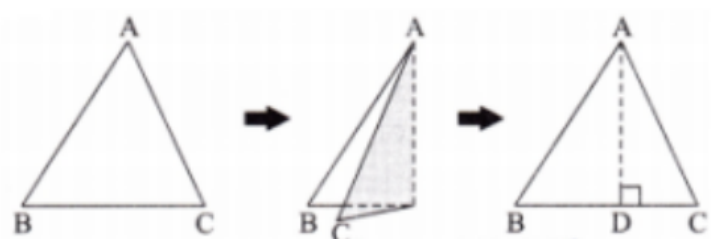
Cut out a paper triangle. Fix one of the sides as the base. Fold it in such a way that the resulting crease is an altitude from the top vertex to the base. Justify why the crease formed should be perpendicular to the base.
Solution:
The line formed becomes perpendicular because the shortest distance from a point (a vertex) to a line (the base) is always along a perpendicular.
When we fold the paper, we align the vertex with the base, and the crease created represents this shortest distance—therefore, the crease must be perpendicular to the base.
7.5 Types of Triangles
NCERT In-Text Questions (Page 170)
What could an acute-angled triangle be? Can we define it as a triangle with one acute angle? Why not?
Solution:
A triangle in which all three angles are acute is called an acute-angled triangle.We cannot define it using just one acute angle because even a right-angled triangle or an obtuse-angled triangle has two acute angles.
Therefore, all three angles must be acute to classify a triangle as acute-angled.
Figure it Out (Page 170)
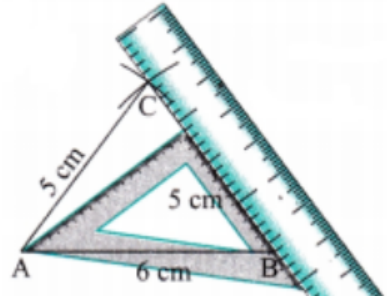
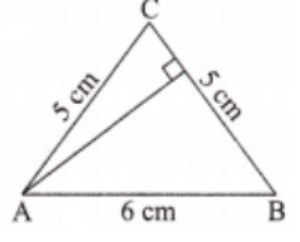
Question 1. Construct a triangle ABC with BC = 5 cm, AB = 6 cm, CA = 5 cm. Construct an altitude from A to BC.
Solution:
Steps of Construction
Step 1: Draw the base AB = 6 cm.
Step 2: With A as the centre, draw a sufficiently long arc of radius 5 cm.
Step 3: With B as the centre, draw another arc of radius 5 cm so that it intersects the first arc.
The point of intersection of the two arcs will be the third vertex C of the triangle.
Step 4:
The point where the two arcs intersect is the required third vertex C.
Join AC and BC to form ΔABC.
Step 5:
Align the ruler alongside BC.
Place the set square on the ruler so that one of the right-angle arms of the set square rests perfectly on the ruler.
Step 6:
Slide the set square gently along the ruler until the perpendicular edge touches vertex A.
This constructs a line from A that is perpendicular to BC.
Step 7:
Using the perpendicular edge of the set square, draw the altitude from A to BC. This line represents the perpendicular dropped from vertex A onto side BC.
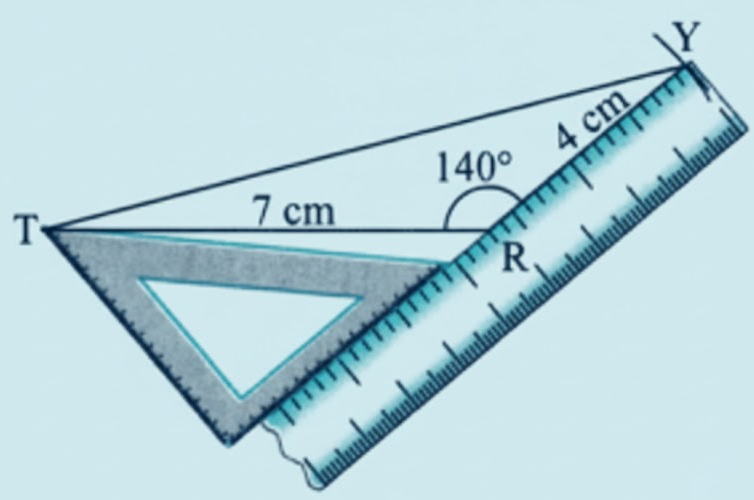
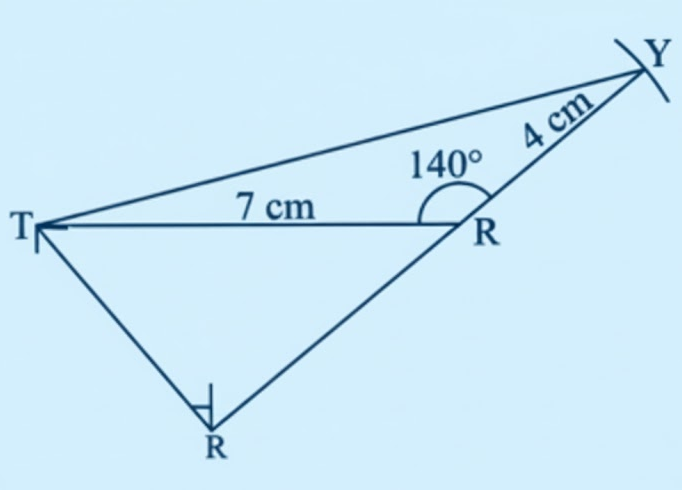
Question 2. Construct a triangle TRY with RY = 4 cm, TR = 7 cm, ∠R = 140°. Construct an altitude from T to RY.
Solution:
Steps of Construction
Step 1: Draw the side TR of length 7 cm.
Step 2: At point R, construct an angle of 140° by drawing the other arm of the angle.
Step 3: On this arm, mark a point Y such that RY = 4 cm.
Step 4: Join TY to complete the required triangle.
Step 5: Align the ruler along RY. Place the set square on the ruler so that one arm of the right angle rests on the ruler.
Step 6: Slide the set square along the ruler until its perpendicular edge touches vertex T.
Step 7: Extend YR, and using the perpendicular edge of the set square, draw the altitude from T onto the extended line YR.
Question 3. Construct a right-angled triangle ∆ABC with ∠B = 90°, AC = 5 cm. How many different triangles exist with these measurements?
[Hint: Note that the other measurements can take any values. Take AC as the base. What values can ∠A and ∠C take so that the other angle is 90°?]
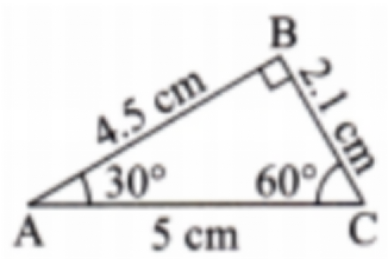
Solution:
Given, ∠B = 90°, and AC = 5 cm (hypotenuse)
Since ∠B = 90°, ∠A and ∠C add upto 90°.
If we fixed AC = 5 cm and ∠A and ∠C vary, then there are infinitely many triangles possible.
Because the shape of the triangle can change with the different values of angles A and C.
One such example is given here:
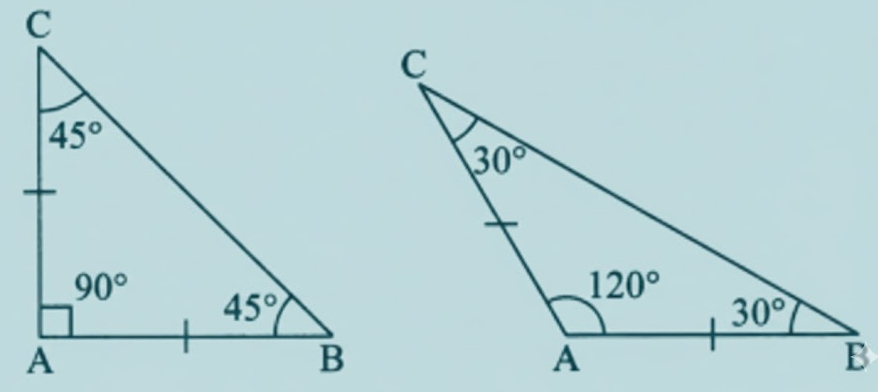
Question 4. Through construction, explore if it is possible to construct an equilateral triangle that is (i) right-angled, (ii) obtuse-angled. Also construct an isosceles triangle that is (i) right-angled, (ii) obtuse-angled.
Solution:
An equilateral triangle cannot be right-angled or obtuse-angled because all three angles in an equilateral triangle are always 60°.
An isosceles right-angled triangle is possible and has:
one angle of 90°, and
the other two angles of 45° each.
An isosceles obtuse-angled triangle is also possible, for example:
one angle of 120°, and
the remaining two angles of 30° each.
Key Concepts of Triangles and Their Construction
In NCERT Solutions for Class 7 Maths Chapter 7 A Tale of Three Intersecting Lines, students learn how every triangle is formed by three line segments. Understanding triangle construction rules builds a strong foundation for tackling complex geometry questions.
This chapter emphasizes the importance of the triangle inequality property. Knowing when a triangle is possible for given side lengths can help you solve school tests and competitive exams with confidence.
Regular practice of exercise-based NCERT solutions will reinforce key geometry concepts. Always check if the sum of any two sides is greater than the third to ensure the triangle’s existence in every problem.
FAQs on NCERT Solutions For Class 7 Maths Chapter 7 A Tale of Three Intersecting Lines - 2026-27 Free PDF Download (Login Required)
1. What is covered in NCERT Solutions for Class 7 Maths Chapter 7 A Tale of Three Intersecting Lines?
NCERT Solutions for Class 7 Maths Chapter 7 A Tale of Three Intersecting Lines covers stepwise solutions for all textbook exercises, intext questions, back exercises, and important diagrams.
- Includes definitions, solved examples, and key formulae
- Follows the CBSE 2026–27 syllabus for maximum exam alignment
- Provides exam-oriented answers for better marks
- Offers free PDF downloads and revision strategies
2. How to write stepwise NCERT answers to score full marks in Class 7 Maths Chapter 7?
To score full marks with NCERT Solutions for Class 7 Maths Chapter 7, ensure
- Each step is shown clearly as per the marking scheme
- Proper use of definitions and diagrams where required
- Numbering each step within calculations or logical reasoning
- Highlighting key terms and final answers
- Following the CBSE answer structuring guidelines strictly
3. Are diagrams or definitions necessary in Class 7 Maths Chapter 7 answers?
Yes, adding diagrams and clear definitions is often necessary in NCERT Solutions for Class 7 Maths Chapter 7:
- Diagrams: Help score easy marks and make explanations clear
- Definitions: Show conceptual understanding
- Always label diagrams neatly and use correct mathematical terms as per syllabus
4. Where can I download free PDF of Class 7 Maths Chapter 7 NCERT Solutions?
You can download the free PDF of NCERT Solutions for Class 7 Maths Chapter 7 A Tale of Three Intersecting Lines from trusted educational websites.
- Look for the official PDF download button on solution pages
- Ensure alignment with CBSE 2026–27 syllabus
- Use the PDF for offline revision and practice
5. Which questions from Chapter 7 are likely to appear in CBSE school exams?
Important questions from NCERT Chapter 7 often appear in CBSE exams, especially:
- Back exercise and intext NCERT questions
- Definitions and properties of angles formed by intersecting lines
- Diagram-based reasoning questions
- Application-based problems as seen in exam patterns
6. How do I structure long answers in Class 7 Maths Chapter 7 for maximum marks?
To structure long answers for NCERT Solutions Class 7 Maths Chapter 7 and score better:
- Begin with a brief definition or formula
- Draw a neatly labelled diagram if required
- Break the solution into numbered steps
- Highlight key results and final answer
7. How does using stepwise, exam-oriented solutions for Class 7 Maths Chapter 7 improve accuracy and confidence?
Stepwise, exam-oriented NCERT Solutions for Class 7 Maths Chapter 7 build accuracy and confidence by:
- Matching the CBSE marking scheme
- Making error spotting easier
- Reinforcing mathematical reasoning and logic
- Helping practice presentation style for real exams
8. Do examiners award partial marks for correct steps even if the final answer is wrong?
Yes, according to CBSE marking scheme for Class 7 Maths:
- Partial marks are given for correct steps shown
- Even if the final answer is incorrect, presenting clear, logical steps can earn marks
- Always show all the working to maximise your score
9. What are the key definitions and formulae from Class 7 Maths Chapter 7 A Tale of Three Intersecting Lines?
Key definitions and formulae from NCERT Class 7 Maths Chapter 7 include:
- Intersecting lines: Lines that meet at a point
- Vertically opposite angles: Equal angles formed when two lines intersect
- Linear pair: Two adjacent angles whose sum is 180°
- Basic angle formula: Angle properties used in problems
Ensure to learn and write these in your answers for scoring full marks.
10. How can I quickly revise Class 7 Maths Chapter 7 A Tale of Three Intersecting Lines before exams?
For fast revision before exams:
- Review stepwise NCERT Solutions and key definitions
- Go through important diagrams and labelling
- Practice with worksheets and extra questions
- Use revision notes and the NCERT Solutions PDF for last-minute preparation
This targeted approach improves speed and exam confidence.
