




Exercise-wise Stepwise Answers for Class 7 Maths Chapter 2 Arithmetic Expressions
2.1 Simple Expressions
NCERT In-Text Questions (Page 24)
Choose your favourite number and write as many expressions as you can that have that value.
Solution:
Let us take the number 20 as an example.
We can express it using different arithmetic operations, such as:
12 + 8 = 20
4 × 5 = 20
40 ÷ 2 = 20
and many more similar expressions.
Figure it Out (Page 25)
Question 1.
Fill in the blanks to make the expressions equal on both sides of the ‘=’ sign:
(a) 13 + 4 = _________ + 6
(b) 22 + _________ = 6 × 5
(c) 8 × _________ = 64 ÷ 2
(d) 34 – _________ = 25
Solution:
(a) 13 + 4 = 17
11 + 6 = 17
Therefore, 13 + 4 = 11 + 6
(b) Since 6 × 5 = 30
22 + 8 = 30
Therefore, 22 + 8 = 6 × 5
(c) Since 64 ÷ 2 = 32
8 × 4 = 32
Therefore, 8 × 4 = 64 ÷ 2
(d) Since 34 – 25 = 9
Therefore, 34 – 9 = 25
Question 2.
Arrange the following expressions in ascending (increasing) order of their values.
(a) 67 – 19
(b) 67 – 20
(c) 35 + 25
(d) 5 × 11
(e) 120 ÷ 3
Solution:
(a) 67 – 19 = 48
(b) 67 – 20 = 47
(c) 35 + 25 = 60
(d) 5 × 11 = 55
(e) 120 ÷ 3 = 40
Clearly, 40 < 47 < 48 < 55 < 60
Therefore, 120 ÷ 3 < 67 – 20 < 67 – 19 < 5 × 11 < 35 + 25
Thus, (e) < (b) < (a) < (d) < (c).
Comparing Expressions
NCERT In-Text Questions (Page 26)
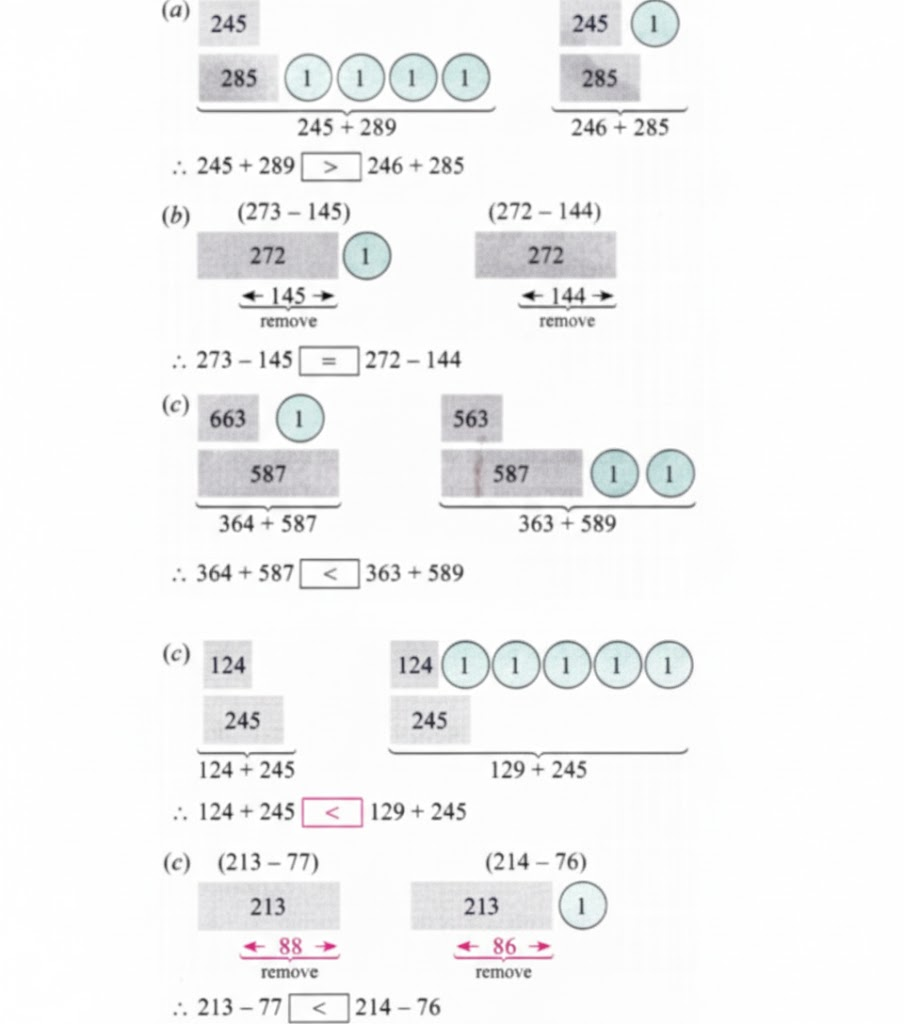
Use ‘>’ or ‘<’ or ‘=’ in each of the following expressions to compare them. Can you do it without complicated calculations? Explain your thinking in each case.
(a) 245 + 289 ▭ 246 + 285
(b) 273 – 145 ▭ 272 – 144
(c) 364 + 587 ▭ 363 + 589
(d) 124 + 245 ▭ 129 + 245
(e) 213 – 77 ▭ 214 – 76
Solution:
Terms in Expressions
NCERT In-Text Questions (Pages 28-29)
Check if replacing subtraction by addition in this way does not change the value of the expression, by taking different examples.
Solution:
Let us consider the numbers 56 and 17.
We have:
56 – 17 = 39
Now, if we rewrite it as:
56 + (–17) = 39
So, replacing the subtraction sign with an addition sign by using a negative number keeps the value of the expression the same.
(Answers may differ if you choose different numbers.)
Can you explain why subtracting a number is the same as adding its inverse, using the Token Model of integers that we saw in the Class 6 textbook of mathematics?
Solution:
Do it yourself.
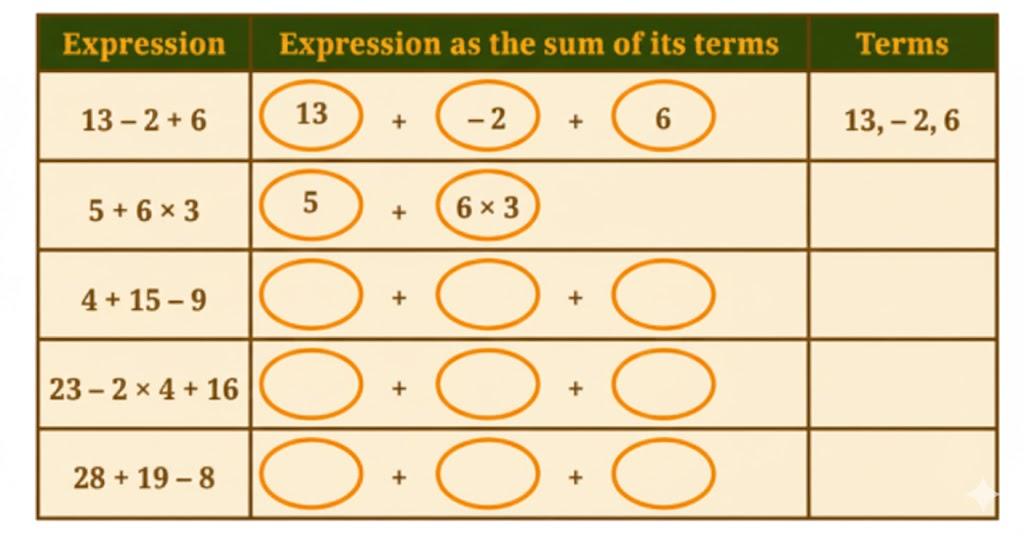
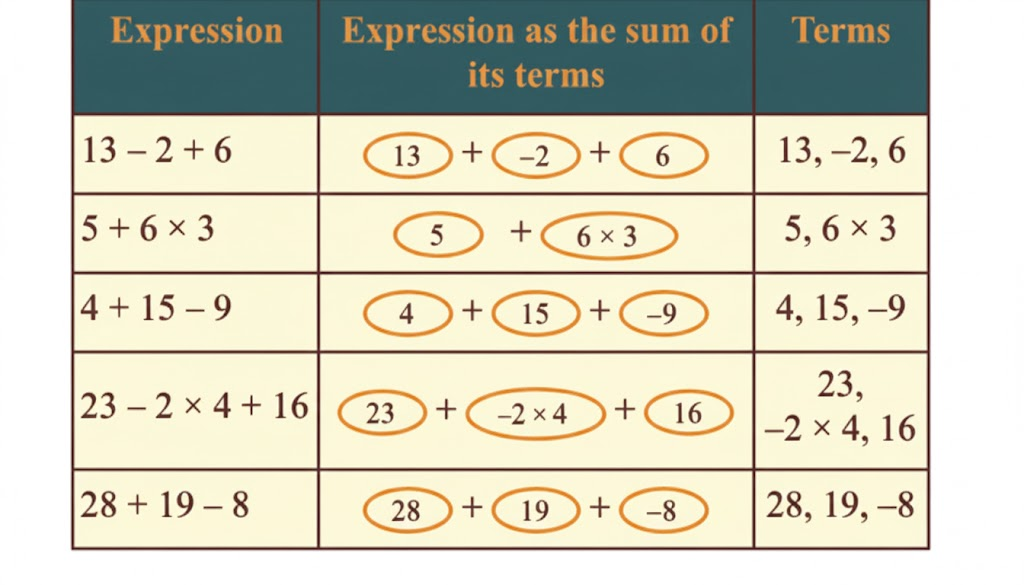
In the following table, some expressions are given. Complete the table.
Solution:
Does changing the order in which the terms are added give different values?
Solution: No, the value will not change. In this expression, all the terms are connected with a ‘+’ sign. Changing the order of the terms does not affect the result because addition is commutative.
For example:
4 + 15 + (–9) = 10
and
(–9) + 15 + 4 = 10
Both give the same value.
Swapping and Grouping
NCERT In-Text Questions (Pages 29-31)
Will this also hold when there are terms having negative numbers as well? Take some more expressions and check.
Solution:
Yes, exchanging the positions of negative numbers does not change the total.
For example:
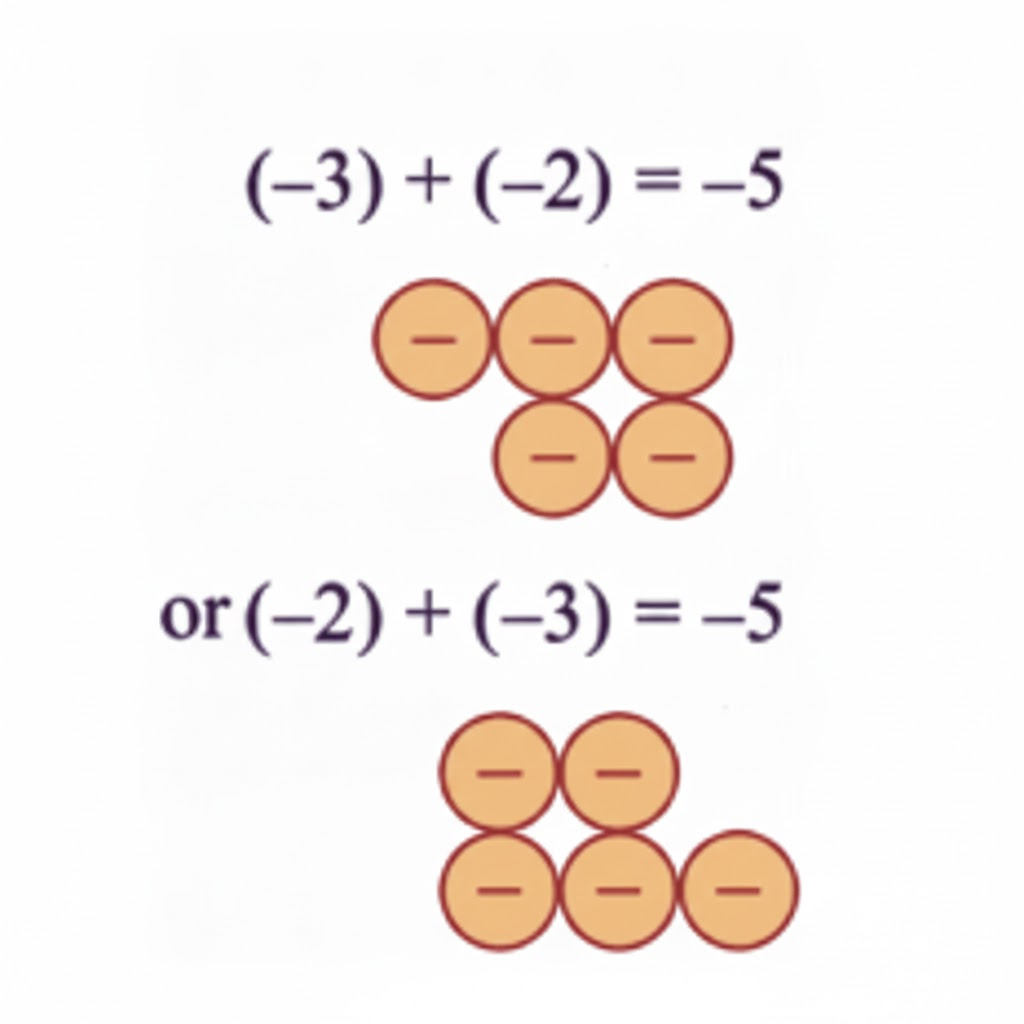
(–3) + (–2) = –5
and
(–2) + (–3) = –5
Both give the same sum.
(Answers may vary.)
Can you explain why this is happening using the Token Model of integers that we saw in the Class 6 textbook of mathematics?
Solution:
Yes
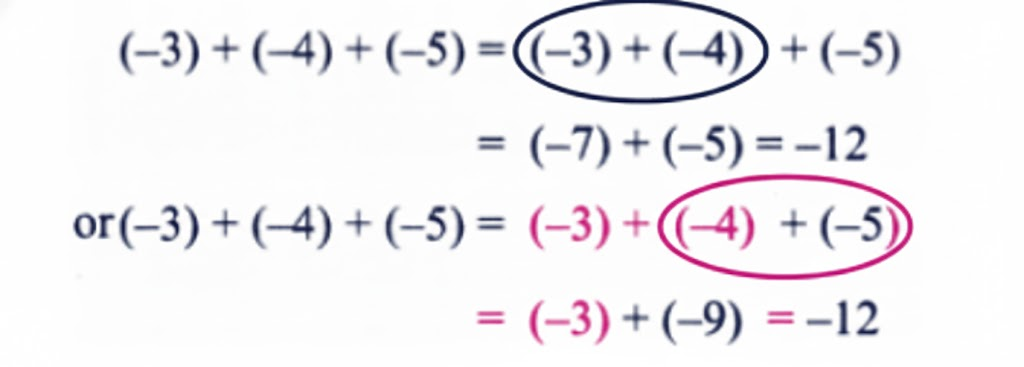
Will this also hold when there are terms having negative numbers as well? Take some more expressions and check.
Solution:
Yes, when adding negative numbers, grouping them in any order will still give the same result.
For example:
(–4) + (–6) + (–3) = –13
or
(–6) + [(–4) + (–3)] = –13
or
[(–3) + (–6)] + (–4) = –13
The total remains the same each time because addition is associative.
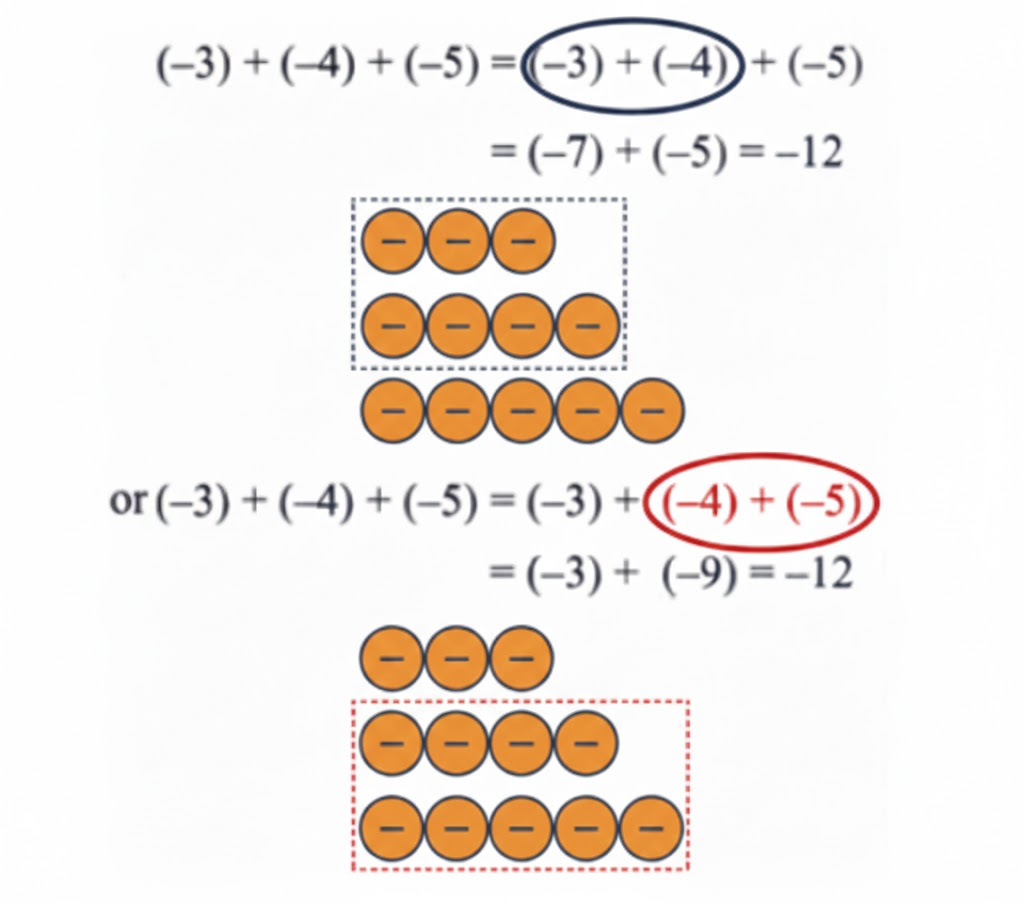
Can you explain why this is happening using the Token Model of integers that we saw in the Class 6 textbook of mathematics?
Solution:
Yes
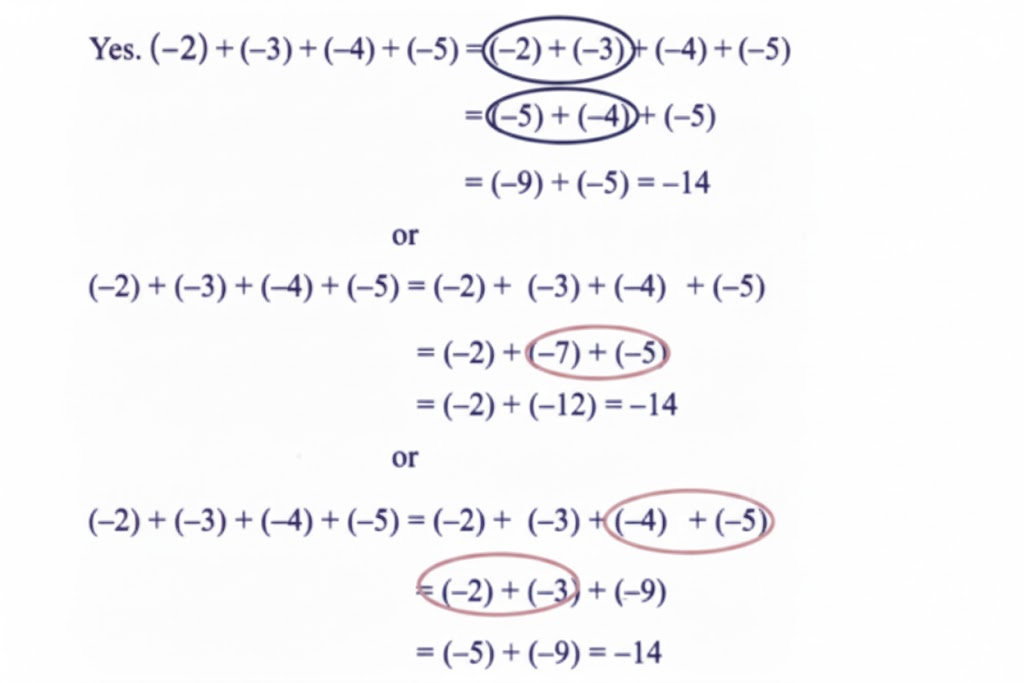
Does adding the terms of an expression in any order give the same value? Take some more expressions and check. Consider expressions with more than 3 terms also.
Solution:
Can you explain why this is happening using the Token Model of integers that we saw in the Class 6 textbook of mathematics?
Solution: Students should do it by themselves.
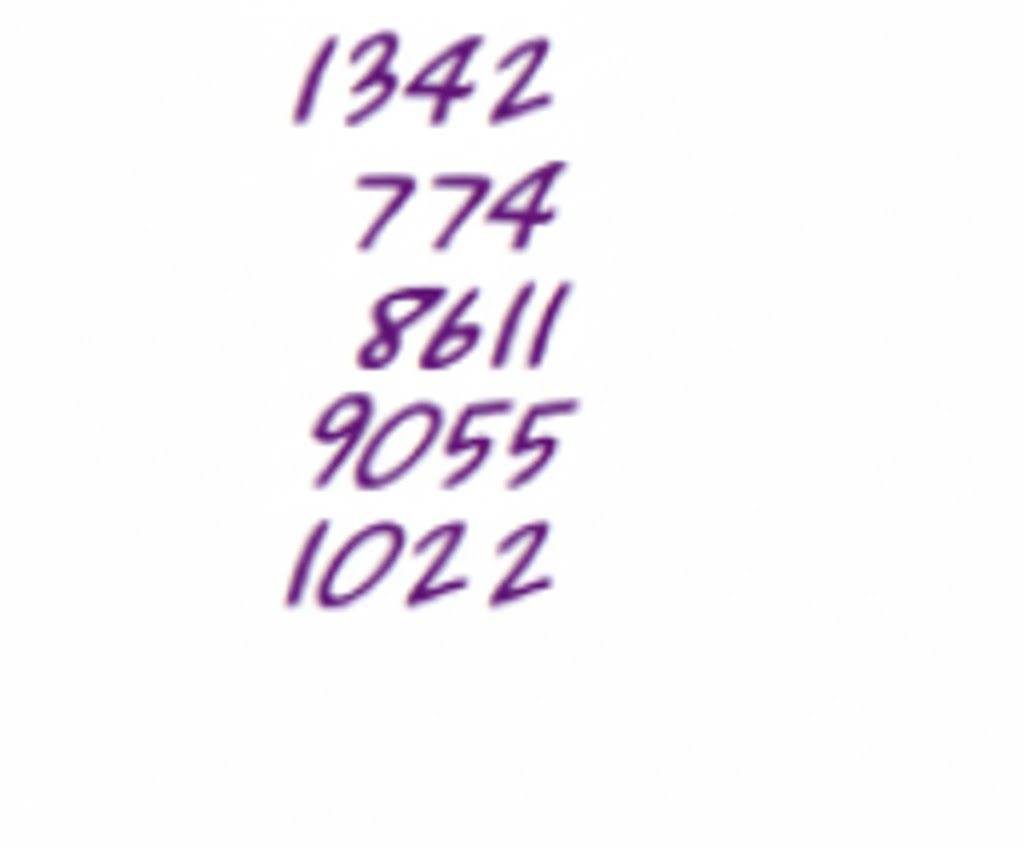
Manasa is adding a long list of numbers. It took her five minutes to add them all and she got the answer 11749. Then she realised that she had forgotten to include the fourth number 9055. Does she have to start all over again?
Solution:
No, she does not need to start the calculation again. She only needs to add the fourth number, 9055, to the sum she already found (11749) to get the correct total.
So,
11749 + 9055 = 20804
More Expressions and Their Terms
NCERT In-Text Questions (Pages 32-33)
If the total number of friends goes up to 7 and the tip remains the same, how much will they have to pay? Write an expression for this situation and identify its terms.
Solution:
There are 7 friends, and each dosa costs ₹23.
So, the total cost of 7 dosas is:
7 × 23
The tip is fixed at ₹5.
Therefore, the expression representing the total cost is:
7 × 23 + 5 = 161 + 5 = ₹166
The terms in the expression 7 × 23 + 5 are 7 × 23 and 5.
Think and discuss why she wrote this.
The expression written as a sum of terms is-
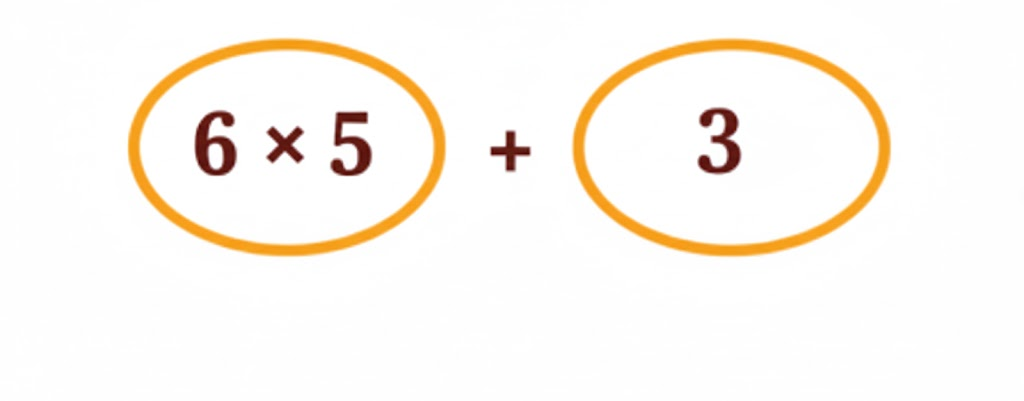
Solution:
Do it yourself.
For each of the cases below, write the expression and identify its terms:
If the teacher had called out ‘4’, Ruby would write _________
If the teacher had called out ‘7’, Ruby would write _________
Solution:
If the teacher had called our ‘4’, Ruby would write 8 × 4 + 1
Terms: 8 × 4, 1
If the teacher had called our ‘7’, Ruby would write 4 × 7 + 5
Terms: 4 × 7, 5
Write an expression like the above for your class size.
Solution:
Do it yourself.
Identify the terms in the two expressions above.
Solution:
432 = 4 × 100 + 1 × 20 + 1 × 10 + 2 × 1
Terms: 4 × 100, 1 × 20, 1 × 10, and 2 × 1
432 = 8 × 50 + 1 × 10 + 4 × 5 + 2 × 1
Terms: 8 × 50, 1 × 10, 4 × 5, and 2 × 1
Can you think of some more ways of giving ₹ 432 to someone?
Solution:
Do it yourself.
Figure it Out (Pages 34-35)
Question 1.
Find the values of the following expressions by writing the terms in each case.
(a) 28 – 7 + 8
(b) 39 – 2 × 6 + 11
(c) 40 – 10 + 10 + 10
(d) 48 – 10 × 2 + 16 + 2
(e) 6 × 3 – 4 × 8 × 5
Solution:
(a) 28 – 7 + 8 = 28 + (-7) + 8
Terms: 28, -7, and 8
28 – 7 + 8
= 28 + (-7) + 8
= 21 + 8 = 29
(b) 39 – 2 × 6 + 11 = 39 + (-2 × 6) + 11
Terms: 39, -2 × 6, and 11
39 – 2 × 6 + 11
= 39 + (-2 × 6) + 11
= 39 + (-12) + 11
= 27 + 11
= 38
(c) 40 – 10 + 10 + 10 = 40 + (-10) + 10 + 10
Terms: 40, -10, 10, and 10
40 – 10 + 10 + 10
= 40 + (-10) + 10 + 10
= 30 + 10 + 10
= 40 + 10
= 50
(d) 48 – 10 × 2 + 16 + 2 = 48 + (-10 × 2) + (16 + 2)
Terms: 48, -10 × 2, 16 + 2
48 – 10 × 2 + 16 + 2
= 48 + (-10 × 2) + (16 + 2)
= 48 + (-20) + (8)
= 28 + 8 = 36
(e) 6 × 3 – 4 × 8 × 5 = (6 × 3) + (-4 × 8 × 5)
Terms: 6 × 3, 4 × 8 × 5
6 × 3 – 4 × 8 × 5
= (6 × 3) + (-4 × 8 × 5)
= 18 + (-160)
= -142
Question 2.
Write a story/situation for each of the following expressions and find their values.
(а) 89 + 21 – 10
(b) 5 × 12 – 6
(c) 4 × 9 + 2 × 6
Solution:
(a) 89 + 21 – 10
Riya and Siya are cousins. They visited the beach, where Riya collected 89 stones and Siya collected 21 stones. When they returned home, their younger sister asked for some stones, and they gave her 10 stones from their collection. How many stones do Riya and Siya have left in total?
89 + 21 – 10 = 89 + 21 + (–10)
= 89 + 11 = 100
So, they have 100 stones left altogether.
(b) 5 × 12 – 6
Radha purchased 5 pens from a stationery shop, and each pen cost ₹12. The shopkeeper gave her a discount of ₹6 on the total amount. How much does she need to pay?
5 × 12 – 6 = 5 × 12 + (–6)
= 60 – 6 = ₹54
So, Radha has to pay ₹54.
(c) 4 × 9 + 2 × 6
Sumit bought 4 pencils, each costing ₹9, and 2 erasers, each priced at ₹6. How much does he have to spend in total?
4 × 9 + 2 × 6 = 36 + 12 = ₹48
So, Sumit needs to pay ₹48.
Question 3.
For each of the following situations, write the expression describing the situation, identify its terms, and find the value of the expression.
(а) Queen Alia gave 100 gold coins to Princess Elsa and 100 gold coins to Princess Anna last year. Princess Elsa used the coins to start a business and doubled her coins. Princess Anna bought jewellery and has only half of the coins left. Write an expression describing how many gold coins Princess Elsa and Princess Anna together have.
(b) A metro train ticket between two stations is ₹ 40 for an adult and ₹ 20 for a child. What is the total cost of the tickets?
(i) for four adults and three children?
(ii) for two groups having three adults each?
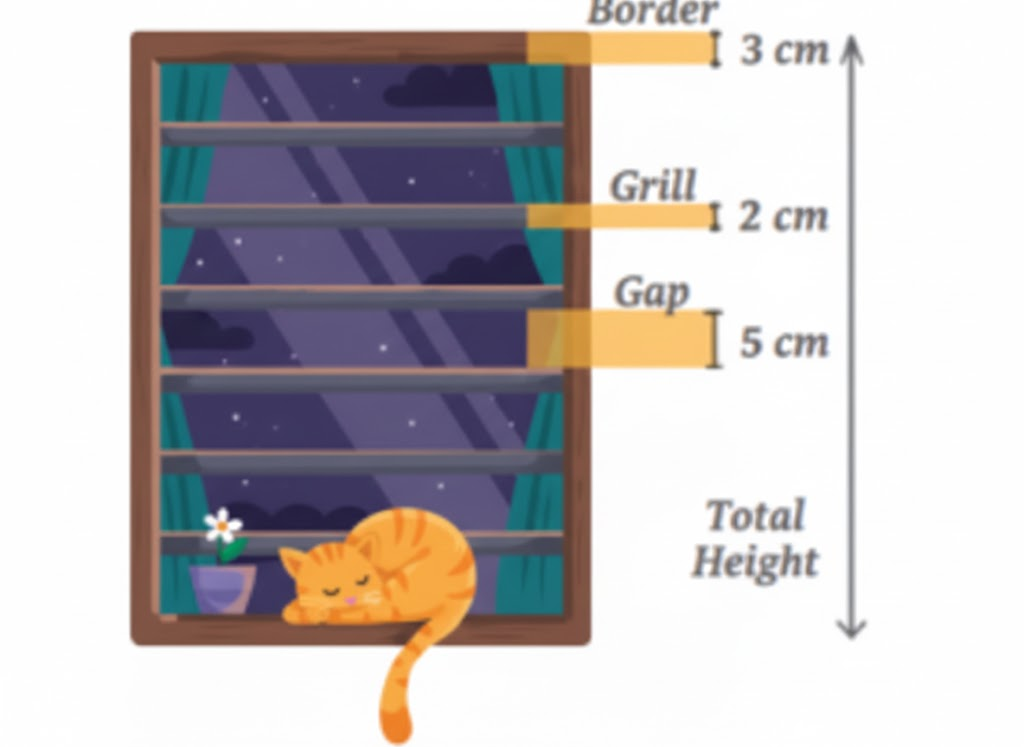
(c) Find the total height of the window by writing an expression describing the relationship among the measurements shown in the picture.
Solution:
(a) Princess Elsa received 100 gold coins, and Princess Anna also received 100 gold coins.
Princess Elsa used her coins to start a business and doubled them.
So, the number of coins Elsa has now = 2 × 100Princess Anna bought jewellery and was left with half of her coins.
So, the number of coins Anna has now = 100 ÷ 2
Therefore, the total number of gold coins they have together is:
2 × 100 + 100 ÷ 2
Expression:
2 × 100 + 100 ÷ 2
Terms:
2 × 100
100 ÷ 2
Now, calculating:
2 × 100 = 200
100 ÷ 2 = 50
Total = 200 + 50 = 250
(b) (i)
Ticket price for one adult = ₹40
So, ticket price for four adults = 4 × 40Ticket price for one child = ₹20
So, ticket price for three children = 3 × 20
Expression:
4 × 40 + 3 × 20
Terms:
4 × 40
3 × 20
Now calculate:
4 × 40 = 160
3 × 20 = 60
Total = 160 + 60 = ₹220
(b) (ii)
Ticket price for one adult = ₹40
Ticket price for three adults = 3 × 40
There are two such groups, so:
Expression:
2 × (3 × 40)
Terms:
2 × (3 × 40)
Now calculate:
3 × 40 = 120
2 × 120 = 240
Total = ₹240
(c)
From the picture:
Number of gaps = 7, each 5 cm
Number of grills = 6, each 2 cm
Number of borders = 2, each 3 cm
Expression for total height:
7 × 5 + 6 × 2 + 2 × 3
Terms:
7 × 5
6 × 2
2 × 3
Now calculate:
7 × 5 = 35
6 × 2 = 12
2 × 3 = 6
Total height = 35 + 12 + 6 = 53 cm
Tinker the Terms I
NCERT In-Text Questions (Pages 36-37)
Some expressions are given in the following three columns. In each column, one or more terms are changed from the first expression. Go through the example (in the first column) and fill in the blanks, doing as little computation as possible.
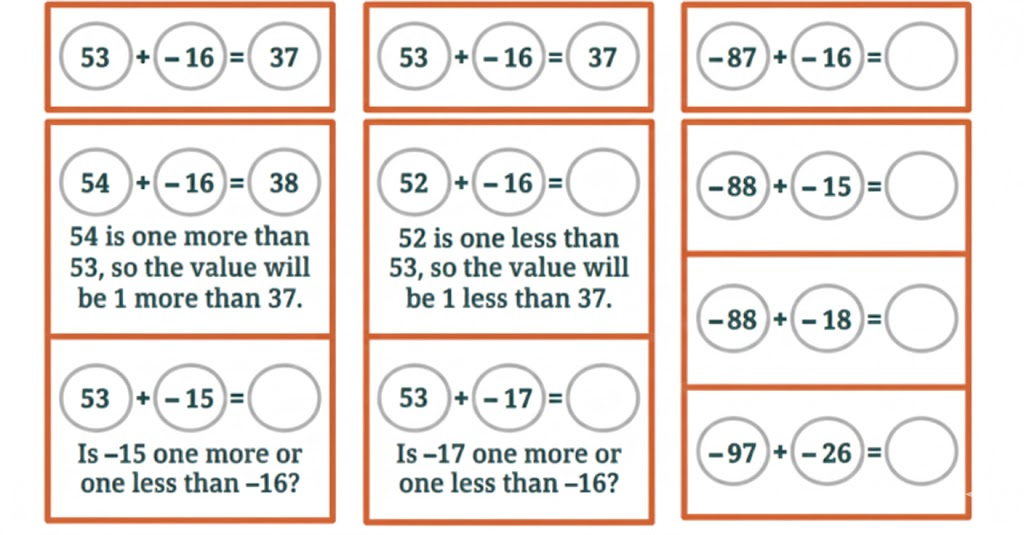
Solution:
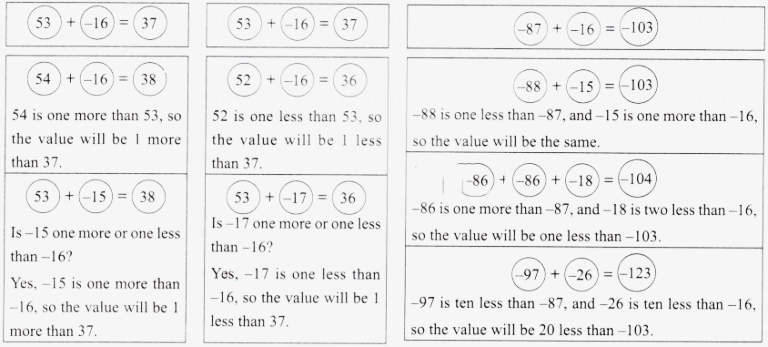
Figure it Out (Pages 37-38)
Question 1.
Fill in the blanks with numbers, and boxes with operation signs such that the expressions on both sides are equal.
(a) 24 + (6 – 4) = 24 + 6 ☐ _________
(b) 38 + (_________ ☐ ________) = 38 + 9 – 4
(c) 24 – (6 + 4) = 24 ☐ 6 – 4
(d) 24 – 6 – 4 = 24 – 6 ☐ _________
(e) 27 – (8 + 3) = 27 _________ 8 _________ 3
(f) 27 – (_________ ☐ ________) = 27 – 8 + 3
Solution:
(a) 24 + (6 – 4) = 24 + 6 – 4
(b) 38 + (9 – 4) = 38 + 9 – 4
(c) 24 – (6 + 4) = 24 – 6 – 4
(d) 24 – 6 – 4 = 24 – 6 – 4
(e) 27 – (8 + 3) = 27 – 8 – 3
(f) 27 – (8 – 3) = 27 – 8 + 3
Question 2.
Remove the brackets and write the expression having the same value.
(a) 14 + (12 + 10)
(b) 14 – (12 + 10)
(c) 14 + (12 – 10)
(d) 14 – (12 – 10)
(e) -14 + 12 – 10
(f) 14 – (-12 – 10)
Solution:
(a) 14 + (12 + 10)
= 14 + 12 + 10
= 14 + 22
= 36
(b) 14 – (12 + 10)
= 14 – 12 – 10
= 14 – 22
= -8
(c) 14 + (12 – 10)
= 14 + 12 – 10
= 14 + 2
= 16
(d) 14 – (12 – 10)
= 14 – 12 + 10
= 14 – 2
= 12
(e) -14 + 12 – 10
= -14 + 2
= -12
(f) 14 – (-12 – 10)
= 14 + 12 + 10
= 14 + 22
= 36
Question 3.
Find the values of the following expressions. For each pair, first try to guess whether they have the same value. When are the two expressions equal?
(a) (6 + 10) – 2 and 6 + (10 – 2)
(b) 16 – (8 – 3) and (16 – 8) – 3
(c) 27 – (18 + 4) and 27 + (-18 – 4)
Solution:
(a) (6 + 10) – 2 and 6 + (10 – 2)
(6 + 10) – 2 = 16 – 2 = 14
and 6 + (10 – 2) = 6 + 8 = 14
Clearly, (6 + 10) – 2 = 6 + (10 – 2)
Hence, the expressions in part (a) have the same value.
(b) 16 – (8 – 3) and (16 – 8) – 3
16 – (8 – 3) = 16 – 5 = 11
and (16 – 8) – 3 = 8 – 3 = 5
16 – (8 – 3) ≠ (16 – 8) – 3
Hence, the expressions in part (b) do not have the same value.
(c) 27 – (18 + 4) and 27 + (-18 – 4)
27 – (18 + 4) = 27 – 22 = 5
and 27 + (-18 – 4) = 27 + (-22) = 5
Clearly, 27 – (18 + 4) = 27 + (-18 – 4)
Hence, the expressions in part (c) have the same value.
Question 4.
In each of the sets of expressions below, identify those that have the same value. Do not evaluate them, but rather use your understanding of terms.
(a) 319 + 537, 319 – 537, -537 + 319, 537 – 319
(b) 87 + 46 – 109, 87 + 46 – 109, 87 + 46 – 109, 87 – 46 + 109, 87 – (46 + 109), (87 – 46) + 109
Solution:
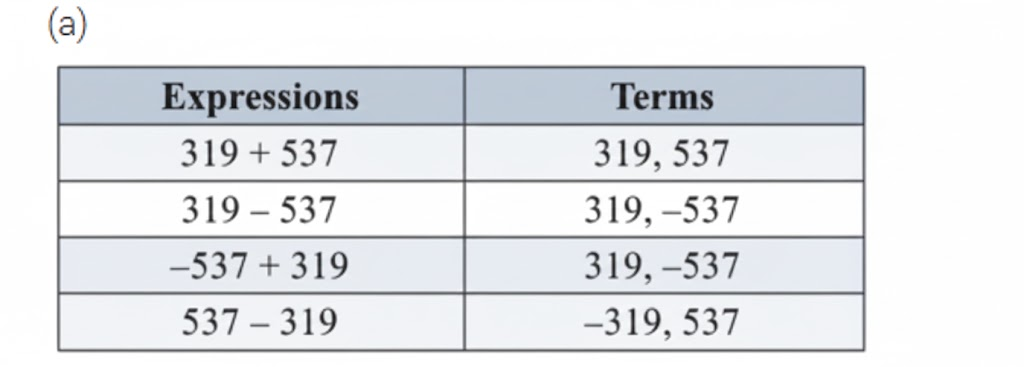
Expressions that contain the same terms will have the same value.
Therefore, 319 – 537 and –537 + 319 give the same result.
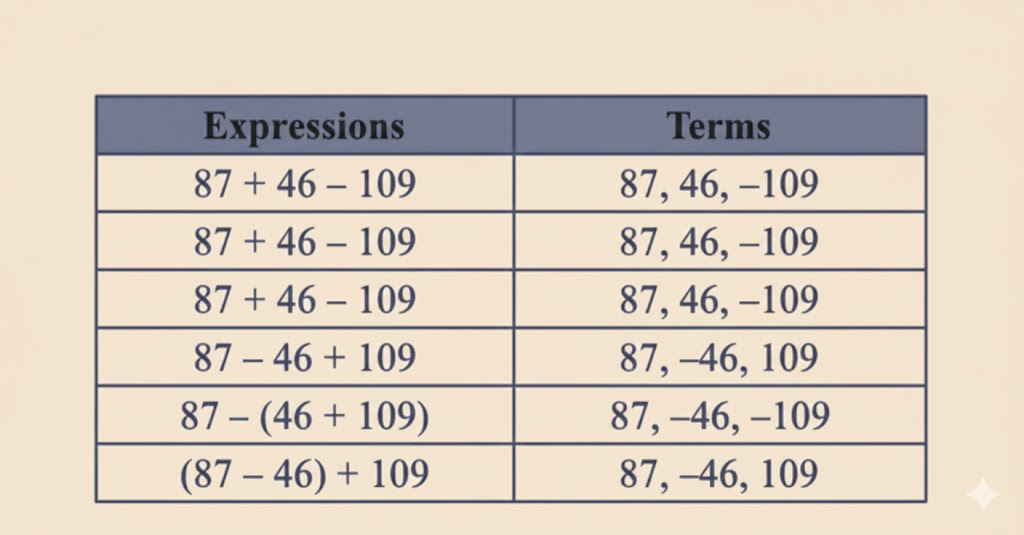
Expressions that contain the same terms have equal values.
Therefore, 87 + 46 – 109, 87 + 46 – 109, and 87 + 46 – 109 all have the same value.
Also, 87 – 46 + 109 and (87 – 46) + 109 give the same result because the terms remain unchanged.
Question 5.
Add brackets at appropriate places in the expressions such that they lead to the values indicated.
(a) 34 – 9 + 12 = 13
(b) 56 – 14 – 8 = 34
(c) -22 – 12 + 10 + 22 = – 22
Solution:
(a) 34 – (9 + 12) = 34 – 21 = 13
(b) (56 – 14) – 8 = 42 – 8 = 34
(c) -22 – (12 + 10) + 22 = -22 – 22 + 22 = -22
Question 6.
Using only reasoning of how terms change their values, fill the blanks to make the expressions on either side of the equality (=) equal.
(a) 423 + ________ = 419 + ________
(b) 207 – 68 = 210 – ________
Solution:
(a) 423 + 419 = 419 + 423
(b) 207 – 68 = 210 – 71
Question 7.
Using the numbers 2, 3, and 5, and the operators ‘+’ and ‘-‘, and brackets, as necessary, generate expressions to give as many different values as possible.
For example, 2 – 3 + 5 = 4 and 3 – (5 – 2) = 0
Solution: Here are a few expressions formed by using numbers 2, 3, and 5 and the operators ‘+’ and ‘-‘ and brackets having different values.
(2 + 3) – 5 = 5 – 5 = 0,
5 + (3 – 2) = 5 + 1 = 6,
-5 + (2 – 3) = -5 + (-1) = -6,
(-2 + 3) – 5 = 1 – 5 = – 4, etc.
Question 8.
Whenever Jasoda has to subtract 9 from a number, she subtracts 10 and adds 1 to it.
For example, 36 – 9 = 26 + 1.
(a) Do you think she always gets the correct answer? Why?
(b) Can you think of other similar strategies? Give some examples.
Solution:
(a) Yes, she will always get the correct answer if she subtracts 10 from a number and then adds 1 to the result instead of directly subtracting 9 from the number, because subtracting 10 and adding 1, i.e., -10 + 1 = -9, is equivalent to subtracting 9 from the number.
As 36 – 9 = 27 or (36 – 10) + 1 = 26 + 1 = 27
(b) Do it yourself.
Question 9.
Consider the two expressions:
(a) 73 – 14 + 1
(b) 73 – 14 – 1
For each of these expressions, identify the expressions from the following collection that are equal to it.
(a) 73 – (14 + 1)
(b) 73 – (14 – 1)
(c) 73 + (-14 + 1)
(d) 73 + (-14 – 1)
Solution:
Given expressions:
73 – 14 + 1 = 60 and 73 – 14 – 1 = 58
Now,
(a) 73 – (14 + 1) = 73- 15 = 58
(b) 73 – (14 – 1) = 73 – 13 = 60
(c) 73 + (-14 + 1) = 73 – 13 = 60
(d) 73 + (-14 – 1) = 73 + (-15) = 58
Hence, expressions (b) and (c) are equal to the expression 73 – 14 + 1, and expressions (a) and (d) are equal to the expression 73 – 14 – 1.
Removing Brackets-II
NCERT In-Text Questions (Pages 39-40)
If another friend, Sangmu, joins them and orders the same items, what will be the expression for the total amount to be paid?
Solution:
If another friend, Sangmu, joins Lhamo and Norbu and orders the same items, then the total amount can be expressed as:
3 × (43 + 24)
5 × 4 + 3 ≠ 5 × (4 + 3). Can you explain why?
Is 5 × (4 + 3) = 5 × (3 + 4) = (3 + 4) × 5?
Solution:
The expression 5 × 4 + 3 means “3 more than 5 × 4,” which equals 23.
But 5 × (4 + 3) means “5 times the sum of 4 and 3,” which equals 35.
Therefore, 5 × 4 + 3 ≠ 5 × (4 + 3).
The expressions 5 × (4 + 3), 5 × (3 + 4), and (3 + 4) × 5 all represent “5 times the sum of 3 and 4” and give the same value.
Hence,
5 × (4 + 3) = 5 × (3 + 4) = (3 + 4) × 5
Tinker the Terms II
NCERT In-Text Questions (Page 41)
Use this method to find the following products:
(а) 95 × 8
(b) 104 × 15
(c) 49 × 50
Is this quicker than the multiplication procedure you use generally?
Solution:
(a) 95 × 8 = (100 – 5) × 8
= 100 × 8 – 5 × 8
= 800 – 40
= 760
(b) 104 × 15 = (100 + 4) × 15
= 100 × 15 + 4 × 15
= 1500 + 60
= 1560
(c) 49 × 50 = (50 – 1) × 50
= 50 × 50 – 50 × 1
= 2500 – 50
= 2450
Yes, this method is faster than the usual way of doing multiplication.
Which other products might be quicker to find, like the ones above?
Solution:
Do it yourself.
Figure it Out (Pages 41-42)
Question 1.
Fill in the blanks with numbers and boxes by signs, so that the expressions on both sides are equal.
(а) 3 × (6 + 7) = 3 × 6 + 3 × 7
(b) (8 + 3) × 4 = 8 × 4 + 3 × 4
(c) 3 × (5 + 8) = 3 × 5 ☐ 3 × ________
(d) (9 + 2) × 4 = 9 × 4 ☐ 2 × ________
(e) 3 × ( ________ + 4) = 3 ________ + ________
(f) (________ + 6) × 4 = 13 × 4 + ________
(g) 3 × (________ + ________) = 3 × 5 + 3 × 2
(h) (________ + ________) × ________ = 2 × 4 + 3 × 4
(i) 5 × (9 – 2) = 5 × 9 – 5 × ________
(j) (5 – 2) × 7 = 5 × 7 – 2 × ________
(k) 5 × (8 – 3) = 5 × 8 ☐ 5 × ________
(l) (8 – 3) × 7 = 8 × 7 ☐ 3 × 7
(m) 5 × (12 – ________) = ________ ☐ 5 × ________
(n) (15 – ________) × 7 = ________ ☐ 6 × 7
(o) 5 × (________ – ________) = 5 × 9 – 5 × 4
(p) (________ – ________) × ________ = 17 × 7 – 9 × 7
Solution:
(а) 3 × (6 + 7) = 3 × 6 + 3 × 7
(b) (8 + 3) × 4 = 8 × 4 + 3 × 4
(c) 3 × (5 + 8) = 3 × 5 + 3 × 8
(d) (9 + 2) × 4 = 9 × 4 + 2 × 4
(e) 3 × (10 + 4) = 30 + 12
(f) (13 + 6) × 4 = 13 × 4 + 24
(g) 3 × (5 + 2) = 3 × 5 + 3 × 2
(h) (2 + 3) × 4 = 2 × 4 + 3 × 4
(i) 5 × (9 – 2) = 5 × 9 – 5 × 2
(j) (5 – 2) × 7 = 5 × 7 – 2 × 7
(k) 5 × (8 – 3) = 5 × 8 – 5 × 3
(l) (8 – 3) × 7 = 8 × 7 – 3 × 7
(m) 5 × (12 – 3) = 60 – 5 × 3
(n) (15 – 6) × 7 = 105 – 6 × 7
(o) 5 × (9 – 4) = 5 × 9 – 5 × 4
(p) (17 – 9) × 7 = 17 × 7 – 9 × 7
Question 2.
In the boxes below, fill in ‘<’, ‘>’ or ‘=’ after analysing the expressions on the LHS and RHS. Use reasoning and understanding of terms and brackets to figure this out, and not by evaluating the expressions.
(a) (8 – 3) × 29 ☐ (3 – 8) × 29
(b) 15 + 9 × 18 ☐ (15 + 9) × 18
(c) 23 × (17 – 9) ☐ 23 × 17 + 23 × 9
(d) (34 – 28) × 42 ☐ 34 × 42 – 28 × 42
Solution:
(a) (8 – 3) × 29 > (3 – 8) × 29
Because, (3 – 8) × 29 = -(8 – 3) × 29
⇒ (8 – 3) × 29 > (3 – 8) × 29
(b) 15 + 9 × 18 < (15 + 9) × 18
Because, (15 + 9) × 18 = 15 × 18 + 9 × 18 and 15 × 18 > 15
So, 15 + 9 × 18 < (15 + 9) × 18
(c) 23 × (17 – 9) < 23 × 17 + 23 × 9
Because, 23 × (17 – 9) = 23 × 17 – 23 × 9
Clearly, 23 × 17 > 23 × 17 – 23 × 9
⇒ 23 × (17 – 9) < 23 × 17 + 23 × 9
(d) (34 – 28) × 42 = 34 × 42 – 28 × 42
Question 3.
Here is one way to make 14: 2 × (1 + 6) = 14. Are there other ways of getting 14? Fill them out below:
(a) ________ × (________ + ________) = 14
(b) ________ × (________ + ________) = 14
(c) ________ × (________ + ________) = 14
(d) ________ × (________ + ________) = 14
Solution:
(a) 2 × (5 + 2) = 14
(b) 2 × (3 + 4) = 14
(c) 2 × (4 + 3) = 14
(d) 2 × (6 + 1) = 14
Question 4.
Find out the sum of the numbers given in each picture below in at least two different ways. Describe how you solved it through expressions.
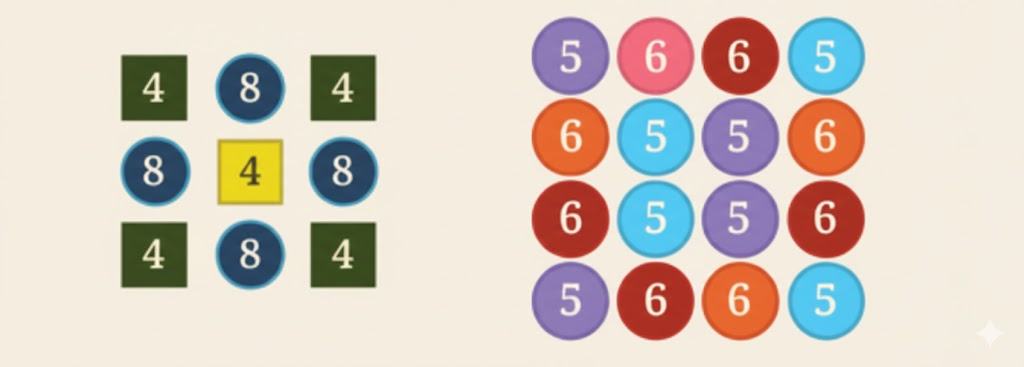
Solution:
For I: 5 × 4 + 4 × 8 = 20 + 32 = 52
or 4 × (4 + 8) + 4 = 4 × 12 + 4 = 52
For II: 8 × (5 + 6) = 8 × 11 = 88
or 8 × 5 + 8 × 6 = 40 + 48 = 88
1. Read the situations given below. Write appropriate expressions for each of them and find their values.
(a) The district market in Begur operates on all seven days of the week. Rahim supplies 9 kg of mangoes each day from his orchard, and Shyam supplies 11 kg of mangoes each day from his orchard to this market. Find the number of mangoes supplied by them in a week to the local district market.
(b) Binu earns ₹ 20,000 per month. She spends ₹ 5,000 on rent, ₹ 5,000 on food, and ₹ 2,000 on other expenses every month. What is the amount Binu will save by the end of the year?
(c) During the daytime, a snail climbs 3 cm up a post, and during the night, while asleep, accidentally slips down by 2 cm. The post is 10 cm high, and a delicious treat is on top. In how many days will the snail get the treat?
Solution: (a)
Rahim supplies 9 kg of mangoes to the market each day, and Shyam supplies 11 kg each day.
So, the total quantity supplied per day is:
(9 + 11) kg
Therefore, the total quantity supplied in 7 days is:
7 × (9 + 11) = 7 × 20 = 140 kg
(b)
Binu earns ₹20,000 per month.
His monthly expenses are:
Rent: ₹5,000
Food: ₹5,000
Other expenses: ₹2,000
Total monthly expenses = 5,000 + 5,000 + 2,000 = ₹12,000
So, Binu’s monthly savings =
₹20,000 – ₹12,000 = ₹8,000
His yearly savings =
12 × 8,000 = ₹96,000
Thus, Binu saves ₹96,000 by the end of the year.
(c)
The snail climbs 3 cm up the post during the day but slips 2 cm down at night.
So, its net climb per day is:
3 – 2 = 1 cm
In 7 days, it climbs 7 cm.
The height of the post is 10 cm.
On the 8th day, the snail climbs 3 cm and reaches the top:
7 + 3 = 10 cm
Therefore, the snail needs 8 days to reach the top of the post and enjoy the treat.
2. Melvin reads a two-page story every day except on Tuesdays and Saturdays. How many stories would he complete reading in 8 weeks? Which of the expressions below describes this scenario?
(a) 5 × 2 × 8
(b) (7 – 2) × 8
(c) 8 × 7
(d) 7 × 2 × 8
(e) 7 × 5 – 2
(f) (7 + 2) × 8
(g) 7 × 8 – 2 × 8
(h) (7 – 5) × 8
Solution: Melvin reads a two-page story every day except Tuesday and Saturday.
So, the number of days he reads in a week is:
7 – 2
Since he reads one story per day,
the number of stories he reads in one week is:
1 × (7 – 2)
Therefore, in 8 weeks, the number of stories he reads is:
8 × 1 × (7 – 2)
= 8 × (7 – 2)
or
= (7 – 2) × 8 → (Expression (b))
Using distributive property:
7 × 8 – 2 × 8 → (Expression (g))
Thus, only expressions (b) and (g) correctly represent this situation.
3. Find different ways of evaluating the following expressions:
(а) 1 – 2 + 3 – 4 + 5 – 6 + 7 – 8 + 9 – 10
(b) 1 – 1 + 1 – 1 + 1 – 1 + 1 – 1 + 1 – 1
Solution:
(a) 1 – 2 + 3 – 4 + 5 – 6 + 7 – 8 + 9 – 10
= (1 + 3 + 5 + 7 + 9) + (-2 – 4 – 6 – 8 – 10)
= 25 + (-30)
= -5
or
1 – 2 + 3 – 4 + 5 – 6 + 7 – 8 + 9 – 10
= (1 – 2) + (3 – 4) + (5 – 6) + (7 – 8) +(9 – 10)
= (-1) + (-1) + (-1) + (-1) + (-1)
= -5
(b) 1 – 1 + 1 – 1 + 1 – 1 + 1 – 1 + 1 – 1
= (1 – 1) + (1 – 1) + (1 – 1) + (1 – 1) + (1 – 1)
= 0 + 0 + 0 + 0 + 0
= 0
or
1 – 1 + 1 – 1 + 1 – 1 + 1 – 1 + 1 – 1
= (1 + 1 + 1 + 1 + 1) + (-1 – 1 – 1 – 1 – 1)
= 5 + (-5)
= 0
4. Compare the following pairs of expressions using ‘<’, ‘>’, or ‘=,’ or by reasoning.
(a) 49 – 7 + 8 ☐ 49 – 7 + 8
(b) 83 × 42 – 18 ☐ 83 × 40 – 18
(c) 145 – 17 × 8 ☐ 145 – 17 × 6
(d) 23 × 48 – 35 ☐ 23 × (48 – 35)
(e) (16 – 11) × 12 ☐ -11 × 12 + 16 × 12
(f) (76 – 53) × 88 ☐ 88 × (53 – 76)
(g) 25 × (42 + 16) ☐ 25 × (43 + 15)
(h) 36 × (28 – 16) ☐ 35 × (27 – 15)
Solution:
(a) 49 – 7 + 8 = 49 – 7 + 8
(∵ All the terms on both sides are the same)
(b) 83 × 42 > 83 × 40
∴ 83 × 42 – 18 > 83 × 40 – 18
(c) 17 × 8 > 17 × 6
⇒ -17 × 8 < -17 × 6
∴ 145 – 17 × 8 < 145 – 17 × 6
(d) 23 × (48 – 35) = 23 × 48 – 23 × 35
and 35 < 23 × 35 23 × 48 – 35 > 23 × (48 – 35)
(e) (16 – 11) × 12 = 16 × 12 – 11 × 12 = -11 × 12 + 16 × 12
∴ (16 – 11) × 12 = -11 × 12 + 16 × 12
(f) (76 – 53) × 88 = 76 × 88 – 53 × 88 = -(53 – 76) × 88
∴ (76 – 53) × 88 > 88 × (53 – 76)
(g) 43 + 15 = 42 + 1 + 15 = 42 + 16
⇒ 25 × (43 + 15) = 25 × (42 + 16)
∴ 25 × (42 + 16) = 25 × (43 + 15)
(h) 35 × (27 – 15) = 35 × (28 – 16)
∴ 36 × (28 – 16) > 35 × (27 – 15)
5. Identify which of the following expressions are equal to the given expression without computation. You may rewrite the expressions using terms or removing brackets. There can be more than one expression that is equal to the given expression.
(a) 83 – 37 – 12
(i) 84 – 38 – 12
(ii) 84 – (37 + 12)
(iii) 83 – 38 – 13
(iv) -37 + 83 – 12
(b) 93 + 37 × 44 + 76
(i) 37 + 93 × 44 + 76
(ii) 93 + 37 × 76 + 44
(iii) (93 + 37) × (44 + 76)
(iv) 37 × 44 + 93 + 76
Solution:
(a) 83 – 37 – 12 = 83 – 37 – 12 + (1 – 1)
= (83 + 1) – 37 – 1 – 12
= 84 – 38 – 12 (option (i))
= 34
Or
83 – 37 – 12 = -37 + 83 – 12
= 46 – 12
= 34 (option (iv))
Hence, (i) and (iv) are equal to the given expression 83 – 37 – 12.
(b) (iv) 37 × 44 + 93 + 76
Rearrange the terms, and we get 93 + 37 × 44 + 76, which is equal to the given expression.
Hence, (iv) is equal to the given expression 93 + 37 × 44 + 76.
6. Choose a number and create ten different expressions having that value.
Solution:
Students should do it by themselves.
NCERT Solutions for Class 7 Maths Chapter 2 Arithmetic Expressions (2026-27)
Mastering Arithmetic Expressions Class 7 is critical for building a solid mathematical base. These NCERT solutions (2026-27) guide you through simple and complex calculations, using stepwise logic to improve speed and accuracy in exams.
Learn how to confidently use signs, brackets, and mental strategies for calculation. Practicing with NCERT Class 7 Maths Chapter 2 solutions strengthens your ability to analyze, compare, and simplify arithmetic expressions with ease.
Take advantage of exercise-based solutions from the textbook to reinforce concepts and boost calculation confidence. Focusing on reasoning and order of operations ensures you score well in school and future competitive exams.
FAQs on NCERT Solutions For Class 7 Maths Chapter 2 Arithmetic Expressions - 2026-27 Free PDF Download (Sign-in Required)
1. What are NCERT Solutions for Class 7 Maths Chapter 2 Arithmetic Expressions?
NCERT Solutions for Class 7 Maths Chapter 2 Arithmetic Expressions provide step-by-step answers to all textbook questions, helping students master key concepts according to the CBSE syllabus.
- Each solution is structured for clear understanding of arithmetic expressions, operations, and fundamental rules.
- Description includes exercise-wise stepwise answers as per the latest marking scheme.
- Useful for regular practice, exam preparation, and quick revisions.
- Includes important definitions, solved examples, and common mistake alerts.
2. How can I write stepwise answers for Class 7 Maths Chapter 2 to score full marks?
Writing stepwise answers in Arithmetic Expressions ensures you earn marks for each calculation and explanation as per CBSE marking scheme.
- Break each solution into clear, logical steps for every operation performed.
- Show the formula, values substituted, and each simplification.
- Highlight the final answer and box it as per exam conventions.
- If diagrams or tables are required, keep them neat and well-labelled.
3. Which topics are most important in Class 7 Maths Chapter 2 for CBSE exams?
Key topics in Chapter 2 Arithmetic Expressions that frequently appear in CBSE exams include:
- Simplification of arithmetic expressions using BODMAS/BIDMAS rules
- Use of brackets (parentheses, braces, and square brackets)
- Word problems involving expressions and simple equations
- Identifying and forming expressions for given scenarios
- Definitions of arithmetic operations and related terms
4. Are diagrams or definitions mandatory for NCERT Maths answers in Class 7 Chapter 2?
Definitions should be included where asked, especially for terms like expression, variable, and operation. Diagrams are generally not mandatory for Arithmetic Expressions in Class 7, but neat workings and boxed answers are essential.
- In questions requiring explanation, always start with a precise definition from the textbook.
- Diagrams may be useful in word problems if variables represent objects or positions.
- Maintain neatness for all workings to avoid losing step marks.
5. Where can I download free PDF solutions for Class 7 Maths Chapter 2?
You can download free PDF solutions for NCERT Class 7 Maths Chapter 2 from trusted educational platforms and the official NCERT website.
- Many sites offer direct download links for chapter-wise solutions PDF for offline study.
- These PDFs include stepwise answers, keys, and revision notes for Arithmetic Expressions.
- Always use updated solutions relevant for CBSE 2026–27.
6. How do I prepare for CBSE marking scheme in Class 7 Maths Chapter 2?
To align your answers with the CBSE marking scheme for Arithmetic Expressions:
- Write each intermediate step and calculation clearly.
- State definitions or formulae wherever required.
- Use keywords like 'expression', 'simplify', and 'operation'.
- Box the final answer and cross-check common mistakes to avoid negative marking.
7. What are common mistakes to avoid in Arithmetic Expressions problems?
Major mistakes in Chapter 2 Arithmetic Expressions include:
- Ignoring the correct order of operations (BODMAS rule)
- Missing brackets or incorrect bracket expansion
- Skipping calculation steps and losing step marks
- Copying numbers or expressions inaccurately from the question
- Forgetting to box or underline the answer
8. How do examiners award marks if the final answer is wrong but steps are correct?
Examiners usually give partial marks for each correct step even if the final answer is incorrect in CBSE Maths exams.
- Each solution is evaluated according to the marking scheme, with marks for method and calculation steps.
- Always show all steps in arithmetic expressions to maximise your score.
9. Is referring to textbook page numbers helpful during revision?
Referring to textbook page numbers during revision is helpful as it helps you quickly locate important definitions, solved examples, and exercise questions in Chapter 2.
- Speeds up last-minute revision using intext and back exercise solutions.
- Makes it easier to clarify doubts and align your answers with the NCERT flow.
10. Are NCERT Solutions enough for Class 7 Maths exam preparation?
NCERT Solutions are the most reliable source for Class 7 Maths, as CBSE and school exams are mainly based on these textbooks.
- Cover all types of questions — intext, back exercise, and important examples.
- Strengthen core concepts and prepare for common exam patterns.
- For more practice, attempt exemplar questions and worksheets after mastering the NCERT solutions.
11. How to present long answers for maximum marks in Class 7 Maths?
For long answers, use a structured approach to match the CBSE marking scheme:
- Begin with a precise definition or introduction.
- Show all calculation steps with clear reasoning.
- Label diagrams or tables neatly if required.
- End with the final answer boxed or underlined.
