








Definition Types and Functions of Money with Examples
“Money doesn’t grow on trees”. How many of you have heard this from your parents when you wanted to buy your favorite toy? Almost every one of you, right? But do you know what is money? Or why are your parents so concerned about money? Let us understand what is money in simple terms through this article.
If you go to a shop and ask for chocolate, the shopkeeper tells you that you will get it after paying 20 rupees, right? This is called money. You are giving money to get your chocolate. Thus, money is what we give for buying food, toys, clothes, candy, cars, houses, etc. Money can be explained as something which everyone accepts in exchange for goods and services.
What is Currency?
Remember your grandma gives you different coloured papers every time you visit her, which your mother asks you to put safely in a piggy bank, right? These papers are called notes. Different colours represent different values of notes.
Money is used in the form of papers or coins, officially issued by the government of that country, which is called the currency of that country. Different countries have different currencies. India’s currency is “Rupees.” The currency of the United States of America is “Dollars,” for Europe, it is “Euro,” and U.K.’s currency is “Pounds Sterling.”
What is the Indian Rupee?
Indian Rupee is the official money used only in India. It is issued and regulated by the Reserve Bank of India. One rupee is equal to 100 paise. It can be written as “Rs” or using the symbol ₹. The Indian currency is available in two forms:
1. Coins
Different valued coins have different shapes and sizes that keep on changing from time to time. Nowadays, the coins of one paise to twenty paise are not used. The coins of Rs 1, 2, and 5 denominations are mostly used.
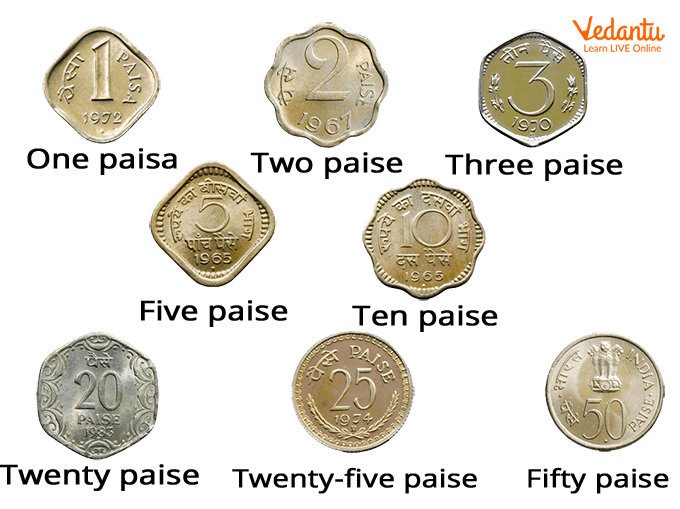
Different Types of Indian Coins (paisa) Not in Use.
2. Currency Notes
The Indian currency notes are made of cotton paper. The different denominations of money are printed in different colours to make them easily recognisable. Officially, the notes of Rs 5, 10, 20, 50, 100, 200, 500, and 2000 are used in the country.
Conversion of Rupees and Paise
When rupee and paise are written together in numerical form, they are separated with a (.). For example, 18 rupees and 30 paise can be written as 18.30.
We know that Rs.1 = 100 paise.
So, to convert rupees into paise, we multiply the amount by 100.
For example,
Rs. 14 = 14 X 100
= 1400 paise
Similarly, to convert paise into rupees, we divide the amount by 100.
For example,
10000 paise = 10000 ÷ 100
= 100 Rs.
Practice Problems on Money
Here are some maths questions on money for your practice.
1. Money Worksheet:
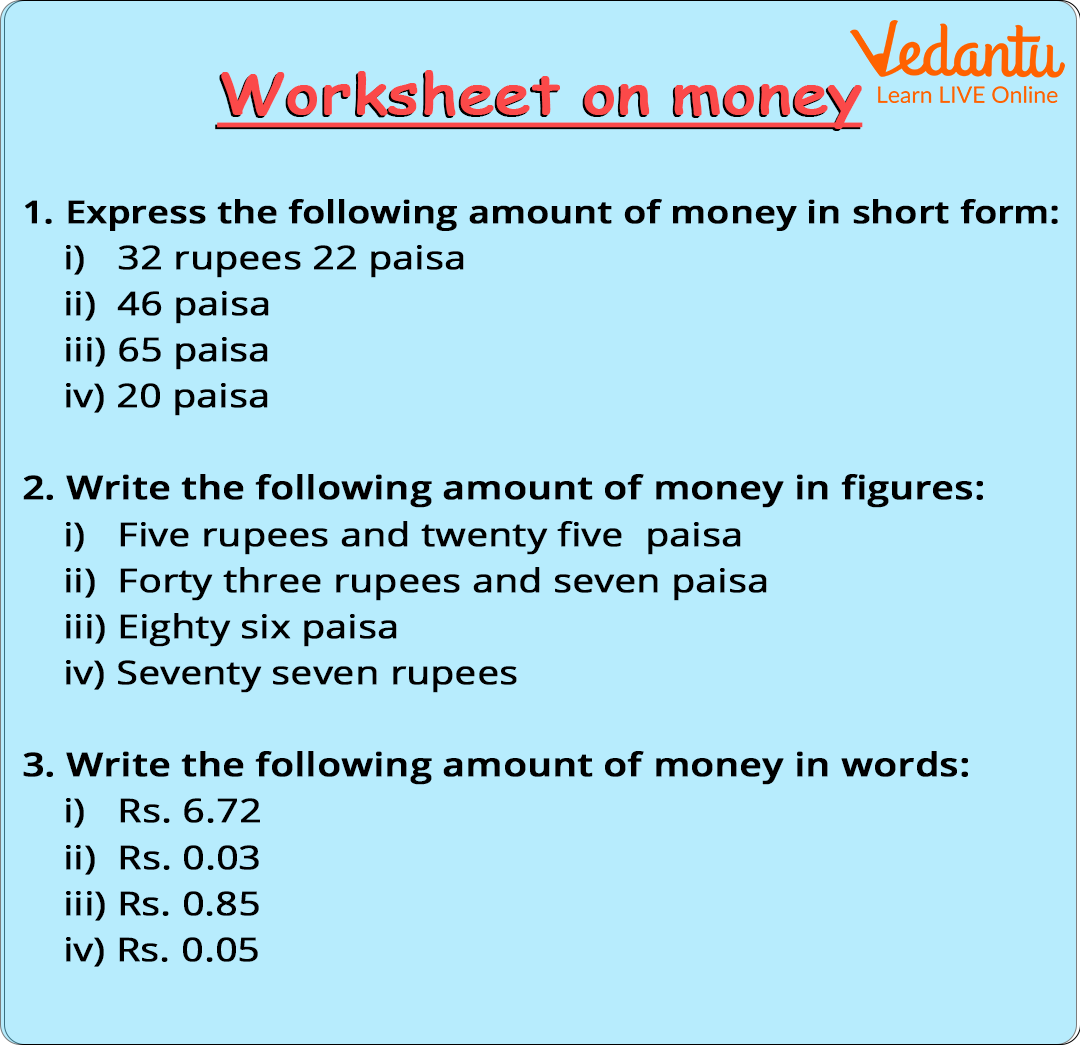
Worksheet on Money
2. Write the total amount of money in each row.
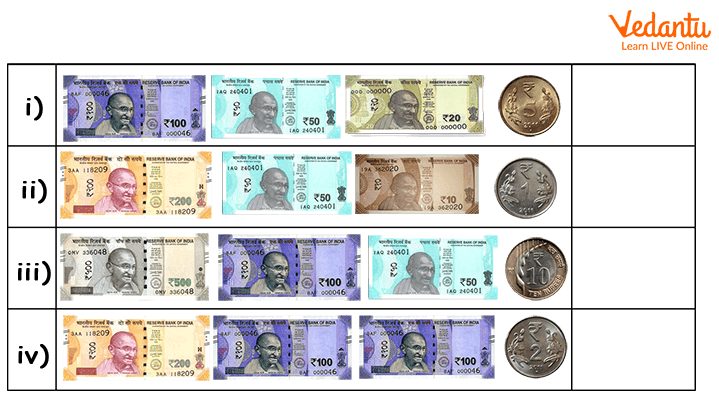
Write the Total Amount of Money in Each Row
3. Solve these word problems.
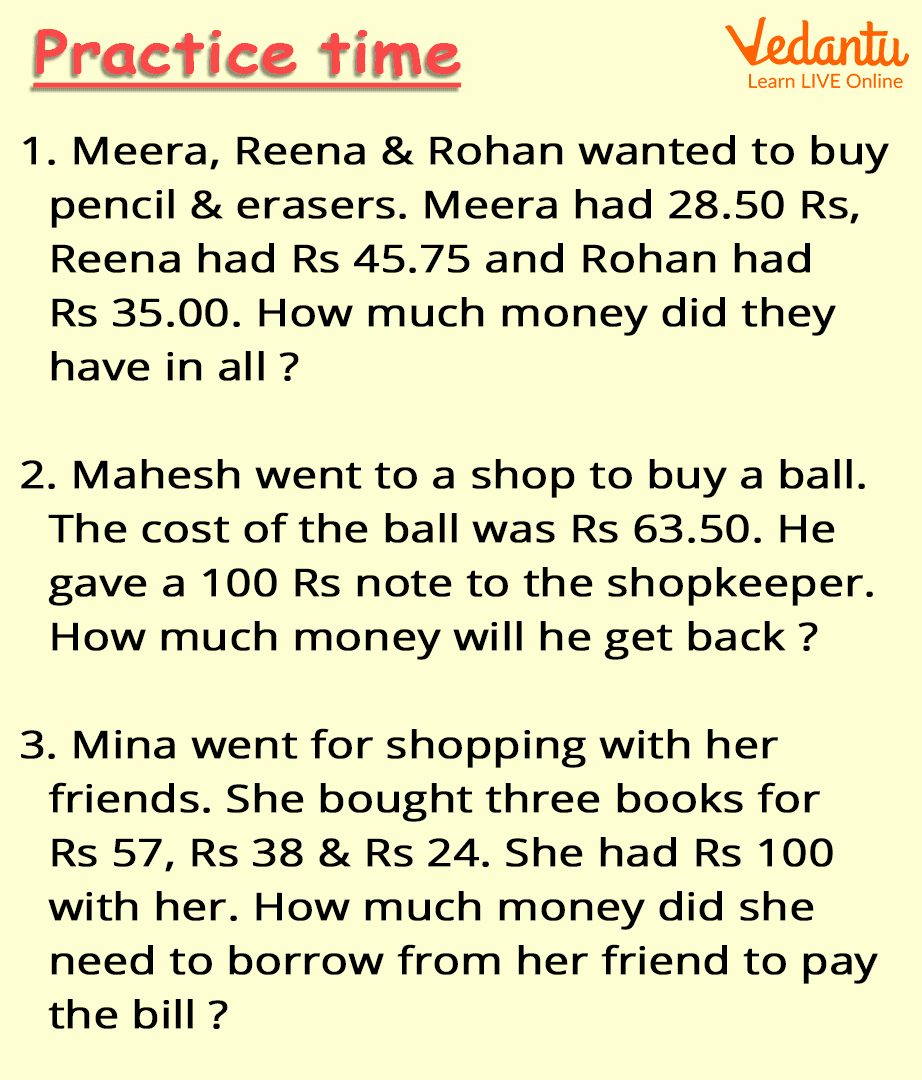
Solve these Word Problems
Conclusion
Did you enjoy learning what is money in detail? Now, next time you will know how many toys you can buy with your pocket money. Also, if you want to learn other maths topics in detail, you can explore our other pages. We also have grammar concepts and bedtime stories for you so that you do not get bored with studying only maths.
FAQs on What Is Money in Mathematics
1. What is money in economics?
Money is anything that is widely accepted as a medium of exchange for goods and services. In economics and basic financial mathematics, money is defined by its functions rather than its physical form. It serves as:
- A medium of exchange (used to buy and sell)
- A unit of account (measures value in numbers)
- A store of value (retains purchasing power over time)
- A standard of deferred payment (used for future payments and loans)
2. What are the main functions of money?
The four main functions of money are medium of exchange, unit of account, store of value, and standard of deferred payment. These functions explain how money operates in mathematical and economic systems:
- Medium of exchange – eliminates barter and simplifies transactions.
- Unit of account – expresses prices numerically (e.g., $10, $50).
- Store of value – preserves wealth for future use.
- Standard of deferred payment – allows loans and credit calculations.
3. What is the difference between money and currency?
Currency is the physical form of money, while money is the broader concept that includes anything accepted as payment. In simple terms:
- Money = coins, notes, bank deposits, digital balances.
- Currency = physical cash issued by a government.
4. How is the value of money calculated?
The value of money is calculated using its purchasing power, which measures how many goods or services it can buy. Mathematically, purchasing power is related to price levels:
- Value of Money ≈ 1 / Price Level
5. What is money supply in economics?
Money supply is the total amount of money available in an economy at a given time. It is commonly measured in categories:
- M0 – physical currency in circulation.
- M1 – currency + demand deposits.
- M2 – M1 + savings deposits and near money.
6. What is inflation and how does it affect money?
Inflation is a sustained increase in the general price level, which reduces the purchasing power of money. It is often calculated using:
- Inflation Rate = [(New Price − Old Price) / Old Price] × 100%
7. What is the time value of money?
The time value of money states that money today is worth more than the same amount in the future due to earning potential. It is calculated using formulas like:
- Future Value (FV) = PV(1 + r)n
8. What is commodity money?
Commodity money is money that has intrinsic value because it is made of a valuable material. Examples include gold, silver, or salt. Unlike paper money, commodity money’s value comes from both:
- Its use as a medium of exchange.
- Its inherent material value.
9. What is fiat money?
Fiat money is money that has value because of government decree and public trust, not because of intrinsic worth. Modern currencies like the US dollar or euro are fiat money. Its value depends on:
- Government regulation
- Economic stability
- Supply and demand
10. Why is money important in economic calculations?
Money is important because it provides a standard numerical measure of value for economic and mathematical calculations. It allows:
- Price comparison using numbers
- Profit and loss computation
- Interest and loan calculations
- GDP and national income measurement
