








How to Do Skip Counting by 100 with Examples and Number Patterns
Skip counting by 100 is a method of learning to add numbers by 100. When we start learning the concept of addition, we start with skip counting and adding. When doing skip counting by 100, we keep adding the same number 100 to the previous number to get the next number in the series. The series obtained by skip counting by 100 starting with 0 looks like 0, 100, 200, 300, 400, and so on. This method of addition helps us in memorizing the counting numbers and the concept of addition.
The article talks about how skip counting is an essential skill for math and how important it is to learn it. In this article, we will learn to add numbers using the method of skip counting by 100.
Steps to do Skip Counting by 100
To understand the process of skip counting by 100, we follow a certain set of steps to obtain the series of counting 100. Below is a list of steps we can follow to learn the process:
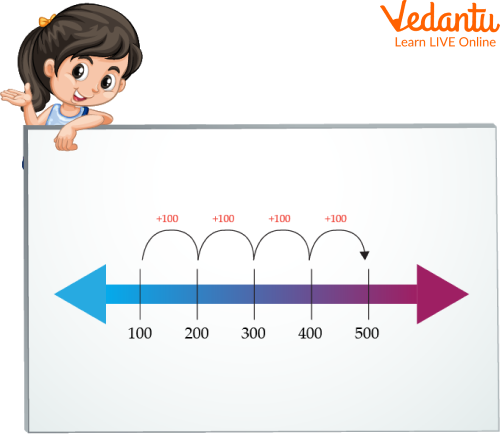
Step 1: Starting with the number 100, add 100 to the previous number to obtain the next number in the series. After 100, we obtain 100 + 100 = 200. This is the second number in the multiplication table of 100.
Step 2: To obtain the next number in the series, add 100 to 200, that is, 200 + 100 = 300. So, 300 is the next number in the series.
Step 3: As we add 100 to each previous number, we obtain the series as 100, 200, 300, 400, 500, 600, 700, and so on.
Step 4: 100, 200, 300, 400, 500, 600, 700, ... is the series of multiples of 100 that we obtained by skip counting by 100.
The following is the illustration of it:
Ways of Doing Skip Counting by 100
Skip Counting by 100 Chart
When skipping 100 natural numbers; we add 4 after each skip.
Skip Counting by 100 on Number Line
In this section; we will learn the concept of skip counting by 100 on a number line. We will make jumps to reach from one number to another.
Let us have a look at the number line below. Starting from the number 200, when skip counting by 100, the next number will be 200 + 100 = 300. So, we have landed on the number 300. Next, when we take another jump, we land on 300 + 100 = 400. Continuing in the same manner, we skip a number and land on the next number. So, the series continues like 200, 300, 400, 500, 600, 700, and so on.

Skip Counting by 100 on Number Line
Solved Examples
Here are the examples related to skip counting, which are as follows;
Q 1. Find the skip counting of 100 from 162.
Ans: To start the skip counting of 100 from 162, we need to add 100 to the next number.
So the first number will be 162.
Second number: 162 + 100 = 262
Third number: 262 + 100 = 362
And so on…
The pattern will become 162, 262, 362, 462, 562, …… and so on.
Q 3. Find the skip counting of 100 starting from 360.
Ans: To start the skip counting of 100 from 360, we need to add 100 to the next number.
So the first number will be 360.
Second number: 360 + 100 = 460
Third number: 460 + 100 = 560
And so on…
The pattern will become:
Skip Counting by 100 Worksheets
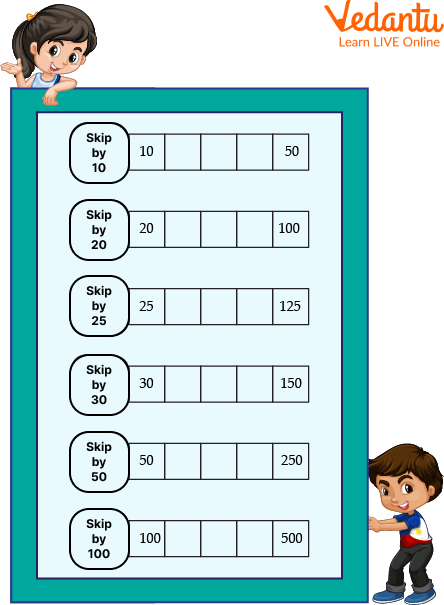
Here is the skip counting by 10 to 100 worksheets, which are as follows:
Worksheet
Summary
Skip counting is a great way to learn math, and it has been used in schools for decades. However, there are many different ways to skip count. This article will discuss the most common ones and show you how they work. Skip counting is a mathematical tool that can be used to find the sum of numbers. It is an efficient way to teach children how to count and can also be used as a mental exercise for adults. It is also a good way for them to practice their counting skills and ensure they get the correct answer.
This article concludes that Skip counting is an important tool for educators to use when teaching math skills and place value. In conclusion, skip counting is an easy and effective way to learn how to count. Children need to skip counting to prepare them for more difficult math concepts.
FAQs on Skip Counting By 100 in Maths
1. What is skip counting by 100?
Skip counting by 100 means adding 100 to a number repeatedly to create a number pattern. It is a counting method where each new number is 100 more than the previous one.
- Start with any number.
- Add 100 each time.
- Example: 100, 200, 300, 400, 500.
2. How do you skip count by 100?
To skip count by 100, add 100 to the starting number again and again. Follow these steps:
- Step 1: Choose a starting number (e.g., 250).
- Step 2: Add 100 → 250 + 100 = 350.
- Step 3: Keep adding 100 → 450, 550, 650.
3. What are the first 10 numbers when skip counting by 100?
The first 10 numbers when skip counting by 100 starting from 100 are 100, 200, 300, 400, 500, 600, 700, 800, 900, 1000. Each number increases by exactly 100. This pattern shows a constant difference of 100 between consecutive numbers.
4. Why is skip counting by 100 important?
Skip counting by 100 is important because it strengthens understanding of place value and prepares students for addition and multiplication. It helps learners:
- Recognize number patterns.
- Add large numbers mentally.
- Understand hundreds, thousands, and beyond.
5. Can you give an example of skip counting by 100 starting from 45?
Yes, skip counting by 100 from 45 means repeatedly adding 100 to 45.
- 45 + 100 = 145
- 145 + 100 = 245
- 245 + 100 = 345
- 345 + 100 = 445
6. What pattern do you notice when skip counting by 100?
When skip counting by 100, the hundreds digit increases by 1 while the tens and ones digits stay the same. For example:
- 321, 421, 521, 621
7. How is skip counting by 100 related to multiplication?
Skip counting by 100 is the same as multiplying by 100 repeatedly. For example:
- 100 × 1 = 100
- 100 × 2 = 200
- 100 × 3 = 300
8. What is the formula for skip counting by 100?
The formula for skip counting by 100 is n = a + 100k, where a is the starting number and k is the number of steps. For example, if a = 50 and k = 3:
- n = 50 + (100 × 3)
- n = 50 + 300
- n = 350
9. What is the difference between skip counting by 10 and skip counting by 100?
The difference is that skip counting by 10 adds 10 each time, while skip counting by 100 adds 100 each time.
- By 10: 50, 60, 70, 80.
- By 100: 50, 150, 250, 350.
10. What are common mistakes when skip counting by 100?
A common mistake in skip counting by 100 is changing the tens or ones digits instead of only increasing the hundreds digit. Students should remember:
- Add exactly 100 each time.
- Keep the last two digits the same (unless crossing a thousand).
- Check place value carefully.
