








Rules of Subtraction with Definition Formula and Solved Examples
Subtraction is the process of taking away a number from another. It is a primary arithmetic operation denoted by a subtraction symbol (-) and is the method of calculating the difference between two numbers. The value of a number becomes less when you subtract any number from it. Here we will mainly look at their concepts, examples, and worksheets related to subtraction so that we can understand this article better.
What is Subtraction?
Subtraction is an operation used to find the difference between numbers. When you have a group of objects and take away a few objects, the group becomes smaller. For example, you bought 9 cupcakes for your birthday party, and your friends ate 7 cupcakes. Now you are left with 2 cupcakes. This can be written as a subtraction expression: 9 - 7 = 2 and is read as "nine minus seven equals two". When we subtract 7 from 9 (9 - 7), we get 2. Here, we performed the subtraction operation on two numbers, 9 and 7, to get the difference of 2.
Subtraction Formula
When we subtract two numbers, we use some terms which are used in the subtraction expression:
Minuend: The number from which the other number is subtracted.
Subtrahend: The number which is to be subtracted from the minuend.
Difference: The final result after subtracting the subtrahend from the minuend.
The subtraction formula is written as Minuend - Subtrahend = Difference
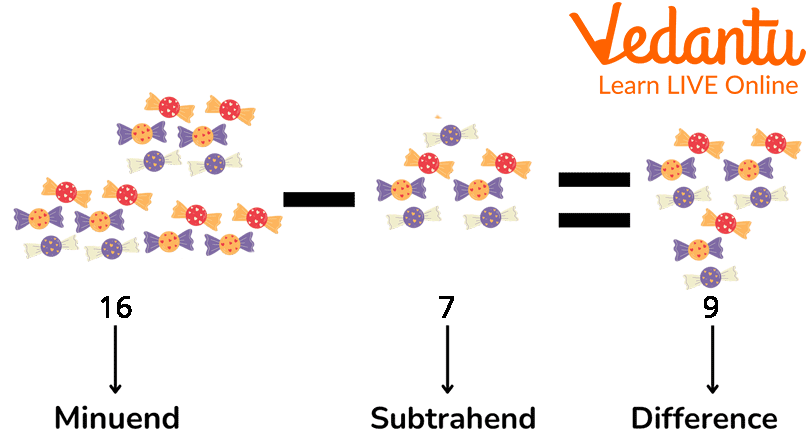
Subtraction of Numbers
How To Solve Subtraction Problems?
While solving subtraction problems, one-digit numbers can be subtracted in a simple way. Still, for larger numbers, we split the numbers into columns using their respective place values, like Ones, Tens, Hundreds, Thousands, and so on. While solving such problems, we may encounter some cases with and some without. Subtraction with borrowing is also known as subtraction with regrouping. When the minuend is smaller than the subtrahend, we use the regrouping method. While regrouping, we borrow 1 number from the preceding column to make the minuend bigger than the subtrahend. Let us understand this with the help of a few examples.
Example: Subtraction of 21731 from 54896
Ans: Given us, Subtraction of 21731 from 54896
Then, After that we will subtract it by placing it in a column, As shown below;
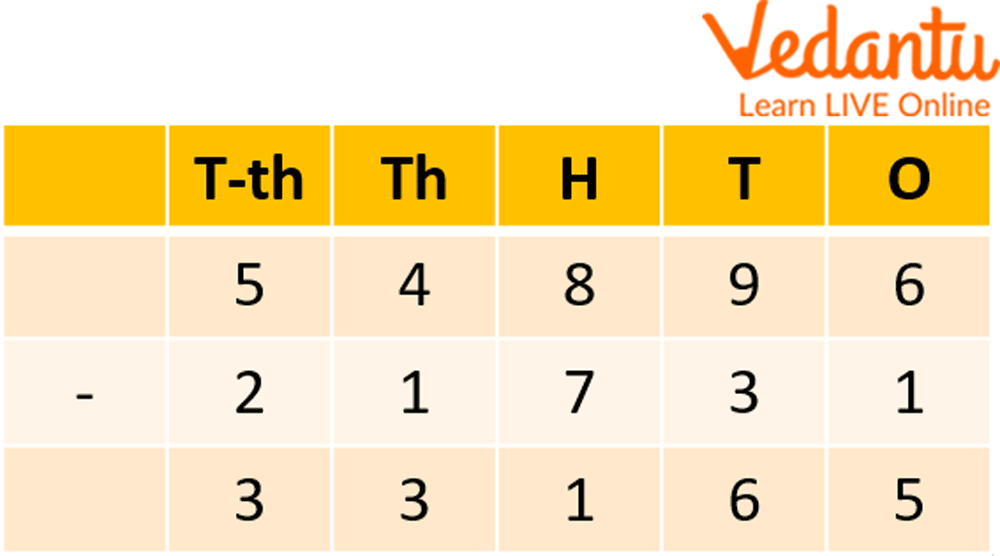
Subtraction of Two 5-digit Numbers
Subtraction Sign Rules
Here, we are going to see adding and subtracting negative numbers rule.
Following are the rules of subtraction of positive and negative numbers:
The subtraction of two positive numbers can be either positive or negative.
Example: 5 - 2 = 3, 6 - 8 = -2
The subtraction of two negative numbers can be either positive or negative.
Example: (-5) - (-2) = -3, (-5) - (-7) = 2
Solved Examples
Q 1. Subtraction of 29627 from 76322
Ans: Given us, Subtraction of 29627 from 76322
Then, After that we will subtract it by placing it in a column, As shown below;
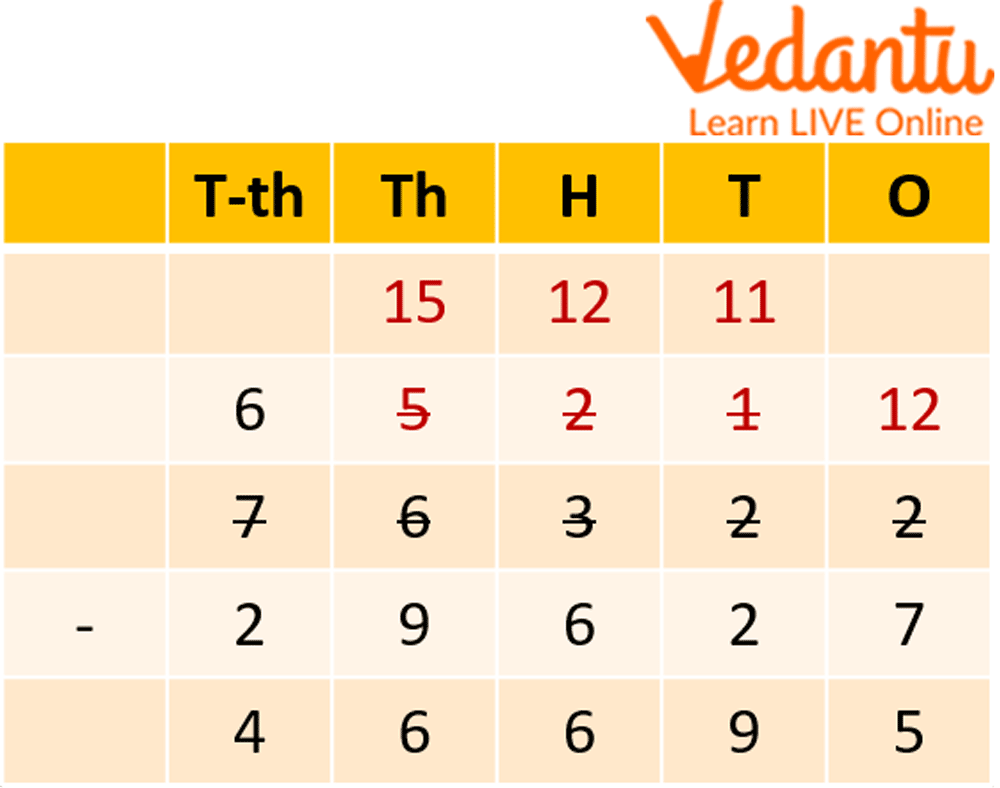
Subtraction of 29627 and 76322
Q 2. Subtraction of 798 from 845
Ans: Given, Subtraction of 798 from 845
Then, After that we will subtract it by placing it in a column, As shown below;
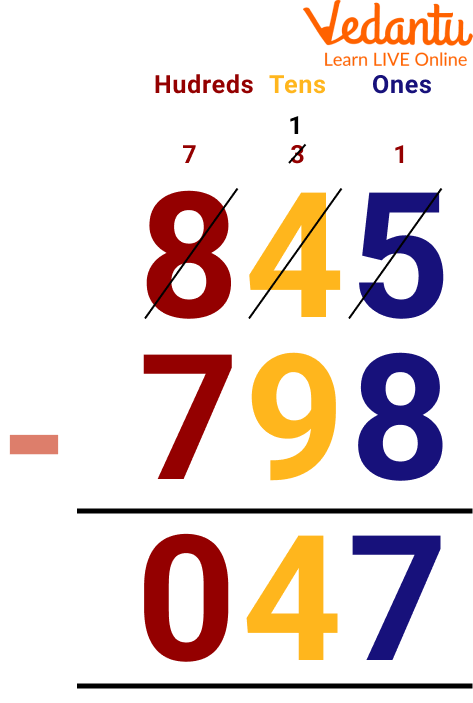
Subtraction of 798 From 845
Subtraction Practice Problems
Here is a worksheet related to subtraction, which can be improved by practising:
Q 1. 236 - 126
Ans: 110
Q 2. 465 - 237
Ans: 228
Q 3. 126 - 200
Ans: -74
Q 4. 500 - 126
Ans: 374
Q 5. 246 - 186
Ans: 60
Summary
Subtraction is one of the most important math skills a child needs to learn. It is the foundation for more complicated mathematical concepts such as multiplication and division. Subtraction helps children develop their number sense, which is the understanding that numbers have meaning beyond just a symbol on a page and are necessary for all types of mathematics. Subtraction can help children understand place value, an important concept in all areas of mathematics. It is an important mathematical concept that can solve many problems. In this article, we learned about adding and subtracting negative numbers rules and some problems regarding them.
FAQs on Rules of Subtraction in Mathematics
1. What are the rules of subtraction in maths?
The rules of subtraction state that you subtract numbers by taking away the subtrahend from the minuend and follow place value correctly. In basic arithmetic:
- Minuend − Subtrahend = Difference
- Subtract digits from right to left (ones, tens, hundreds).
- If the top digit is smaller, use borrowing (regrouping).
- When subtracting negative numbers, change subtraction to addition of the opposite.
2. What is the formula for subtraction?
The basic subtraction formula is Minuend − Subtrahend = Difference. In symbols, a − b = c, where:
- a is the minuend (number you start with)
- b is the subtrahend (number you take away)
- c is the difference (result)
3. How do you subtract numbers step by step?
To subtract numbers, align place values and subtract from right to left using borrowing if needed. Steps:
- Write numbers in columns by place value.
- Start subtracting from the ones place.
- If the top digit is smaller, borrow 1 from the next left digit.
- Continue for tens, hundreds, and so on.
Subtract 52 − 38
- Borrow: 12 − 8 = 4
- 4 − 3 = 1
4. What is borrowing in subtraction?
Borrowing in subtraction is the process of taking 1 from a higher place value when the top digit is smaller than the bottom digit. It is also called regrouping.
- Reduce the digit in the higher place by 1.
- Add 10 to the current place.
5. What are the rules for subtracting negative numbers?
When subtracting negative numbers, change subtraction into addition of the opposite number. The rule is a − (−b) = a + b.
- Subtracting a negative becomes addition.
- Subtracting a positive keeps the sign.
- 7 − (−3) = 7 + 3 = 10
- 5 − 8 = −3
6. What is the difference between subtraction and addition?
The main difference is that addition combines quantities, while subtraction takes one quantity away from another. Key differences:
- Addition uses the + sign; subtraction uses the − sign.
- Addition finds the total; subtraction finds the difference.
- Addition is commutative (a + b = b + a); subtraction is not commutative (a − b ≠ b − a).
7. Is subtraction commutative or associative?
Subtraction is neither commutative nor associative.
- Not commutative: 6 − 2 = 4, but 2 − 6 = −4.
- Not associative: (10 − 5) − 2 = 3, but 10 − (5 − 2) = 7.
8. How do you subtract decimals?
To subtract decimals, align the decimal points and subtract as with whole numbers. Steps:
- Write numbers so decimal points line up.
- Add zeros if needed.
- Subtract from right to left, borrowing if required.
5.60 − 2.35
- 0 − 5 (borrow) → 10 − 5 = 5
- 5 − 3 = 2
- 5 − 2 = 3
9. What are common mistakes in subtraction?
Common subtraction mistakes include errors in borrowing, place value alignment, and sign handling. Frequent errors:
- Not aligning digits by place value.
- Forgetting to reduce the digit after borrowing.
- Confusing subtraction of negative numbers.
- Subtracting smaller from larger without considering signs.
10. Can you give an example of subtraction in real life?
Subtraction is used in real life to find how much is left after taking something away. Example:
- You have $50 and spend $18.
- Compute 50 − 18 = 32.
