








How to Do Subtraction by Crossing Out with Examples
Subtraction is one of the four basic arithmetic operations you unknowingly use in your daily life. One of the many times you must have used subtraction in your daily life is when sharing toys or food with your sibling. In that case, how do you know the number of toys or other things you have left with you? In such cases, you perform subtraction. But how do you do it? Let’s learn an easy way to perform subtraction that is perfect for beginners: subtraction by crossing out.
What is Subtraction by Crossing out?
Subtraction is performed when a quantity of items is taken away from the total items given. As discussed in the example where you have to give your brother/sister some toys or candy, you get the remaining candy by subtracting. Subtracting by crossing out is a simple way to learn subtraction. You arrange all the items and then cross out the number of items taken away from the total number of items.
Examples of Subtraction by Crossing Out
Let’s continue with the same situation. Suppose you are the elder sibling, and your dad gives you 7 candies to eat and asks you to give 3 candies to your brother/sister. How many candies are left with you after giving 3 candies to your brother/sister?
We know that 3 candies are given to your sibling. Then, first, you put all seven candies in order and then cross three of them as shown in the subtraction picture given below.

Crossing out candies
After crossing out, only four are left behind, as shown above. That means you have 4 candies left.
This subtraction can also be written as given below:
7 - 4 = 3
Or it is also written as given in the image below
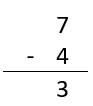
Therefore, you also understand that to make 7, you have to add 3 to 4.
Subtraction by Crossing Out Problems With Solution
Here are some subtraction word problems that you can easily solve by using the crossing-out method.
1. There are 3 balls with you. 2 of the balls are flat. How many balls can you play with?
Solution: The total number of balls is 3.
To find the number of balls perfect for playing, you can use the crossing-out subtraction method.

Crossing out the balls
This way, you can see that there is only 1 ball left from the total of 3 balls.
So, the correct answer is 1.
We can also write it as $3 - 2 = 1$.
2. Suppose you have bought 4 ice creams. Of the 4 ice creams, 2 melted. How many ice creams are left with you?
Solution: There are four ice creams in total.
Two ice creams melted.
To find the number of remaining ice creams, you have to perform subtraction. By using the method of "crossing out," you can find the number of ice creams remaining.

Crossing out ice-creams
As you can see from the above image, there are only two ice creams left.
We can also write it as, $4 - 2 = 2$.
So, the correct answer is 2.
3. Ravi’s father bought him 5 sweets and told him to give 2 sweets to his sister. How many sweets are left with Ravi?
Solution: The total no sweets that Ravi had = 5.
The number of sweets Ravi had to give her was 2.
Therefore, to find the number of sweets left with Ravi after giving them to her sister, you have to perform subtraction by crossing them out.
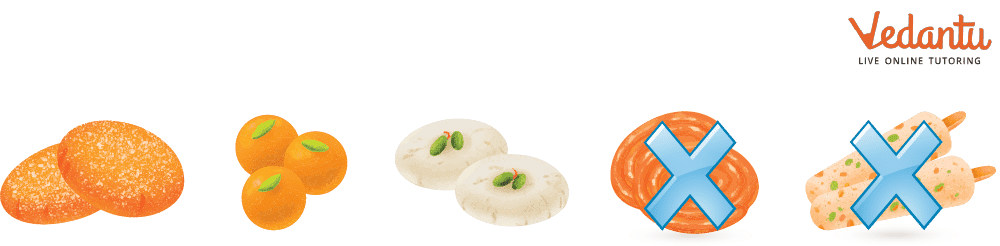
Crossing out the given sweets
As a result, the remaining sweets after crossing out the ones given to his sister are three.
Therefore, the correct answer is 3.
This can also be written as, $5 - 2 = 3$.
Conclusion
So far, you've learnt about subtraction and cross-out subtraction. You learnt that subtraction is used in daily life for various purposes. You have learnt that to find any remaining quantity, you can use subtraction. Subtraction by crossing out is nothing but the method where you cross out the images of the things that are subtracted from a total quantity. Apart from that, you have also learnt to solve word problems related to simple subtraction by using the crossing-out method.
FAQs on Subtraction By Crossing Out Explained Step by Step
1. What is subtraction by crossing out?
Subtraction by crossing out is a basic subtraction method where objects are removed or crossed out from a group to find how many are left. It helps learners visually understand the meaning of subtraction as “taking away.”
- Start with the total number of objects.
- Cross out the number being subtracted.
- Count the remaining objects to get the answer.
2. How do you solve subtraction by crossing out step by step?
You solve subtraction by crossing out by drawing objects, crossing out the number to subtract, and counting what remains. Follow these steps:
- Write or draw the first number (minuend).
- Cross out the second number (subtrahend).
- Count the remaining objects.
3. Why is subtraction by crossing out important for kids?
Subtraction by crossing out is important because it builds a clear visual understanding of the concept of taking away. It helps children:
- Connect numbers with real objects.
- Develop counting and number sense.
- Understand the meaning of subtraction before learning formal methods.
4. Can you give an example of subtraction by crossing out?
Yes, an example of subtraction by crossing out is solving 6 − 2 by drawing and removing objects. Example:
- Draw 6 stars: ★ ★ ★ ★ ★ ★
- Cross out 2 stars.
- Count the remaining stars.
5. What is the difference between subtraction by crossing out and borrowing?
The main difference is that crossing out is a visual method for small numbers, while borrowing (regrouping) is used for larger numbers in column subtraction.
- Crossing out: Draw and remove objects to subtract.
- Borrowing: Regroup digits when subtracting multi-digit numbers (e.g., 52 − 38).
6. When should students use subtraction by crossing out?
Students should use subtraction by crossing out when learning basic subtraction with small numbers. It is most effective:
- For numbers up to 10 or 20.
- In kindergarten or early primary grades.
- When building foundational number skills.
7. What are the parts of a subtraction problem in crossing out method?
The parts of a subtraction problem are the minuend, subtrahend, and difference.
- Minuend: The total number you start with.
- Subtrahend: The number you cross out.
- Difference: The number left after crossing out.
8. How does subtraction by crossing out help in understanding word problems?
Subtraction by crossing out helps in word problems by visually representing objects being taken away. For example:
- “Sara had 10 candies and gave away 4.”
- Draw 10 candies.
- Cross out 4 candies.
- Count the remaining 6 candies.
9. What are common mistakes in subtraction by crossing out?
Common mistakes include crossing out the wrong number of objects or miscounting the remaining items. Learners should:
- Carefully count the starting number.
- Cross out exactly the subtracted amount.
- Recount the remaining objects slowly.
10. Is subtraction by crossing out the same as take away method?
Yes, subtraction by crossing out is a visual form of the take away method in subtraction. Both methods represent removing objects from a group to find what is left. The crossing out method simply uses drawings or pictures to show the process clearly, making it easier for young learners to grasp the concept.
