








How Do Levers Make Work Easier in Daily Life?
Levers are fundamental simple machines that play a crucial role in both classical mechanics and everyday applications. Mastery of lever systems, their mechanical advantages, and their principles is essential for topics involving equilibrium, torque, and rotational motion in JEE Main Physics.
Lever System: Definition and Components
A lever is a rigid bar that rotates around a fixed point called the fulcrum. This simple machine is used to amplify an input force (effort) to overcome a resistance (load) by changing the position of the fulcrum and the points where force is applied.
In a lever system, the main components include the fulcrum, effort arm, load arm, applied effort, and load. The arrangement of these elements determines the force required and the type of lever used. Related principles are extensively covered in Equilibrium and mechanics.
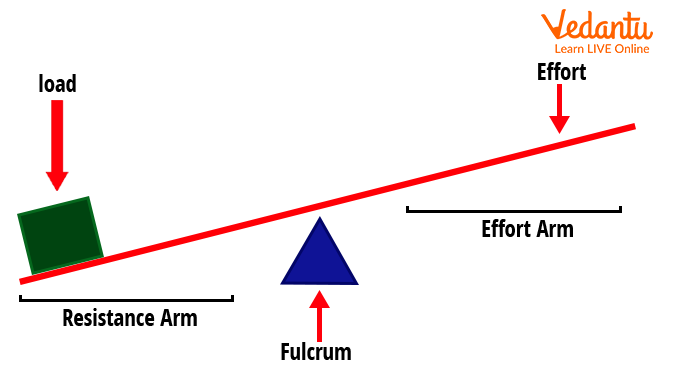
Principle of Moments in Levers
The functioning of a lever is based on the principle of moments. This principle states that when a lever is in equilibrium, the total clockwise moment about the fulcrum is equal to the total anticlockwise moment about the same point.
Mathematically, the condition for equilibrium in levers is given by:
$ \text{Effort} \times \text{Effort Arm} = \text{Load} \times \text{Load Arm} $
This equation represents the balance of rotational effects, or torques, about the fulcrum. The lever’s application is closely related to the concept of Torque in mechanics.
Classification: Types of Levers
Levers are classified into three types based on the relative position of the fulcrum, load, and effort. This classification determines the mechanical advantage and application of the lever system in practical situations.
- First-order levers have the fulcrum between load and effort
- Second-order levers have the load between fulcrum and effort
- Third-order levers have the effort between fulcrum and load
Examples from each type illustrate how levers are applied differently in various devices and in the human body.
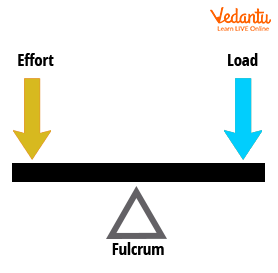
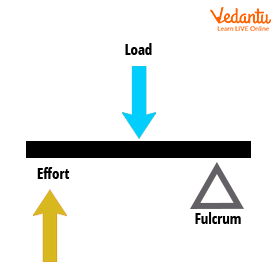
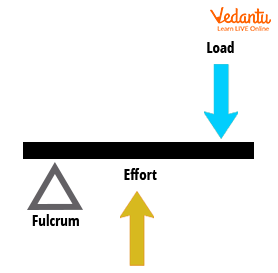
Mechanical Advantage of Levers
Mechanical advantage (MA) is a key parameter that describes the efficiency of a lever. It is defined as the ratio of output force (load) to the input force (effort) applied to the lever.
The general formula for mechanical advantage in levers is:
$ \text{Mechanical Advantage (MA)} = \dfrac{\text{Load}}{\text{Effort}} = \dfrac{\text{Effort Arm}}{\text{Load Arm}} $
A higher mechanical advantage implies that a smaller effort is needed to balance or move a larger load. Understanding MA in levers is essential for calculating equilibrium and moment in rotational systems; refer to Moment Of Inertia for further study.
Summary Table: Types of Levers and Their Examples
| Type of Lever | Common Examples |
|---|---|
| First Order | Scissors, see-saw, crowbar |
| Second Order | Wheelbarrow, nutcracker, bottle opener |
| Third Order | Tweezers, fishing rod, human forearm |
Key Applications of Levers
Levers are used in a variety of practical tools and machines, such as scissors, bottle openers, wheelbarrows, and staplers. Each application takes advantage of mechanical advantage and lever classification to optimize force and movement.
- Bottle opener as a second-order lever
- Broom as a third-order lever
- Screwdriver for lifting as a first-order lever
Study of such applications is extended in biomechanics and the human skeletal system, providing real-world relevance to lever systems.
Biomechanics: Levers in the Human Body
Bones and muscles in the human body form natural lever systems. The joints act as fulcrums, bones as lever arms, and muscles provide the effort. Analysis of movement using lever principles enables understanding of biomechanics and force amplification.
For example, during forearm flexion, the elbow acts as the fulcrum, the biceps apply the effort, and the hand bears the load. Such systems are discussed in detail in On Levers.
Levers in Rotational Motion and Equilibrium
Lever systems are directly related to the principles of rotational dynamics and equilibrium. The calculation of moments (torques) and the study of rotational inertia require understanding of lever arms. These are essential concepts in Dynamics Of Rotational Motion.
Problems involving levers frequently appear in JEE examinations, focusing on equilibrium of forces, calculation of moments, and the impact of changing arm lengths.
Solved Example: Calculating Mechanical Advantage
For a lever where the effort arm is 40 cm and the load arm is 10 cm, the mechanical advantage is calculated by: $ \text{MA} = \dfrac{40}{10} = 4 $. This means the lever multiplies the applied effort by a factor of four.
Summary of Key Points
- Levers are simple machines amplifying force by rotational effect
- Three types are classified by positions of fulcrum, load, and effort
- Principle of moments governs lever equilibrium
- Mechanical advantage quantifies lever efficiency
- Various real-life and biomechanical applications exist
Thorough understanding of lever systems is vital for mastering related topics in JEE Main Physics, including equilibrium, torque, and rotational mechanics. Further practice and conceptual clarity can be achieved by reviewing solved problems and related concepts such as Moment Of Inertia Of A Cone.


FAQs on Understanding Levers: Definition, Types, and Everyday Examples
1. What is a lever in physics?
A lever is a simple machine that helps to amplify force using a rigid bar rotating around a fixed point called the fulcrum. Key points of levers include:
- It consists of three basic parts: the fulcrum, effort (input force), and load (output force).
- Levers help to lift or move objects more easily by applying a small effort to move a larger load.
- A lever follows the principle of moments, where the sum of clockwise moments equals the sum of anticlockwise moments for equilibrium.
2. What are the three classes of levers with examples?
Levers are classified into three classes based on the position of fulcrum, load, and effort.
- First Class Lever: Fulcrum is between load and effort (e.g., seesaw, crowbar).
- Second Class Lever: Load is between fulcrum and effort (e.g., wheelbarrow, nutcracker).
- Third Class Lever: Effort is between fulcrum and load (e.g., tongs, human arm).
3. What is the mechanical advantage of a lever?
Mechanical advantage of a lever measures how much a lever amplifies the input force. It is calculated as:
- Mechanical Advantage = Load / Effort
- It tells how many times the input force is multiplied by the lever.
- Levers with a mechanical advantage greater than 1 make lifting easier.
4. Explain the principle of moments in levers.
The principle of moments states that for a lever in equilibrium, the clockwise moments equal the anticlockwise moments about the fulcrum.
- Moment = Force × Perpendicular distance from fulcrum
- For balance: Effort × Effort arm = Load × Load arm
- This principle helps to determine unknown forces or distances in lever problems.
5. What is a first class lever, and can you give two examples?
A first class lever has the fulcrum positioned between the effort and the load. Examples include:
- Seesaw – Fulcrum is at the center, effort and load at each end.
- Scissors – Fulcrum is at the pivot, effort is applied on the handles, load is at the blades.
6. Why is a wheelbarrow considered a second class lever?
A wheelbarrow is a second class lever because the load lies between the fulcrum (wheel) and the effort (handles). Features include:
- Fulcrum at the wheel, load in the container, effort at the handles.
- This arrangement allows heavier loads to be lifted with less effort.
7. How do levers make work easier?
Levers make work easier by multiplying the input force and changing its direction.
- They reduce the amount of effort needed to move or lift heavy objects.
- The position of fulcrum, effort, and load determines the efficiency.
- Levers transfer energy efficiently, making tasks simpler.
8. State two uses of levers in daily life.
Levers are commonly used in daily life to perform various tasks with less effort, such as:
- Opening a bottle cap with an opener (first class lever).
- Lifting a load using a crowbar (first class lever).
9. What is meant by the effort arm and load arm of a lever?
The effort arm is the distance from the fulcrum to the point where the effort is applied. The load arm is the distance from the fulcrum to the point where the load is placed.
- The lengths of these arms affect the mechanical advantage and efficiency of the lever.
- Longer effort arm or shorter load arm means a greater mechanical advantage.
10. Can you name an example of a third class lever found in the human body?
The human forearm acts as a third class lever.
- Fulcrum: Elbow joint
- Effort: Applied by muscles in the arm
- Load: The weight held in the hand
11. What is the function of levers in the human body?
Levers in the human body help to move parts efficiently by amplifying muscle force.
- Bones serve as levers, joints serve as fulcrums, and muscles provide effort.
- This structure allows movement such as walking, lifting, and grasping objects.
12. Why does increasing the effort arm make it easier to lift a load?
Increasing the effort arm increases the mechanical advantage of a lever, making it easier to lift a load.
- A longer effort arm means you can use less force to move the same load.
- This principle is used in tools like crowbars and seesaws.
