




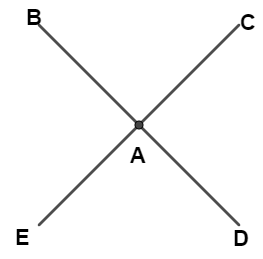
Four identical rods which have thermally insulated lateral surfaces are joined at point A. Points B,C,D & E are connected to large reservoirs. If heat flows into the junction from point B at rate of $1W$ and from point ‘C’ at $3W$ inside, flows out from D at $5W$, which relation (s) is//are correct for temperature of these points ?
(A) ${T_A} < {T_E}$
(B) ${T_B} = {T_C}$
(C) ${T_C} > {T_D}$
(D) ${T_B} = {T_E}$
Answer
 Verified
236.4k+ views
Hint: In order to solve this question, we will first equate the total rate of heat flowing into point A and the total rate of heat flowing out of point B and then we will check each option for temperature relations at every four points.
Complete answer:
Let us assume the rate of heat flow through the rod EA be $xW$ into the point A and draw the rough diagram to represent the heat flow direction at each rod as
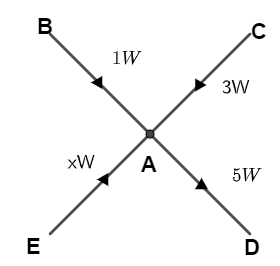
Now, total heat flowing into the point A is $(1 + 3 + x)W$ and the net flow of heat out of the point A is $5W$ now, equate both values we get,
$
1 + 3 + x = 5 \\
x = 1W \\
$
Now, since heat is flowing from point E to A which means
$
{T_E} > {T_A} \\
\Rightarrow {T_A} < {T_E} \\
$
So, option (A) is correct
Since, heat is flowing out of the point A to D but going into the point A from C which means
$
{T_C} > {T_A} > {T_D} \\
\Rightarrow {T_C} > {T_D} \\
$
So, option (C) is correct.
Since rate of heat flow is equal in rods BA and EA so, we have
$
{T_B} - {T_A} = {T_E} - {T_A} \\
{T_B} = {T_E} \\
$
So, option D is also correct.
But, ${T_B} \ne {T_C}$ so option (B) is incorrect.
Hence, the correct options are (A), (C), and (D)
Note:It should be remembered that, heat energy always flows from higher temperature point to the lower temperature point and for a closed system net heat flowing into the junction point is always equals to the net heat flowing out of the junction point.
Complete answer:
Let us assume the rate of heat flow through the rod EA be $xW$ into the point A and draw the rough diagram to represent the heat flow direction at each rod as
Now, total heat flowing into the point A is $(1 + 3 + x)W$ and the net flow of heat out of the point A is $5W$ now, equate both values we get,
$
1 + 3 + x = 5 \\
x = 1W \\
$
Now, since heat is flowing from point E to A which means
$
{T_E} > {T_A} \\
\Rightarrow {T_A} < {T_E} \\
$
So, option (A) is correct
Since, heat is flowing out of the point A to D but going into the point A from C which means
$
{T_C} > {T_A} > {T_D} \\
\Rightarrow {T_C} > {T_D} \\
$
So, option (C) is correct.
Since rate of heat flow is equal in rods BA and EA so, we have
$
{T_B} - {T_A} = {T_E} - {T_A} \\
{T_B} = {T_E} \\
$
So, option D is also correct.
But, ${T_B} \ne {T_C}$ so option (B) is incorrect.
Hence, the correct options are (A), (C), and (D)
Note:It should be remembered that, heat energy always flows from higher temperature point to the lower temperature point and for a closed system net heat flowing into the junction point is always equals to the net heat flowing out of the junction point.
Recently Updated Pages
A man m 80kg is standing on a trolley of mass 320kg class 11 physics JEE_MAIN

An ideal liquid is oscillating in a V tube as shown class 11 physics JEE_Main
Two persons of masses 55kg and 65kg respectively are class 11 physics JEE_Main
Which one of the following substances possess the highest class 11 physics JEE_Main
Four identical rods which have thermally insulated class 11 physics JEE_Main
Figure shows the PV plot of an ideal gas taken through class 11 physics JEE_Main
Trending doubts
JEE Main 2026: Session 1 Results Out and Session 2 Registration Open, City Intimation Slip, Exam Dates, Syllabus & Eligibility
Understanding the Angle of Deviation in a Prism
Hybridisation in Chemistry – Concept, Types & Applications
How to Convert a Galvanometer into an Ammeter or Voltmeter
Understanding Electromagnetic Waves and Their Importance
Understanding Uniform Acceleration in Physics
Other Pages
JEE Advanced Marks vs Ranks 2025: Understanding Category-wise Qualifying Marks and Previous Year Cut-offs
CBSE Notes Class 11 Physics Chapter 4 - Laws of Motion - 2025-26
CBSE Notes Class 11 Physics Chapter 14 - Waves - 2025-26
CBSE Notes Class 11 Physics Chapter 9 - Mechanical Properties of Fluids - 2025-26
CBSE Notes Class 11 Physics Chapter 11 - Thermodynamics - 2025-26
CBSE Notes Class 11 Physics Chapter 1 - Units And Measurements - 2025-26