




How will you convert:
(i) Propene to propan-1-ol
(ii) Ethanal to propan-2-ol
Answer
 Verified
581k+ views
Hint: - (i )In conversion of propene to propan-1-ol, oxidation reaction takes place. Oxidation reaction is the reaction in which oxygen is added to a compound. To convert propene to propan-1-ol, we will use the method of reaction of propene with peroxide.
Complete step-by-step answer:
Reaction of alkene with hydrogen halide in presence of peroxide results Anti Markovnikov’s addition. Anti Markovnikov’s addition states that in reaction of alkene with hydrogen halide, hydrogen is added to the carbon atom of the double bond which is bonded to least number of hydrogen atoms and the halide atom is boned to the another carbon atom of double bond.

The produced alkyl halide reacts with KOH followed by heating produces propan-1-ol.

Note:
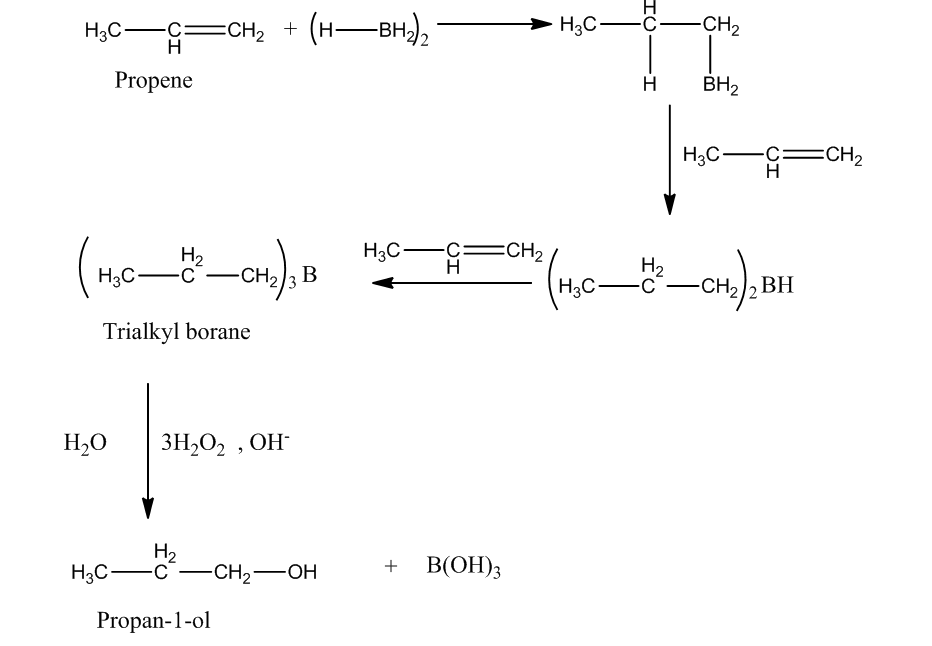
The other method to produce propan-1-ol from propene is hydroboration oxidation reaction. In this reaction, reaction of diborane $\left( {{\rm{B}}{{\rm{H}}_{\rm{3}}}} \right)$with propene produces trialkyl boranes (addition product). Then, the oxidation trialkyl boranes to alcohol takes place by ${{\rm{H}}_{\rm{2}}}{{\rm{O}}_{\rm{2}}}$(peroxide) in presence of a base $\left( {{\rm{NaOH}}} \right)$.
(ii)
Hint:
In conversion of ethanal to propan-2-ol, the carbon atom increases by one. So, we will use Grignard reagent so, that, parent chain can be increased by one carbon atom.
Complete step-by-step answer:
The reaction of Grignard reagent with carbonyl compounds produces alcohol. We need one more carbon atom than the original reactant. So, we have to use ${\rm{C}}{{\rm{H}}_{\rm{3}}}{\rm{MgI}}$ as the Grignard reagent.
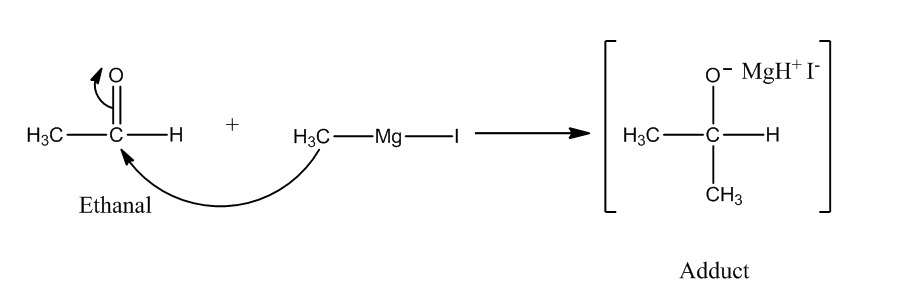
Step 1: The nucleophilic attack of Grignard reagent to the carbonyl group produces an adduct.
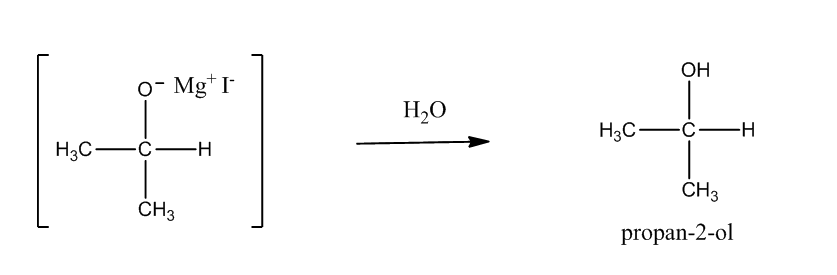
Step2: Hydrolysis of adduct produces an alcohol.
Note: It is possible to get confused in taking Grignard reagent for the conversion of ethanal to propan-2-ol. You have to observe the number of carbon atoms in reactant and the product. In the given question, one more carbon atom is present in product than the reactant. So, Grignard reagent has only one carbon atom.
Complete step-by-step answer:
Reaction of alkene with hydrogen halide in presence of peroxide results Anti Markovnikov’s addition. Anti Markovnikov’s addition states that in reaction of alkene with hydrogen halide, hydrogen is added to the carbon atom of the double bond which is bonded to least number of hydrogen atoms and the halide atom is boned to the another carbon atom of double bond.
The produced alkyl halide reacts with KOH followed by heating produces propan-1-ol.
Note:
The other method to produce propan-1-ol from propene is hydroboration oxidation reaction. In this reaction, reaction of diborane $\left( {{\rm{B}}{{\rm{H}}_{\rm{3}}}} \right)$with propene produces trialkyl boranes (addition product). Then, the oxidation trialkyl boranes to alcohol takes place by ${{\rm{H}}_{\rm{2}}}{{\rm{O}}_{\rm{2}}}$(peroxide) in presence of a base $\left( {{\rm{NaOH}}} \right)$.
(ii)
Hint:
In conversion of ethanal to propan-2-ol, the carbon atom increases by one. So, we will use Grignard reagent so, that, parent chain can be increased by one carbon atom.
Complete step-by-step answer:
The reaction of Grignard reagent with carbonyl compounds produces alcohol. We need one more carbon atom than the original reactant. So, we have to use ${\rm{C}}{{\rm{H}}_{\rm{3}}}{\rm{MgI}}$ as the Grignard reagent.
Step 1: The nucleophilic attack of Grignard reagent to the carbonyl group produces an adduct.
Step2: Hydrolysis of adduct produces an alcohol.
Note: It is possible to get confused in taking Grignard reagent for the conversion of ethanal to propan-2-ol. You have to observe the number of carbon atoms in reactant and the product. In the given question, one more carbon atom is present in product than the reactant. So, Grignard reagent has only one carbon atom.
Recently Updated Pages
How will you convert i Propene to propan1ol ii Ethanal class 12 chemistry JEE_Main

Atomic Structure JEE Main Mock Test 2026-27: Free Practice Online
JEE Main 2025-26 Mock Test: Classification of Elements & Periodicity
JEE Main Mock Test 2025-26: Free Practice, Analysis & Tips
JEE Main Mock Test 2026-27: Some Basic Concepts in Chemistry
Class 12 Chemistry Mock Test Series for JEE Main – Free Online Practice
Trending doubts
JEE Main 2026: Exam Dates, Session 2 Updates, City Slip, Admit Card & Latest News
Understanding the Electric Field of a Uniformly Charged Ring
Understanding Atomic Structure for Beginners
Electron Gain Enthalpy and Electron Affinity Explained
Derivation of Equation of Trajectory Explained for Students
Understanding the Different Types of Solutions in Chemistry
Other Pages
NCERT Solutions For Class 12 Chemistry Chapter 2 Electrochemistry - 2026-27 Free PDF Download (Sign-in Required)
NCERT Solutions For Class 12 Chemistry Chapter 1 Solutions - 2026-27 Free PDF Download (Sign-in Required)
NCERT Solutions For Class 12 Chemistry Chapter 3 Chemical Kinetics - 2026-27 Free PDF Download (Login Required)
CBSE Notes Class 12 Chemistry Chapter 1 - Solutions - 2026-27 PDF Download (Login Required)
NCERT Solutions for Class 12 Chemistry Chapter 6 Haloalkanes and Haloarenes - 2026-27 Free PDF Download (Sign-In Required)
NCERT Solutions For Class 12 Chemistry Chapter 7 Alcohol Phenol And Ether - 2026-27 Free PDF Download (Login Required)
NCERT Solutions For Class 12 Chemistry Chapter 2 Electrochemistry - 2026-27 Free PDF Download (Sign-in Required)
NCERT Solutions For Class 12 Chemistry Chapter 1 Solutions - 2026-27 Free PDF Download (Sign-in Required)
NCERT Solutions For Class 12 Chemistry Chapter 3 Chemical Kinetics - 2026-27 Free PDF Download (Login Required)