




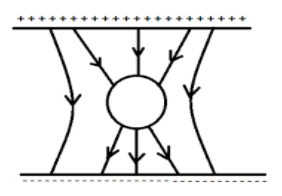
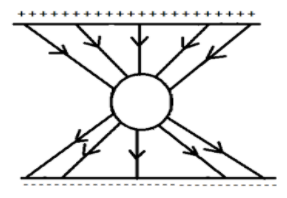
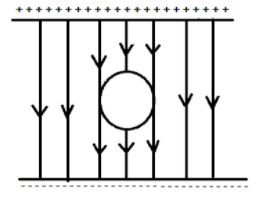
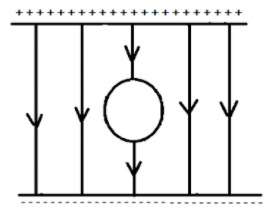
An uncharged sphere of metal is placed inside a charged parallel plate capacitor. The lines of force will look like:
A)
B)
C)
D)
Answer
 Verified
232.8k+ views
Hint: In order to solve this question, the knowledge of properties of electric lines of force is important. These field lines emerge radially outward in case of positive charge and radially inward in case of negative charge. Also, the concept of electrostatic properties of conductors is important. The electrostatic properties of conductor says that the electric field lines inside a conductor should be zero, all the charge lies on the surface of the conductor only. Also, the electric field lines are always normal to the surface of the charged conductor.
Complete answer:
Here we will analyse this question by the given options, starting from the option D we have, In option D the electric field lines are perpendicular to the surface of the uncharged sphere of metal but these lines are not slightly curved near the surface of the conductor or conducting sphere of metal. So, option D is incorrect.
Now we will analyse option C, in option C the electric field lines are not perpendicular to the surface of the uncharged metallic sphere and also not slightly curved near the surface of the metal sphere. So, option C is also incorrect.
Now moving to option B, in option B the electric field lines are not perpendicular to the surface of the metallic sphere. So this option is also incorrect.
Now moving to option A, here all the electric field lines are perpendicular to the surface of the uncharged sphere of metal also, these electric field lines are slightly curved near the surface of the conducting sphere.
So, option A is the correct answer.
Note: It is important to note that in option A, negative charge would be induced on the upper surface of the sphere, and positive charge would be induced on the lower surface. Also, the electric lines of force never intersect the conductor. These lines are perpendicular and slightly curved near the surface of the conductor. Also, these lines of force would enter the sphere normally at the surface.
Complete answer:
Here we will analyse this question by the given options, starting from the option D we have, In option D the electric field lines are perpendicular to the surface of the uncharged sphere of metal but these lines are not slightly curved near the surface of the conductor or conducting sphere of metal. So, option D is incorrect.
Now we will analyse option C, in option C the electric field lines are not perpendicular to the surface of the uncharged metallic sphere and also not slightly curved near the surface of the metal sphere. So, option C is also incorrect.
Now moving to option B, in option B the electric field lines are not perpendicular to the surface of the metallic sphere. So this option is also incorrect.
Now moving to option A, here all the electric field lines are perpendicular to the surface of the uncharged sphere of metal also, these electric field lines are slightly curved near the surface of the conducting sphere.
So, option A is the correct answer.
Note: It is important to note that in option A, negative charge would be induced on the upper surface of the sphere, and positive charge would be induced on the lower surface. Also, the electric lines of force never intersect the conductor. These lines are perpendicular and slightly curved near the surface of the conductor. Also, these lines of force would enter the sphere normally at the surface.
Recently Updated Pages
Mass vs Weight: Key Differences Explained for Students

JEE Isolation, Preparation and Properties of Non-metals Important Concepts and Tips for Exam Preparation
Isoelectronic Definition in Chemistry: Meaning, Examples & Trends
Ionisation Energy and Ionisation Potential Explained
Iodoform Reactions - Important Concepts and Tips for JEE
Introduction to Dimensions: Understanding the Basics
Trending doubts
JEE Main 2026: Session 2 Registration Open, City Intimation Slip, Exam Dates, Syllabus & Eligibility
JEE Main 2026 Application Login: Direct Link, Registration, Form Fill, and Steps
JEE Main Marking Scheme 2026- Paper-Wise Marks Distribution and Negative Marking Details
Understanding the Angle of Deviation in a Prism
Hybridisation in Chemistry – Concept, Types & Applications
How to Convert a Galvanometer into an Ammeter or Voltmeter
Other Pages
JEE Advanced Marks vs Ranks 2025: Understanding Category-wise Qualifying Marks and Previous Year Cut-offs
Dual Nature of Radiation and Matter Class 12 Physics Chapter 11 CBSE Notes - 2025-26
Understanding Uniform Acceleration in Physics
Understanding the Electric Field of a Uniformly Charged Ring
JEE Advanced Weightage 2025 Chapter-Wise for Physics, Maths and Chemistry
Derivation of Equation of Trajectory Explained for Students