




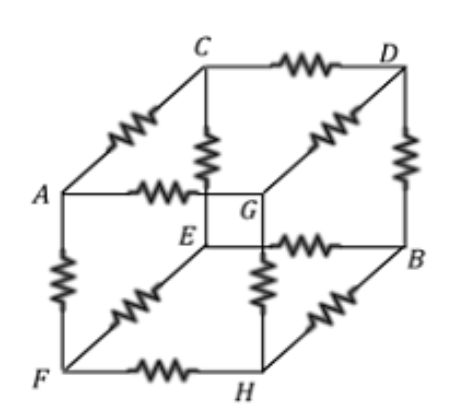
A cube made up of wire each of resistance R. Then find equivalent resistance across the diagonal.
a. $\dfrac{5}{6}R$
b. $\dfrac{3}{4}R$
c. $\dfrac{7}{12}R$
d. $R$
Answer
 Verified
231.9k+ views
Hint: Here we have to find the equivalent resistance of the circuit in the shape of a cube. First of all, we have to simplify the circuit in order to find out the desired result. Here A and B is considered to be the ends or vertices which contain a diagonal.
Complete answer:
To find the equivalent resistance of the given circuit diagram in the shape of a cube. We have to simplify the cube in a $2$D sketch so that it is easily read or calculated.
Let us consider the diagonal to be AB.
So, we will formulate a sketch based on the $3$D structure of cube to a $2$D flat plane with A and B being the ends, as the question has asked to find out the resistance along a diagonal.
The sketch is formulated as:
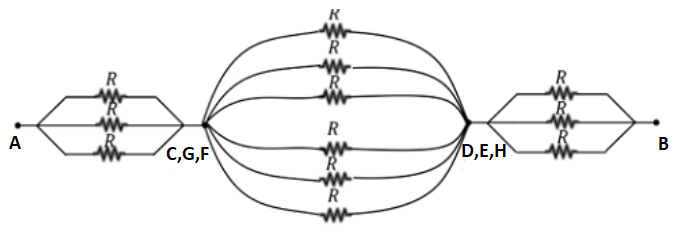
Due to symmetry, we have found out that the terminal C,G,F and D,E,H have the same potentials. So, can be regarded as the same point.
Now, the resistance around A and C,G,F are in parallel connection. Again, the resistance along B and D,E,H also the resistances along C,G,F and D,E,H are parallel. While all those three are in series connection.
So, the equivalent resistance is found as,
${{R}_{AB}}=\dfrac{R}{3}+\dfrac{R}{6}+\dfrac{R}{3}$
$\Rightarrow {{R}_{AB}}=\dfrac{5}{6}R$
The correct option is a. $\dfrac{5}{6}R$.
Note: It must be noted that we can figure out the equivalent resistance of anything in a $3$D format. So, our first aim must be to present it in the form of a $2$D sketch. And we must also remember that all the connections must be the same as that of a $3$D figure.
Complete answer:
To find the equivalent resistance of the given circuit diagram in the shape of a cube. We have to simplify the cube in a $2$D sketch so that it is easily read or calculated.
Let us consider the diagonal to be AB.
So, we will formulate a sketch based on the $3$D structure of cube to a $2$D flat plane with A and B being the ends, as the question has asked to find out the resistance along a diagonal.
The sketch is formulated as:
Due to symmetry, we have found out that the terminal C,G,F and D,E,H have the same potentials. So, can be regarded as the same point.
Now, the resistance around A and C,G,F are in parallel connection. Again, the resistance along B and D,E,H also the resistances along C,G,F and D,E,H are parallel. While all those three are in series connection.
So, the equivalent resistance is found as,
${{R}_{AB}}=\dfrac{R}{3}+\dfrac{R}{6}+\dfrac{R}{3}$
$\Rightarrow {{R}_{AB}}=\dfrac{5}{6}R$
The correct option is a. $\dfrac{5}{6}R$.
Note: It must be noted that we can figure out the equivalent resistance of anything in a $3$D format. So, our first aim must be to present it in the form of a $2$D sketch. And we must also remember that all the connections must be the same as that of a $3$D figure.
Recently Updated Pages
States of Matter Chapter For JEE Main Chemistry

Young’s Double Slit Experiment Derivation Explained
Wheatstone Bridge – Principle, Formula, Diagram & Applications
Circuit Switching vs Packet Switching: Key Differences Explained
Mass vs Weight: Key Differences Explained for Students
JEE Main Participating Colleges 2026 - A Complete List of Top Colleges
Trending doubts
JEE Main 2026: Admit Card Out, City Intimation Slip, Exam Dates, Syllabus & Eligibility
JEE Main 2026 Application Login: Direct Link, Registration, Form Fill, and Steps
JEE Main Marking Scheme 2026- Paper-Wise Marks Distribution and Negative Marking Details
Understanding the Angle of Deviation in a Prism
Hybridisation in Chemistry – Concept, Types & Applications
How to Convert a Galvanometer into an Ammeter or Voltmeter
Other Pages
JEE Advanced Marks vs Ranks 2025: Understanding Category-wise Qualifying Marks and Previous Year Cut-offs
Understanding Uniform Acceleration in Physics
Dual Nature of Radiation and Matter Class 12 Physics Chapter 11 CBSE Notes - 2025-26
Understanding the Electric Field of a Uniformly Charged Ring
Derivation of Equation of Trajectory Explained for Students
Understanding Electromagnetic Waves and Their Importance