






Important MCQs and Key Facts about Ilbari Rulers of Delhi Sultanate
The Ilbari Dynasty, also known as the Slave Dynasty or Mamluk Dynasty, was the first ruling dynasty of the Delhi Sultanate. It laid the foundation of Muslim rule in India and played a crucial role in shaping the political and administrative structure of medieval India. The dynasty ruled from 1206 to 1290 CE and included powerful rulers like Qutb-ud-din Aibak, Iltutmish, Razia Sultan, and Balban. Questions related to the Ilbari Dynasty are frequently asked in competitive exams such as UPSC, SSC, State PCS, NDA, CDS, and other government exams. Below are important GK questions with answers to help students prepare effectively.
Overview of the Ilbari Dynasty
Key Facts About the Ilbari Dynasty
| Feature | Details | Period |
|---|---|---|
| Founder | Qutb-ud-din Aibak | 1206 CE |
| Famous Rulers | Iltutmish, Razia Sultan, Balban | 13th Century |
| End of Dynasty | Defeat of Kayqubad | 1290 CE |
The Ilbari rulers were originally Turkish slaves who rose to power due to their military skills and loyalty. They strengthened the administrative system and defended India against Mongol invasions. The dynasty ended in 1290 CE with the rise of the Khalji Dynasty.
Important GK Questions With Answers On Ilbari Dynasty
Foundation and Early Rule
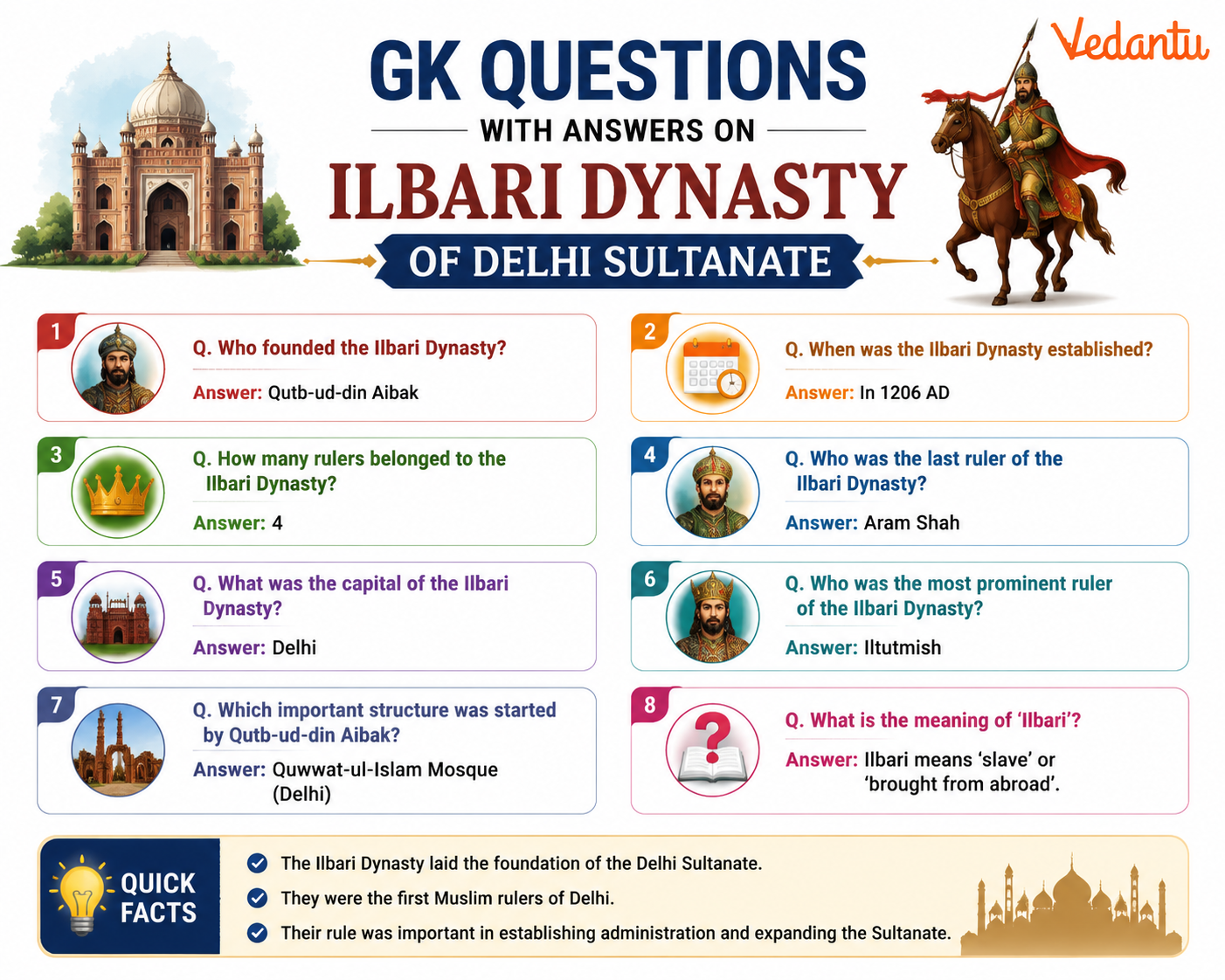
- Who founded the Ilbari Dynasty? Answer - Qutb-ud-din Aibak.
- In which year was the Ilbari Dynasty established? Answer - 1206 CE.
- What was Qutb-ud-din Aibak known as? Answer - Lakh Baksh because of his generosity.
- Which monument was started by Qutb-ud-din Aibak? Answer - Qutub Minar.
Iltutmish and Administration
- Who consolidated the Delhi Sultanate after Aibak? Answer - Iltutmish.
- What was the administrative group formed by Iltutmish? Answer - Turkan-i-Chahalgani or the Group of Forty.
- Who introduced the silver coin Tanka and copper coin Jital? Answer - Iltutmish.
- Who received recognition from the Abbasid Caliph? Answer - Iltutmish.
Razia Sultan and Later Rulers
- Who was the first and only woman ruler of the Delhi Sultanate? Answer - Razia Sultan.
- Why did Razia Sultan face opposition? Answer - Due to her gender and preference for non-Turkish nobles.
- Who was the last powerful ruler of the Ilbari Dynasty? Answer - Ghiyas-ud-din Balban.
- What policy did Balban follow to strengthen kingship? Answer - Policy of Blood and Iron.
Major Contributions of the Ilbari Dynasty
- Established the foundation of the Delhi Sultanate in India.
- Developed a centralized administrative system.
- Introduced a stable currency system with Tanka and Jital.
- Constructed important monuments like Qutub Minar.
- Protected India from Mongol invasions during Balban’s reign.
Important Years to Remember
- 1206 CE - Foundation of Ilbari Dynasty.
- 1211 CE - Iltutmish became Sultan.
- 1236 CE - Razia Sultan became ruler.
- 1266 CE - Balban became Sultan.
- 1290 CE - End of Ilbari Dynasty.
Exam Preparation Tips
While preparing GK questions on the Ilbari Dynasty, focus on rulers, administrative reforms, important battles, coins, and architectural contributions. Pay special attention to Iltutmish and Balban, as they are frequently asked in competitive exams. Revise important years and match rulers with their achievements for better retention.
Conclusion
The Ilbari Dynasty marked the beginning of the Delhi Sultanate and played a vital role in establishing stable Muslim rule in northern India. Through effective administration, military strength, and architectural contributions, the dynasty created a strong political base for future rulers. Practicing GK questions with answers on the Ilbari Dynasty helps students strengthen their historical knowledge and improve performance in competitive examinations.
FAQs on GK Questions on Ilbari Dynasty of the Delhi Sultanate with Answers
1. Who founded the Ilbari Dynasty of the Delhi Sultanate?
The Ilbari Dynasty was founded by Qutb-ud-din Aibak in 1206 AD after the death of Muhammad Ghori.
- He was a former Turkish slave and trusted general of Muhammad Ghori.
- Established the rule of the Slave Dynasty (Mamluk Dynasty) in Delhi.
- Marked the beginning of the Delhi Sultanate period in Indian history.
- His reign laid the foundation of Muslim rule in North India.
2. Why is the Ilbari Dynasty also called the Slave Dynasty?
The Ilbari Dynasty is called the Slave Dynasty because its rulers were originally Turkish slaves who rose to power.
- The term Mamluk means "owned" or "slave."
- Rulers like Qutb-ud-din Aibak, Iltutmish, and Balban were once slaves.
- They gained positions through merit and military skill.
- It represents a unique example of social mobility in medieval India.
3. Who was the greatest ruler of the Ilbari Dynasty?
The greatest ruler of the Ilbari Dynasty was Shams-ud-din Iltutmish due to his administrative and military achievements.
- Consolidated the Delhi Sultanate.
- Introduced the Iqtadari system for administration.
- Received recognition from the Caliph of Baghdad.
- Made Delhi the capital of the Sultanate.
4. Who was the first woman ruler of the Delhi Sultanate?
The first and only woman ruler of the Delhi Sultanate was Razia Sultan.
- She ruled from 1236 to 1240 AD.
- Daughter of Iltutmish.
- Known for her administrative ability and bravery.
- Faced opposition from Turkish nobles (Chahalgani).
5. What were the main achievements of Ghiyas-ud-din Balban?
The major achievements of Ghiyas-ud-din Balban strengthened the power of the Delhi Sultanate.
- Introduced the policy of "Blood and Iron".
- Strengthened the army and central administration.
- Crushed rebellions and controlled the nobles.
- Defended India against Mongol invasions.
6. What is the time period of the Ilbari Dynasty?
The Ilbari Dynasty ruled from 1206 AD to 1290 AD in medieval India.
- Founded by Qutb-ud-din Aibak.
- Ended with the rise of the Khilji Dynasty.
- It was the first ruling dynasty of the Delhi Sultanate.
- Played a crucial role in shaping early Sultanate administration.
7. What is the significance of the Qutub Minar in the Ilbari Dynasty?
The Qutub Minar is a significant monument built during the Ilbari rule symbolizing the establishment of Muslim power in India.
- Construction started by Qutb-ud-din Aibak.
- Completed by Iltutmish.
- Located in Delhi and now a UNESCO World Heritage Site.
- Represents Indo-Islamic architecture.
8. What was the Chahalgani during the Ilbari Dynasty?
The Chahalgani was a powerful group of forty Turkish nobles during Iltutmish’s reign.
- Also called the Group of Forty.
- Played a key role in administration and politics.
- Later became powerful and challenged royal authority.
- Suppressed effectively by Balban.
9. How did the Ilbari Dynasty come to an end?
The Ilbari Dynasty ended in 1290 AD due to internal weakness and political instability.
- Weak successors after Balban.
- Nobles gained excessive power.
- Overthrown by Jalal-ud-din Khilji.
- Marked the beginning of the Khilji Dynasty.
10. What administrative reforms were introduced during the Ilbari Dynasty?
The Ilbari rulers introduced key administrative reforms that strengthened the Delhi Sultanate.
- Implementation of the Iqtadari system (land revenue assignment).
- Centralized military organization.
- Establishment of a structured bureaucracy.
- Strengthening of law and order under Balban.
- These reforms influenced later Sultanate rulers.
