






Major Phases in the Timeline of Portugal as a Global Trading Power
Portugal has played a major role in global trade history, especially during the Age of Exploration. As a small European nation with a long Atlantic coastline, Portugal developed strong maritime skills that helped it become one of the earliest global trading powers. From medieval trade networks to a vast overseas empire connecting Europe, Africa, Asia, and South America, Portugal shaped international commerce for centuries. This timeline of the history of Portugal as a trader explains how the country evolved from a regional trading kingdom to a global maritime empire and later adapted to modern global trade systems.
Early Trade Foundations - Before the 15th Century
Before becoming a global maritime power, Portugal was involved in regional trade within the Iberian Peninsula and the Mediterranean. During the Roman period and later under Moorish rule, important ports such as Lisbon became active centers of commerce.
Key Features of Early Portuguese Trade
- Trade in agricultural goods like olive oil, wine, and salt.
- Exchange of metals and fish with neighboring regions.
- Use of Atlantic ports for regional maritime activities.
- Influence of Phoenician, Roman, and Moorish trading systems.
These early interactions built the maritime knowledge that later supported Portugal's expansion into global trade routes.
The Age of Exploration - 15th to 16th Century
The 15th century marked a turning point in Portuguese trade history. Under Prince Henry the Navigator, Portugal invested in navigation, shipbuilding, and exploration. This period transformed Portugal into a global trading power.
Major Milestones
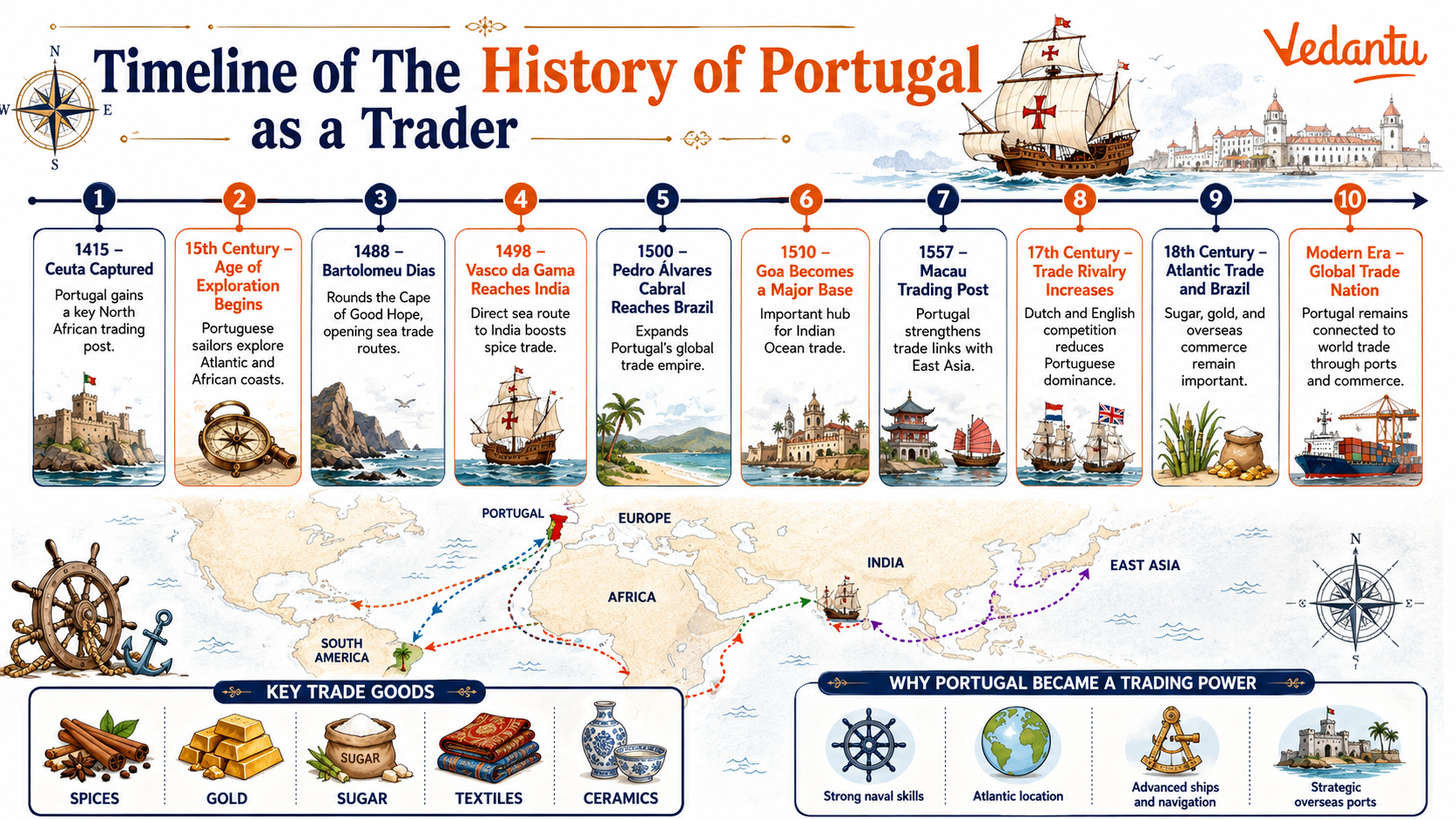
- 1415 - Capture of Ceuta in North Africa, opening access to African trade routes.
- 1488 - Bartolomeu Dias rounded the Cape of Good Hope.
- 1498 - Vasco da Gama reached India by sea.
- 1500 - Pedro Alvares Cabral reached Brazil.
These discoveries allowed Portugal to establish direct trade links with Africa, India, Southeast Asia, China, and Brazil.
Timeline of the History of Portugal as a Trader
| Period | Key Event | Trade Significance |
|---|---|---|
| Before 1400 | Regional Iberian and Mediterranean trade | Development of maritime skills and port cities |
| 1415 - 1600 | Age of Exploration | Control of spice trade and global sea routes |
| 1600 - 1800 | Colonial consolidation | Expansion of sugar, gold, and slave trade |
| 1800 - 1900 | Decline of empire | Loss of monopoly trade advantages |
| 1900 - Present | Modern global trade integration | EU membership and diversified economy |
This timeline highlights the transformation of Portugal from a regional trader into a global maritime empire and finally into a modern European trading nation.
Portuguese Colonial Trade Network - 16th to 18th Century
During this period, Portugal controlled a vast trading network across multiple continents. Lisbon became one of Europe's wealthiest cities due to the spice trade and colonial goods.
Main Trade Commodities
- Spices from India and Southeast Asia.
- Gold and ivory from Africa.
- Sugar and later coffee from Brazil.
- Participation in the Atlantic slave trade.
Portugal established trading posts known as feitorias in Africa and Asia to control commerce. These outposts secured trade routes and strengthened Portugal's global dominance.
Decline of Portuguese Trade Dominance - 17th to 19th Century
From the 17th century onward, Portugal faced competition from emerging European powers such as the Netherlands and England. Military conflicts and limited resources reduced Portuguese control over global trade.
Reasons for Decline
- Dutch and British naval competition.
- Loss of key Asian territories.
- Economic dependence on Brazil.
- Brazil's independence in 1822.
Although Portugal retained some colonies in Africa and Asia, its role as the leading global trader diminished significantly.
Modern Portugal in Global Trade - 20th Century to Present
In the modern era, Portugal transitioned from a colonial trading empire to a diversified economy integrated into global markets. The country joined the European Economic Community in 1986, now the European Union, strengthening its international trade relations.
Key Features of Modern Portuguese Trade
- Export of textiles, footwear, cork, and wine.
- Strong tourism and service sector contribution.
- Trade partnerships within the European Union.
- Growing renewable energy and technology sectors.
Today, Portugal maintains a balanced trade economy based on manufacturing, services, and international partnerships.
Importance of Portugal in World Trade History
Portugal's trading activities reshaped global commerce. It pioneered direct sea routes between Europe and Asia, expanded Atlantic trade, and laid the foundations for globalization. Portuguese explorers and merchants connected distant continents, influencing cultural exchange, economic systems, and international relations.
- Introduced Europe to direct spice trade.
- Established early global maritime trade networks.
- Contributed to the development of navigation technology.
- Played a central role in early globalization.
Understanding the timeline of the history of Portugal as a trader helps students appreciate how maritime exploration influenced global economic systems and international trade patterns that continue today.
FAQs on Timeline of the History of Portugal as a Trading Nation: Key Events and Milestones
1. What is the timeline of the history of Portugal as a trader?
The timeline of Portugal as a trader begins in the 15th century and expands through the Age of Exploration into a global maritime empire.
• 1415 – Capture of Ceuta, marking the start of overseas expansion
• 1488 – Bartolomeu Dias rounds the Cape of Good Hope
• 1498 – Vasco da Gama reaches India, opening the sea route to Asia
• 1500 – Discovery of Brazil by Pedro Álvares Cabral
• 16th century – Control of the spice trade in Africa, India, and Southeast Asia
• 17th–18th centuries – Decline due to Dutch and British competition
• 19th–20th centuries – Gradual end of colonial trade empire
2. Why did Portugal become a leading trading nation in the 15th century?
Portugal became a leading trading nation due to its maritime innovation, strategic location, and royal support during the Age of Discovery.
• Support from Prince Henry the Navigator
• Development of advanced ships like the caravel
• Strategic Atlantic coastal location
• Desire to access the spice trade and bypass Ottoman-controlled land routes
• Strong naval power and exploration policies
3. Who were the most important Portuguese explorers in trade history?
Several key explorers helped establish Portugal as a global trading power during the 15th and 16th centuries.
• Prince Henry the Navigator – Sponsored early voyages along Africa
• Bartolomeu Dias – First to round the Cape of Good Hope (1488)
• Vasco da Gama – Opened direct sea trade route to India (1498)
• Pedro Álvares Cabral – Claimed Brazil (1500)
• Afonso de Albuquerque – Expanded Portuguese trade empire in Asia
4. How did Vasco da Gama impact Portugal’s trade expansion?
Vasco da Gama’s voyage to India in 1498 revolutionized global trade by opening a direct sea route to Asia.
• Connected Europe directly to Indian Ocean trade networks
• Reduced dependence on Middle Eastern and Venetian traders
• Boosted Portugal’s control over the spice trade
• Marked the beginning of Portugal’s maritime empire
5. What goods did Portugal trade during its golden age?
During its golden age, Portugal traded valuable commodities from Africa, Asia, and South America.
• Spices – Pepper, cinnamon, cloves, nutmeg
• Gold and ivory from West Africa
• Sugar from Brazil
• Slaves in the Atlantic slave trade
• Textiles, silk, and precious stones
6. How did Portugal control the spice trade in Asia?
Portugal controlled the spice trade by establishing fortified trading posts and naval dominance in the Indian Ocean.
• Built forts in Goa, Malacca, and Hormuz
• Used a naval pass system called Cartaz
• Defeated regional powers in key sea battles
• Formed alliances with local rulers
7. What role did Brazil play in Portugal’s trading empire?
Brazil became a major source of wealth and trade for Portugal after its discovery in 1500.
• Large-scale production of sugar plantations
• Later discoveries of gold and diamonds
• Participation in the Atlantic triangular trade
• Strengthened Portugal’s economic base in the 16th–18th centuries
8. Why did Portugal’s trading dominance decline?
Portugal’s trading dominance declined due to foreign competition and limited resources.
• Rise of the Dutch and British East India Companies
• Loss of territories to European rivals
• 1580–1640 union with Spain weakened independence
• Smaller population and financial limitations
9. How did Portuguese trade influence global history?
Portuguese trade reshaped global commerce by connecting Europe, Africa, Asia, and the Americas.
• Initiated the Age of Exploration
• Established early forms of globalization
• Spread Christianity and European culture overseas
• Created new maritime trade routes
10. What was the significance of the Treaty of Tordesillas in Portuguese trade history?
The Treaty of Tordesillas (1494) divided newly discovered lands between Portugal and Spain, shaping Portugal’s trade empire.
• Signed between Portugal and Spain with Papal approval
• Gave Portugal rights over Brazil, Africa, and Asian routes
• Prevented direct conflict between the two powers
• Influenced colonial trade boundaries for centuries
