






Detailed Pay Scale, Allowances, and Benefits for Indian Government Officials
The salary of government officials in India is determined by structured pay scales recommended by the Central Pay Commission. These salaries vary based on position, rank, responsibilities, and level of government - central or state. Government jobs in India are highly sought after due to job security, fixed pay structure, allowances, and pension benefits. Understanding the salary structure of different government officials is important for students preparing for competitive exams such as UPSC, SSC, Banking, Railways, Defence, and State PSC examinations.
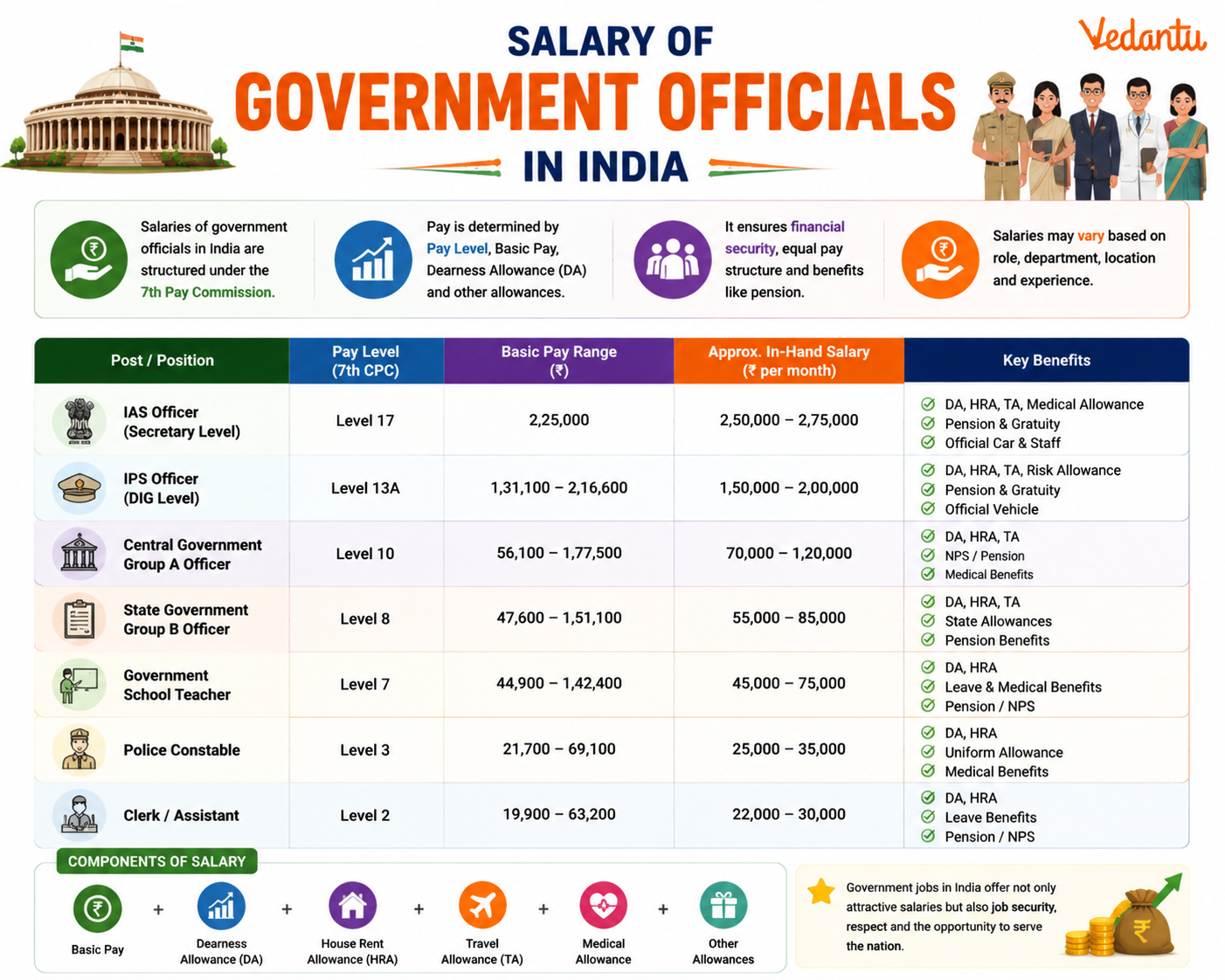
Pay Structure of Government Officials in India
The salary structure of central government employees is governed by the 7th Central Pay Commission (7th CPC), implemented in 2016. It introduced a Pay Matrix system which replaced the earlier Grade Pay system. Salaries are determined based on:
- Basic Pay
- Pay Level in the Pay Matrix
- Dearness Allowance (DA)
- House Rent Allowance (HRA)
- Travel Allowance (TA)
- Other special allowances depending on the post
State government officials follow similar structures, but their pay scales are decided by respective state pay commissions.
Salary of Top Constitutional Authorities in India
| Position | Monthly Salary (Approx) | Authority |
|---|---|---|
| President of India | Rs 5,00,000 | Article 59 |
| Vice President of India | Rs 4,00,000 | Article 97 |
| Prime Minister of India | Rs 2,80,000 | Parliamentary Law |
The salaries of constitutional authorities are determined by Parliament. They also receive official residence, staff, security, and other allowances.
Salary of Judges in India
| Judicial Position | Monthly Salary (Approx) | Level |
|---|---|---|
| Chief Justice of India | Rs 2,80,000 | Supreme Court |
| Supreme Court Judge | Rs 2,50,000 | Supreme Court |
| Chief Justice of High Court | Rs 2,50,000 | High Court |
Judges receive fixed salaries along with official residences and other benefits. Their salaries are protected to ensure judicial independence.
Salary of Civil Services Officers (UPSC)
Civil servants such as IAS, IPS, and IFS officers are paid according to the Pay Matrix Level under the 7th Pay Commission. Their salary increases with promotion and years of service.
Entry Level Salary
- Pay Level 10
- Basic Pay - Rs 56,100 per month
- Gross Salary - Around Rs 80,000 to Rs 1,00,000 including allowances
Cabinet Secretary (Highest Post)
- Pay Level 18
- Fixed Salary - Rs 2,50,000 per month
In addition to salary, civil servants receive government accommodation, official vehicles, domestic staff, and pension benefits.
Salary of Members of Parliament (MPs)
Members of Parliament receive a fixed monthly salary along with constituency allowances and daily allowances during parliamentary sessions.
- Basic Salary - Rs 1,00,000 per month
- Constituency Allowance - Rs 70,000 per month
- Office Allowance - Rs 60,000 per month
- Additional travel and daily allowances
The salary and allowances of MPs are determined by the Parliament of India.
Salary of Defence Officers
Defence officers in the Army, Navy, and Air Force are paid according to rank and years of service. They also receive Military Service Pay and other field allowances.
- Lieutenant - Starting basic pay around Rs 56,100
- Captain - Around Rs 61,300 basic pay
- Colonel - Around Rs 1,30,600 basic pay
- General - Rs 2,50,000 fixed pay
Defence personnel also receive risk allowances, uniform allowance, free medical facilities, and pension benefits.
Allowances and Benefits of Government Officials
Apart from basic salary, government officials receive various allowances and benefits that significantly increase their total earnings.
- Dearness Allowance revised periodically
- House Rent Allowance based on city category
- Medical benefits for family
- Pension and gratuity after retirement
- Leave Travel Concession
- Job security and fixed working hours
Importance for Competitive Exams
Questions related to salaries of constitutional authorities, judges, MPs, and civil servants are frequently asked in UPSC, SSC, Banking, Defence, and State PSC examinations. Candidates should remember:
- Latest salary figures after the 7th Pay Commission
- Articles of the Constitution related to salary
- Difference between basic pay and gross salary
- Hierarchy of posts and corresponding pay levels
Conclusion
The salary of government officials in India is structured, transparent, and regulated by constitutional and legal provisions. From the President of India to entry level civil servants, each position has a defined pay scale along with allowances and benefits. Government jobs continue to be attractive due to financial stability, pension schemes, and social prestige. For students and aspirants, understanding these salary structures helps in exam preparation as well as career planning.
FAQs on Salary of Government Officers in India: Complete Pay Structure Overview
1. What is the salary of the President of India in 2026?
The President of India receives a monthly salary of ₹5,00,000 as per the latest revision.
• This salary is decided under the President's Emoluments and Pension Act.
• The President also receives official residence at Rashtrapati Bhavan, security, and other allowances.
• The salary is subject to revision by Parliament of India.
This is one of the highest salaries among government officials in India.
2. How much salary does the Prime Minister of India get?
The Prime Minister of India earns approximately ₹2,80,000 per month, including basic pay and allowances.
• Basic salary: Around ₹1,60,000
• Sumptuary and daily allowances included
• Official residence and security provided
The salary structure is governed by the Salary, Allowances and Pension of Members of Parliament Act.
3. What is the salary of Members of Parliament (MPs) in India?
Members of Parliament (MPs) receive a monthly salary of ₹1,00,000 excluding allowances.
• Constituency allowance: ₹70,000 per month
• Office expense allowance: ₹60,000 per month
• Free travel and accommodation benefits
This salary is determined by the Parliament of India and revised periodically.
4. What is the salary of an IAS officer in India?
An entry-level IAS officer earns approximately ₹56,100 per month under the 7th Pay Commission.
• Senior-level officers can earn up to ₹2,50,000 per month
• Includes Dearness Allowance (DA), HRA, and TA
• Cabinet Secretary earns the highest pay in IAS cadre
The salary increases with rank, experience, and promotions.
5. What is the salary of an IPS officer in India?
An entry-level IPS officer receives around ₹56,100 per month as per the 7th CPC pay matrix.
• Senior IPS officers can earn up to ₹2,25,000 per month
• Includes risk allowance and other benefits
• Additional perks include official vehicle and security
The salary varies based on rank such as SP, DIG, IG, and DGP.
6. What is the salary of a Supreme Court judge in India?
A Supreme Court Judge earns a monthly salary of ₹2,50,000.
• Chief Justice of India (CJI) earns ₹2,80,000 per month
• Salaries revised under the Supreme Court Judges (Salaries and Conditions of Service) Act
• Includes official residence and staff
This ensures judicial independence and dignity of the judiciary.
7. What is the salary of a State Government employee in India?
The salary of a State Government employee varies based on state and post but follows similar structures to the 7th Pay Commission.
• Entry-level salary may start from ₹18,000 per month
• Includes DA, HRA, and other allowances
• State Public Service Commission officers earn higher pay scales
Pay structures differ across states like UP, Maharashtra, and Tamil Nadu.
8. What is the salary of a government school teacher in India?
A government school teacher earns between ₹35,000 to ₹1,00,000 per month depending on experience and grade.
• Primary teacher: ₹35,000–₹50,000
• TGT/PGT teacher: ₹50,000–₹1,00,000
• Includes DA, HRA, pension benefits
Salaries are regulated by state governments and central bodies like KVS and NVS.
9. Who decides the salary of government officials in India?
The salary of government officials in India is decided by the Pay Commission and approved by the government.
• Currently based on the 7th Central Pay Commission (7th CPC)
• Parliament approves salaries of constitutional posts
• State governments decide salaries for state officials
Pay Commissions are formed approximately every 10 years.
10. What is the highest-paid government job in India?
The Cabinet Secretary of India is among the highest-paid government officials with a salary of ₹2,50,000 per month.
• Chief Justice of India earns ₹2,80,000 per month
• President earns ₹5,00,000 per month (constitutional head)
• Senior IAS and IPS officers reach top pay scales
The highest salary depends on constitutional authority and rank.
