






Key Provisions, Penalties, and Road Safety Changes in the Motor Vehicles Amendment Act
The Motor Vehicles Amendment Bill is a significant reform introduced to amend the Motor Vehicles Act, 1988 in India. The primary objective of the amendment is to improve road safety, enhance transparency in the transport system, strengthen penalties for traffic violations, and promote digital governance in transport services. The Features Of Motor Vehicles Amendment Bill are important from a General Knowledge perspective as well as for competitive exams due to their impact on public safety, governance, and legal enforcement in India.
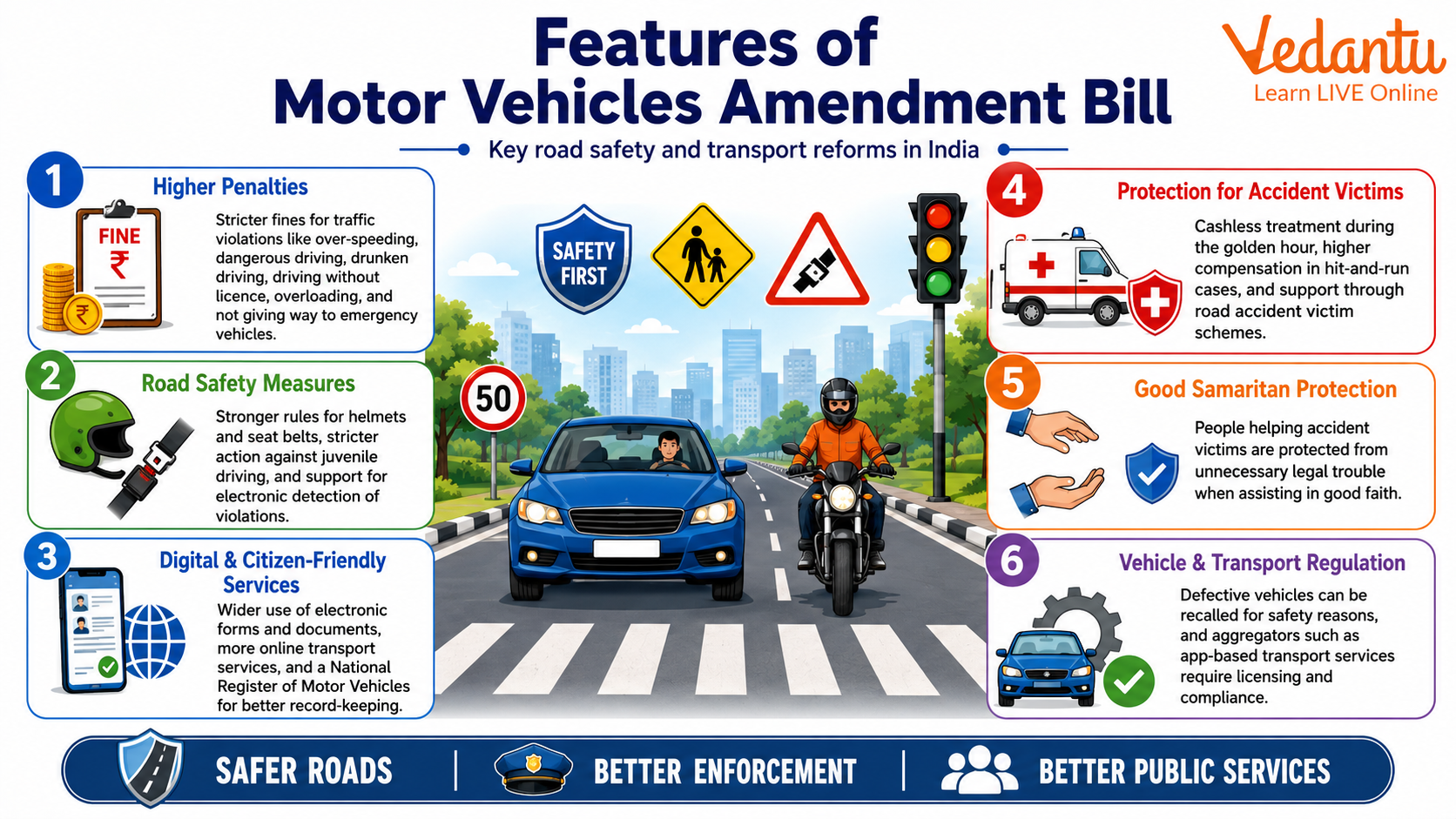
Background of the Motor Vehicles Amendment Bill
India records one of the highest numbers of road accidents in the world. The original Motor Vehicles Act, 1988 required reforms to address modern challenges such as increasing vehicle numbers, digital enforcement, corruption in licensing, and the need for stricter penalties. The Motor Vehicles Amendment Bill was introduced to make road transport safer, more accountable, and technology-driven.
- Passed by Parliament in 2019.
- Aims to reduce road accidents and fatalities.
- Encourages use of technology for better enforcement.
- Provides stronger penalties for traffic violations.
Key Features Of Motor Vehicles Amendment Bill
1. Increase in Traffic Penalties
One of the most notable features is the sharp increase in fines and penalties for traffic violations. The aim is to deter reckless driving and ensure better compliance with traffic rules.
- Higher fines for drunk driving.
- Increased penalty for driving without a license.
- Heavy fines for not wearing seat belts or helmets.
- Penalty for juvenile driving shifted to guardian or vehicle owner.
2. Protection of Good Samaritans
The Bill provides legal protection to Good Samaritans who help accident victims. This encourages people to assist injured individuals without fear of legal harassment.
3. Compensation for Road Accident Victims
The amendment increases compensation for victims of road accidents and introduces a Motor Vehicle Accident Fund to provide compulsory insurance cover to all road users.
- Increased compensation in case of death.
- Higher compensation for grievous injury.
- Cashless treatment during the golden hour.
4. National Transportation Policy
The Bill empowers the Central Government to develop a National Transportation Policy in consultation with state governments to establish a comprehensive planning framework for road transport.
5. Recall of Defective Vehicles
The government is authorized to order recall of motor vehicles if they pose a risk to the environment, drivers, or other road users. Manufacturers are required to compensate buyers or replace defective vehicles.
6. Regulation of Cab Aggregators
The amendment includes provisions to regulate cab aggregators such as app-based taxi services. They must obtain licenses and comply with safety and service standards.
7. Digitalization of Services
The Bill promotes digital documentation and electronic monitoring of transport services to reduce corruption and improve efficiency.
- Online issue of driving licenses.
- Electronic monitoring of violations.
- Computerized vehicle registration process.
Comparison of Penalties Before and After Amendment
| Offence | Earlier Fine | Revised Fine |
|---|---|---|
| Drunk Driving | Up to Rs 2000 | Up to Rs 10000 |
| No Driving License | Rs 500 | Rs 5000 |
| No Helmet | Rs 100 | Rs 1000 |
The significant increase in fines reflects the government's intention to discourage traffic violations and promote responsible driving behavior across the country.
Importance of the Motor Vehicles Amendment Bill
The Features Of Motor Vehicles Amendment Bill are crucial because they directly address road safety, administrative transparency, and victim protection. Road accidents cause thousands of deaths annually, and stronger legal measures help reduce negligence.
- Improves road discipline.
- Ensures better accountability of drivers.
- Provides financial security to accident victims.
- Encourages responsible manufacturing practices.
Criticism and Challenges
Despite its benefits, the amendment has faced criticism in some states due to high penalties. Some state governments initially reduced the fines, citing concerns over burden on citizens. However, the objective remains focused on long term road safety improvement.
Preparation Tips for Competitive Exams
Questions related to the Features Of Motor Vehicles Amendment Bill may appear in General Awareness sections of competitive exams. Focus on key provisions, increased penalties, protection of Good Samaritans, recall policy, and the Accident Fund.
- Remember the year of passage - 2019.
- Understand the purpose of increased fines.
- Learn provisions related to accident compensation.
- Revise digital and recall provisions carefully.
Conclusion
The Features Of Motor Vehicles Amendment Bill represent a comprehensive reform in India's road transport laws. By increasing penalties, ensuring victim compensation, protecting Good Samaritans, and introducing digital governance, the amendment aims to create safer roads and a more transparent transport system. Understanding its provisions is essential for students, exam aspirants, and informed citizens.
FAQs on Features Of Motor Vehicles Amendment Bill and Its Major Reforms
1. What is the Motor Vehicles Amendment Bill?
The Motor Vehicles Amendment Bill is a legislative reform introduced to improve road safety, traffic regulations, and penalties in India under the Motor Vehicles Act, 1988.
Key objectives include:
• Increasing traffic fines and penalties for violations
• Promoting road safety measures
• Protecting Good Samaritans who help accident victims
• Introducing stricter norms for drunken driving, overspeeding, and juvenile offences
This amendment aims to reduce road accidents and improve compliance with traffic laws.
2. When was the Motor Vehicles Amendment Act passed?
The Motor Vehicles (Amendment) Act, 2019 was passed by the Indian Parliament in July 2019 and came into effect on 1 September 2019.
Important facts:
• Passed by the Lok Sabha and Rajya Sabha in 2019
• Amended the original Motor Vehicles Act, 1988
• Focused on strengthening road transport laws and traffic penalties
This Act brought significant reforms to India’s road transport system.
3. What are the key features of the Motor Vehicles Amendment Bill 2019?
The Motor Vehicles Amendment Bill 2019 introduced major reforms to enhance road safety and accountability.
Main features include:
• Heavy increase in traffic fines and penalties
• Protection for Good Samaritans
• Compensation up to ₹5 lakh for hit-and-run cases
• Stricter punishment for juvenile offenders
• Mandatory electronic monitoring and enforcement
• Regulation of cab aggregators like Ola and Uber
These provisions aim to reduce road accidents and enforce stricter traffic discipline.
4. How did traffic fines change under the Motor Vehicles Amendment Act?
The Motor Vehicles Amendment Act 2019 significantly increased traffic violation fines to discourage rule-breaking.
Examples of revised penalties:
• Drunk driving: ₹2,000 → ₹10,000
• Driving without licence: ₹500 → ₹5,000
• No helmet/seatbelt: Increased fine
• Overspeeding: Higher penalties depending on vehicle type
The higher fines aim to improve road discipline and traffic safety in India.
5. What provisions were made for road accident victims?
The amendment strengthened compensation and protection for road accident victims.
Major provisions include:
• Increased compensation for hit-and-run cases (up to ₹5 lakh in case of death)
• Creation of a Motor Vehicle Accident Fund
• Cashless treatment during the golden hour
• Legal protection for Good Samaritans
These measures aim to provide quicker relief and medical support after road accidents.
6. What is the Good Samaritan provision in the Motor Vehicles Amendment Act?
The Good Samaritan provision protects individuals who voluntarily help road accident victims from legal harassment.
Key highlights:
• No civil or criminal liability for helpers
• No compulsion to reveal identity
• Protection from repeated questioning by police
This reform encourages citizens to assist injured persons without fear of legal trouble.
7. What are the rules regarding juvenile offenders under the Act?
The Act introduced strict penalties for juvenile driving offences to enhance accountability.
Key provisions:
• Guardian or vehicle owner held responsible
• Fine up to ₹25,000
• Imprisonment up to 3 years
• Cancellation of vehicle registration
• Juvenile ineligible for driving licence until age 25
These rules aim to prevent underage driving and improve road safety.
8. How does the Act regulate cab aggregators like Ola and Uber?
The amendment provides legal recognition and regulation for cab aggregators such as Ola and Uber.
Important provisions:
• Aggregators must obtain a state licence
• Compliance with IT Act and safety guidelines
• Driver background verification
• Fare regulation by state governments
This ensures better passenger safety and accountability in app-based transport services.
9. What is the Motor Vehicle Accident Fund?
The Motor Vehicle Accident Fund is a government-created fund to provide financial assistance to road accident victims.
Its purposes include:
• Compensation for hit-and-run victims
• Funding cashless treatment during the golden hour
• Support for uninsured accident victims
This fund strengthens the social security framework under the Motor Vehicles Amendment Act.
10. Why is the Motor Vehicles Amendment Bill important for competitive exams?
The Motor Vehicles Amendment Act 2019 is important for GK, UPSC, SSC, Banking, and State PSC exams due to its legal and social impact.
Exam-relevant points:
• Year of enactment: 2019
• Increased traffic penalties and road safety reforms
• Good Samaritan protection
• Motor Vehicle Accident Fund
• Juvenile and aggregator regulations
It is frequently asked in questions related to Indian Polity, Current Affairs, and Road Safety Laws.
