






Key Features and Constitutional Issues of the Delhi Statehood Law
The Delhi Statehood Act is a proposed legislative measure aimed at granting full statehood status to the National Capital Territory of Delhi. Currently, Delhi functions as a Union Territory with a special status under Article 239AA of the Indian Constitution. The demand for statehood has been a long-standing political and administrative issue in India. Understanding the Delhi Statehood Act is important for students preparing for competitive exams such as UPSC, SSC, and other state-level examinations, as it involves constitutional provisions, federal structure, governance, and center-state relations.
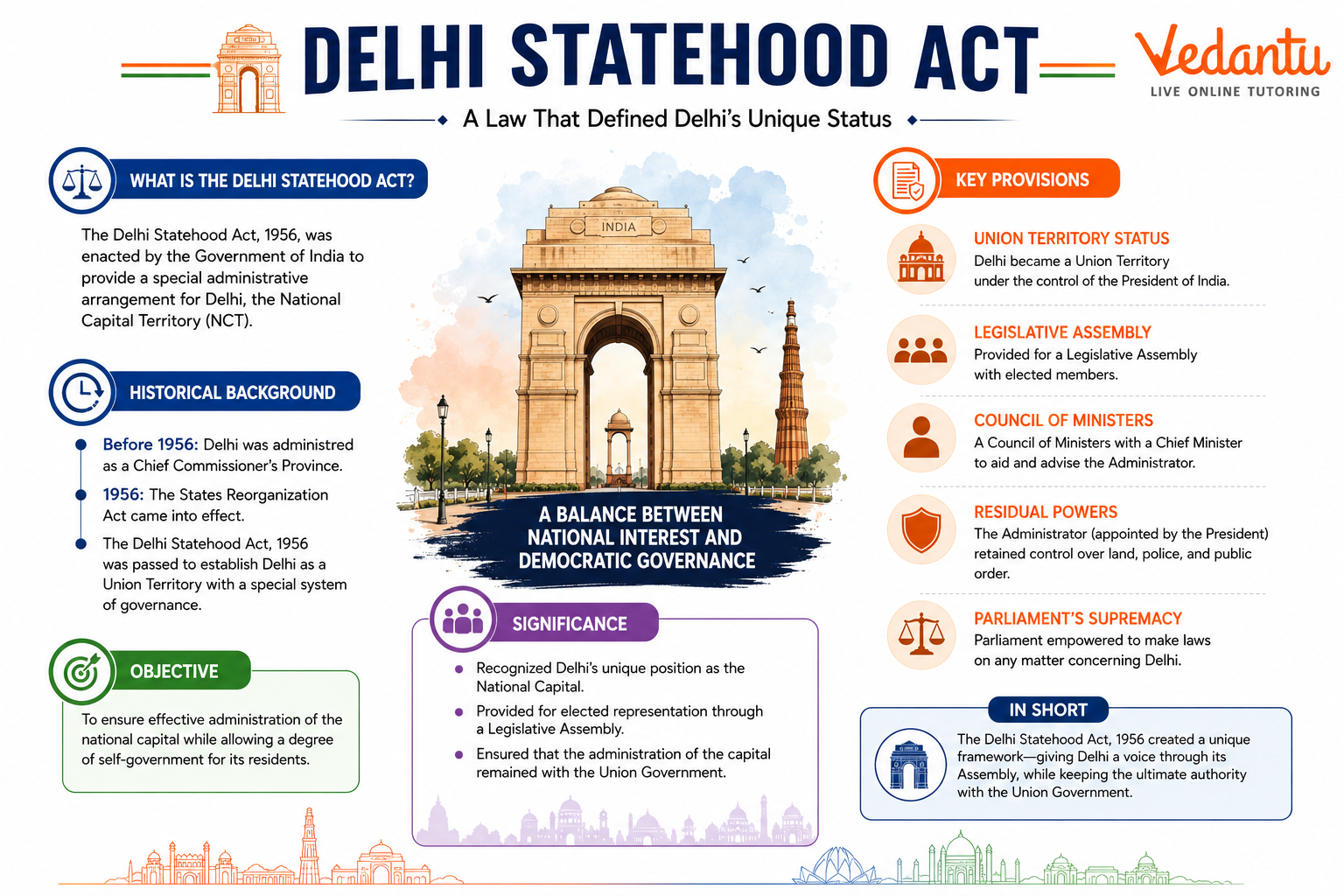
Background of Delhi’s Political Status
Delhi has undergone several administrative changes since independence. Initially classified as a Part C state, it later became a Union Territory. In 1991, the 69th Constitutional Amendment Act introduced Article 239AA, which provided Delhi with a Legislative Assembly and a Council of Ministers. However, certain subjects remain under the control of the Central Government.
- 1956 - Delhi became a Union Territory under the States Reorganisation Act.
- 1991 - 69th Constitutional Amendment granted special status to Delhi.
- Article 239AA - Provided for a Legislative Assembly and Council of Ministers.
- Police, Public Order, and Land remain under the Central Government.
What is the Delhi Statehood Act?
The Delhi Statehood Act is a proposed law that seeks to grant full statehood to Delhi by transferring complete legislative and administrative powers to the elected government of Delhi. This would mean that subjects like police, public order, and land would come under the control of the Delhi government rather than the Central Government.
The proposal generally suggests that areas housing key national institutions such as Parliament, Rashtrapati Bhavan, and diplomatic missions may remain under Central control as a separate National Capital District.
Key Features of the Proposed Delhi Statehood Act
- Grant of full statehood status to Delhi.
- Transfer of subjects such as police, land, and public order to the state government.
- Creation of a separate administrative zone for national institutions.
- Reduction in the discretionary powers of the Lieutenant Governor.
- Strengthening of federal principles and democratic governance.
Delhi Status Comparison
| Feature | Current Status | After Statehood |
|---|---|---|
| Type of Territory | Union Territory with Legislature | Full State |
| Control over Police | Central Government | Delhi State Government |
| Control over Land | Central Government | Delhi State Government |
| Role of Lieutenant Governor | Significant Powers | Limited Constitutional Role |
The table above highlights the key administrative differences between the present structure and the proposed statehood model. The main change would be the transfer of critical governance powers to the elected state government.
Arguments in Favor of Statehood
- Ensures democratic accountability as elected representatives control all subjects.
- Reduces administrative conflicts between the Lieutenant Governor and the elected government.
- Improves governance efficiency and decision-making.
- Strengthens the federal structure of India.
Arguments Against Statehood
- Delhi is the national capital and requires Central control for security reasons.
- Presence of foreign embassies and national institutions demands special administrative arrangements.
- Possible constitutional and security challenges.
Constitutional Provisions Related to Delhi
Article 239
Provides for the administration of Union Territories by the President through an Administrator.
Article 239AA
Inserted by the 69th Constitutional Amendment Act, 1991. It grants special status to Delhi and provides for a Legislative Assembly while reserving public order, police, and land for the Union Government.
Article 239AB
Provides for President’s Rule in Delhi in case of failure of constitutional machinery.
Importance for Competitive Exams
The Delhi Statehood issue is important for exams that test knowledge of Indian Polity and Governance. Questions may focus on constitutional amendments, federal structure, center-state relations, and administrative powers.
- UPSC Civil Services Examination - Indian Polity section.
- SSC and State PSC examinations.
- Questions related to constitutional amendments and governance.
Conclusion
The Delhi Statehood Act represents an important debate in Indian federalism and democratic governance. While the demand for full statehood aims to provide greater autonomy and accountability, concerns related to national security and constitutional balance continue to shape the discussion. A clear understanding of this topic helps students grasp the complexities of India’s federal system and prepares them effectively for competitive examinations.
FAQs on Delhi Statehood Act: Complete Explanation for Students
1. What is the Delhi Statehood Act?
The Delhi Statehood Act is a proposed law aimed at granting full statehood status to the National Capital Territory (NCT) of Delhi.
- It seeks to convert Delhi from a Union Territory with a legislature into a full-fledged state of India.
- It proposes transferring powers related to police, public order, and land to the elected Delhi government.
- The issue is linked to debates on federalism, governance, and Centre–State relations.
- Commonly searched under: Delhi full statehood demand, NCT of Delhi powers, Article 239AA.
2. Why does Delhi demand full statehood?
Delhi demands full statehood to gain complete administrative and legislative control over its governance.
- Currently, key subjects like police, land, and public order are controlled by the Central Government.
- The elected government argues this limits effective governance and accountability.
- Full statehood would ensure greater autonomy and democratic powers.
- Related queries: Why Delhi needs statehood, powers of Delhi government, Centre vs Delhi dispute.
3. What is the current constitutional status of Delhi?
Delhi is currently a Union Territory with a special status under Article 239AA of the Indian Constitution.
- It is officially called the National Capital Territory (NCT) of Delhi.
- It has an elected Legislative Assembly and a Chief Minister.
- The Lieutenant Governor (LG) represents the President of India.
- Key powers remain with the Centre, especially over police and land.
- People also ask: Is Delhi a state or union territory?
4. Which Article of the Constitution deals with Delhi’s special status?
Article 239AA of the Indian Constitution grants special status to Delhi.
- Inserted by the 69th Constitutional Amendment Act, 1991.
- Provides for a Legislative Assembly and Council of Ministers in Delhi.
- Restricts legislative powers over public order, police, and land.
- Important for UPSC, SSC, and other competitive exams under Indian Polity.
5. What are the main features proposed in the Delhi Statehood Act?
The Delhi Statehood Act proposes granting full legislative and administrative powers to Delhi.
- Transfer of control over Delhi Police, land, and public order to the state government.
- Reduction or redefinition of the Lieutenant Governor’s discretionary powers.
- Clear separation between National Capital area and the rest of Delhi (in some proposals).
- Focus on strengthening federal structure and democratic governance.
6. What is the role of the Lieutenant Governor in Delhi?
The Lieutenant Governor (LG) is the constitutional head of Delhi representing the President of India.
- Appointed by the President.
- Has special powers in matters related to public order, police, and land.
- Can refer disagreements with the elected government to the President.
- Frequently discussed in Centre–Delhi power disputes and Supreme Court judgments.
7. When was the demand for Delhi statehood first raised?
The demand for full statehood for Delhi has been raised since the 1950s.
- Delhi was a Part C State before 1956.
- Became a Union Territory under the States Reorganisation Act, 1956.
- Political parties have repeatedly included Delhi statehood in their manifestos.
- The issue remains significant in Indian political debates.
8. How is Delhi different from other Union Territories?
Delhi is unique because it has a Legislative Assembly unlike most Union Territories.
- Governed under Article 239AA with special provisions.
- Has an elected Chief Minister and Council of Ministers.
- Shares administrative powers with the Central Government.
- Similar UT with legislature: Puducherry.
- Search terms: UT with legislature, special status of Delhi.
9. What are the arguments against granting full statehood to Delhi?
Opponents argue that full statehood may affect national security and central control over the capital.
- Delhi houses key institutions like Parliament, Supreme Court, and Rashtrapati Bhavan.
- The Centre requires control over law and order in the national capital.
- Concerns about administrative conflicts between state and Union governments.
- Debate revolves around balancing national interest and federal autonomy.
10. Why is the Delhi Statehood Act important for competitive exams?
The Delhi Statehood Act is important for exams because it relates to Indian Polity and Constitutional provisions.
- Frequently asked in UPSC, SSC, State PSC, and other GK exams.
- Covers topics like Article 239AA, 69th Amendment Act, federalism, and Centre–State relations.
- Helps understand governance structure of the National Capital Territory.
- Falls under syllabus areas such as Indian Constitution, Political System, and Current Affairs.
