Banks and the Magic of Finance Class 7 Questions and Answers
Use the Banks and the Magic of Finance Class 7 extra questions and answers to practise 13 solved questions on bank accounts, interest, digital payments and the stock market. The set includes MCQs, very short answers, short answers and long answers. A flow chart shows how a UPI payment moves between two bank accounts.
Banks and The Magic of Finance Class 7 MCQ
Q1. Which type of bank account is generally suitable for a shopkeeper who makes frequent deposits and withdrawals?
A. Fixed deposit account
B. Current account
C. Savings account
D. Loan account
Answer: B. Current account.
Q2. Which institution supervises India’s banking system?
A. A commercial bank
B. A stock exchange
C. The Reserve Bank of India
D. The National Payments Corporation of India
Answer: C. The Reserve Bank of India.
Q3. Meera deposits money into her bank account and later withdraws some of it. How will the two transactions appear in her passbook?
A. Deposit as a debit and withdrawal as a credit
B. Both as credits
C. Both as debits
D. Deposit as a credit and withdrawal as a debit
Answer: D. Deposit as a credit and withdrawal as a debit.
Q4. A company issues shares to raise money for expansion. What does a person receive when they buy one of these shares?
A. A small ownership stake in the company
B. A fixed deposit with the company
C. A loan from the company
D. A guarantee that their money will grow
Answer: A. A small ownership stake in the company.
Class 7 Social Science Chapter 8 Very Short Answer Questions
Q5. What is financial infrastructure? Give two examples.
Answer: Financial infrastructure is the network of institutions and systems that help people save, borrow, invest and make payments. Banks and digital payment systems are two examples.
Q6. How did the Jan Dhan Yojana make bank accounts easier to access?
Answer:
The scheme helped more people open bank accounts without having to maintain a minimum balance. Having an account allowed people to receive wages or government benefits directly.
Q7. Why might a bank pay more interest on a fixed deposit than on a savings account?
Answer:
In a fixed deposit, the customer agrees to keep the money with the bank for a set period. The bank can plan around that period and may offer a higher interest rate in return.
Class 7 Social Science Chapter 8 Short Questions and Answers
Q8. How does a UPI payment move money from one bank account to another?
Answer:
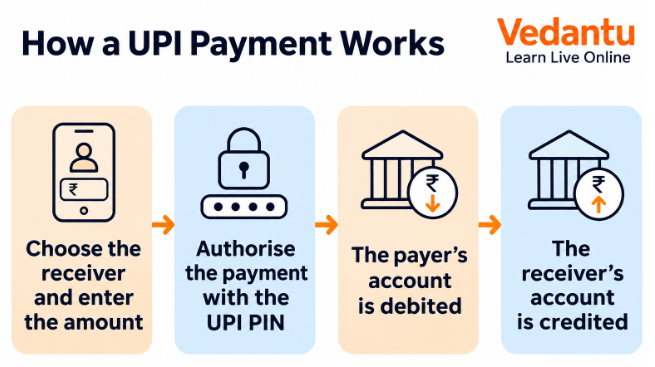
For example, when a customer pays a shopkeeper through UPI, the amount is deducted from the customer’s bank account and added to the shopkeeper’s bank account.
Q9. How does compound interest differ from simple interest? Show how ₹1,000 grows over two years at 10% per year under both methods.
Answer:
Simple interest is calculated on the original ₹1,000 each year. The interest is ₹100 per year, so the amount after two years is ₹1,200.
Compound interest is calculated on the amount that includes the interest already added. With annual compounding, the first year’s interest is ₹100. The second year’s interest is 10% of ₹1,100, or ₹110. The amount after two years is ₹1,210.
Q10. A caller claims to be from a bank and asks for an OTP to complete a transaction. Why should the customer keep the OTP private?
Answer:
An OTP is a one-time code used to verify a transaction or another account activity.
A fraudster may use the code to approve an activity without the customer’s permission.
The customer should end the call and use the bank’s official contact details to check the claim.
Class 7 Social Science Chapter 8 Long Answer Questions
Q11. How do banks connect people who save with people who need to borrow? Explain how banks earn income from this process.
Answer:
People deposit money in banks and may earn interest on their savings.
Banks keep some money in reserve and lend part of the deposits to people and businesses.
Borrowers repay the amount they borrowed along with interest.
Banks generally charge a higher interest rate on loans than they pay on savings deposits. The difference between the interest they receive and the interest they pay is one source of income for banks.
Q12. How does the stock market help companies raise money and give people a way to invest their savings?
Answer:
A company can raise money by issuing shares to investors. It can use that money to expand or start new projects.
Each share gives the buyer a small ownership stake in the company.
Investors can also buy and sell existing shares through the stock market.
Share prices can rise or fall. Investors may gain if they sell for more than they paid or lose money if they sell for less.
Q13. How do physical and financial infrastructure work together when a small business expands? Explain with an example.
Answer:
A small food producer can take a bank loan to buy equipment and increase production. Electricity powers the equipment, and roads help the producer deliver goods to shops. The shops can pay through bank transfers or digital payments. The producer can then use part of the sales income to repay the loan and buy more supplies. In this way, physical infrastructure helps the business make and deliver goods, while financial infrastructure helps it borrow money and receive payments.
How to Prepare Banks and the Magic of Finance for Class 7
Start with a familiar example, such as putting money into a savings account or paying a shopkeeper through UPI. Then use the Class 7 Banks and the Magic of Finance questions and answers to explain what happens to the money in each case.
Compare bank accounts by purpose: Think about why a shopkeeper who makes frequent transactions might use a current account, while someone saving for a set period might choose a fixed deposit.
Work out interest year by year: In a compound interest question, add the first year’s interest before calculating the second year’s interest. This helps you see why the total differs from simple interest.
Follow a payment from start to finish: Use the UPI flow chart to track whose account is debited and whose account is credited.
Explain where the money goes: When a company issues shares, explain how the company raises funds and what the investor receives in return.
How Vedantu’s Class 7 Chapter 8 Important Questions Help Students
Vedantu provides Banks and the Magic of Finance Extra Questions and Answers covering 13 solved questions on bank accounts, interest, loans, digital payments and shares. Students can use these questions to test their understanding, revise key concepts and practise writing complete answers.
Check your understanding with MCQs: Try the questions before looking at the answers. Mark any option you guessed so you know which topic to revisit.
See how much detail to include: Use the very short and short answers to see how to state a point clearly. Compare them with the long answers, which explain how ideas connect and include examples where needed.
Check where your calculation went wrong: Compare your working with the solved interest example to see whether you used the right amount for each year.
Practise again offline: Use the Banks and the Magic of Finance Class 7 PDF to retry questions you found difficult, then check whether you can explain the answer in your own words.
Class 7 Social Science Part 2 Chapter 8 Banks and the Magic of Finance Study Materials
Class 7 Social Science Chapter-wise Important Questions
Important Study Materials for CBSE Class 7 Social Science
FAQs on Important Questions for Class 7 Social Science (Exploring Society: India and Beyond Part 2) Chapter 8 Banks and the Magic of Finance | 2026-27
1. Why is the Reserve Bank of India called the banker to banks?
The RBI maintains bank accounts and helps them transfer funds to one another. It can also lend money to banks when they need funds.
2. How is paying by cheque different from paying through UPI?
A cheque is a written instruction asking the bank to pay someone. It usually takes time to clear. UPI lets you authorise a payment digitally, and the money usually reaches the receiver’s account within seconds.
3. How can a passbook help you check your bank balance?
A passbook records money credited to and debited from your account. Check the balance after the most recent entry to see how much money was in the account at that point.
4. Why can compound interest increase the cost of borrowing?
If unpaid interest is added to the amount owed, future interest is calculated on that larger amount. This can increase the total the borrower has to repay.
5. What is included in Vedantu’s Banks and the Magic of Finance Class 7 PDF?
The PDF includes 13 solved questions in four formats, from MCQs to long answers. It also includes a worked example on simple and compound interest and a flowchart showing how a UPI payment works.