Infrastructure: Engine of India’s Development Class 7 Questions and Answers
Use the Infrastructure: Engine of India’s Development Class 7 PDF for offline practice. The solved questions cover transport, communication, energy and the care of public facilities. The picture-based questions help you connect what you see, such as a living root bridge or a damaged footpath, with how infrastructure affects everyday life.
Class 7 Social Science Chapter 7 MCQs with Answers
Q1. Which of these is an example of communication infrastructure?
A. A railway platform
B. A mobile tower
C. A roadside drain
D. A cargo terminal
Answer - B. A mobile tower.
Q2. Which four cities does the Golden Quadrilateral connect?
A. Delhi, Mumbai, Chennai and Kolkata
B. Delhi, Jaipur, Kochi and Patna
C. Mumbai, Bengaluru, Hyderabad and Pune
D. Chennai, Lucknow, Ahmedabad and Kolkata
Answer - A. Delhi, Mumbai, Chennai and Kolkata.
Q3. Which form of transport is suitable for carrying a large shipment of cement overseas?
A. Metro rail
B. Passenger aircraft
C. Cargo ship
D. City bus
Answer - C. Cargo ship.
Q4. Which example shows how communication infrastructure supports e-governance?
A. A shopkeeper sells goods through an online marketplace.
B. A family books a taxi through an app.
C. A student watches a science video online.
D. A citizen uses DigiLocker to access a government-issued document.
Answer - D. A citizen uses DigiLocker to access a government-issued document.
Class 7 Social Science Chapter 7 Very Short Answer Questions
Q5. What is physical infrastructure? Give two examples.
Answer
Physical infrastructure includes the basic facilities and systems that help people travel, communicate and carry out daily activities. Roads and mobile towers are two examples.
Q6. What happens to cargo at a seaport?
Answer
Ships dock at seaports so workers can load and unload cargo. Goods can then continue their journey by ship or move inland by road or rail.
Q7. Why are schools and health centres examples of social infrastructure?
Answer
Schools provide education, while health centres provide medical care. Both offer services that support the well-being and development of a community.
Q8. How can communication infrastructure help during a natural disaster?
Answer
Mobile networks can carry warnings through text messages or apps. These alerts help people learn about the danger and take action quickly.
Class 7 Social Science Chapter 7 Short Questions and Answers
Q9. How does a highway connection help producers reach more customers?
Answer
A highway gives producers a road link to towns and cities beyond their local market.
Trucks can carry larger loads, and better roads can reduce travel time and transport costs.
Faster delivery matters for goods such as fruits and vegetables because they can reach buyers while still fresh.
Q10. Look at the illustration of a living root bridge in Meghalaya. What is the bridge made from, and how does it help people in the area?

Answer
People guide living tree roots across a stream and weave them together to form a bridge.
The woven roots create a path between the two banks.
The bridge helps people cross the stream in a hilly area where building roads can be difficult.
Q11. Rani sends a voice note from Madhya Pradesh to her cousin in Tamil Nadu. What infrastructure helps the message reach her cousin?
Answer
Electricity powers the mobile tower and other network equipment.
A nearby tower connects Rani’s phone to the communication network.
Network equipment, including fibre cables, carries the voice note as digital data so it can reach her cousin’s phone.
Q12. Look at the illustration of a neighbourhood street. How do the pothole and the littered footpath affect people? Give one action residents can take and one action the local body can take.
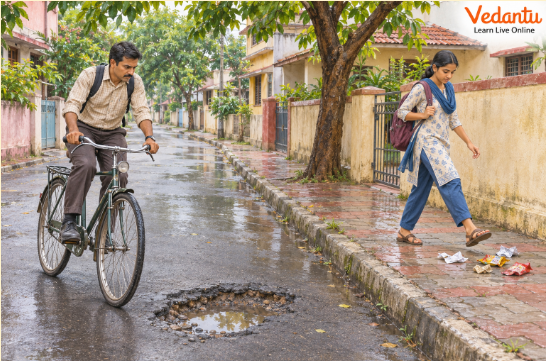
Answer
The pothole makes cycling less safe, while litter makes the footpath harder to use.
Residents can put waste in designated bins to keep the footpath clear.
The local body can repair the pothole so people can use the road more safely.
Class 7 Social Science Chapter 7 Long Answer Questions
Q13. A producer sends goods by road, rail and sea. Explain what each mode of transport contributes to the journey.
Answer
Road transport collects the goods. Trucks can carry goods from a farm or factory to a railway freight terminal.
Rail transport moves large loads inland. A freight train can carry goods over long distances to a port or a terminal near it.
The port connects land and sea transport. Workers transfer the goods to the port and load them onto a cargo ship.
Sea transport carries the goods overseas. Ships can move large quantities of goods across long distances to markets in other countries.
Q14. How does communication infrastructure support education, business, government services and emergency response? Give one example for each.
Answer
Q15. Why does a town need to maintain its existing infrastructure as well as build new facilities? Explain how local bodies and citizens can help.
Answer
Maintenance keeps facilities usable. Repairing potholes, clearing drains and keeping footpaths clean make everyday travel easier and safer.
Local bodies organise public services. Panchayats and municipalities can improve waste collection, maintain drains and look after local roads and footpaths.
Citizens help protect shared facilities. They can dispose of waste properly, avoid damaging public property and report problems such as broken streetlights.
Planning helps facilities serve people over time. Safe footpaths and infrastructure that uses cleaner energy are examples of improvements that can meet local needs while reducing harm to the environment.
How Infrastructure Supports Development in Class 7 Social Science Chapter 7
Infrastructure: Engine of India’s Development shows how roads, railways, ports and communication networks help people reach places, move goods and access services. Follow these connections as you read the chapter.
Roads bring markets closer: A highway can shorten the journey from a farm to a town, helping fresh produce reach buyers sooner.
Different transport networks work together: A truck can collect goods from a factory, a freight train can move them towards a port, and a ship can carry them overseas.
Local designs suit local needs: In Meghalaya, living root bridges give people a way to cross streams on foot in hilly areas.
Communication networks connect people to services: Mobile towers and fibre cables help carry messages, support online learning and deliver emergency alerts.
Maintenance keeps facilities usable: Repairing potholes and clearing litter make roads and footpaths easier to use.
How to Practise Class 7 Social Science Chapter 7 Important Questions with Vedantu
After reading Infrastructure: Engine of India’s Development, use Vedantu’s important questions to see how well you can explain the chapter in your own words.
Check what you remember: Start with the MCQs. Mark any question you guessed, even if you chose the correct option.
Explain how a facility helps: In a short answer about highways, name who benefits and explain how. For example, better roads help farmers get fresh produce to more buyers.
Use clues from the picture: In the living root bridge illustration, follow the woven roots across the stream. Use what you see to explain how the bridge connects the two banks.
Organise longer answers: If a question asks how goods travel by road, rail and sea, describe the journey in order and give each mode of transport its own point.
Check your answer and try again: Compare your response with Vedantu’s solved answer to spot a missing reason, step or example. Use the Chapter 7 PDF to retry the questions you marked.
Class 7 Social Science Part 2 Chapter 7 Infrastructure: Engine of India’s Development Study Materials
Class 7 Social Science Chapter-wise Important Questions
Important Study Materials for CBSE Class 7 Social Science
FAQs on Important Questions for Class 7 Social Science (Exploring Society: India and Beyond Part 2) Chapter 7 Infrastructure: Engine of India’s Development | 2026-27
1. What are the main topics in Class 7 Social Science Chapter 7?
Infrastructure: Engine of India’s Development Class 7, Chapter 7, covers transport and communication networks, the role of electricity, and facilities such as schools and health centres. It also explains how citizens and local bodies share the responsibility of maintaining public infrastructure.
2. What is the difference between physical and social infrastructure?
Physical infrastructure includes roads, railways and mobile towers that support travel, trade and communication. Social infrastructure includes schools, hospitals and libraries that support education, health and community life.
3. Why is the Golden Quadrilateral important for trade in India?
It connects Delhi, Mumbai, Chennai and Kolkata by highway. These road links help businesses move goods between major cities and reach markets along the routes.
4. How do living root bridges meet local needs in Meghalaya?
Local communities guide and weave living tree roots across streams. Over time, the roots form bridges that connect footpaths on opposite banks and help residents travel through hilly areas.
5. Why do ports need good road and rail connections?
Roads and railways carry goods from farms and factories to ports, where they can be loaded onto ships. They also carry goods unloaded from ships to towns and cities inland.
6. Why is maintaining public infrastructure a shared responsibility?
Local bodies can repair roads and organise waste collection. Citizens can use bins, take care of public property and report damage. Both actions help keep roads, footpaths and other shared facilities usable.
7. How can I use Vedantu’s Class 7 Social Science Chapter 7 questions and answers PDF?
Use the PDF to practise MCQs, short answers, picture-based questions and long answers offline. Try each question first, then check the solved answer for any reason, step or example you missed.