Class 9 Life on Earth Chapter 2 Important Questions and Answers for Exam Preparation
The Class 9 Chapter 2 Life on Earth Important Questions PDF covers terrestrial and aquatic biomes, biodiversity hotspots, ecological balance, forest livelihoods and conservation programmes.
Students can use the Class 9 Chapter 2 Life on Earth Important Questions PDF Download to practise questions, check their answers and revise chapter examples. The questions below include 1-mark MCQs, 2-mark very short answers, 3-mark short answers and 5-mark long answers.
Class 9 Chapter 2 Life on Earth Important Questions MCQ with Answers
1. Which biome is the coldest and has soil that stays frozen almost all year (permafrost)?
A) Desert
B) Taiga
C) Tundra
D) Grassland
Answer: C) Tundra
2. Which organisms are found at the base of a biome pyramid?
A) Herbivores
B) Producers
C) Carnivores
D) Top predators
Answer: B) Producers
3. Which of these is NOT mentioned in the chapter as a biodiversity hotspot?
A) Western Ghats
B) North-East India
C) Andaman & Nicobar Islands
D) Thar Desert
Answer: D) Thar Desert
4. Thenmala, India’s first planned ecotourism destination, is in:
A) Assam
B) Kerala
C) Uttarakhand
D) Karnataka
Answer: B) Kerala
5. Channapatna toys of Karnataka are made from the wood of which forest tree?
A) Teak
B) Sal
C) Wrightia tinctoria (Aale mara)
D) Bamboo
Answer: C) Wrightia tinctoria (Aale mara)
6. Which type of traditional water tank was built in Tamil Nadu?
A) Keres
B) Eri
C) Chevuru
D) Ahar pynes
Answer: B) Eri
Class 9 Social Science Part 2 Chapter 2 Very Short Answer Questions
7. What is a biome?
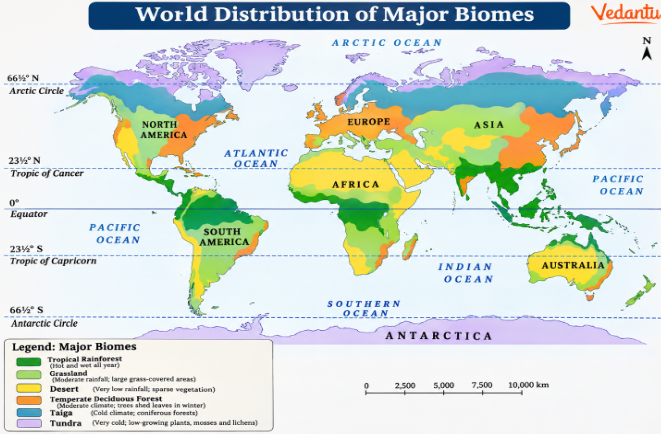
Answer: A biome is a large natural region of the world where certain types of plants and animals live under similar climatic conditions. Tundras, hot deserts, green forests and grasslands are examples of biomes.
8. What is ecotourism?
Answer: Ecotourism is responsible travel to nature-friendly places, such as forests, where tourists enjoy nature and also help to protect it. It has minimal impact on the environment, respects local communities, and supports local people.
9. What is the Forest Rights Act (FRA), 2006?
Answer: The Scheduled Tribes and Other Traditional Forest Dwellers (Recognition of Forest Rights) Act, 2006, recognises the rights of eligible communities over the forest land and resources they have traditionally depended on. It allows them to collect minor forest produce such as bamboo, honey and medicinal plants. It also gives them ownership of small patches of land that they cultivate.
10. What are ecological commons? Give two examples.
Answer: Ecological commons are natural resources that are shared by a community and used together for its survival and well-being. No one person owns them; they belong to the whole community. Examples: forests and rivers (lakes, grazing lands, air and biodiversity are also commons).
Class 9 Social Science Chapter 2 Life on Earth Short Answer Questions
11. What is biodiversity? Why is it important?
Answer: Biodiversity is the variety of life on Earth. It includes plants, animals, microorganisms and the ecosystems they live in. It covers not only the number of species, but also the genetic differences within species and the variety of habitats. It is important because it keeps ecosystems healthy and supports human survival.
12. Why are tropical rainforests called a “gene bank”? Name two regions where the largest rainforests are found.
Answer:
Tropical rainforests are rich in biodiversity. They preserve unique genetic material, which supports conservation and scientific research. This is why they are called a “gene bank”.
The largest tropical rainforests are in the Amazon Basin (South America), the Congo Basin (Africa) and parts of Southeast Asia, such as Indonesia and Malaysia.
13. What is a Geographical Indication (GI) tag? How does it help local communities? Give two examples of GI-tagged forest products.
Answer:
A GI tag is a type of intellectual property right. It shows that a product comes from a specific place and that its quality or reputation is linked to that place.
It helps protect region-specific products, promotes cultural heritage and brings economic benefits to local communities through exclusive market recognition.
Examples (any two): Ramban Sulai Honey (Jammu and Kashmir), Tezpur Litchi (Assam), Kandhamal Haldi (Odisha).
14. Explain how a biome pyramid shows the flow of energy.
Answer:
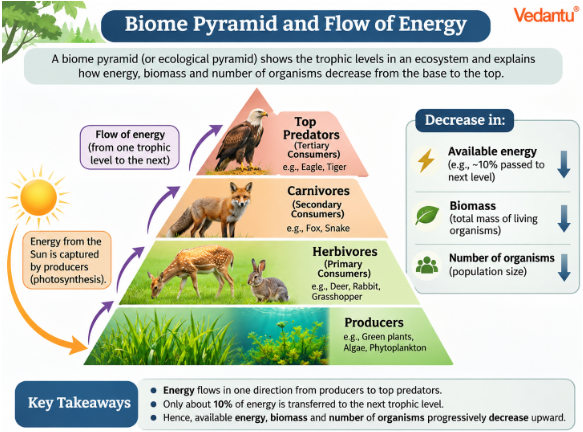
At the base of the pyramid are the producers, such as plants and algae. They capture solar energy through photosynthesis.
The next levels are herbivores (primary consumers), carnivores (secondary consumers) and top predators (tertiary consumers).
As we move up the pyramid, the number of organisms, biomass, and available energy decrease. This is because energy is lost as heat at each level during metabolic processes.
So a biome pyramid helps us understand the structure of ecosystems, the flow of energy and the balance between living organisms.
Class 9 Social Science Chapter 2 Life on Earth Long Answer Questions
15. Explain the geographical aspects of biodiversity conservation.
Answer: These aspects examine how location, climate, landforms, and ecosystems affect the protection of living organisms. Biodiversity is spread unevenly across the Earth, so geography plays an important role in conservation.
Hotspots of biodiversity: Regions like the Himalaya, the Western Ghats, North-East India and the Andaman & Nicobar Islands have unique species found nowhere else. Protecting them is a priority.
Ecosystem-based conservation: Different biomes support different life forms, so conservation must suit the place. For example, mangrove protection along coasts or afforestation in mountains.
Protected areas: National parks, wildlife sanctuaries, biosphere reserves and World Heritage Sites are chosen based on geography. They protect important habitats and prevent habitat fragmentation.
Geographical barriers and corridors: Rivers, mountains and valleys affect animal movement and gene flow. This knowledge helps create wildlife corridors.
Human–environment interaction: Sustainable practices vary with geography, such as terrace farming in the hills and agroforestry in the plains.
16. How do forests support the livelihoods of people? Explain the role of forest dwellers in caring for forests.
Answer:
Livelihoods: Rural and tribal communities depend heavily on forests for food, fuel, fodder, medicine, shelter, timber, bamboo and firewood. Non-timber forest products such as honey, fruits, nuts, resins and medicinal plants help families meet daily needs and earn income. Forests also support livestock grazing, small forest-based industries, ecotourism and employment. Communities like the Gonds and Bhils perform rituals to honour forest deities before collecting resources, which shows respect for nature.
Role of forest dwellers:
Knowledge holders: They have rich traditional knowledge of herbs, plants and forest resources, which helps in biodiversity conservation.
Livelihood and income: They gather and process non-timber forest products like tendu leaves, mahua flowers, honey, lac and bamboo.
Forest protection: They have led movements such as the Bishnoi Movement in Rajasthan (led by Amrita Devi) and the Chipko Movement in Uttarakhand. They also play a key role in community forest management.
Household needs: They collect firewood, fodder, wild fruits, roots, tubers and medicinal plants.
Cultural and social role: Forests are linked to their rituals, festivals, and beliefs, making them guardians of ecological and cultural traditions.
17. What challenges do people living in forests face? Describe the steps taken by the Government to support them, with Mendha Lekha as an example.
Answer:
Challenges:
They struggle to get healthcare, education and clean water.
Women face health problems from fuelwood fumes.
Restrictions on forest use, deforestation and commercial exploitation limit their access to forest produce. This creates conflict between conservation laws and their survival needs.
Floods, landslides and forest fires damage homes, crops and roads.
Wild animals damage crops and sometimes attack people.
They face discrimination and often sell forest produce at low prices.
Government efforts: The Forest Rights Act (2006) recognises their rights over forest land and resources. The Government also runs welfare schemes for education scholarships, healthcare and skill development. The Joint Forest Management (JFM) programme involves communities in protecting forests. Other initiatives include PESA, DAJGUA and PM JANMAN.
Mendha Lekha: A tribal village in Gadchiroli district, Maharashtra, mainly home to the Gond tribe. It was the first village in India to gain rights over its forest resources under the Forest Rights Act (2006). It follows the principle of Mawa Nate Mawa Raj (“our village, our rule”), and the Gram Sabha makes all decisions. The villagers protect their 1,800 hectares of forest by regulating tree cutting, preventing forest fires and harvesting bamboo as a renewable resource. They use the income for education and infrastructure.
Key Topics in Class 9 Chapter 2 Life on Earth Important Questions and Answers
Before practising the Class 9 Chapter 2 Life on Earth Important Questions and Answers, students should revise the main concepts and examples from the chapter.
How to Prepare Class 9 Social Science Part 2 Chapter 2 Important Questions
Understanding the chapter examples makes it easier to write complete answers. For Class 9 Social Science Part 2 Chapter 2 question answer practice, follow these steps:
Learn the differences: Compare forests, grasslands, deserts and tundra using their climate, vegetation and animal life.
Study the diagrams: Understand the rainforest layers, biome distribution map and biome pyramid.
Remember Indian examples: Revise Thenmala, the Western Ghats, Channapatna toys, Mendha Lekha and traditional water tanks.
Connect causes and effects: Explain how climate affects vegetation and how forest loss affects people and wildlife.
Practise five-mark answers: Arrange your points under suitable headings, especially for conservation and forest livelihood questions.
Check the textbook: Compare your answers with the Class 9 Chapter 2 Life on Earth Important Questions and Answers and revise any missed points.
How Vedantu Helps Students Revise Class 9 Life on Earth Important Questions
Learning the meaning of a term is only one part of preparation. Students should also be able to explain it using examples from the chapter.
Vedantu's Class 9 Chapter 2 Life on Earth Important Questions and Answers can help you practise different ways to answer the same topic.
For definitions: Explain biomes, biodiversity, ecotourism and ecological commons in simple sentences.
For comparisons: Separate the features of different biomes instead of mixing their characteristics.
For examples: Remember why tropical rainforests are called gene banks and how GI tags support local products.
For detailed answers: Use separate points for forest livelihoods, government measures and community conservation.
For self-checking: Attempt the questions without looking at the answers, then review the facts and examples you missed.
Students can also use the chapter's maps, illustrations and activities to understand how geographical conditions influence life in different regions.
Class 9 Social Science Part 2 Chapter 2 Life on Earth Important Study Materials
Use the following resources alongside the solved questions for textbook explanations and chapter revision.
Class 9 Social Science Chapter-Wise Important Questions
Students can practise other chapters from Understanding Society: India and Beyond, Parts I and II, using the chapter-wise resources below.
Important Study Materials for CBSE Class 9 Social Science
FAQs on Important Questions for Class 9 Social Science Chapter 2 Life on Earth | 2026-27
1. Why do different regions of the Earth have different types of vegetation?
Vegetation differs across regions because of changes in temperature, rainfall, soil and landforms. Areas with heavy rainfall support dense forests, while dry regions have grasses, shrubs and plants that need less water.
2. What is the difference between tropical and temperate grasslands?
Tropical grasslands, also called savannas, have warm temperatures, seasonal rainfall and scattered trees. Temperate grasslands, such as prairies and steppes, have distinct seasons, fewer trees and often fertile soil suitable for farming.
3. How are animals adapted to survive in desert and tundra biomes?
Desert animals, such as camels, are adapted to survive with limited water and in dry conditions. Tundra animals, such as reindeer and Arctic foxes, are adapted to freezing temperatures and harsh winters. These adaptations help them survive in their respective environments.
4. What are sacred groves, and why are they protected?
Sacred groves are small forest areas protected by local communities because of religious and cultural beliefs. They provide shelter to rare plants, medicinal species and wildlife. Some also help protect water sources and maintain groundwater.
5. How does Joint Forest Management (JFM) help protect forests?
Joint Forest Management encourages local communities to help protect and manage forests. It lets people support conservation activities while benefiting from forest resources, helping protect forests and support local livelihoods.
6. Where can students find Class 9 Chapter 2 Life on Earth important questions and answers PDF?
Students can download the Class 9 Chapter 2 Life on Earth important questions and answers PDF from Vedantu. It covers MCQs, very short answers, short answers and long answers on important chapter topics. Students can also use Vedantu's revision notes and NCERT Solutions to prepare for exams.